
Welcome to the cutting edge of decentralized finance. If you have interacted with the Ethereum network (Layer 1, or L1), you have likely experienced the frustration of high transaction fees, often referred to as "gas." While Ethereum offers unparalleled security and decentralization, its success has led to network congestion, turning simple transactions into costly affairs.
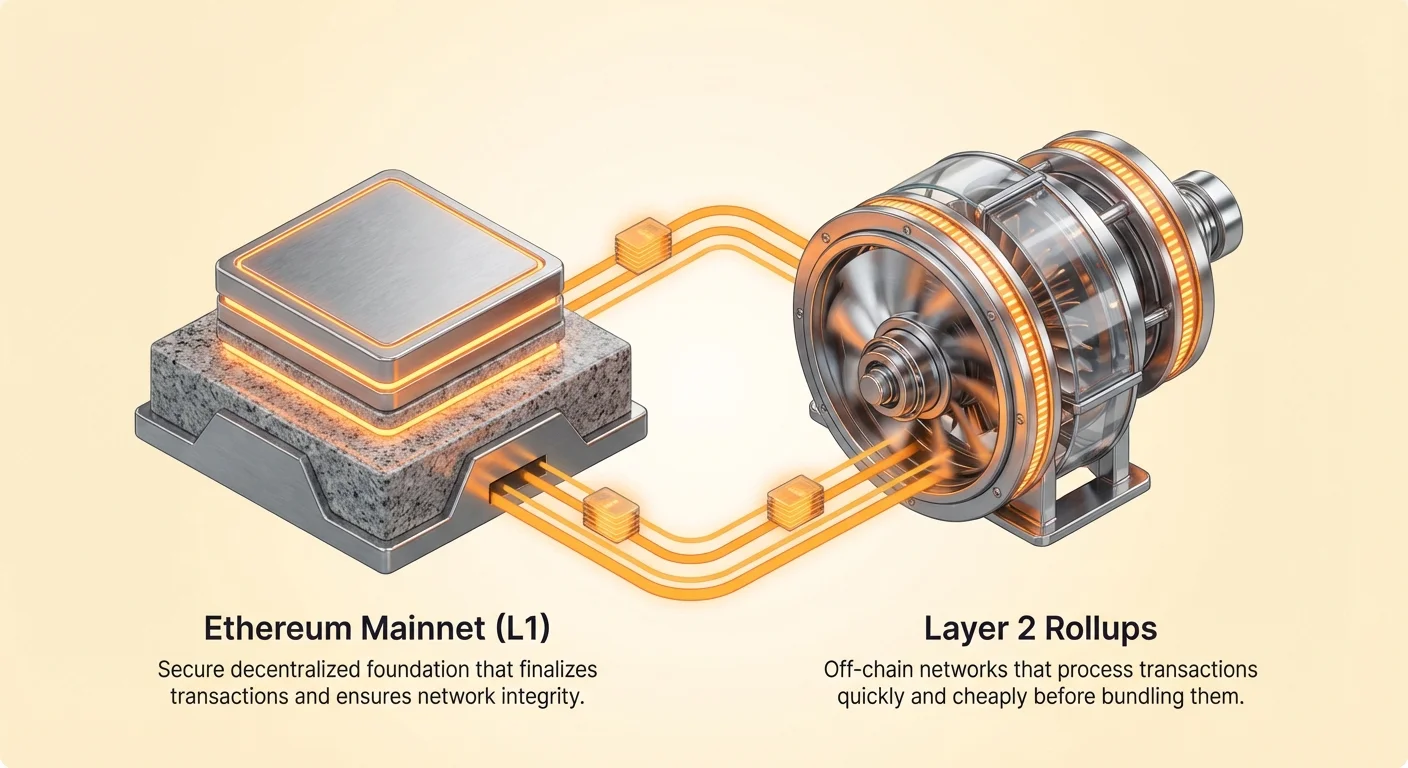
Fortunately, a revolutionary solution exists: Layer 2 (L2) scaling solutions. These are secondary frameworks built on top of Ethereum that handle the bulk of transactions off-chain, bundling them cheaply, and only submitting final, verified proofs back to the secure Layer 1. This guide is designed to transform you from a beginner struggling with gas costs into an informed user capable of optimizing fees, safely migrating assets, and strategically interacting with the decentralized ecosystem. Our focus is on practical, actionable strategies to achieve significant cost savings, ensuring you stop guessing and start implementing effective optimization techniques.
Understanding Ethereum's Scaling Challenge: The Need for Layer 2s
To effectively minimize transaction costs, we must first understand why they are so high. Ethereum is often compared to a highly secured but narrow four-lane highway. Every vehicle (transaction) must pay a toll (gas), and when the highway is flooded with traffic, the tolls skyrocket due to competition for limited space.
The Core Bottleneck: Layer 1 Transaction Costs
Layer 1 (L1) refers to the main Ethereum blockchain. Every action executed here—sending a token, swapping assets on a Decentralized Exchange (DEX), or minting an NFT—must be processed and validated by thousands of nodes globally. This distributed verification is what makes Ethereum secure and censorship-resistant.
The cost of a transaction (gas fee) is determined by two factors: the computational complexity of the action and the current network demand. While developers work to make code more efficient, the demand factor is the primary driver of high costs. During peak usage, users must offer exorbitant fees to incentivize validators to include their transaction quickly, leading to gas prices often reaching hundreds of dollars for a complex swap.
The Solution: Offloading Computation
Layer 2 networks solve the congestion problem by providing express lanes that integrate directly with the main highway. L2s process thousands of transactions externally, achieving high throughput at minimal cost. They then compress this activity into a single, compact data chunk, which is periodically sent back to L1 for final settlement and security verification.
The term for these aggregated transactions is "rollups." By rolling up thousands of user transactions into a single L1 transaction, the overall cost is dramatically reduced, and the savings are passed on to the end-user.
Rollup Architectures: Optimistic vs. Zero-Knowledge
Not all L2s are created equal. The two dominant scaling technologies, Optimistic Rollups and Zero-Knowledge (ZK) Rollups, use fundamentally different mechanisms for verifying transactions, which impacts their security model, withdrawal speed, and ultimately, your gas costs. Understanding these differences is crucial for choosing the right platform for your activity.
Optimistic Rollups: Speed and Fraud Proofs
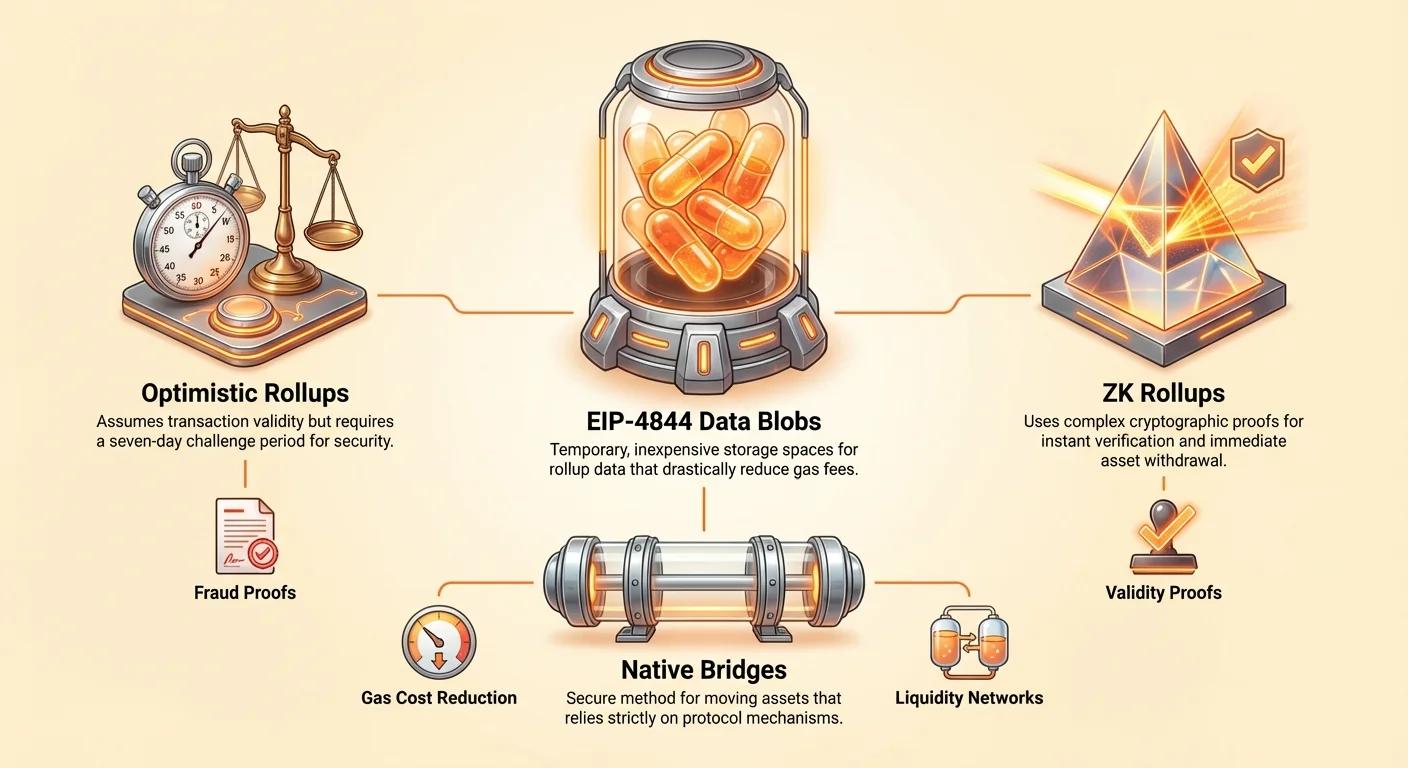
Optimistic Rollups (like Arbitrum and Optimism) assume all transactions processed on the L2 are valid—hence the term "optimistic." This allows them to execute transactions quickly without needing immediate cryptographic proof.
How they achieve security:
- Challenge Period: After a bundle of transactions is posted to L1, there is a "challenge period" (typically 7 days). During this week, anyone can review the posted transactions and submit a "fraud proof" if they detect an incorrect or malicious state change.
- Withdrawal Delay: Because of this built-in challenge period, withdrawing assets from an Optimistic Rollup back to L1 usually requires you to wait the full 7 days. This is the trade-off for their simplicity and fast initial execution.
Actionable Insight: Optimistic rollups are excellent for high-frequency trading or general DeFi interaction where rapid execution is key, but be mindful of the significant delay if you suddenly need to liquidate or move funds back to L1.
Zero-Knowledge (ZK) Rollups: Instant Verification
Zero-Knowledge Rollups (like zkSync and Polygon zkEVM) take the opposite approach. They do not assume validity; they cryptographically prove it before anything is posted to L1. They generate a complex mathematical proof (a SNARK or STARK) that verifies the correctness of every transaction in the bundle, without revealing the underlying transaction data itself.
How they achieve security:
- Validity Proofs: When a batch is submitted to L1, it includes an immediate, verifiable cryptographic proof that confirms the L2's new state is valid.
- Instant Withdrawal: Since the proof is verified immediately by L1 smart contracts, there is no need for a challenge period. This means users can withdraw assets back to L1 much faster—usually minutes, rather than days.
Actionable Insight: ZK rollups are ideal for users who prioritize rapid finality and instant withdrawal capabilities, though historically, the complexity of generating these proofs made them slightly more expensive per transaction than Optimistic equivalents (though this is rapidly changing).
Cost Comparison: Where Do ZK and Optimistic Differ?
While both rollup types dramatically reduce fees compared to L1, their underlying mechanics affect their relative costs:
- Optimistic Cost Driver: The primary cost is posting the raw transaction data (called "call data") to L1 so that fraud proofs can be generated if needed.
- ZK Cost Driver: The primary cost is generating the complex cryptographic proof on the L2 side, and then verifying that proof on the L1 side.
Historically, Optimistic Rollups were cheaper for simple transfers, but with massive technological improvements (especially surrounding EIP-4844, discussed below), ZK Rollups are rapidly achieving cost parity or even superiority, particularly for complex contract interactions.
Mastering Gas Cost Reduction on Layer 2
The existence of L2s guarantees lower fees, but savvy users can employ further optimization techniques to achieve the absolute lowest possible transaction costs. This involves leveraging recent Ethereum upgrades and understanding data storage costs.
Leveraging EIP-4844: The 'Proto-Danksharding' Revolution
The single most significant factor in reducing L2 gas fees is the Ethereum upgrade known as EIP-4844, often called "Proto-Danksharding." This upgrade fundamentally altered how L2s post data to L1, leading to cost reductions of 90% or more on rollups that adopted it.
Understanding Call Data vs. Blob Data
Prior to EIP-4844, L2s were forced to use expensive L1 space called call data to store their transaction bundles. Call data is permanent storage and is therefore extremely costly, as it must be retained by every node forever. This cost was the primary bottleneck for L2 pricing.
EIP-4844 introduced data blobs (or "blobs"). Think of blobs as temporary, cheap parking spaces specifically for rollup data.
- Blobs are significantly cheaper than permanent call data.
- Blobs are automatically pruned (deleted) after about 18 days, meaning validators don't have to store them forever, reducing the storage burden and thus the cost.
Practical Impact: L2s that utilize blobs (like Arbitrum and Optimism chains, as well as modern ZK chains) are now exponentially cheaper. Always verify that your chosen L2 is fully integrated with EIP-4844 to ensure you benefit from these lowest-possible data costs.
Practical Tips for Estimating and Minimizing L2 Gas Fees
While L2 fees are generally low, they are not static. They still fluctuate based on network demand on the L2 itself and the current price of L1 gas (since L2s still pay L1 for security).
- Monitor L2-Specific Congestion: Check the L2's dedicated block explorer (e.g., Arbiscan, Optimism Scan) before executing a complex swap. If a major NFT mint or large-scale protocol launch is underway on the L2, gas fees will spike temporarily.
- Timing Your Transactions: Just as L1 gas fees are lowest during off-peak hours (late night UTC or early morning on weekends), L2 fees are often lowest when the underlying L1 is also quiet. Since L2 transaction verification relies on L1 availability, executing your transaction when L1 congestion is minimal often results in lower overall L2 costs.
- Utilize Fee Aggregators and Calculators: Many advanced wallet interfaces and DeFi dashboards offer real-time gas comparisons between various L2s and L1. Use these tools to see which network currently offers the best rate for your specific transaction type (e.g., token swap vs. basic transfer).
- Batch Transactions (Where Possible): If you are migrating funds or setting up multiple positions, many smart contract wallets (which leverage Account Abstraction) allow you to bundle multiple actions into a single transaction. This pays the gas overhead once instead of multiple times.
Secure Bridging Strategies: Moving Assets Safely Across Chains
Moving assets between L1 and an L2, or between two different L2s, requires the use of a "bridge". Bridging is one of the most critical and potentially risky operations in crypto, making security paramount.
Types of Bridges: Native vs. Third-Party
When migrating your assets, especially substantial capital, understanding the security architecture of the bridge is vital.
1. Native/Canonical Bridges (Most Secure)
Native bridges are those officially maintained by the L2 protocol itself (e.g., the standard bridge for Arbitrum or Optimism). These bridges rely directly on the L2's core security model (fraud proofs for Optimistic, validity proofs for ZK).
- Security: They are generally considered the safest because they inherit the security of the underlying L1 settlement layer. They trust only the cryptographic or economic guarantees of the rollup itself.
- Trade-off: If using an Optimistic Rollup, you are subject to the 7-day withdrawal challenge period when bridging back to L1.
2. Third-Party/Liquidity Bridges (Faster, Higher Risk)
Third-party bridges (often called "liquidity networks" or "fast bridges") bypass the native security model to offer instant withdrawals from L2 back to L1. They achieve speed by having liquidity providers lock funds on L1. When you deposit on L2, the bridge releases equivalent funds to you instantly on L1, bypassing the long wait.
- Security: These bridges introduce extra counterparty risk. They rely on their own validation mechanisms, centralized relayers, or multi-sig contracts, making them a separate potential attack vector. Many of the largest crypto hacks have historically targeted third-party bridge contracts.
- Trade-off: Instantaneous withdrawal speed at the cost of relying on a third party’s contract security and liquidity pool robustness.
Best Practice: Use the native bridge for large, non-urgent asset transfers, prioritizing security over speed. Use audited, highly liquid third-party bridges only for smaller, time-sensitive transfers.
Cross-L2 Bridging Safety and Liquidity
As the L2 ecosystem expands, users increasingly need to move assets between L2s (e.g., from Arbitrum to zkSync).
When bridging between two different L2s, you have two primary methods:
- The Hub-and-Spoke Approach (Safest): L2 A -> L1 -> L2 B. This involves withdrawing funds fully back to Ethereum L1 using the native bridge, waiting the necessary time (or paying a fast bridge fee), and then depositing into L2 B. This is the most secure method as L1 acts as the trusted, neutral settlement layer.
- Direct L2-to-L2 Bridges: These are always executed by a third party, as there is no native protocol for an Optimistic Rollup to verify the proofs of a ZK Rollup directly. While highly convenient, they combine the risks of third-party bridging with the complexity of verifying two separate security models.
Liquidity Consideration: When using any third-party bridge (even for L2-to-L2 transfers), always check the bridge’s liquidity pool for the specific token you are moving. Low liquidity means your transfer may be delayed or fail, especially during periods of high demand.
Best Practices for Bridge Selection
Before initiating any bridge transaction, follow these steps:
- Verify the Source: Only use official interfaces linked directly from the L2 project’s official documentation. Phishing sites targeting bridge users are common.
- Audit History: For third-party bridges, confirm they have been audited by reputable security firms and research their history of exploits.
- Check Withdrawal Fees: Fees can vary dramatically. Native bridges often charge high fees only for the L1 gas cost, while third-party bridges charge a variable service fee based on liquidity and demand.
- Confirm Token Standard: Ensure the token you receive on the destination chain is the correct wrapped or native version. Bridging issues often arise when users receive an unrecognized, illiquid, or unsupported token version.
Advanced L2 Strategies: Maximizing Efficiency
By combining knowledge of rollup architecture, EIP-4844 cost reductions, and safe bridging, you can implement advanced strategies that maximize self-sovereignty and minimize wasted capital.
When to Use L1 vs. L2 for Specific Tasks
While the goal is to shift almost all activity to L2, L1 still has its place for mission-critical or high-value, infrequent operations.
| Task Category | Recommendation | Rationale |
|---|---|---|
| Simple Transfers (Sending ETH/Tokens) | L2 (Any Rollup) | Fees are minimal; immediate cost savings. |
| High-Frequency Trading/Swapping | L2 (Optimistic or ZK) | High throughput allows frequent trading without prohibitive gas fees. |
| Complex DeFi Strategies (Vaults, Loans) | L2 (Optimistic or ZK) | Contract interactions are drastically cheaper and faster than on L1. |
| Initial L2 Migration (Deposits) | L1 -> L2 (Native Bridge) | Required to get funds onto the express lane; unavoidable L1 gas cost here. |
| Initial Token Minting/Deployment | L1 | For ultimate security and censorship resistance, often best to anchor the base contract on L1. |
| Emergency Liquidation (Withdrawals) | L2 -> L1 (Fast Bridge/Liquidity Provider) | When speed is essential and you can absorb the higher third-party service fee. |
Strategic Planning for L2 Ecosystems
The L2 landscape is increasingly fragmented, with specific rollups specializing in different niches:
- General Purpose DeFi: Use widely adopted rollups with deep liquidity pools (e.g., Arbitrum, Optimism) for most swapping and yield farming.
- Privacy and Specific Apps: Explore application-specific rollups or ZK chains that focus on areas like private transfers, gaming, or high-performance financial computation.
- Yield Generation: Remember that high yields are often temporary. Factor in the cost of initial bridging and potential delayed withdrawal costs before chasing small APY differences. A 7-day withdrawal lock can erase the yield gains if the underlying asset price drops.
Conclusion
The high transaction costs that once plagued the Ethereum ecosystem are rapidly becoming a memory, thanks to the maturation of Layer 2 scaling solutions. By prioritizing security through native bridges, strategically timing your transactions, and ensuring you interact only with rollups leveraging EIP-4844's cost-efficient data blobs, you can successfully navigate the current market without succumbing to excessive gas fees. Ethereum's future is multi-layered, and mastering L2 optimization is the essential skill required to build self-sovereignty in the decentralized economy.