The cryptocurrency market has evolved significantly since the inception of Bitcoin in 2009. While Bitcoin remains the foundational asset of the industry, a vast and complex environment of alternative digital assets has emerged around it. These assets, collectively known as altcoins, represent a diverse array of technologies, philosophies, and use cases.
Understanding the altcoin ecosystem requires looking beyond market capitalization or price action. It demands a functional analysis of what these digital assets actually do. The landscape is no longer just about competing currencies trying to be a better form of digital cash. It now encompasses decentralized finance, digital ownership, governance systems, and infrastructure layers that power the next generation of the internet.
Investors and enthusiasts must navigate a space populated by thousands of different projects. Some aim to provide privacy, while others focus on speed or stability. Distinguishing between these categories is essential for grasping how the broader blockchain economy operates. This breakdown categorizes these assets based on their technical architecture and their primary utility within the decentralized web.
The Fundamental Distinction: Coins Versus Tokens
The terms "coin" and "token" are often used interchangeably in casual conversation, but they refer to distinct technical concepts. Understanding this difference is the first step in analyzing the crypto ecosystem. The distinction lies in the infrastructure that supports the asset and how it is created.
Understanding Native Coins
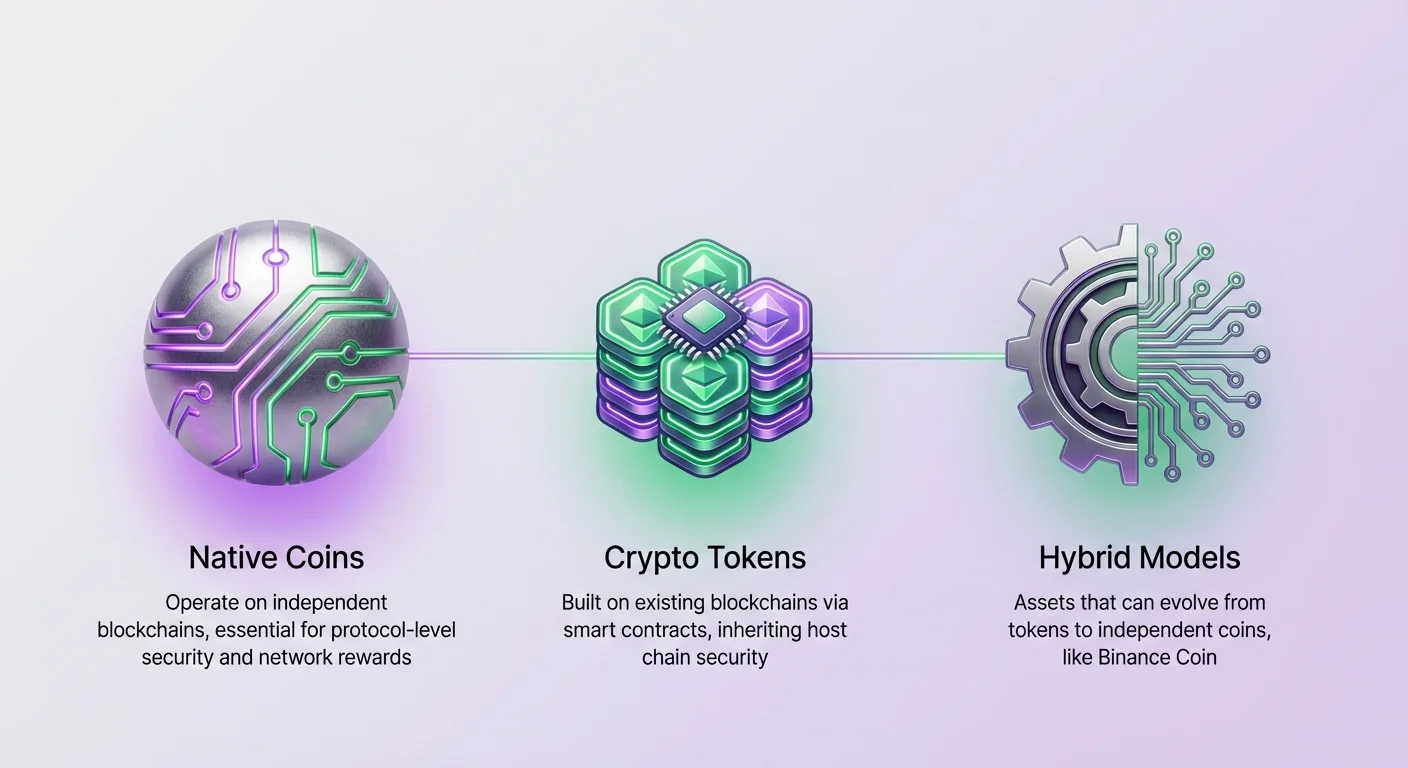
A coin is a cryptocurrency that operates on its own independent blockchain. These assets are native to their specific network and are essential for the network's operation. Bitcoin is the prime example, as it exists on the Bitcoin blockchain. Similarly, Ether is the native coin of the Ethereum network, and SOL is the native coin of the Solana blockchain.
Coins serve critical functions at the protocol level. They are primarily used to pay for transaction fees and to reward the network participants who secure the system. In a Proof-of-Work system, miners receive coins for solving complex mathematical problems. In Proof-of-Stake systems, validators earn coins for verifying transactions and maintaining the ledger.
Because they have their own independent infrastructure, coins are responsible for their own security. The network does not rely on another blockchain to process transactions or maintain consensus. This independence offers sovereignty but requires significant resources to maintain a secure and decentralized network of validators or miners.
The Role of Tokens
In contrast to coins, tokens are digital assets built on top of an existing blockchain. They do not have their own independent ledger. Instead, they rely on the host blockchain's infrastructure for security and transaction processing. A developer does not need to build a new blockchain from scratch to create a token.
Tokens are created using smart contracts, which are self-executing codes deployed on a programmable blockchain like Ethereum or Solana. These smart contracts define the rules for how the token functions, including its total supply and how it can be transferred.
This architecture allows for rapid innovation. Developers can leverage the robust security of an established network like Ethereum to launch new applications. Tokens can represent virtually anything, from membership in a community to voting rights in a decentralized organization. They inherit the security of the underlying chain, meaning users do not have to worry about the token's specific network being attacked, provided the host chain is secure.
Hybrid Models and Evolution
The line between coins and tokens is not always rigid, and assets can evolve over time. Some projects launch as tokens on a major blockchain to raise funds and build a community before migrating to their own independent blockchain. When this migration occurs, the asset transitions from being a token to becoming a coin.
Binance Coin (BNB) is a notable historical example of this transition. It began as an ERC-20 token on the Ethereum network before migrating to its own native chain. This ability to shift forms highlights the fluidity of the crypto ecosystem.
Furthermore, the rise of Layer 2 networks has introduced new nuances. These networks operate on top of a Layer 1 blockchain but process transactions independently to reduce costs. Assets on these networks often function as tokens that rely on the main chain for final settlement, yet they power their own distinct ecosystems.
| Feature | Native Coin | Crypto Token |
|---|---|---|
| Infrastructure | Runs on its own blockchain | Built on an existing blockchain |
| Creation | Protocol-level generation | Created via smart contracts |
| Security | Secures its own network | Inherits host chain security |
The Functional Architecture of Altcoins
Beyond the technical distinction of coins and tokens, altcoins can be categorized by the specific function they serve. The earliest altcoins were primarily designed to be currencies. They aimed to improve upon Bitcoin's design choices, such as transaction speed or mining algorithms. Over time, this shifted toward functionality that extends far beyond simple value transfer.
Mining-Based Cryptocurrencies
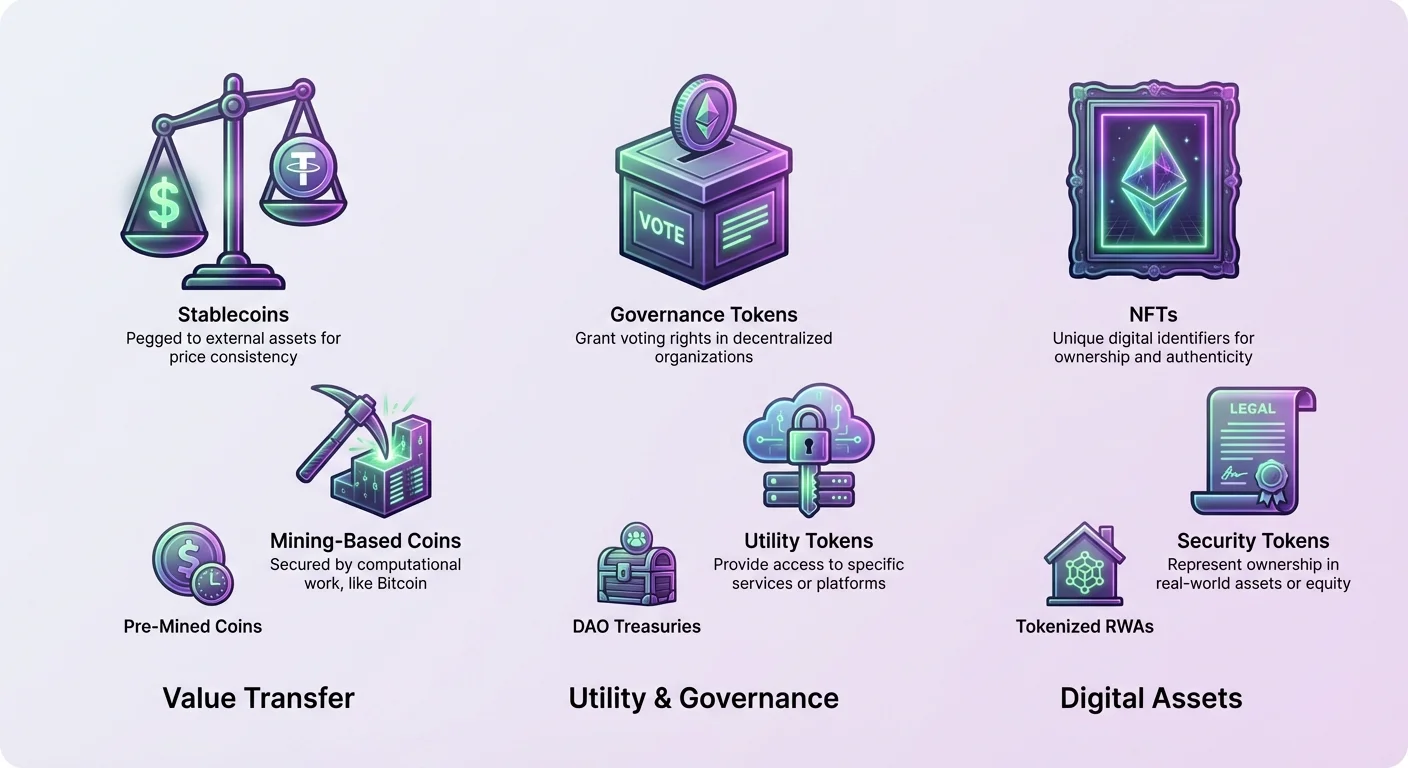
Mining-based altcoins follow the Bitcoin model. They are created through a process where computer hardware solves cryptographic puzzles to secure the network. The primary goal of many of these early assets was to function as a medium of exchange or a store of value.
Developers of these assets often tweaked the parameters of Bitcoin's code. Some increased the block size to allow for more transactions per second. Others changed the hashing algorithm to allow for mining with different types of hardware, such as consumer-grade graphics cards.
While many of these assets still exist, the industry focus has largely shifted away from pure currency clones. However, they remain a vital part of the ecosystem, representing the original vision of decentralized, peer-to-peer electronic cash that operates without a central authority.
Pre-Mined and Consensus Variants
Not all coins rely on mining. Many modern blockchains utilize consensus mechanisms that do not require energy-intensive hardware. In these systems, the initial supply of coins is often created at the genesis of the network. These are sometimes referred to as pre-mined coins.
These assets are typically associated with Proof-of-Stake networks. In this model, network security is maintained by validators who "stake" or lock up their coins as a security deposit. If they act honestly, they earn rewards. If they attempt to validate fraudulent transactions, they lose their stake.
This architectural shift has allowed for blockchains with significantly higher transaction throughput and lower environmental impact. These platforms often serve as the foundation for smart contracts and decentralized applications, rather than just functioning as digital money.
The Role of Stablecoins in the Ecosystem
One of the most significant developments in the crypto space is the rise of stablecoins. These assets address one of the primary criticisms of cryptocurrencies: extreme price volatility. While Bitcoin and other altcoins can experience massive price swings, stablecoins are designed to maintain a constant value.
Mechanisms of Stability
Stablecoins achieve price consistency by pegging their value to an external asset. The most common reference point is a fiat currency, typically the US dollar. For every unit of the stablecoin in circulation, the issuer essentially promises that it is worth one dollar.
There are different ways to maintain this peg. The most straightforward method is through fiat-collateralization. In this model, a central entity holds reserves of cash or cash equivalents that match the supply of the tokens. Users can theoretically redeem their tokens for the underlying fiat currency.
Other stablecoins use different mechanisms, such as over-collateralization with other cryptocurrencies or algorithmic supply adjustments. Regardless of the method, the goal remains the same: to provide a digital asset that behaves like cash but possesses the transferability and programmability of a cryptocurrency.
Bridging Fiat and Crypto
Stablecoins serve as a crucial bridge between the traditional financial system and the blockchain economy. They allow traders to exit volatile positions without converting back to fiat currency, which can be slow and costly.
In the world of Decentralized Finance (DeFi), stablecoins are indispensable. They are used as the primary unit of account for lending and borrowing protocols. Users can lend their stablecoins to earn interest or use them as collateral to borrow other assets.
Additionally, stablecoins are increasingly used for cross-border remittances. They offer a way to send value globally around the clock, often with lower fees and faster settlement times than traditional banking wire transfers.
| Attribute | Bitcoin (BTC) | Stablecoins |
|---|---|---|
| Primary Purpose | Store of value / Digital Gold | Stability / Medium of exchange |
| Volatility | High volatility | Low (Pegged value) |
| Supply | Fixed (21 million cap) | Variable (Based on reserves) |
Exploring the Token Economy
The introduction of smart contracts allowed for the creation of tokens that represent specific rights or utilities. This marked a transition from general-purpose currencies to specialized assets designed for specific ecosystems.
Utility Tokens
Utility tokens are the fuel for specific applications or ecosystems. They are not designed to be investments in a company, but rather coupons or keys that grant access to a service. To use a decentralized cloud storage network, for example, a user might need to pay in the network's native utility token.
These tokens function similarly to arcade tokens or frequent flyer miles. Their value is theoretically derived from the demand for the service they unlock. If more people want to use the decentralized application, the demand for the token may increase.
In many cases, utility tokens are also used to incentivize behavior. A platform might reward users with tokens for contributing data or providing liquidity. This creates a self-sustaining loop where users are compensated for helping the network grow.
Security and Equity Tokens
Security tokens represent a different class of asset. They are designed to be the digital equivalent of traditional securities, such as stocks or bonds. These tokens represent ownership in an external asset or a share in the future profits of a project.
Unlike utility tokens, security tokens are often subject to strict financial regulations. They essentially tokenize real-world equity. Holding a security token might entitle the owner to dividends, revenue sharing, or legal ownership rights in a company or piece of real estate.
This category aims to bring the efficiency of blockchain technology to traditional financial markets. By tokenizing securities, issuers can potentially offer fractional ownership, 24/7 trading, and faster settlement times compared to traditional stock exchanges.
Governance and Community Control
As decentralized protocols grew, the need for decentralized management became apparent. This led to the emergence of governance tokens, which distribute control of a project to its community.
Voting Rights and DAOs
Governance tokens grant holders the right to influence the future of a protocol. They function similarly to shareholder votes in a corporation but operate entirely on the blockchain. Holders can propose changes or vote on proposals submitted by others.
This system is the backbone of Decentralized Autonomous Organizations (DAOs). A DAO is an organization represented by rules encoded as a computer program that is transparent, controlled by the organization members, and not influenced by a central government.
Voting power is typically proportional to the number of tokens held. This ensures that those with the most significant financial stake in the ecosystem have the most say in its direction. However, this also introduces challenges regarding whale dominance, where large holders can sway decisions.
The Impact on Protocol Development
The decisions made by governance token holders can be far-reaching. They might vote on technical upgrades to the software, changes to the fee structure, or how to spend the funds in the project's treasury.
For example, a decentralized exchange might accumulate trading fees in a community treasury. Token holders would then vote on whether to use those funds to hire more developers, fund marketing campaigns, or burn tokens to reduce supply.
This mechanism aligns the interests of the developers, users, and investors. It moves the control of the platform away from a centralized team and places it in the hands of the collective user base, fostering a sense of ownership and community responsibility.
Non-Fungible Tokens (NFTs) and Digital Ownership
While most cryptocurrencies are fungible, meaning one unit is identical to another, Non-Fungible Tokens (NFTs) introduced the concept of uniqueness to the blockchain. This category has expanded the definition of what a crypto asset can be.
Beyond Digital Art
NFTs are unique digital identifiers that cannot be copied, substituted, or subdivided. They are recorded on a blockchain and are used to certify authenticity and ownership. While initially popularized by digital art and collectibles, the technology represents a broader shift in digital property rights.
Each NFT has distinct metadata that separates it from other tokens. This makes them ideal for representing items that are not interchangeable. In gaming, for instance, an NFT can represent a specific sword or character with unique stats. Players essentially own their in-game assets and can trade them freely on open markets.
This verifiable scarcity allows content creators to monetize their work directly. Musicians can sell unique audio tracks, and artists can sell limited edition digital prints, all without relying on intermediaries to verify the transaction.
Tokenizing Real-World Assets
The utility of NFTs extends into the physical world through the tokenization of real-world assets (RWAs). This involves creating a digital token that represents ownership of a physical item, such as real estate, luxury goods, or commodities.
By representing a physical house as an NFT, for example, the ownership history becomes transparent and immutable on the blockchain. It also opens the possibility of fractional ownership, where multiple investors hold a share of a high-value asset represented by tokens.
This technology could streamline supply chain management. An NFT can be created for a luxury handbag at the point of manufacture. As the bag moves through the supply chain, its journey is recorded on the blockchain, allowing the final buyer to verify its provenance and authenticity instantly.
Infrastructure and Layer 2 Solutions
As the adoption of major blockchains like Ethereum increased, network congestion and high fees became significant issues. This spurred the development of a new category of altcoins focused on scaling and infrastructure.
Scaling Existing Networks
Layer 2 solutions are protocols built on top of an existing blockchain (Layer 1) to improve its scalability. They process transactions off the main chain and then settle the final data back to the Layer 1 network.
These protocols often have their own tokens. These tokens may be used to pay for transaction fees within the Layer 2 network or for governance purposes. By moving the bulk of the computation off the main chain, they allow for faster and cheaper transactions while still inheriting the security of the underlying blockchain.
Projects in this category are essential for bringing blockchain technology to a mass audience. They make it economically feasible to use decentralized applications for microtransactions or high-frequency trading, which would be prohibitively expensive on a congested Layer 1.
Interoperability Protocols
Another critical infrastructure category involves interoperability. Blockchains are naturally isolated systems; Bitcoin cannot natively "talk" to Ethereum. Interoperability protocols aim to bridge these islands, allowing information and value to flow freely between different networks.
Tokens associated with these projects often serve to secure the bridging mechanism. They incentivize the node operators who relay data between chains. This creates a connected ecosystem where a user can easily move assets from one blockchain to another without relying on centralized exchanges.
This connectivity is vital for the future of the "multichain" world. It prevents liquidity from being trapped in silos and allows developers to build applications that leverage the strengths of multiple different blockchains simultaneously.
Assessing Risks and Market Dynamics
While the functional diversity of the altcoin ecosystem offers numerous opportunities, it also presents distinct risks. Understanding these dangers is as important as understanding the technology itself.
Volatility and Liquidity Factors
Altcoins are generally more volatile than Bitcoin. Because they often have lower market capitalizations, it takes less capital to move their price significantly. This can lead to rapid gains but also devastating losses.
Liquidity is another major concern. Major coins like Bitcoin and Ethereum are traded on almost every exchange with high volume. Smaller altcoins may suffer from low liquidity, meaning it can be difficult to buy or sell large amounts without causing the price to crash.
Investors often face high "slippage" in these markets, where the final execution price is worse than the expected price. In extreme cases, if a project loses support, liquidity can dry up entirely, leaving holders with assets they cannot sell.
Regulatory and Technical Challenges
The regulatory environment for altcoins is still evolving and remains a source of uncertainty. Governments worldwide are working to define which assets are currencies, which are commodities, and which are securities.
Tokens that are deemed to be unregistered securities could face strict penalties or be delisted from exchanges. This regulatory risk adds a layer of complexity to the ecosystem that does not affect Bitcoin to the same degree, given its established status as a commodity in many jurisdictions.
Technological risk is also prevalent. Many altcoins are experimental technologies. Smart contracts can contain bugs that hackers can exploit to drain funds. Unlike traditional banking, there is no reversible transaction or insurance policy for protocol failures. Users must rely entirely on the quality of the code.
Conclusion
The altcoin ecosystem has transformed from a small collection of Bitcoin alternatives into a sprawling, multi-layered economy. It encompasses everything from stable assets designed for payments to complex governance systems managing billions of dollars in decentralized treasuries. The distinction between coins and tokens, while technical, underpins the structure of this new digital landscape.
Navigating this environment requires looking past the hype and understanding the function of the asset. Whether it is a utility token granting access to a service or a governance token steering a protocol, each category serves a specific purpose. The risks regarding volatility and regulation are real, but so is the innovation driving the sector forward.
True understanding of crypto comes from analyzing what an asset does, not just how it trades.