
Decentralized finance has transformed how cryptocurrency holders interact with their assets. Instead of simply holding digital currencies in a wallet and hoping for price appreciation, users can now put their assets to work. This shift has created an ecosystem where capital efficiency is paramount. Users seek to maximize returns through various mechanisms, with yield farming emerging as a dominant strategy. However, the landscape of yield farming is complex and often treacherous.
The promise of high returns attracts capital, but not all yields are created equal. Some protocols offer sustainable rewards based on genuine economic activity and careful token distribution. Others rely on aggressive inflationary mechanics that often lead to boom-and-bust cycles. Understanding the difference requires a deep dive into tokenomics, the study of the economic incentives and distribution models that govern a cryptocurrency.
Distinguishing between a legitimate opportunity and a short-term scheme is a critical skill for any participant in the DeFi space. It involves looking beyond the advertised Annual Percentage Yield (APY) to understand where the returns come from. By analyzing the source of yield, the structure of liquidity pools, and the behavior of other market participants, investors can make more informed decisions. This guide explores the mechanics of farm tokenomics to help you navigate this dynamic environment.
The Mechanics of Decentralized Liquidity
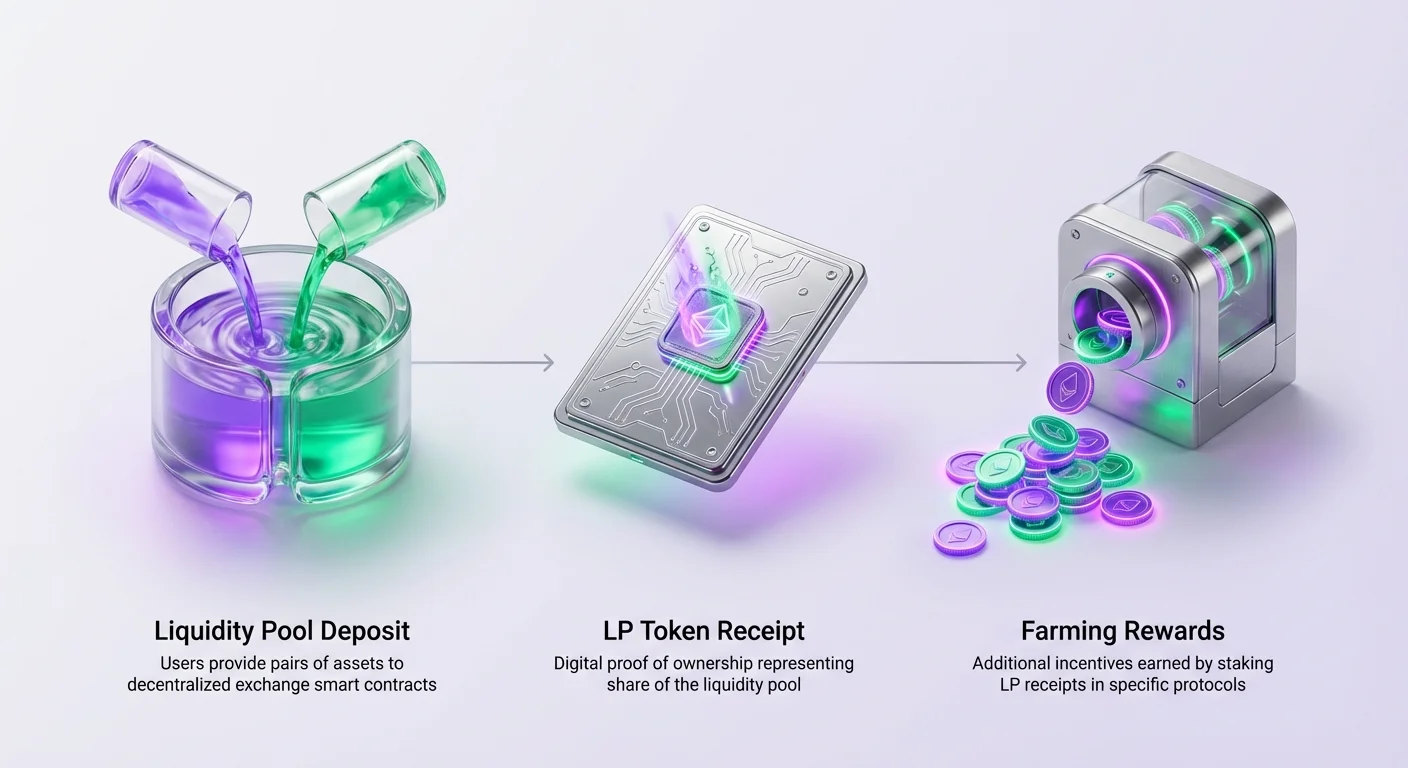
To understand farming, one must first understand the foundation upon which it is built: liquidity pools. Decentralized exchanges (DEXs) operate without a central authority matching buyers and sellers. Instead, they rely on automated market makers (AMMs) and peer-to-peer trading. This system requires a constant supply of assets to facilitate trades.
How Liquidity Pools Function
A liquidity pool is essentially a smart contract that holds funds. In a classic DEX model, these pools are composed of two different assets, creating a trading pair. For example, a pool might contain a specific token and a base currency like Wrapped Ethereum (WETH). The ratio of these assets is typically established at a 50/50 value split when the liquidity is deposited.
This balance is crucial for the AMM to function. If a user wants to deposit $1,000 worth of liquidity, they must provide $500 of one asset and $500 of the other. The smart contract ensures that the value remains balanced relative to the current market price. When traders swap tokens against the pool, the ratio changes, and the price adjusts accordingly based on the algorithmic curve of the AMM.
Incentivizing Participation
Without sufficient liquidity, a DEX cannot function effectively. Low liquidity leads to high slippage, where the execution price of a trade differs significantly from the expected price. To prevent this and ensure a smooth trading experience, exchanges must incentivize users to deposit their funds. The primary incentive is a share of the trading fees.
In many standard DEX models, a fee is charged on every swap. A common standard is 0.25% of the trading volume. This fee is collected by the smart contract and distributed proportionally to the liquidity providers. If a pool generates high volume, the fees can be substantial. However, for many protocols, trading fees alone are not enough to attract the massive amounts of capital needed for deep liquidity. This is where yield farming enters the picture.
Understanding Liquidity Pool Tokens
When a user deposits assets into a liquidity pool, they do not simply send funds and hope the protocol remembers them. The interaction is governed by precise smart contracts that issue a proof of ownership. These proofs are known as Liquidity Pool (LP) tokens. They serve as a digital receipt for the assets deposited.
The Role of the LP Token
LP tokens represent a user's share of the total liquidity in a specific pool. If a user provides 1% of the total assets in a pool, they receive LP tokens representing a 1% claim. These tokens are essential for reclaiming the deposited funds. To exit a position, the user returns the LP tokens to the smart contract, which then burns them and releases the underlying assets.
Crucially, the amount of assets returned may differ from the amount deposited. This change occurs due to trading activity shifting the ratio of tokens in the pool. Additionally, the accumulated trading fees are often added to the pool's liquidity, meaning the LP token grows in value over time relative to the pool's reserves.
Portability and Composability
One of the defining features of DeFi is composability, often referred to as "money LEGOs." LP tokens are standard ERC-20 tokens (or equivalent on other chains), meaning they can be moved, traded, or used in other protocols. They are not stuck in the user's wallet. This portability is what enables yield farming.
Since the LP token proves ownership of liquidity, protocols can build secondary mechanisms that recognize and reward holding these tokens. By depositing these receipts into a separate contract known as a "farm," users can earn additional incentives on top of the standard trading fees. This layering of rewards is the core mechanic of modern yield farming strategies.
The Evolution from Liquidity to Farming
The transition from simple liquidity provision to yield farming marks a significant evolution in decentralized finance. Initially, liquidity providers relied solely on trading fees. While sustainable, this model often resulted in lower yields during periods of low trading volume. To bootstrap growth and attract sticky capital, protocols began issuing their own native tokens as additional rewards.
This practice created a competitive landscape where DEXs competed for liquidity by offering higher and higher rewards. Users quickly realized they could maximize returns by moving capital to wherever the incentives were most aggressive. This behavior gave rise to the concept of "farming" yield, where the primary goal is harvesting these reward tokens rather than just earning trading fees.
Farming adds a layer of complexity to the investment decision. Users must now evaluate the value of the reward token itself. If the reward token drops in price, the overall yield of the farm decreases significantly. Therefore, the tokenomics of the reward token become just as important as the underlying trading fees of the liquidity pool.
The Anatomy of Farming Rewards
Yield farming rewards are not magic money; they come from specific sources defined by the protocol's code. In most cases, these rewards are paid in the native token of the decentralized exchange or platform. The rate at which these tokens are distributed determines the Annual Percentage Yield (APY) advertised to users.
Token Emissions and Supply
The source of most farming yields is the protocol's uncirculating supply. When a project launches, a portion of the total token supply is often allocated to "ecosystem incentives" or "community rewards." These tokens are released over time to people who perform services for the network, such as providing liquidity. This release process is often called emission.
Emissions increase the circulating supply of the token. This is an inflationary mechanic. If the demand for the token does not increase to match the new supply entering the market, the price per token is likely to decrease. Sustainable farms balance these emissions carefully. They aim to distribute enough tokens to attract liquidity without flooding the market and crashing the token's value.
Calculating the Yield
The APY of a farm is dynamic. It fluctuates based on two main factors: the price of the reward token and the total value of assets deposited in the farm. If the price of the reward token rises, the APY goes up. Conversely, if more users deposit into the farm, the rewards are diluted across a larger pool of capital, causing the APY to drop.
Protocols project these yields based on current data. A common model assumes that the current rate of rewards continues for a year, compounded. However, because market conditions change rapidly, the advertised APY is rarely exactly what a user earns over a long period. It is a snapshot of the current incentive structure.
Identifying Pump-and-Dump Tokenomics
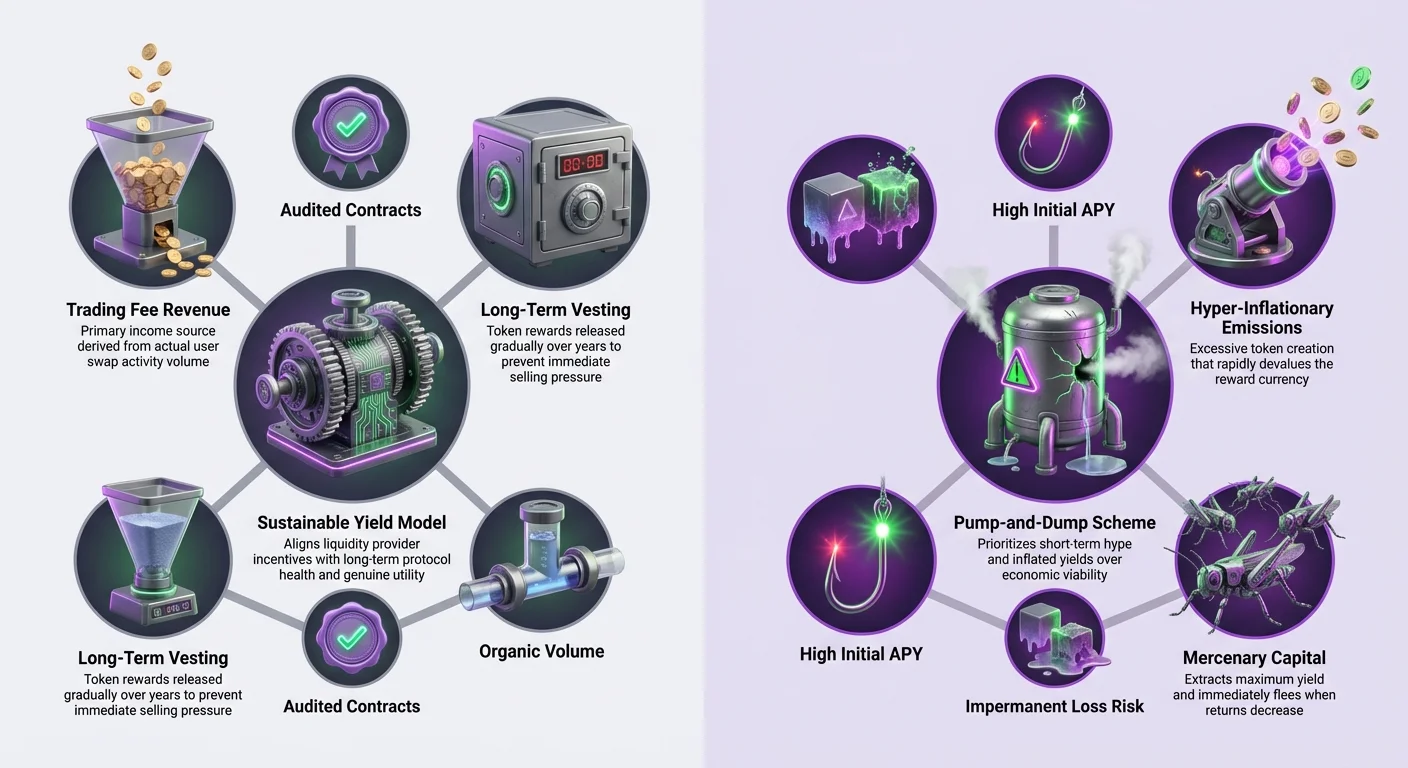
Not all yield farms are designed for longevity. Some are created with pump-and-dump mechanics that prioritize short-term hype over long-term viability. These schemes often use astronomically high APYs to attract a rush of capital. It is not uncommon to see yields exceeding 1,000% or even 10,000% in the early days of such projects.
The Trap of Hyper-Inflation
Extremely high yields are a major red flag. To sustain a 1,000% APY, the protocol must emit tokens at a ferocious rate. This creates hyper-inflation for the reward token. While the paper gains look impressive, the immense sell pressure from farmers dumping the rewards usually drives the token price to zero very quickly.
In these scenarios, the early participants might profit, but latecomers are often left holding worthless tokens. The high yield acts as a lure. Once the liquidity creates a market for the token, the developers or early insiders may sell their stakes, leaving the liquidity providers with "impermanent loss" that becomes permanent due to the token's collapse.
Unsustainable Distribution Schedules
Pump-and-dump schemes often lack a long-term distribution plan. They may release a massive percentage of the total supply in the first few weeks. This front-loaded emission schedule is designed to create a frenzy. A sustainable project, by contrast, will typically have a distribution schedule that spans years.
For example, a responsible allocation might release tokens block-by-block over a seven-year period. This linear or tapering distribution ensures that incentives remain available for future users and that the market is not suddenly flooded with supply. When evaluating a farm, checking the duration of the rewards program is a vital step in assessing safety.
The Mercenary Liquidity Problem
High APYs attract a specific type of market participant known as the mercenary liquidity provider. These users have no loyalty to the protocol or interest in its long-term success. Their strategy is purely extractive. They enter a farm when yields are high, harvest the reward tokens, and immediately sell them on the open market.
This constant selling pressure suppresses the price of the protocol's token. As the token price drops, the APY decreases. Once the yield is no longer superior to other opportunities, mercenary capital flees. They withdraw their liquidity and move to the next high-yield farm. This leaves the original DEX with a hollowed-out liquidity pool and a crashed token price.
The "farm and dump" cycle can destroy a project before it establishes a real user base. Protocols that rely solely on high emissions to attract liquidity often find themselves in a death spiral. Without genuine trading volume to generate fee revenue, the protocol has no value proposition once the token incentives run dry. This phenomenon highlights why sustainable tokenomics are crucial for survival.
Sustainable Yield Models
To combat the issues of mercenary capital and hyper-inflation, legitimate protocols adopt sustainable yield models. The goal is to align the interests of the liquidity providers with the long-term health of the decentralized exchange. Sustainable yields are typically lower than the astronomical figures seen in pump-and-dump schemes, often settling in a range that reflects genuine risk and utility.
Aligning Incentives
A sustainable model focuses on gradual growth. Instead of a 5,000% APY that crashes in a week, a protocol might target a starting APY of 80% or lower, which tapers over time. This rate is high enough to compensate for the risks of smart contract use and impermanent loss but low enough to avoid destroying the token's value through inflation.
The objective is to bootstrap the network. The rewards serve as a subsidy to attract liquidity until organic trading volume grows. As the DEX becomes more popular, trading fee revenue should ideally replace token emissions as the primary source of yield. This transition marks the maturity of a DeFi protocol.
Strategic Token Allocation
Sustainable projects often allocate a fixed portion of their supply to incentives, managed by a transparent schedule. For instance, designating 35% of the total supply for rewards distributed over several years provides clarity to investors. It signals that the team is planning for the future, not just a quick exit.
Furthermore, sustainable farms are often built on reputable exchanges with third-party audits. Security is a component of sustainability. A farm that offers moderate yield but has a high degree of smart contract security is often more profitable in the long run than a high-risk, high-yield fork with unaudited code.
Analyzing Reward Distribution Mechanics
The technical implementation of reward distribution varies across protocols. Understanding how rewards are calculated and paid out can help users optimize their farming strategy. Most DEXs use a block-based distribution system, where a set amount of tokens is released every time a new block is added to the blockchain.
Proportional Allocations
Rewards are allocated based on the user's share of the farm. If a farm emits 10 tokens per block, and a user holds 10% of the staked LP tokens in that farm, they receive 1 token per block. This means a user's earnings depend heavily on the behavior of others. If other users withdraw, the remaining user's share increases, and they earn more tokens per block. Conversely, if a "whale" deposits a large amount, everyone else's share is diluted.
This dynamic creates a competitive environment. Users must monitor the total value locked (TVL) in the farm. A rising TVL is good for the protocol's health but bad for the individual farmer's short-term yield, as the rewards are split among more participants.
Distribution Periods and Intervals
Some protocols organize rewards into specific epochs or distribution periods. For example, a reward rate might be set for a one-week interval. This provides predictability for farmers. They know that for the next seven days, the emission rate will remain constant.
At the end of the period, the protocol operators or the decentralized governance community may adjust the rates. They might shift rewards to different pools to incentivize liquidity for new trading pairs. Staying informed about these schedule changes is essential for maintaining an efficient farming strategy.
The Role of Lockup Periods
While many farms allow users to deposit and withdraw at will, some introduce lockup periods to promote stability. A lockup requires the user to commit their liquidity for a specific duration, such as a week, a month, or even a year. In exchange for this commitment, the protocol often offers a higher reward rate.
Lockups prevent the rapid flight of mercenary capital. If liquidity is locked, it cannot vanish the moment the token price dips or a new farm launches. This creates a more stable trading environment for the DEX. However, it increases risk for the user. If the market crashes while funds are locked, the user cannot exit to cut their losses.
Flexible farms, which have no lockup periods, offer the ultimate freedom. Users can claim rewards and withdraw their principal at any moment. This flexibility typically commands a lower premium than locked positions. Users must weigh the benefit of liquidity—the ability to move cash now—against the potential for higher returns in a restricted contract.
Risks Beyond Tokenomics
Evaluating the economic model is only half the battle. Yield farming carries inherent technical and market risks that exist regardless of how sustainable the tokenomics might be. The most prominent of these is impermanent loss, but smart contract vulnerabilities also pose a severe threat.
Impermanent Loss Mechanics
Impermanent loss occurs when the price of the two assets in a liquidity pool diverges. If one asset creates a massive gain while the other stays stable, the AMM sells the appreciating asset to buy more of the stable one to maintain the 50/50 ratio. As a result, the liquidity provider ends up with less of the winning asset than if they had simply held it in a wallet.
This loss is termed "impermanent" because it disappears if the prices return to their original ratio. However, if the user withdraws their liquidity while the prices are different, the loss becomes permanent. High farming yields are often necessary to compensate for this risk. If the APY does not exceed the potential impermanent loss, farming is a losing strategy.
Smart Contract Risks
Every farm is a collection of code deployed on a blockchain. If that code contains bugs or exploits, hackers can drain the funds. No amount of sustainable tokenomics can protect against a security breach. Users should prioritize platforms that have undergone rigorous audits by reputable security firms.
"Rug pulls" are another danger, where malicious developers intentionally leave backdoors in the code to steal user funds. This is common in anonymous, high-yield projects. Analyzing the reputation of the team and the longevity of the platform is a crucial defense mechanism against these attacks.
Evaluating a Farm Before Entering
Before depositing assets into any smart contract, a systematic evaluation is necessary. This process moves beyond looking at the APY number and investigates the fundamental health of the protocol. A checklist approach can help filter out high-risk schemes from genuine opportunities.
Analyzing the Platform
Start with the DEX itself. Does it have a history of operation? Is the team public or anonymous? Check for third-party audits. A reputable DEX will have clear documentation regarding its security practices. Look for volume statistics. A farm on a "ghost chain" or a DEX with zero trading volume is unlikely to sustain its value, as there is no fee revenue to backstop the token incentives.
Scrutinizing the Token
Examine the reward token. What is its utility? Does it have governance rights, or is it purely a farm token? Look at the total supply and the current circulating supply. If only 1% of tokens are circulating and 99% are waiting to be dumped on the market, the price pressure will be immense.
Finally, use third-party analytics tools. Platforms like Debank or blockchain explorers allow you to see the health of your positions and the activity of the pool. Transparency is key. If you cannot easily find information about where the yield comes from or how the distribution works, it is safer to stay away.
Conclusion
Navigating the world of farm tokenomics requires a balance of skepticism and technical understanding. The allure of high yields is a powerful driver in DeFi, but it often masks unsustainable economic models designed to enrich early insiders at the expense of latecomers. By distinguishing between genuine liquidity incentives and inflationary pump-and-dump schemes, users can protect their capital and find true value.
Sustainable yield farming relies on reasonable emission schedules, transparent distribution mechanics, and legitimate trading volume. It is a long-term game of capital efficiency rather than a sprint for quick riches. As the DeFi landscape matures, the market will likely continue to favor protocols that prioritize security and steady growth over temporary hype.
The most successful yield farmers are those who prioritize the safety of their principal and the sustainability of the protocol over the highest possible short-term APY.