
The world of digital finance has shifted significantly with the rise of decentralized applications. At the heart of this ecosystem lies the concept of user control and peer-to-peer interaction. Unlike traditional financial systems where banks act as intermediaries, the decentralized web allows individuals to interact directly with protocols. This removes the need for permission from third parties to move assets or access services.
To participate in this economy, users must first establish a digital presence that acts as both an identity and a vault. This is the primary function of a crypto wallet. These applications serve as the interface for managing digital assets and signing transactions on a blockchain. Without a wallet, one cannot access the vast array of financial instruments available in the decentralized landscape.
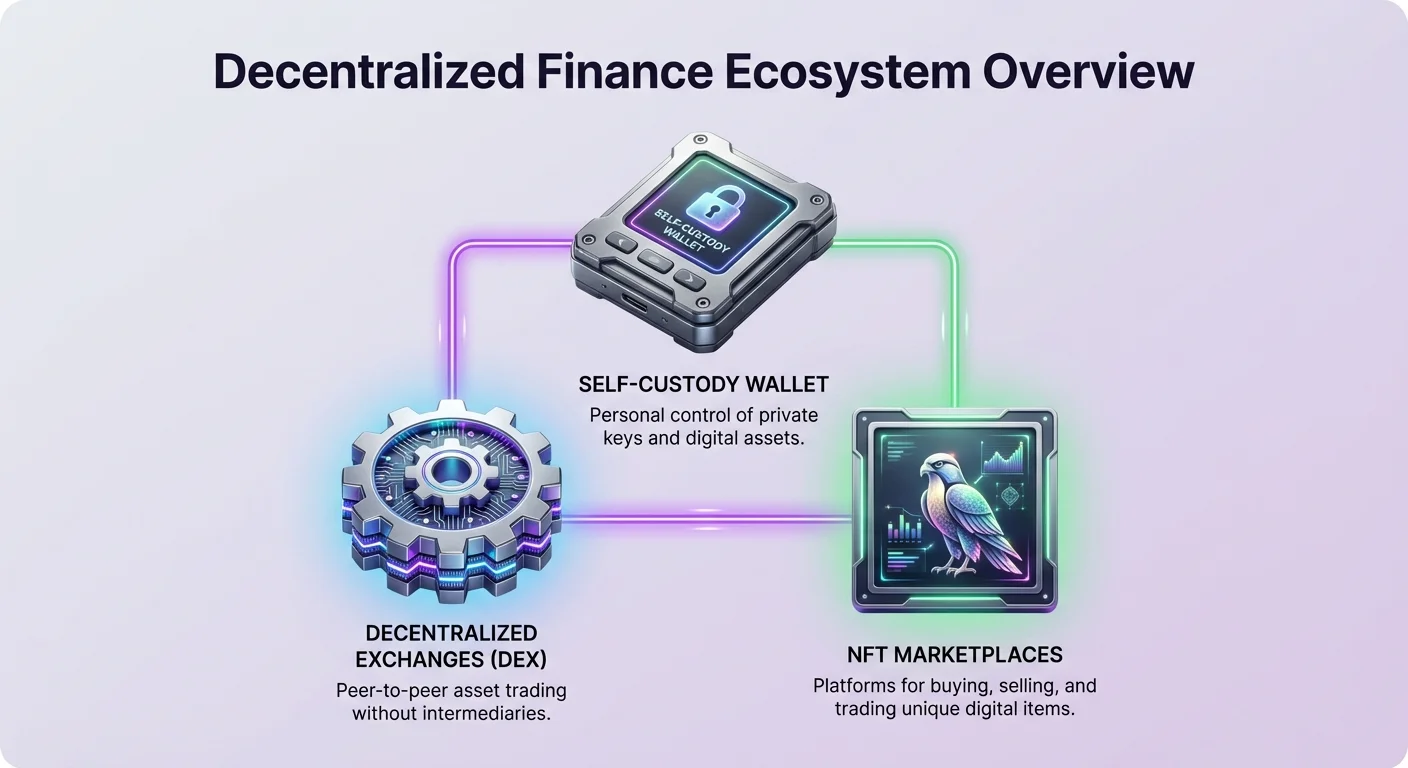
Getting started requires understanding the fundamental tools that make these interactions possible. The two most prominent pillars of this ecosystem are decentralized exchanges and non-fungible token marketplaces. Both rely on the same underlying technology but serve different purposes for the user. Understanding how to navigate these platforms securely is essential for anyone looking to explore this new financial frontier.
This guide covers the essential components of a decentralized finance starter kit. It explores the mechanics of self-custody, the intricacies of swapping assets without intermediaries, and the methods for acquiring unique digital items. By mastering these concepts, users can navigate the decentralized web with confidence and security.
The Importance of Self-Custody
The foundation of any decentralized finance journey is the self-custody wallet. In the crypto space, wallets are often categorized by who holds the ultimate control over the funds. Custodial wallets are those managed by centralized entities, such as large exchanges. In these scenarios, the third party holds the private keys, meaning they theoretically have the power to freeze funds or restrict access.
Self-custody, or non-custodial wallets, place the power entirely in the hands of the user. A self-custody wallet generates a set of private keys and a recovery phrase that only the user knows. This means that no bank, government, or corporation can access the funds without the user's explicit permission. It represents the truest form of ownership in the digital realm.
With this total control comes significant responsibility. If a user loses their wallet recovery phrase or private keys, there is no customer support line that can restore access to the account. The assets are mathematically locked away forever. Therefore, the setup process involves securely backing up these credentials, often on physical paper, to ensure they remain offline and safe from digital threats.
Most decentralized applications, including exchanges and NFT marketplaces, require a self-custody wallet to function. These applications do not hold user funds. Instead, they request permission to interact with the assets sitting in the user's wallet. This architecture ensures that users maintain ownership of their assets right up until the moment a trade or purchase is executed.
Understanding Decentralized Exchanges
The Role of the DEX
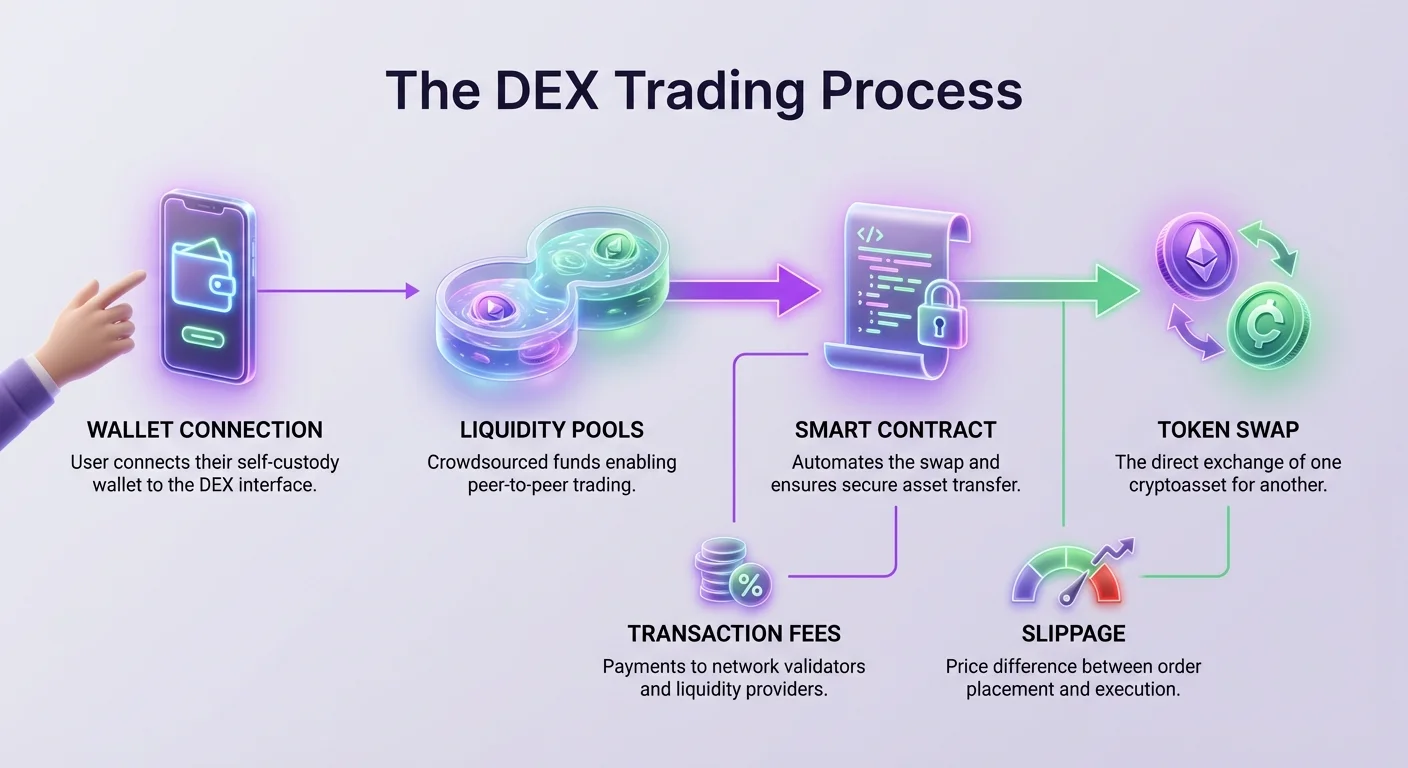
A decentralized exchange, or DEX, serves as the backbone of the decentralized finance economy. These platforms facilitate the swapping of cryptoassets without the need for a central authority. In a centralized exchange, a company matches buyers with sellers using an order book. In contrast, a DEX uses smart contracts to automate this process peer-to-peer.
DEXs are permissionless, meaning anyone with a wallet and an internet connection can access them. There are no geographic restrictions or Know-Your-Customer (KYC) mandates typically associated with traditional finance. This openness allows for a truly global market where trading runs 24/7, facilitated entirely by code rather than human brokers.
It is important to distinguish the capabilities of a DEX from a centralized counterpart. DEXs generally facilitate trades between different cryptocurrencies. They do not typically handle swaps between fiat currency (like USD or EUR) and crypto. Users usually need to acquire cryptocurrency elsewhere before bringing it to a DEX to trade for other digital assets.
Liquidity and Pools
The mechanism that powers most decentralized exchanges is the Automated Market Maker (AMM). Unlike traditional markets that rely on professional market makers to provide buy and sell orders, AMMs rely on crowdsourced liquidity. This liquidity is organized into "pools."
A liquidity pool is essentially a smart contract that holds funds for a specific trading pair. For example, a VERSE-WETH pool contains both VERSE tokens and Wrapped Ethereum. When a trader wants to swap one token for the other, they are trading against the assets in this pool rather than waiting for another person to take the other side of the trade.
The people who deposit their assets into these pools are known as liquidity providers. In exchange for locking up their funds to facilitate trades for others, providers earn a share of the trading fees generated by the protocol. This incentive structure ensures that there is always enough capital available for traders to execute swaps instantly.
Liquidity is the most critical metric for the health of a DEX. It measures how easily assets can be exchanged without causing drastic price shifts. In a pool with low liquidity, a single large trade can significantly skew the price. Conversely, deep liquidity pools allow for large transactions to occur with minimal impact on the asset's market price.
The Mechanics of Swapping
Executing a Trade
The primary action performed on a DEX is the "swap." This process involves exchanging one cryptoasset for another at the current market rate determined by the ratio of assets in the liquidity pool. To perform a swap, a user connects their Web3 wallet to the DEX interface. This connection allows the site to see the balances available for trading.
The user selects the input token (what they want to sell) and the output token (what they want to buy). The interface will populate the estimated amount of the output token based on current prices. Once the user confirms the amount, they must sign a transaction with their wallet. This action broadcasts the request to the blockchain.
Transaction fees are a necessary component of this process. Every action that changes the state of a blockchain requires a fee paid in the network's native currency. For instance, swapping tokens on the Ethereum network requires ETH to pay for the "gas." Users must always ensure they hold a small amount of this native currency in their wallet to cover these costs.
Exchange Paths and Routing
Direct trading pairs do not always exist for every combination of assets. A user might hold a specific token and wish to swap it for another obscure token that shares no direct liquidity pool. In these instances, the DEX utilizes an automated routing system to find the most efficient path for the trade.
An exchange path, or route, finds the most liquid way to move from Asset A to Asset B. For example, if a user wants to trade ETH for SHIB, but the direct pool is small or non-existent, the DEX might route the trade through an intermediary. The path could look like ETH -> VERSE -> SHIB.
The DEX automatically calculates this route to ensure the user gets the best possible price with the lowest fees. By utilizing these multi-hop paths, decentralized exchanges can offer a vast array of trading possibilities even if direct liquidity between two specific assets is not available. This interconnected web of pools makes the DeFi market highly efficient.
Advanced Trading Concepts
Understanding Slippage
When trading on a decentralized exchange, the final price of an asset may differ slightly from the quoted price at the moment the order was initiated. This phenomenon is known as slippage. It occurs primarily due to market volatility or low liquidity in a specific trading pool.
Slippage happens when the size of a user's order is large enough to shift the ratio of assets in the pool. For example, buying a significant amount of a token reduces its supply in the pool while increasing the supply of the payment token. This scarcity drives up the price for the latter portion of the order.
DEX interfaces allow users to set a "slippage tolerance." This is a percentage representing the maximum price change the user is willing to accept. If the price slips by more than this percentage during the transaction, the trade will fail. It is generally not advisable to increase slippage tolerance too high, as it exposes the user to poor execution prices or front-running bots.
Fees and Analytics
Every swap incurs an exchange fee. This is a small percentage of the trade volume that is deducted from the transaction. This fee is distributed to the liquidity providers and the protocol itself. For example, a DEX might charge 0.3% per swap, with the vast majority going to the people who funded the pool and a small fraction going to the platform's treasury.
Analyzing these metrics is crucial for understanding the market. Most DEXs provide an analytics dashboard. This section displays data on total volume, liquidity depth, and the top performing pairs. Users can verify the health of a trading pair before committing funds by checking the average trade size and fee generation over the last 24 hours.
| Metric | Definition | Why It Matters |
|---|---|---|
| Liquidity | Total value locked in a pool | Determines price stability and trade impact |
| Volume | Total value traded over time | Indicates market activity and interest |
| Fees | Revenue generated by swaps | Shows profitability for liquidity providers |
Entering the NFT Marketplace
Decentralized Marketplaces
Beyond fungible tokens, the crypto ecosystem supports unique digital items known as Non-Fungible Tokens (NFTs). Buying and selling these assets requires navigating specialized marketplaces. Like exchanges, these marketplaces can be centralized or decentralized, each offering different benefits and risks regarding asset control.
Decentralized marketplaces operate on public blockchains like Ethereum or Polygon. They allow users to trade peer-to-peer without entrusting their assets to a middleman. Platforms like Rarible exemplify this model, often utilizing a decentralized governance structure. In this model, holders of the platform's native token can participate in decision-making processes regarding the platform's future.
Centralized marketplaces, while popular due to high volume, operate more like traditional Web2 companies. They are often owned by a single corporation that makes all decisions regarding fees, features, and moderation. Using a decentralized alternative aligns more closely with the ethos of Web3, reducing the risk of censorship or corporate insolvency affecting user assets.
Connecting and Buying
To interact with an NFT marketplace, a user must connect their self-custody wallet. This connection acts as a login credential. Once connected, the user can browse collections, view their own profile, and initiate transactions. The marketplace reads the data on the blockchain to display the NFTs currently held in the user's wallet.
Purchasing an NFT generally requires cryptocurrency held in the same wallet. If a marketplace supports multiple chains, the user must pay in the currency native to the NFT's network. For example, an NFT on the Polygon network would typically be purchased using MATIC, while one on Ethereum would require ETH.
The buying process is secured by smart contracts. When a user clicks "Buy," they are prompted to sign a transaction in their wallet. This transaction transfers the cryptocurrency to the seller and simultaneously transfers the NFT to the buyer. If any part of this exchange fails, the entire transaction reverts, ensuring funds are never lost in limbo.
Methods of Buying NFTs
Fixed Price vs. Auctions
There are two primary methods for purchasing NFTs on decentralized marketplaces. The simplest method is the "Buy Now" option. Sellers specify a fixed price for their asset. During the listing period, any user can pay that specific price to instantly acquire the NFT. This mimics a standard e-commerce experience.
The second method is the auction. Auctions are often used for high-value or unique items where the market price is uncertain. The most common type is the English auction, or timed auction. A seller sets a minimum price, and interested buyers place bids. Each bid must be higher than the previous one.
When the timer runs out, the highest bidder automatically wins the item. The marketplace's smart contract handles the transfer of funds and assets. It is important for bidders to realize that placing a bid often requires locking up the funds in a smart contract or approving the marketplace to spend their tokens if the bid wins.
Making Offers
Even if an NFT is not explicitly listed for sale, or if it is listed at a high "Buy Now" price, potential buyers can make offers. An offer acts as an open bid that the owner can choose to accept or ignore. This allows for negotiation and price discovery within the marketplace.
Offers are binding commitments. When a user makes an offer, they must have the necessary funds in their wallet. If the seller accepts the offer, the transaction executes immediately. Users can usually cancel their offers at any time before acceptance, though this may require a small gas fee to update the status on the blockchain.
Key NFT Attributes
Royalties and Creator Fees
A unique feature of the NFT ecosystem is the ability to enforce creator royalties on secondary sales. When an artist or project creator mints an NFT, they can specify a royalty percentage. This fee is automatically deducted from the sale price whenever the NFT is resold on a supported marketplace.
For example, if a creator sets a 5% royalty and a user resells the NFT for 10 ETH, the creator receives 0.5 ETH automatically. This mechanism ensures that creators continue to benefit from the success of their work as it gains value in the secondary market. It aligns the incentives of the original creator with the community of collectors.
Properties and Rarity
Most NFT collections, particularly those involving profile pictures or avatars, utilize a system of properties or traits. These are metadata characteristics associated with the token, such as background color, accessories, or clothing. The combination of these traits determines the visual appearance of the NFT.
Marketplaces aggregate this data to calculate rarity. Traits that appear on fewer items within the collection are considered rarer and often command a higher market price. Users can filter search results by these properties to find specific combinations or to identify undervalued items based on their statistical rarity.
Verification and Badges
Due to the open nature of decentralized networks, anyone can mint an NFT that looks identical to a popular project. To combat counterfeits, reputable marketplaces use verification badges. These are visual indicators that signal an NFT collection has been vetted and is confirmed to originate from the legitimate creator.
Buyers should always look for these badges when purchasing from well-known collections. In the absence of a badge, checking the contract address and transaction history is necessary to verify authenticity. Relying on visual appearance alone is risky in an environment where images can be easily copied.
Analytics and Market Data
Monitoring Collection Health
Before purchasing an NFT, analyzing the market data for the collection is advisable. Marketplaces provide statistics such as the "floor price," which represents the lowest current asking price for an item in the collection. The floor price serves as a baseline for valuing assets within that specific group.
Volume is another critical metric. High trading volume indicates active interest and liquidity, making it easier to resell the NFT later. Conversely, a collection with zero recent volume may be difficult to exit, regardless of the theoretical floor price.
Viewing Your Collection
Once a purchase is complete, the NFT resides in the user's wallet. However, because the wallet software itself primarily stores keys, viewing the visual representation of the NFT often happens through the marketplace interface. By connecting the wallet to the marketplace and navigating to the user profile, one can see a gallery of their holdings.
This profile view allows users to manage their assets. From here, owners can list items for sale, transfer them to other wallets, or simply display their collection to the world. The decentralized nature of the data means this collection is visible on any marketplace the user connects to, not just the one where the item was purchased.
Conclusion
Navigating the world of decentralized finance and NFTs requires a shift in mindset from reliance on intermediaries to personal responsibility. Setting up a self-custody wallet is the first step toward financial sovereignty, granting the user absolute control over their digital assets. This control enables permissionless interaction with a vast ecosystem of exchanges and marketplaces.
By understanding the mechanics of liquidity pools, swaps, and slippage, users can trade efficiently and avoid common pitfalls. Similarly, recognizing the nuances of NFT marketplaces, from auction mechanics to royalty standards, allows for safer and more informed purchasing decisions. As the technology evolves, these fundamental skills remain the bedrock of participating in the Web3 economy.
The key to success in decentralized finance is combining secure self-custody practices with a clear understanding of how protocols function.