
The transition of Bitcoin from a niche digital experiment to a recognized global asset class has fundamentally altered how it is held and managed. In the early years, custody was largely a matter of individual responsibility, often involving simple software wallets or early hardware devices. However, as corporations and institutional investors have entered the space, the requirements for security have evolved drastically. The stakes are no longer just personal savings but potentially billions of dollars in shareholder value.
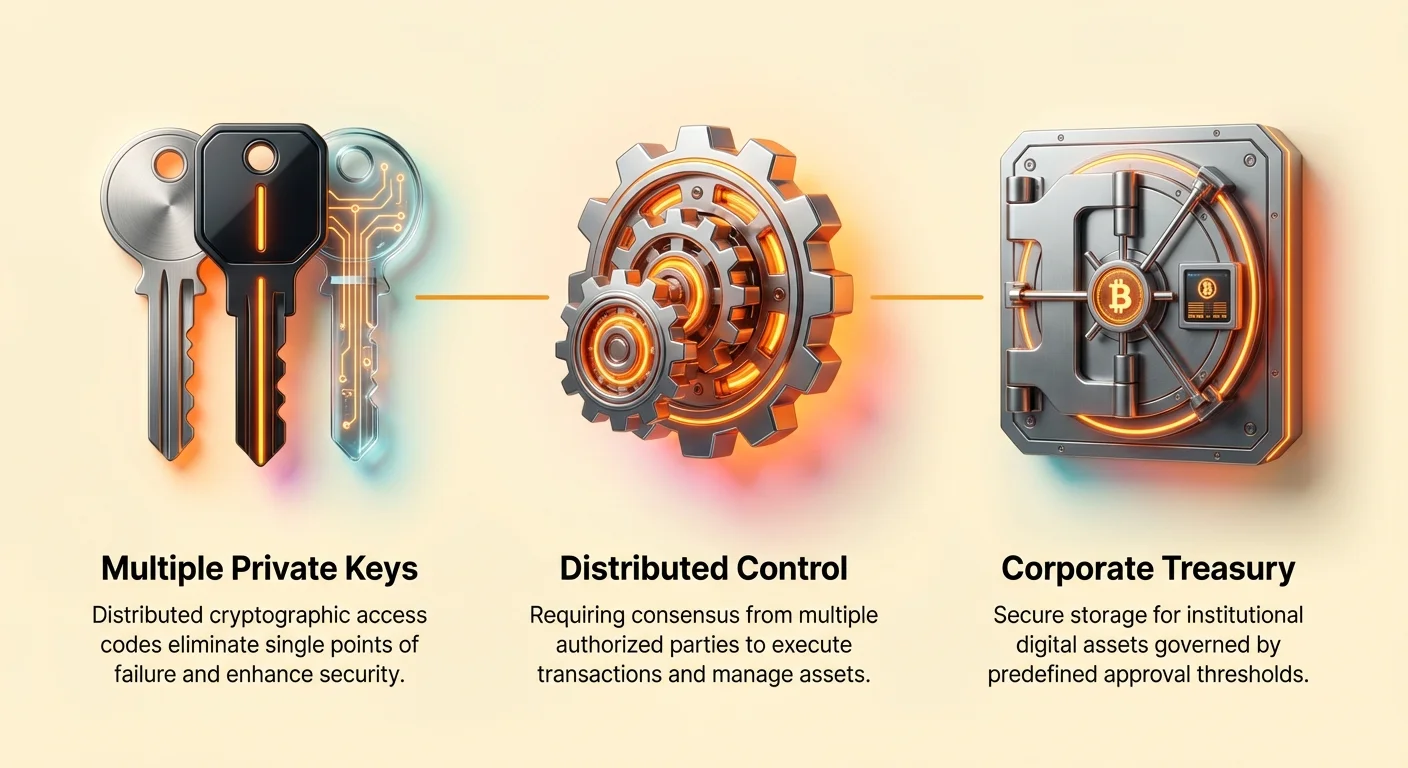
For institutions, the primary challenge is not just securing the asset against external theft, but establishing robust internal governance. A single private key represents a single point of failure, a risk profile that is unacceptable for a corporate treasury. If one person holds the key, that person holds absolute power over the funds. If that key is lost, the funds are irretrievable.
To address these systemic risks, advanced custody solutions have moved toward multisignature (multisig) technology. This approach mirrors traditional corporate controls, such as requiring two signatures on a large check. By distributing control across multiple parties and devices, organizations can enforce democratic decision-making and cryptographic security simultaneously. This ensures that no single individual can move funds unilaterally, aligning digital asset management with established fiduciary standards.
The Strategic Shift to Corporate Treasuries
Drivers of Institutional Adoption
The modern financial landscape has seen a significant migration of capital into digital assets. Publicly traded companies and private enterprises are increasingly adding Bitcoin to their balance sheets. This trend is driven by a desire to hedge against inflation and diversify portfolios beyond traditional fiat currencies and government bonds. With a fixed supply of 21 million coins, Bitcoin offers a scarcity model that appeals to treasurers looking to preserve purchasing power over long time horizons.
Major corporations, including technology firms and automotive giants, have integrated Bitcoin into their treasury strategies. This is not merely for speculation but often serves as a strategic reserve asset. The rationale is that in an environment of monetary expansion, holding cash reserves in fiat currency carries the risk of devaluation. By allocating a percentage of the treasury to Bitcoin, companies aim to mitigate this risk while gaining exposure to a high-growth asset class.
Financial Reporting Implications
Holding digital assets introduces unique considerations for corporate accounting. Under current standards in many jurisdictions, Bitcoin is often classified as an intangible asset with an indefinite life. This classification means that it is recorded on the balance sheet at its purchase price. If the market value drops below the cost basis, the company must write down the value, recording an impairment charge.
However, if the price rises, the company generally cannot record the gain until the asset is actually sold. This asymmetry requires careful planning and clear communication with shareholders. Recent changes in accounting rules in some regions are moving toward fair value accounting, which would allow companies to reflect the current market price more dynamically. This evolution in financial reporting standards is likely to further encourage institutional adoption by reducing the accounting friction associated with holding volatile assets.
Understanding Multisignature Architecture
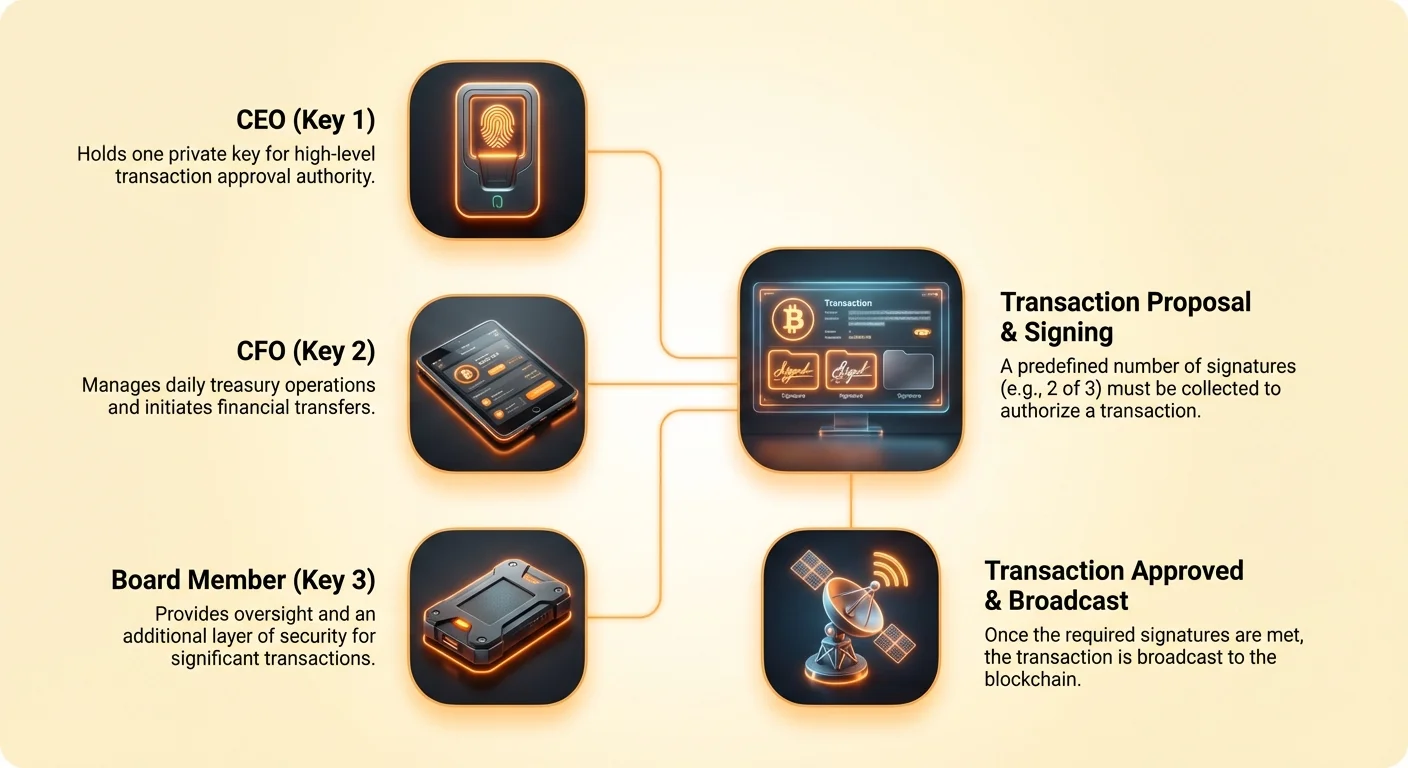
At its core, multisignature technology fundamentally changes the relationship between a wallet and its owner. In a standard "single-signature" wallet, one private key corresponds to one public address. Whoever possesses that private key has total control. In a multisig setup, the wallet is associated with multiple private keys, and a predefined number of those keys are required to authorize a transaction.
This is often described as an "M-of-N" scheme, where "N" is the total number of keys created, and "M" is the number of signatures required to move funds. For example, a 2-of-3 wallet has three total participants, but any two of them can approve a transaction. This architecture separates the concept of ownership from the concept of access. The organization owns the funds, but access is distributed among a committee of authorized signers.
Technical Configuration of Keys
When a shared wallet is initialized, distinct private keys are generated for each participant. These keys never need to leave the possession of the individual signer. The protocol essentially aggregates the public keys derived from these private keys to create a single, common public address. This address is what the outside world sees and where funds are deposited.
Because the private keys are generated independently, they can be stored on completely different devices and in different geographic locations. One key might be on a hardware wallet in a corporate safe, another on a mobile device held by the CFO, and a third in a bank safety deposit box. This geographic and technological dispersion makes it exponentially more difficult for an attacker to compromise the wallet, as they would need to simultaneously breach multiple distinct secure locations.
The Role of Multi-Party Computation (MPC)
While multisig occurs at the protocol level, another advanced method used by institutions is Multi-Party Computation (MPC). MPC splits a single private key into multiple shards or shares. These shares are distributed among different parties. When a transaction is needed, the parties compute the signature together without ever reassembling the full private key in one place.
MPC offers similar governance benefits to multisig but operates slightly differently. It eliminates the single point of failure without necessarily creating multiple distinct on-chain signatures. Many institutional custody providers use a combination of cold storage, multisig, and MPC to ensure the highest tier of security. This allows for flexible governance policies, such as requiring approval from specific departments before a transaction can be cryptographically signed.
Mitigating Governance Risks
Eliminating Key Person Risk
One of the most critical risks in corporate asset management is key person risk. In the context of cryptocurrency, this refers to a scenario where the only person with access to the private keys becomes unavailable due to injury, termination, or death. In a single-signature setup, this event would result in the permanent loss of the company's assets.
Multisig wallets neutralize this threat through redundancy. In a 3-of-5 setup, for instance, if one key holder is unavailable, the remaining four can still easily meet the threshold of three signatures required to move funds. This ensures business continuity regardless of personnel changes or emergencies. It transforms the wallet from a personal possession into a true organizational tool that survives beyond any single individual's tenure.
Preventing Internal Malfeasance
External hackers are a major threat, but internal threats are equally dangerous for institutions. A rogue employee with unilateral access to a corporate treasury could drain the accounts irrecoverably. Multisig acts as a system of checks and balances. By requiring multiple approvals, an organization ensures that no funds leave the treasury without consensus.
For example, a transaction might require signatures from the CEO, the CFO, and a member of the Board of Directors. Even if one of these individuals acted maliciously, they would be unable to move the funds without the cooperation of the others. This structure enforces a layer of social and procedural security on top of the cryptographic security, mirroring the dual-control systems found in high-security banking environments.
Institutional Wallet Configurations
Choosing the right "M-of-N" configuration depends heavily on the size of the organization and its specific governance needs. There is no one-size-fits-all approach, but several standard models have emerged for different tiers of institutional management.
| Configuration | Type | Ideal Use Case |
|---|---|---|
| 2-of-2 | Partnership | Small business partners requiring mutual consent for every transaction. |
| 2-of-3 | Standard | Most common redundancy; allows for one lost key or one unavailable signer. |
| 3-of-5 | Committee | Corporate treasury managed by a finance team; high redundancy. |
| 4-of-6 | Board Level | High-value cold storage requiring broad consensus among directors. |
The 2-of-3 Standard
The 2-of-3 setup is the industry standard for a balance of security and usability. It allows for a "majority vote" on transactions. If one key is lost, the funds are not locked, as the remaining two keys can recover the wallet. Conversely, if one key is stolen, the thief cannot access the funds because they lack the second required signature.
This setup is often used for active treasury management where transactions occur somewhat frequently. It is agile enough to execute trades or payments without excessive logistical hurdles while still providing a safety net against accidents or theft. It is particularly effective for small to mid-sized investment funds or family offices.
Board-Level Cold Storage
For long-term reserve assets that are not intended to move often, higher-order configurations like 4-of-6 or 5-of-8 are appropriate. These are often referred to as "deep cold storage." The keys for these wallets are typically held by the highest-ranking officers or board members, often distributed across different jurisdictions.
This configuration is designed to be slow and deliberate. Moving funds from such a wallet is a significant corporate event, requiring coordination among leadership. This high friction is a feature, not a bug; it prevents impulsive decisions and ensures that any liquidation of the company's core Bitcoin reserves is a fully considered strategic move backed by a supermajority of the leadership team.
Transaction Workflows in Shared Wallets
Initiating Requests
In a shared wallet environment, sending Bitcoin is not an instantaneous "click and send" action. It begins with a transaction request. One authorized participant initiates the process by entering the recipient's address and the amount. However, instead of broadcasting the transaction immediately to the blockchain, the software creates a pending proposal.
This proposal is then visible to all other participants in the wallet. In many modern wallet interfaces, the funds associated with the request are temporarily locked or reserved. This prevents the same funds from being double-spent or allocated to a different proposal while the current one is pending. The balance may appear lower during this phase, reflecting the "reserved" status of the coins.
The Approval Phase
Once a request is generated, the other key holders must review and sign it. This is the governance layer in action. Participants can inspect the destination address and the amount to ensure they match the company's authorized expenditures. If the details are correct, they use their private key to apply a digital signature to the transaction.
If a participant disagrees with the transaction or identifies an error, they can reject the request. If the request is rejected or if it fails to garner the required number of signatures (M), the transaction is never broadcast to the network. The locked funds are released back into the available balance. Only when the threshold of valid signatures is met does the wallet software combine them and broadcast the final, fully authorized transaction to the Bitcoin network for confirmation.
Security Protocols and Best Practices
Air-Gapped Hardware Integration
For institutional governance, software wallets on internet-connected devices (hot wallets) are generally considered insufficient for holding substantial sums. Best practices dictate the use of hardware wallets—physical devices that store private keys offline. These devices execute the cryptographic signing process internally, ensuring that the private key is never exposed to a computer's memory or the internet.
In a robust multisig setup, each participant should ideally use a hardware wallet. This creates an "air-gapped" environment where the approval process requires physical access to a dedicated device. Even if a participant's computer is infected with malware, the attacker cannot extract the private key from the hardware device, significantly hardening the treasury against cyberattacks.
Geographic Key Dispersion
To protect against physical threats such as fire, flood, or theft, institutions must geographically separate their keys. Storing all hardware wallets or seed phrase backups in the same office safe defeats the purpose of multisig redundancy. If that single location is compromised or destroyed, the funds are lost.
A proper governance plan assigns specific locations for each key. One might remain at the headquarters, another at a secure off-site storage facility, and others with legal counsel or independent custodians. This dispersion ensures that no single physical event can destroy the organization's access to its capital. It also necessitates collusion among physically distant parties to steal funds, making insider theft logistically difficult.
The ETF vs. Self-Custody Debate
The rise of Bitcoin Exchange-Traded Funds (ETFs) has provided a convenient vehicle for institutions to gain price exposure to Bitcoin without managing keys. However, this convenience comes with trade-offs that contradict the fundamental ethos of Bitcoin. When investing in an ETF, the institution does not own the underlying Bitcoin; they own shares in a fund that owns the Bitcoin.
Counterparty Risks in Funds
Relying on an ETF introduces counterparty risk. The institution is trusting the fund manager and the fund's custodian to secure the assets. History in both traditional finance and crypto has shown that intermediaries can fail, face insolvency, or suffer from operational disruptions. In such events, the investor's access to liquidity can be frozen, or assets can be tied up in lengthy bankruptcy proceedings.
Furthermore, ETFs charge management fees that erode capital efficiency over time. While these fees cover the cost of custody and administration, they represent a continual drag on the investment's performance. For a corporation intending to hold Bitcoin for a decade or more, these recurring costs can be substantial compared to the one-time setup cost of a robust self-custody solution.
True Ownership Utility
Self-custody through multisig preserves the utility of Bitcoin as a bearer asset. An institution holding its own keys possesses unencumbered ownership. They can transact 24/7, 365 days a year, without waiting for banking hours or fund redemption windows. This liquidity is a powerful operational advantage during times of market stress when traditional financial rails may be congested or closed.
Additionally, direct ownership eliminates the risk of asset seizure or censorship by third parties. The organization retains absolute sovereignty over its wealth, subject only to its own internal governance protocols. For many forward-thinking enterprises, this independence is a primary driver for adopting Bitcoin, and outsourcing custody to an ETF effectively negates this benefit.
Backup and Recovery for Shared Wallets
One of the unique challenges of multisig wallets is the complexity of backup procedures. In a standard wallet, a single recovery phrase (seed phrase) is sufficient to restore access. In a shared wallet, the recovery process is different. Each participant has their own unique recovery phrase derived from their specific private key.
To fully restore a shared wallet, a user typically needs two pieces of information: their own recovery phrase and the wallet configuration data (specifically, the extended public keys of the other participants). Without the configuration data, the wallet software may not know which other keys were involved in generating the shared address.
Therefore, institutional governance policies must mandate that every participant rigorously backs up their individual recovery phrase. These backups should be written on durable materials like steel or paper and stored in secure, tamper-evident environments. Unlike "cloud" backups which introduce attack vectors, physical backups for multisig keys ensure that the security model remains intact even if digital systems fail.
Conclusion
The implementation of multisig technology represents the maturation of Bitcoin custody from a personal security practice to an institutional governance standard. By moving away from single-key vulnerabilities and embracing distributed authorization, corporations can safely integrate digital assets into their treasuries. This approach not only secures capital against theft and loss but also enforces essential checks and balances that align with fiduciary responsibilities.
As the digital asset landscape continues to evolve, the dichotomy between convenience and control remains central. While products like ETFs offer an easy entry point, they strip away the sovereign utility that defines Bitcoin. For organizations committed to the long-term potential of this asset class, establishing a self-sovereign, multisignature governance framework is the superior path. It guarantees that the organization retains absolute control over its financial destiny, independent of third-party risks.
True institutional security requires distributing trust across multiple people and devices to eliminate single points of failure.