
Cryptocurrency markets operate on a continuous basis, offering a dynamic environment for financial participants. Unlike traditional equity markets with set trading hours, the digital asset ecosystem functions twenty-four hours a day. This perpetual activity creates unique opportunities for traders to deploy capital strategies that go beyond simple asset acquisition. Among these advanced strategies, leverage and margin trading stand out as powerful tools for amplifying market exposure.
Leverage allows traders to control position sizes that exceed their actual capital reserves. By borrowing funds from an exchange or liquidity pool, a trader can multiply their buying power. This mechanism transforms small market movements into significant outcomes for the trader's account equity. However, this amplification works in both directions. While gains can be substantial, losses are equally magnified.
Understanding the science of leverage requires a deep dive into margin sizing, collateral management, and the mathematical realities of risk. It is not merely about predicting price direction but managing the geometry of the trade itself. The concept of Risk of Ruin becomes a central statistical probability that every leveraged trader must confront. It dictates the likelihood of depleting trading capital to a point where recovery becomes mathematically impossible.
The Mechanics of Derivative Contracts
To comprehend leverage, one must first understand the financial instruments that facilitate it. In the cryptocurrency space, these are primarily derivatives. A derivative is a financial contract between two or more parties that derives its value from an underlying asset. This underlying asset can be a specific cryptocurrency like Bitcoin or Ethereum.
Derivatives allow participants to speculate on the future price of an asset without necessarily owning the asset itself. The contract tracks the price performance of the digital currency. This structure is essential for leverage because it separates price exposure from physical ownership. Traders are buying and selling the value of the contract rather than transferring the coins on a blockchain.
The most common derivatives in the crypto market include futures, options, and perpetual contracts. Each instrument has distinct mechanics regarding expiration, settlement, and pricing. These instruments provide the framework within which leverage is applied. They serve as the vehicle for transferring risk between parties who wish to hedge their portfolios and those seeking speculative exposure.
Understanding the Underlying Asset Relationship
The relationship between a derivative and its underlying asset is the foundation of contract trading. The derivative attempts to mirror the price action of the spot market. The spot market is where assets are bought and sold for immediate delivery. If the spot price of Bitcoin rises, the value of a Bitcoin derivative contract should theoretically rise in tandem.
However, divergences can occur. In futures markets, the contract price may trade at a premium or discount to the spot price based on market sentiment. If traders are overwhelmingly bullish, the futures price may exceed the spot price. Conversely, bearish sentiment can push the futures price below the spot value.
These discrepancies are critical for traders to understand. They influence the cost of holding a leveraged position. In perpetual futures markets, mechanisms such as funding rates are employed to tether the contract price to the spot price. This ensures that the derivative remains a reliable instrument for tracking the value of the underlying cryptocurrency over time.
The Fundamentals of Leverage Trading
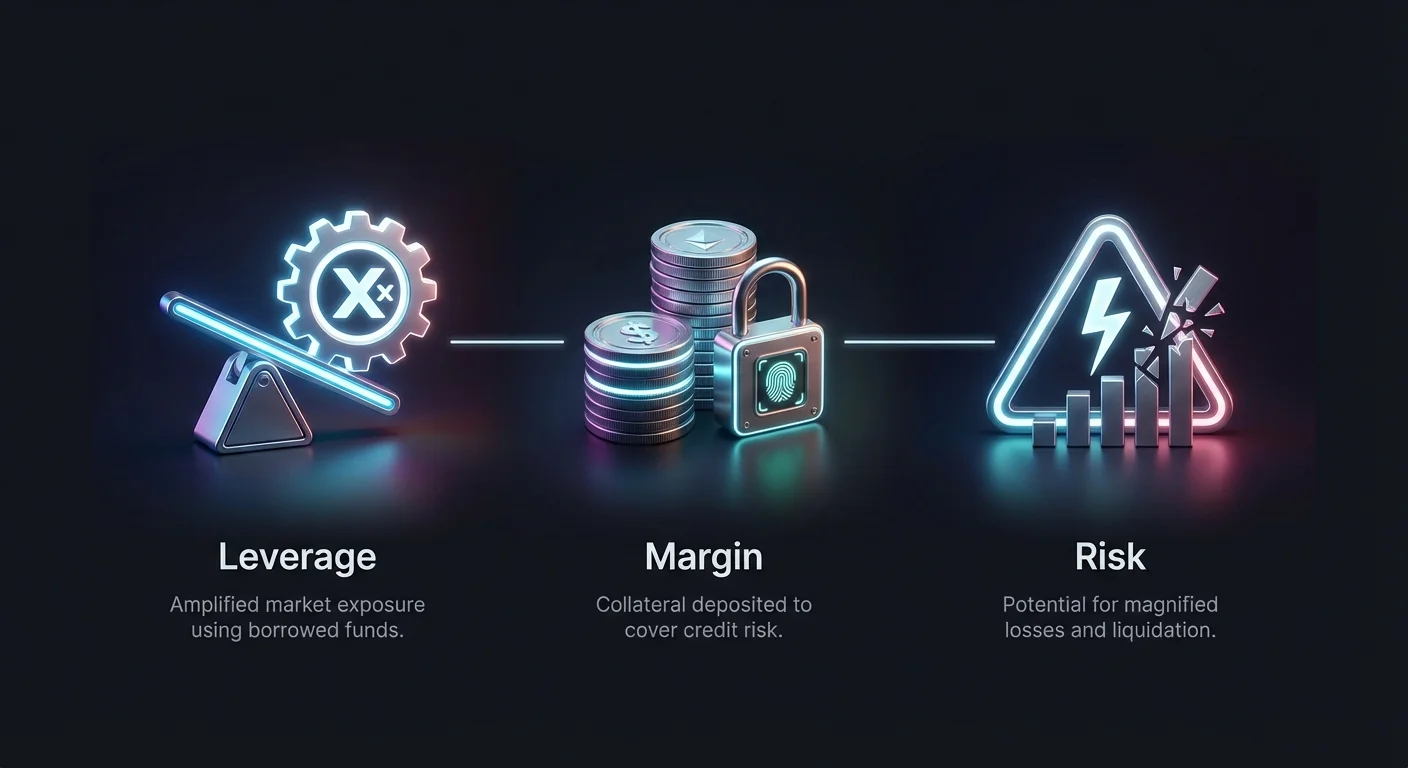
Leverage is defined as the use of borrowed capital to increase the potential return of an investment. In the context of crypto trading, it involves using a relatively small amount of capital, known as margin, to open a much larger position. The ratio of the total position size to the margin capital is the leverage ratio.
For example, a trader using 10x leverage can control a position worth ten times their initial deposit. If a trader has $1,000 and applies 10x leverage, they can open a position valued at $10,000. The exchange or the lending platform provides the remaining $9,000. This borrowing capability is seamless on most modern platforms, often automated within the trade execution process.
The primary benefit of leverage is capital efficiency. It allows traders to gain significant market exposure without tying up large amounts of liquidity. A trader can allocate a small portion of their portfolio to a high-conviction trade while keeping the rest of their capital in reserve or deployed in other strategies.
Capital Efficiency and Buying Power
Capital efficiency refers to the ability to maximize the utility of available funds. In a non-leveraged environment, a trader needs the full value of an asset to purchase it. To buy $10,000 worth of Bitcoin, they must have $10,000 in cash. This locks up the entire amount for the duration of the trade.
With leverage, the capital requirement is reduced to a fraction of the total value. This fraction is the initial margin. The freed-up capital can be used for other purposes, such as hedging against adverse price movements or diversifying into other assets. This flexibility is a hallmark of advanced trading strategies.
However, increased buying power comes with increased responsibility. The borrowed funds must be repaid, and the trader bears the full risk of the total position size. If the market moves against the position, the losses are calculated based on the $10,000 value, not the $1,000 margin. This reality dictates the strict risk management protocols required in leveraged environments.
Margin Requirements and Collateral Types
Margin is the collateral that a trader must deposit to cover the credit risk associated with a leveraged position. It acts as a good-faith deposit or a performance bond. Exchanges require this collateral to ensure that the trader can satisfy their financial obligations if the trade results in a loss.
There are two critical types of margin that traders must monitor: initial margin and maintenance margin. Initial margin is the amount required to open a position. It is determined by the leverage ratio selected by the trader. Higher leverage requires a lower percentage of initial margin, while lower leverage requires a higher percentage.
For instance, a position with 50x leverage might require an initial margin of 2%. Conversely, a position with 2x leverage would require an initial margin of 50%. This initial deposit secures the entry into the market. Once the position is open, the focus shifts to the maintenance margin.
The Critical Role of Maintenance Margin
Maintenance margin is the minimum amount of equity that must be maintained in the trading account to keep a position open. It is typically lower than the initial margin. As market prices fluctuate, the equity in the trader's account changes in real-time.
If the market moves unfavorably, the trader's equity balance decreases. If the balance falls below the maintenance margin level, the position is considered under-collateralized. At this point, the risk of default increases. Exchanges enforce maintenance margin requirements strictly to protect the solvency of the platform and other users.
Traders must actively manage their account balances to ensure they stay above the maintenance threshold. This often involves adding more collateral to the account if the market moves against the position. Failing to maintain the required equity triggers liquidation protocols, which effectively close the trade to prevent further losses.
The Mechanics of Liquidation
Liquidation is the automatic closure of a trader's position by the exchange. This occurs when the trader's account equity falls below the required maintenance margin. The exchange takes over the position and sells it into the market to recover the borrowed funds. This protects the lender from losses that exceed the posted collateral.
Liquidation is a definitive event in leverage trading. It results in the loss of the initial margin and any additional funds allocated to the position. In volatile crypto markets, price spikes can trigger liquidations rapidly. This underscores the danger of high leverage, where the buffer between the entry price and the liquidation price is incredibly narrow.
To avoid liquidation, traders must employ robust risk management strategies. This includes using stop-loss orders to exit losing positions before they reach the liquidation threshold. It also involves prudent margin sizing, ensuring that there is sufficient collateral to withstand normal market volatility without triggering a forced closure.
Traditional Futures Contracts
Futures contracts are a standardized form of derivative. They represent an agreement to buy or sell an asset at a predetermined price on a specific future date. Traditional futures have a fixed expiration date. On this date, the contract settles, and the parties exchange the value difference or the asset itself.
In the context of crypto, a futures contract might commit a trader to buy Bitcoin at a price of $50,000 on a specific date in December. If the price of Bitcoin on that date is $55,000, the trader has profited. If the price is $45,000, the trader has incurred a loss. These contracts allow for forward-looking speculation based on anticipated market conditions.
Since futures contracts have an expiration date, their prices may not always align perfectly with the current spot price. The price of a future contract reflects market expectations for the asset's value at the time of expiry. This creates a forward curve, where future prices can be higher (contango) or lower (backwardation) than the spot price.
Expiration Dates and Contract Rollovers
The existence of an expiration date introduces specific dynamics to futures trading. Traders who wish to maintain a position beyond the expiration date must "roll over" their contracts. This involves closing the expiring contract and opening a new one with a later expiration date.
Rollovers require active management and can incur transaction costs. The price difference between the expiring contract and the new contract can also impact profitability. For institutional traders and hedgers, managing expiration dates is a routine part of portfolio maintenance.
However, for retail traders seeking continuous exposure without the complexity of expiry dates, the market evolved to create a more flexible instrument. This need led to the development and widespread adoption of the perpetual futures contract in the cryptocurrency ecosystem.
Perpetual Futures and Market Alignment
Perpetual futures, often referred to as "perps," are a unique innovation in the crypto derivatives market. As the name implies, these contracts do not have an expiration date. A trader can hold a perpetual position for as long as they satisfy the margin requirements. This removes the need for rollovers and simplifies long-term holding strategies.
Because there is no expiry date to force the contract price to converge with the spot price, perpetuals require a different mechanism to ensure price stability. Without an anchoring mechanism, the price of a perpetual contract could drift significantly away from the actual market value of the asset.
To solve this, exchanges utilize a system known as the funding rate. The funding rate is a periodic payment exchanged between buyers (longs) and sellers (shorts). It acts as an incentive mechanism to keep the perpetual price aligned with the spot price.
The Function of Funding Rates
The funding rate balances the demand between long and short positions. When the perpetual price is higher than the spot price, the funding rate is positive. In this scenario, traders holding long positions pay a fee to traders holding short positions. This cost discourages longs and encourages shorts, pushing the price down toward the spot value.
Conversely, when the perpetual price is lower than the spot price, the funding rate becomes negative. Short position holders pay fees to long position holders. This incentivizes buying and discourages selling, driving the price up toward the spot value. These payments typically occur every eight hours on major exchanges.
Traders must account for funding rates as a carrying cost. In a strong bull market, maintaining a long position can become expensive due to consistently positive funding rates. Smart traders monitor these rates to optimize their entry and exit timing, sometimes engaging in arbitrage strategies to profit from funding rate discrepancies.
Short Selling Mechanisms
Shorting is a strategy used to profit from a decline in asset prices. In a standard "long" trade, a participant buys low and sells high. In a "short" trade, the sequence is reversed: the trader sells high and buys low. This capability is essential for efficient markets, as it allows for price discovery during downtrends.
To execute a short sale, a trader borrows the cryptocurrency from an exchange or a lender. They immediately sell this borrowed asset at the current market price. The trader now holds cash (or a stablecoin equivalent) but owes the cryptocurrency back to the lender.
If the price of the asset drops, the trader can repurchase the cryptocurrency at the lower price. They return the borrowed amount to the lender and keep the difference between the selling price and the repurchase price as profit. This process effectively monetizes market corrections and bearish trends.
Borrowing and Repayment Dynamics
The borrowing process in crypto shorting is often automated within margin and futures platforms. When a trader opens a short position, the system automatically allocates the necessary borrowed assets against the trader's collateral. The trader does not need to manually locate a lender.
However, borrowing assets incurs costs. Interest is charged on the borrowed funds or tokens. This interest accumulates over time and varies based on market demand for the asset. High demand for shorting a specific coin can drive up borrowing costs, squeezing profit margins.
Repayment occurs when the position is closed. The trader buys back the borrowed amount from the market. If the price has risen instead of fallen, the trader must buy back the asset at a higher cost, resulting in a loss. Since asset prices can theoretically rise indefinitely, short selling carries the risk of uncapped losses.
Shorting via Inverse Products
Beyond direct margin shorting, traders can utilize inverse exchange-traded products (ETPs) or inverse futures. These instruments are structured to gain value when the underlying asset falls. For example, a Bitcoin inverse contract is settled in Bitcoin, meaning the value of the collateral increases as the price drops, relative to the fiat value.
Inverse products simplify the shorting process for those who may not want to manage the intricacies of borrowing and interest rates directly. They package the short exposure into a tradable instrument. This accessibility allows a broader range of market participants to hedge their portfolios against downside risk.
However, inverse products often involve complex rebalancing mechanisms. They are generally designed for short-term trading rather than long-term holding. Over extended periods, the compounding effects and volatility decay can impact the performance of these products relative to the underlying asset.
Options Trading Fundamentals
Options contracts provide a different approach to leverage and risk management. Unlike futures, which obligate the parties to transact, options confer the right but not the obligation to buy or sell an asset. This distinction is critical for constructing non-linear payout profiles.
There are two primary types of options: calls and puts. A call option gives the holder the right to buy the underlying asset at a specific price, known as the strike price, within a certain timeframe. Traders buy calls when they expect the price to rise.
A put option gives the holder the right to sell the underlying asset at the strike price. Traders buy puts when they expect the price to fall. The purchaser of an option pays a fee, called the premium, to the seller (writer) of the option. This premium is the maximum loss the buyer can incur, offering a defined risk profile.
American Versus European Option Styles
Crypto options are categorized by their exercise style. The two dominant styles are American and European. American options offer maximum flexibility, as they can be exercised at any point up to and including the expiration date. This allows traders to capture profits early if a favorable price movement occurs before the contract matures.
European options, in contrast, can only be exercised on the specific date of expiration. While less flexible, European options are standard for many institutional-grade crypto derivatives. They are often cash-settled, meaning the profit or loss is exchanged at expiry rather than the physical asset itself.
The choice between styles depends on the trader's strategy. American options typically command a higher premium due to the added value of flexibility. European options may be preferred for strategies that rely on settlement at a precise point in time, often used in complex hedging arrangements.
Binary Options and Fixed Outcomes
Binary options represent a simplified form of derivatives trading. As the name suggests, the outcome is binary: it is either a win or a loss. Traders speculate on whether the price of an asset will be above or below a certain level at a specific time.
If the prediction is correct, the trader receives a fixed payout. If the prediction is incorrect, the trader loses the entire investment wagered on that trade. This "all-or-nothing" structure provides clarity on potential profit and loss prior to trade execution.
Binary options are often used for short-term speculation. The duration of these trades can range from minutes to hours. Because the payout is fixed, the potential return is known, but the risk is total loss of the principal. This high-risk, high-reward dynamic requires precise timing and market analysis.
Risk Management and Position Sizing
The cornerstone of successful leverage trading is risk management. The primary goal is preservation of capital. Without capital, a trader cannot participate in the market. Therefore, determining the appropriate position size is more important than entry or exit signals.
Position sizing involves calculating how much capital to risk on a single trade relative to the total portfolio size. A common rule of thumb is to risk only a small percentage, such as 1% or 2%, of the total account equity on any given trade. This approach ensures that a string of losses does not deplete the account.
When leverage is applied, position sizing must be adjusted. A $1,000 position with 10x leverage has the same volatility impact as a $10,000 spot position. Traders must calculate their risk based on the leveraged value, not just the margin deposit.
Implementing Stop-Loss Orders
A stop-loss order is an automated instruction to sell an asset when it reaches a specific price. It acts as a safety net, limiting the potential loss on a trade. In leveraged trading, stop-loss orders are essential to prevent liquidation.
Placing a stop-loss requires strategic analysis. It should be placed at a level that invalidates the trade thesis. If the price moves beyond this point, the reason for entering the trade is no longer valid, and it is prudent to exit.
Traders must also consider market noise and volatility. Placing a stop-loss too close to the entry price can result in being stopped out prematurely by normal market fluctuations. Conversely, placing it too far away exposes the account to excessive loss. Finding the optimal balance is a key skill in margin trading.
The Risk of Ruin
Risk of Ruin (ROR) is a statistical concept that calculates the probability of a trader losing their entire trading capital. It is influenced by three main factors: the win rate (probability of success), the payoff ratio (average win vs. average loss), and the percentage of capital risked per trade.
Leverage significantly increases the Risk of Ruin. By amplifying losses, leverage can deplete capital rapidly during a losing streak. Even a profitable strategy can lead to ruin if the leverage is too high and the variance of returns is not managed.
To minimize ROR, traders must maintain a positive expectancy and control their drawdowns. Lowering leverage and reducing position size during volatile periods helps to dampen the impact of variance. The goal is to stay in the game long enough for the statistical edge of the strategy to materialize.
Fee Structures and Trading Costs
Trading costs can erode profitability, especially in high-frequency or leveraged strategies. Traders must be aware of the various fees charged by exchanges. The most common are trading fees, also known as maker and taker fees.
Maker fees are charged when a trader provides liquidity to the order book by placing a limit order that is not immediately filled. These fees are typically lower and sometimes even negative (a rebate). Taker fees are charged when a trader removes liquidity by executing a market order that fills immediately. Taker fees are usually higher.
In addition to transaction fees, margin traders incur borrowing costs. These are the interest payments on the leveraged funds. For perpetual contracts, the funding rate serves a similar purpose. Over time, these holding costs can add up, making long-term leveraged positions expensive to maintain.
Liquidation and Penalty Fees
When a position is liquidated, the exchange often charges an additional liquidation fee. This fee covers the administrative cost and risk associated with the forced closure of the trade. Liquidation fees can be substantial, adding insult to injury for the trader.
Some platforms allocate a portion of the liquidation fee to an insurance fund. This fund is used to cover losses in cases where the market moves so fast that the position cannot be closed at the bankruptcy price. While the insurance fund protects the system, the individual trader still bears the cost.
Avoiding liquidation is the best way to avoid these penalty fees. Proper margin maintenance and the use of stop-loss orders ensure that trades are closed on the trader's terms, rather than by the exchange's risk engine.
Exchange Infrastructure: CEX vs. DEX
The venue where trading occurs impacts the execution and security of leveraged trades. Centralized Exchanges (CEX) are the traditional platforms run by a company. They offer high liquidity, fast execution speeds, and customer support. CEXs act as custodians of user funds.
For margin and futures trading, CEXs provide deep order books. This liquidity is crucial for minimizing slippage, which is the difference between the expected price of a trade and the price at which it is executed. In fast-moving markets, deep liquidity ensures that large orders can be filled without significantly moving the price.
However, CEXs are single points of failure. They are susceptible to hacks, server downtime, and regulatory intervention. During periods of extreme volatility, CEXs may experience outages, preventing traders from managing their positions. This "platform risk" is a significant consideration for crypto traders.
Decentralized Derivatives Platforms
Decentralized Exchanges (DEX) operate on blockchain networks using smart contracts. They allow for non-custodial trading, meaning users retain control of their private keys and funds. Decentralized derivatives platforms have emerged to offer leverage and futures trading without a central intermediary.
DEXs offer enhanced privacy and security against exchange hacks. Traders interact directly with the blockchain. However, DEXs may face challenges with liquidity and transaction speed (latency). Executing trades on-chain can be slower and more expensive due to network gas fees.
Innovation in this sector is rapid. Many decentralized platforms now use Layer 2 scaling solutions to offer speed and low fees comparable to centralized exchanges. As the technology matures, the gap between CEX and DEX performance in the derivatives market continues to narrow.
Advanced Strategies: Hedging
Hedging is a risk management strategy used to offset potential losses in an investment. Leverage allows for cost-effective hedging. A trader holding a large spot position in Bitcoin might fear a short-term price drop. Instead of selling the asset and incurring tax events, they can open a short position using futures.
If the market drops, the profit from the short futures position offsets the loss in the spot value. If the market rises, the loss in the futures position is covered by the gain in the spot holdings. The net result is a neutralized exposure to price movements.
Options are also powerful hedging tools. Buying a put option acts as an insurance policy. If the asset price crashes, the value of the put option increases, protecting the portfolio value. The cost of this protection is limited to the option premium paid.
Advanced Strategies: Arbitrage
Arbitrage involves exploiting price differences for the same asset across different markets. In the derivatives space, this often involves "cash and carry" trades or funding rate arbitrage. Cash and carry involves buying the asset in the spot market and selling a futures contract at a higher price.
The trader captures the premium difference between the spot and futures price. Since the prices must converge at expiration, the profit is locked in regardless of market direction. This is a market-neutral strategy that relies on leverage to amplify the small percentage yield.
Funding rate arbitrage involves taking positions to collect the funding fees in perpetual markets. If funding is extremely positive, a trader can short the perpetual contract and buy the spot asset. They earn the funding rate payments while remaining delta-neutral (immune to price movements).
Market Analysis Techniques
Successful leverage trading requires robust market analysis. Traders utilize two main schools of thought: technical analysis and fundamental analysis. Technical analysis involves studying price charts, patterns, and indicators to predict future movements.
Indicators such as Moving Averages, Relative Strength Index (RSI), and Bollinger Bands help traders identify trends and overbought or oversold conditions. In leveraged trading, precise entry and exit points are critical, making technical analysis a favored tool for timing trades.
Fundamental analysis looks at the intrinsic value of the asset. This includes network activity, adoption rates, development progress, and macroeconomic factors. While technicals dictate the timing, fundamentals often dictate the long-term direction. Combining both approaches provides a comprehensive view of the market landscape.
Contract Trading Variations
Contract trading encompasses the broad category of trading agreements based on asset prices. This includes Contracts for Difference (CFDs), which are popular in traditional finance and have been adapted for crypto. CFDs allow traders to speculate on price movements without owning the underlying coins.
Contract trading offers flexibility. Traders can easily switch between long and short strategies. The contracts are typically cash-settled, simplifying the process of taking profits. Platforms offering contract trading often provide high leverage and a wide array of tradable assets.
However, contract trading is derivative-based. The trader is exposed to the counterparty risk of the platform issuer. Unlike holding spot crypto in a wallet, holding a contract relies on the solvency and integrity of the exchange providing the service.
Psychological Discipline in Trading
The psychological aspect of trading is often the differentiator between success and failure. Leverage amplifies emotions. The speed at which profits and losses accumulate can induce euphoria or panic. Emotional decision-making leads to errors, such as chasing losses or exiting winning trades too early.
Discipline involves sticking to a predefined trading plan. This plan should outline entry rules, exit rules, and risk management parameters. Traders must have the discipline to accept losses as part of the business and not deviate from their strategy in the heat of the moment.
Over-leveraging is a common psychological trap. The temptation to use maximum leverage to score a "home run" is strong. However, high leverage reduces the margin for error. A disciplined trader understands that survival is the priority and uses leverage sparingly and strategically.
Regulatory Environment and Compliance
The regulatory landscape for crypto derivatives is evolving. Different jurisdictions have varying rules regarding leverage limits, KYC (Know Your Customer) requirements, and the legality of certain instruments. Some countries restrict retail access to high leverage or ban crypto derivatives entirely.
Traders must be aware of the regulations in their region. Using unregulated platforms can pose legal and financial risks. Regulated exchanges offer a layer of protection through compliance with financial standards and oversight bodies.
As the industry matures, regulatory clarity is expected to improve. This will likely lead to more standardized products and potentially lower leverage limits for retail participants, aiming to protect consumers from the high risks associated with derivative trading.
Managing Liquidity and Slippage
Liquidity is the lifeblood of any market. It refers to the ease with which an asset can be bought or sold without affecting its price. In leverage trading, liquidity is paramount. Low liquidity leads to slippage, where orders are filled at worse prices than expected.
Slippage eats into profits and exacerbates losses. In a liquidation scenario, lack of liquidity can be disastrous. If the exchange cannot sell the collateral at the required price, the losses can exceed the account equity.
Traders should prioritize platforms with high trading volumes and deep order books. Analyzing the market depth—the volume of buy and sell orders at different price levels—provides insight into the market's ability to absorb large trades without significant price disruption.
Comparing Trading Instruments
Understanding the differences between various trading instruments is vital for selecting the right tool for a specific strategy. The table below outlines key distinctions between Spot, Futures, and Options trading.
| Feature | Spot Trading | Futures Trading | Options Trading |
|---|---|---|
| Ownership | Direct asset ownership | No ownership (Contract) | No ownership (Right to buy/sell) |
| Leverage | Typically None (1x) | High (Up to 100x+) | High (Implicit leverage) |
| Expiration | None | Fixed Date or Perpetual | Fixed Expiration Date |
| Risk Profile | Linear (Price movement) | Linear (Magnified) | Non-linear (Defined risk) |
| Shorting | Difficult (Must own first) | Easy (Native feature) | Easy (Buying Puts) |
| Costs | Transaction fees | Fees + Funding/Interest | Premium + Fees |
The Importance of Automated Trading
Automated trading involves using software programs or "bots" to execute trades based on predefined criteria. In the 24/7 crypto market, automation helps traders manage positions around the clock. Bots can monitor markets, execute stop-loss orders, and capitalize on arbitrage opportunities faster than a human.
Algorithmic trading is particularly useful for managing leverage. Algorithms can calculate risk parameters instantly and adjust position sizes dynamically. They remove the emotional component from execution, ensuring that the trading plan is followed strictly.
However, automation carries its own risks. Technical glitches, software bugs, or incorrect programming can lead to rapid losses, especially when leverage is involved. Traders must thoroughly test and monitor their automated systems to ensure reliability.
Conclusion
Leverage trading in the cryptocurrency market offers a sophisticated mechanism for capital efficiency and strategic speculation. By utilizing derivatives such as futures, perpetuals, and options, traders can amplify their market exposure and access opportunities in both rising and falling market conditions. The ability to separate price action from asset ownership fundamentally changes the dynamics of portfolio management, allowing for advanced techniques like hedging and arbitrage.
However, the mathematical reality of leverage introduces significant risks. The magnification of losses, the constant threat of liquidation, and the statistical inevitability of the Risk of Ruin for reckless strategies cannot be ignored. Success in this arena is not solely defined by predicting price movements but by the disciplined application of margin sizing, collateral management, and strict adherence to risk protocols.
True profitability in leverage trading comes from prioritizing capital preservation over aggressive expansion.