
The landscape of digital asset management places a heavy emphasis on individual responsibility. Unlike traditional banking systems where fraudulent transactions can often be reversed or accounts frozen by a central authority, cryptocurrency transactions are final. This immutability is a core feature of blockchain technology, designed to prevent censorship and double-spending. However, it also means that errors or malicious thefts are permanent. Understanding the mechanics of how assets are stored, sent, and received is the first line of defense against fraud.
Navigating this environment requires a shift in mindset from reliance on consumer protections to proactive security hygiene. The threats in the cryptocurrency space range from sophisticated technical exploits to psychological manipulation. Users must navigate the complexities of wallet security, verify the authenticity of service providers, and recognize the hallmarks of social engineering. By mastering the technical fundamentals of custody and transmission, individuals can significantly reduce their exposure to transactional fraud.
The Dynamics of Custody and Control
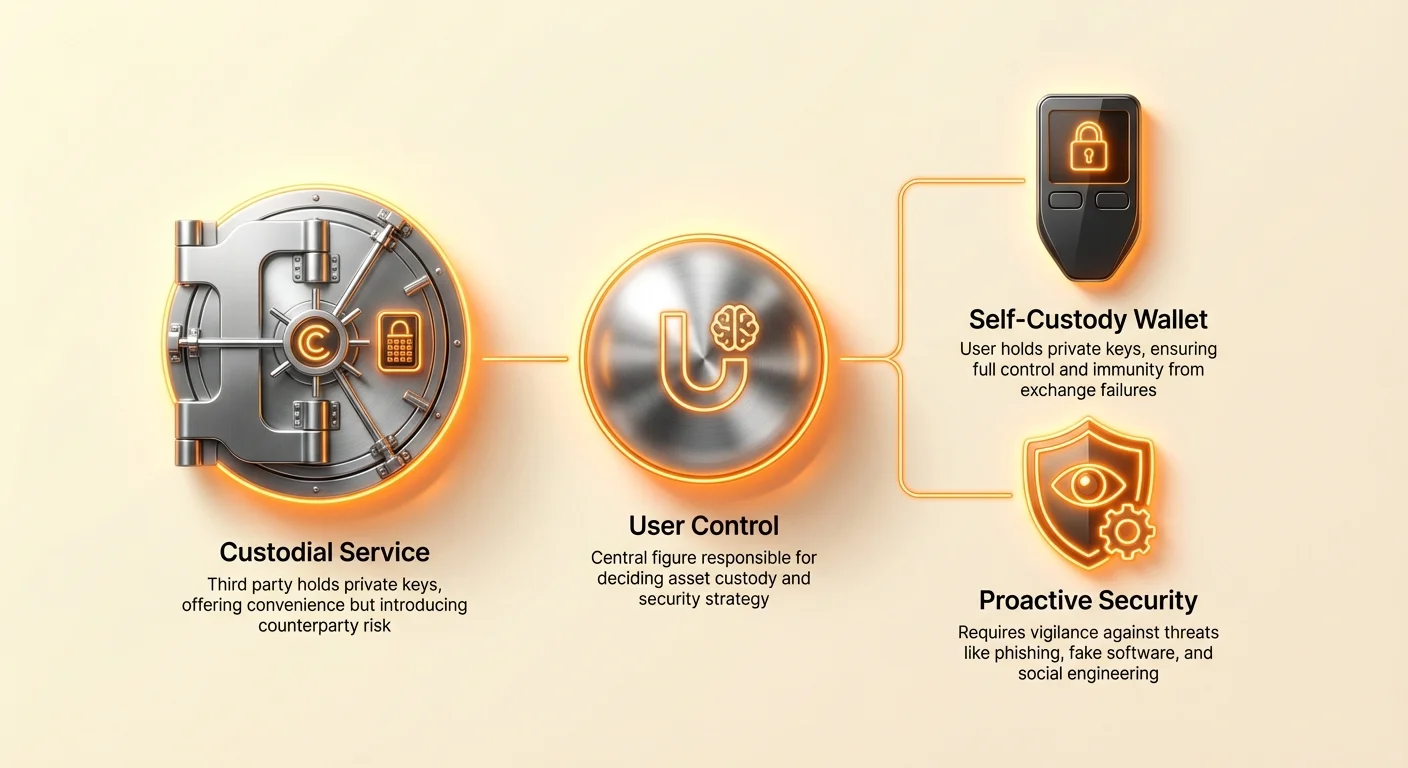
The concept of custody is central to understanding risk in the cryptocurrency ecosystem. Custody refers to who holds the private keys that control the funds. Private keys are cryptographic codes that authorize the movement of assets on the blockchain. If a third party holds these keys, the user is relying on that entity’s security and solvency. If the user holds the keys, they assume full responsibility for the asset's safety.
Custodial Services and Counterparty Risk
Custodial wallets are typically provided by centralized exchanges (CEXs) or brokerage services. When a user buys Bitcoin or other assets on these platforms, the exchange holds the cryptocurrency in its own digital vaults. The user is given a login and a balance display, much like a traditional online bank account. This offers convenience, particularly for newcomers who are uncomfortable managing complex passwords or recovery phrases.
However, this convenience introduces counterparty risk. If the exchange mismanages funds, suffers a security breach, or declares bankruptcy, users may lose access to their holdings. In these scenarios, the user is essentially an unsecured creditor. The history of the crypto industry contains numerous examples of exchanges failing, leaving users with little recourse. Furthermore, custodial services are subject to regulatory pressures. They may be required to freeze accounts or delay withdrawals based on jurisdictional laws or internal fraud detection triggers.
The Self-Custodial Model
Self-custodial wallets, often referred to as non-custodial wallets, eliminate third-party risk by placing the private keys directly in the hands of the user. In this model, the wallet software acts merely as an interface to the blockchain. It does not store the funds itself but manages the keys that allow the user to spend them. Because no central entity controls the keys, no one can freeze the funds or prevent a transaction.
This autonomy provides immunity from exchange insolvencies. Even if the company that built the wallet software disappears, the user can typically restore their funds using their private keys or recovery phrase on different compatible software. This aligns with the ethos of "not your keys, not your bitcoin." However, this freedom means there is no "forgot password" link. If the private keys or recovery phrases are lost, the assets are irretrievable.
Regulatory Verification and Privacy
When using custodial services to convert government-issued currency into cryptocurrency, users encounter Know Your Customer (KYC) and Anti-Money Laundering (AML) regulations. These laws require regulated businesses to collect identity documents, such as passports or driver's licenses, and proof of address. This process is intended to prevent illicit activities like tax evasion or terrorist financing.
While this verification provides a layer of legitimacy to the platform, it also creates a data privacy trade-off. Users must trust the platform to store their personal information securely. In contrast, self-custodial wallets typically do not require identity verification for basic storage and sending functions, offering a higher degree of privacy. Users should be aware that moving funds between a KYC-compliant exchange and a self-custodial wallet creates a link between their real-world identity and their on-chain addresses.
Identifying Malicious Software and Imposters
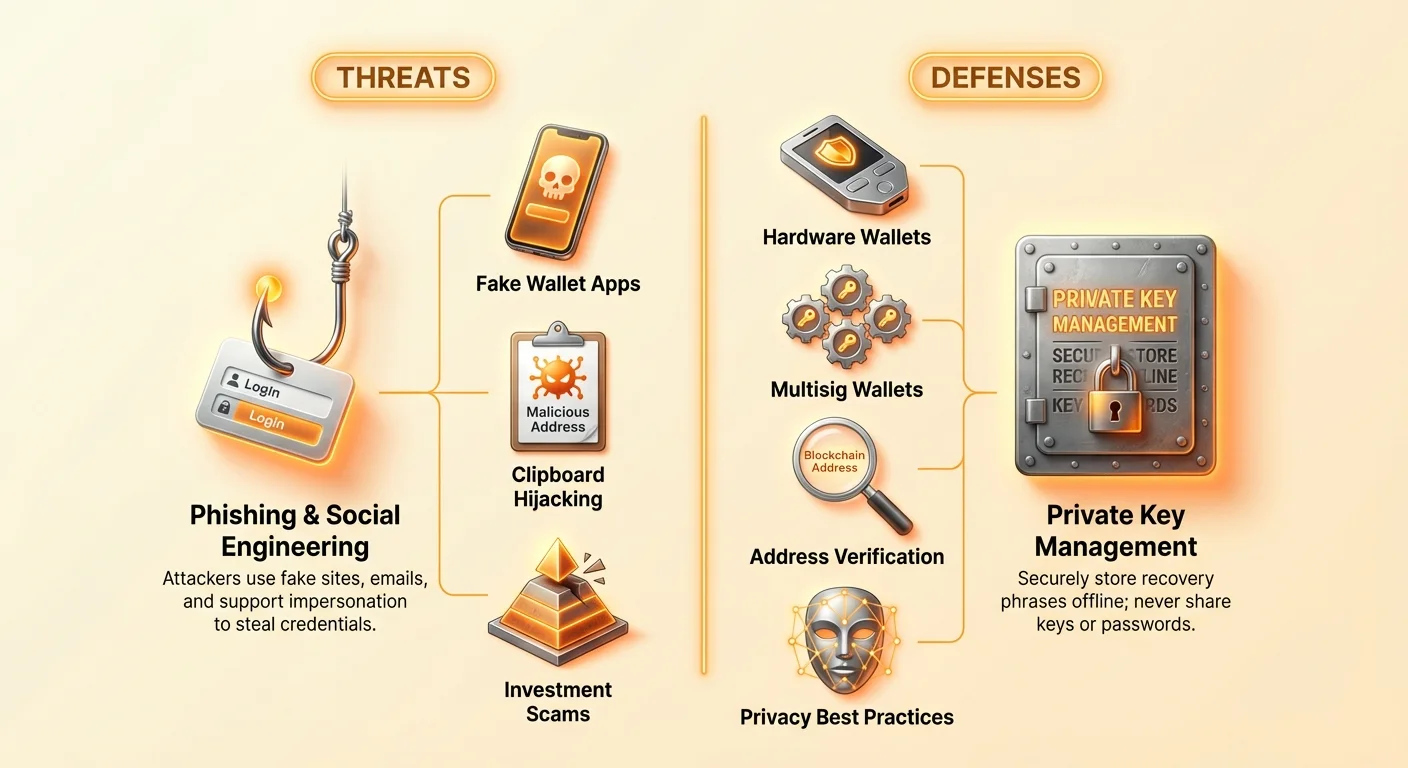
One of the most prevalent vectors for fraud involves the distribution of fake software. Scammers create applications that mimic legitimate wallets or exchanges to steal credentials. These malicious apps often appear in mobile app stores or search engine results, using logos and names that are nearly identical to trusted brands.
Fake Wallet Applications
A fake wallet app may function normally at first, allowing the user to generate an address and receive funds. However, the private keys generated by these apps are often compromised from the start, known to the attacker. Alternatively, the app may simply harvest the user's existing recovery phrase when they attempt to import a legitimate wallet. Once the attacker has the keys or the phrase, they can drain the wallet at any time.
To avoid this, users should always verify the source of the software. Downloading directly from the official website of the wallet provider is safer than searching in an app store. Checking for a secure HTTPS connection on the website is a basic but necessary step. Additionally, reading community reviews on independent forums can help identify flagged applications.
Search Engine Phishing
Attackers frequently purchase advertisement space on search engines for keywords related to popular wallets or exchanges. These ads appear at the top of search results and lead to phishing sites that look exactly like the official service. These sites are designed to capture login credentials or recovery phrases.
Users should avoid clicking on "sponsored" results when searching for financial tools. typing the URL directly into the browser address bar or using bookmarked links significantly reduces the risk of landing on a cloned site. It is also prudent to inspect the URL carefully for subtle misspellings or different domain extensions, a technique known as "typosquatting."
| Feature | Legitimate Wallet | Fake/Phishing Wallet |
|---|---|---|
| Source | Official website or verified app store link | Sponsored ad or unverified link |
| URL | Correct domain (e.g., .com) | Typos or weird extensions (e.g., .net-login) |
| Behavior | Generates keys locally on device | Asks for seed phrase immediately online |
Transactional Mechanics and Fraud Prevention
Sending cryptocurrency involves broadcasting a message to the network signed by a private key. Once this message is included in a block by miners, the transaction is irreversible. Fraudsters exploit this finality by tricking users into sending funds to the wrong destination or by intercepting the transmission process.
Address Verification and Clipboard Hijacking
A Bitcoin address acts as the destination for funds. It is a long string of alphanumeric characters. Because these addresses are complex and case-sensitive, users almost always copy and paste them. Attackers exploit this behavior using clipboard hijacking malware. This malicious software runs in the background of a computer or smartphone and monitors the clipboard for crypto addresses.
A Bitcoin address acts as the destination for funds. It is a long string of alphanumeric characters. Because these addresses are complex and case-sensitive, users almost always copy and paste them. Attackers exploit this behavior using clipboard hijacking malware. This malicious software runs in the background of a computer or smartphone and monitors the clipboard for crypto addresses. When a user copies a legitimate address, the malware instantly replaces it with an address controlled by the attacker. If the user pastes the address without checking, they will send funds to the scammer. To mitigate this, users must verify the entire address, or at least the first and last few characters, before confirming a transaction. Many wallets also support QR code scanning, which reduces the risk of clipboard manipulation, provided the QR code itself has not been tampered with.
Understanding Network Fees
Every transaction on the blockchain requires a network fee. This fee is paid to miners or validators as an incentive to include the transaction in a block. Wallet software typically calculates this fee automatically based on network congestion. High congestion leads to higher fees as users bid for space in the limited block size.
Scammers often exploit confusion regarding fees. A common scam involves a fraudster claiming that a user has received a large sum of money but must pay a "release fee" or "tax" to unlock it. In the self-custodial model, fees are always deducted from the sender's balance. A recipient never needs to pay a fee to receive funds. Any request for a payment to facilitate an incoming transaction is a clear sign of fraud.
The Irreversibility of Errors
Unlike credit card charges, there is no chargeback mechanism in cryptocurrency. If funds are sent to a valid address controlled by a scammer, they cannot be clawed back by the wallet provider or the exchange. This finality applies even to honest mistakes, such as sending Bitcoin to a Bitcoin Cash address or making a typo in the address string.
While some wallets have checksums to prevent sending to invalid addresses, sending to a valid but wrong address is often fatal to the funds. Users should conduct small test transactions when transferring significant amounts. Sending a trivial amount first ensures that the destination is correct and that the recipient has access to the wallet before the bulk of the funds is moved.
Social Engineering and Communication Scams
Social engineering relies on psychological manipulation rather than technical hacking. Attackers seek to gain the victim's trust to persuade them to divulge confidential information or send money voluntarily. These scams are pervasive on social media platforms and communication apps.
Impersonation and Support Scams
A widespread tactic involves scammers posing as customer support agents. When a user posts a question about a technical issue on a public forum like Twitter, Discord, or Telegram, they are often immediately contacted via direct message (DM). The scammer uses a profile picture and name that mimics the official support team.
These imposters will offer to "fix" the issue but will eventually claim that the user needs to "validate" their wallet. They will ask for the user's recovery phrase or ask the user to visit a website where they must enter their keys. Legitimate support teams never ask for passwords, private keys, or recovery phrases. They also rarely initiate contact via direct message. All technical support should be sought through official ticketing systems on the provider's website.
Giveaway and Doubling Schemes
Scammers frequently hijack verified social media accounts or create fake profiles of celebrities and industry leaders. They post messages promising to double any cryptocurrency sent to a specific address. The premise is often framed as a philanthropic giveaway or a celebration of a company milestone.
The logic is simple: "Send 1 BTC, receive 2 BTC back." This is invariably a scam. There is no legitimate investment or giveaway that requires a participant to send money to receive money. These schemes prey on greed and the fear of missing out (FOMO). Regardless of how authentic the profile looks or how many bot accounts are replying with "proof" of receipt, these offers should be ignored and reported.
Phishing Emails
Email phishing remains a dominant threat. Users may receive emails that appear to be from their hardware wallet manufacturer, exchange, or wallet app. These emails often use scare tactics, claiming that an account has been frozen, a password has been reset, or a device is vulnerable to a new security flaw.
The email will contain a call to action, urging the user to click a link to secure their account. This link leads to a fraudulent website designed to steal credentials. Users should treat all crypto-related emails with skepticism. Instead of clicking links, they should navigate to the service's website independently to check for any alerts or notifications.
Advanced Security: Multisig and Backups
For individuals holding significant value, basic wallet security may be insufficient. Advanced storage solutions and rigorous backup protocols provide defense against both external theft and personal error.
Shared Wallets and Multisig
A standard Bitcoin wallet uses a single private key to sign transactions. This creates a single point of failure. If that key is stolen, the thief has total control. If the key is lost, the funds are gone. Multi-signature (multisig) technology addresses this by requiring multiple private keys to authorize a transaction.
In a shared wallet setup, a user might configure a "2-of-3" scheme. This means the wallet has three associated private keys, but any two are required to move funds. These keys can be distributed among different parties (e.g., family members or business partners) or stored in different physical locations by a single user.
This structure mitigates fraud because an attacker would need to compromise multiple devices or locations to steal the funds. It also protects against loss; if one key is destroyed (e.g., in a house fire), the remaining keys can still recover the assets. However, setting up multisig wallets is more complex, and users must ensure they do not lock themselves out by losing more keys than the threshold allows.
Securing the Recovery Phrase
The recovery phrase, or seed phrase, is the master key to a wallet. It is typically a list of 12 to 24 random words generated when a wallet is created. Anyone who possesses this list can regenerate the wallet and access the funds from any device. Therefore, the storage of this phrase is the single most critical security task.
Storing the phrase digitally—such as in a text file, a screenshot, or an email draft—is dangerous. Malware searching for these patterns can easily extract them. The gold standard is offline storage. Writing the phrase on paper or stamping it into metal and storing it in a secure, fireproof location protects it from digital threats.
Some modern wallets offer encrypted cloud backups. In this system, the recovery phrase is encrypted with a strong, custom password before being uploaded to a cloud service. This offers convenience and protection against physical loss of a paper backup. However, it reintroduces a reliance on the cloud provider and the strength of the user's password. Users must weigh the convenience of cloud recovery against the absolute security of offline physical storage.
Peer-to-Peer Trading and Investment Fraud
Peer-to-peer (P2P) marketplaces allow users to trade cryptocurrency directly with one another, bypassing centralized order books. While this offers privacy and a variety of payment methods, it creates an environment ripe for fraud.
Escrow and Reputation
In a P2P trade, one party must send funds before the other. Without a trusted intermediary, the risk of default is high. P2P platforms mitigate this through escrow services. The platform locks the seller's crypto until the buyer confirms payment. Fraudsters attempt to circumvent this by asking to conduct the trade "off-platform" to save on fees.
Once the trade moves off the platform, the protection of escrow is lost. The seller may send the crypto and never receive payment, or the buyer may send payment and never receive the crypto. Users should strictly adhere to the platform's procedures and only trade with users who have a strong reputation history and high completion rates.
Ponzi Schemes and High-Yield Programs
Investment fraud often disguises itself as a high-yield trading program or a new cryptocurrency project. These Ponzi schemes promise guaranteed, consistent daily returns that defy market logic. They claim to use proprietary trading bots or sophisticated arbitrage strategies to generate profit.
In reality, they use funds from new investors to pay "interest" to earlier investors. This creates an illusion of solvency and profitability. Eventually, when recruitment of new victims slows, the scheme collapses, and the operators vanish with the remaining capital. Any project that focuses heavily on recruitment and referral bonuses rather than a clear technical utility or product should be viewed with extreme suspicion.
Privacy Best Practices as Defense
Privacy is not just about secrecy; it is a component of security. The Bitcoin ledger is public, meaning anyone can view the balance and transaction history of any address. If an address is linked to a real-world identity, criminals can target that individual.
Address Reuse
Reusing the same Bitcoin address for multiple transactions consolidates a user's financial history into a single, easily traceable profile. If a user posts a donation address on social media and then uses that same address to receive a large transfer from an exchange, the entire history becomes public.
To mitigate this, users should generate a fresh address for every transaction. Most modern Hierarchical Deterministic (HD) wallets do this automatically. By spreading funds across many addresses, users make it difficult for observers to determine their total net worth, reducing their attractiveness as a target for targeted phishing or physical theft.
UTXO Management
Bitcoin operates on an Unspent Transaction Output (UTXO) model. This is similar to spending cash notes. If a user has a 5 BTC "note" (UTXO) and wants to send 1 BTC, the transaction consumes the entire 5 BTC input. It sends 1 BTC to the recipient and sends 4 BTC back to the sender as "change."
Wallets manage this automatically, but users should be aware of how it affects privacy. If a user combines multiple small UTXOs to make a large purchase, they link the history of all those previous addresses together. Understanding how inputs and outputs function helps users maintain better hygiene over their digital footprint, further insulating them from analysis and potential targeting.
Conclusion
The immutable nature of cryptocurrency transactions demands a rigorous approach to security. Users act as their own banks, a role that confers both freedom and significant responsibility. Protecting assets requires a multi-layered strategy that includes proper private key management, skepticism of unsolicited communications, and verification of software sources. Whether choosing between custodial and self-custodial solutions or navigating peer-to-peer markets, the awareness of counterparty risk is paramount.
Recognizing fraud involves understanding the technical limitations of the network as well as the psychological tactics of scammers. From the finality of blockchain settlements to the transparency of the public ledger, every feature of the technology impacts security strategy. By utilizing tools like hardware wallets, multisig setups, and encrypted backups, individuals can fortify their defenses. Ultimately, the safety of digital assets depends on the user's vigilance and willingness to continuously educate themselves on evolving threats.
Verify every link, secure every key, and trust no one who asks for your credentials.