
The evolution of the cryptocurrency market has moved rapidly beyond simple spot trading. While buying and holding digital assets remains a core strategy for many, the ecosystem has matured to include complex financial instruments. Derivatives, including futures, options, and perpetual contracts, now command significant trading volume. These instruments allow traders to speculate on price movements, hedge against volatility, and utilize leverage to amplify their market exposure. However, the sophistication of these tools introduces a corresponding layer of complexity regarding compliance and reporting.
For traders engaging with advanced financial products, understanding the mechanics of the trade is only half the battle. The regulatory environment surrounding these assets is shifting, and the requirements for accurate reporting are becoming more stringent. Unlike a simple spot purchase where a trader holds an asset in a wallet, derivatives involve contracts, borrowed funds, and continuous settlements. Each of these elements creates specific data points that must be tracked, recorded, and potentially reported to tax authorities depending on the jurisdiction.
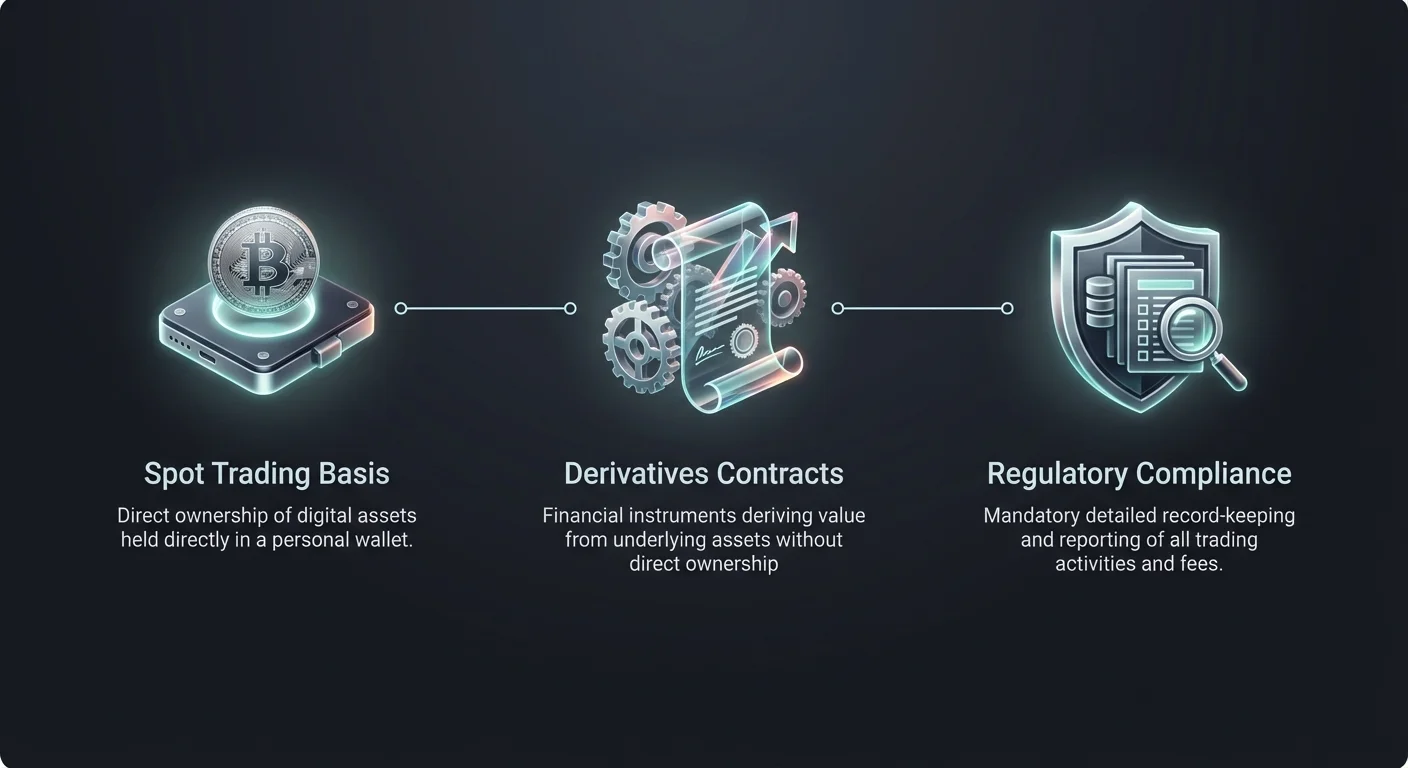
The transition from spot trading to derivatives trading fundamentally changes the nature of the investor's portfolio. It shifts from owning a digital token to holding a contract that derives its value from that token. This distinction is critical. It impacts how profits are realized, how losses are calculated, and how the entire history of the trading activity is viewed by regulators. As the market grows, the scrutiny on these transactions increases, making detailed record-keeping a non-negotiable aspect of advanced crypto trading.
The Mechanics of Derivatives and Value Derivation
A crypto derivative is not the asset itself. It is a financial instrument that derives its value from an underlying cryptocurrency or digital asset. For instance, a contract might track the price of Bitcoin, but holding the contract is not the same as holding Bitcoin in a digital wallet. These are agreements between two or more parties to buy or sell the underlying asset at a specific price or time. This fundamental difference creates the first layer of reporting complexity.
When a trader buys a derivative, they are entering into a contract. The value of this contract fluctuates based on the performance of the underlying asset. In traditional spot markets, the cost basis is simply the price paid for the coin. In derivatives markets, the "price" is often the value of the contract, which may trade at a premium or discount to the spot price. Tracking the entry and exit value of the contract itself, rather than the underlying asset, is essential for accurate profit and loss calculations.
The most common types of derivatives in the crypto space are futures and options. These instruments have been adapted from traditional finance but possess unique characteristics in the digital asset realm. The volatility of the asset class means that the values of these derivatives can swing wildly. This volatility amplifies the importance of precise timestamping and pricing data for every transaction. A discrepancy of a few minutes in reporting a trade execution can result in significantly different value assessments.
Futures Contracts and Settlement Dates
Futures contracts are among the most popular derivative instruments. A futures contract commits two or more parties to buy or sell an asset at a set time in the future at a set price. For example, a trader might purchase a contract that expires on a specific date in August. This agreement binds the trader to the price agreed upon at the initiation of the contract, regardless of the market price when the date arrives.
From a reporting perspective, the expiration date is a critical event. Traditional futures have a definitive end point where the contract is settled. This settlement acts as a clear realization event for profits or losses. The price of the contract usually converges with the spot price of the asset as the expiry date approaches. However, until that date, the contract trades based on market sentiment regarding what the price will be in the future.
Traders must maintain records of the contract's specific series or expiration date. Buying a contract expiring in September is a distinct financial event from buying one expiring in December, even if the underlying asset is the same. Each contract is a separate instrument with its own cost basis and exit proceeds. If a trader holds a contract until expiry, the settlement price determines the final financial outcome. If they sell the contract before expiry, the trade is closed at the market price of the derivative at that moment.
Perpetual Futures: The Reporting Anomaly
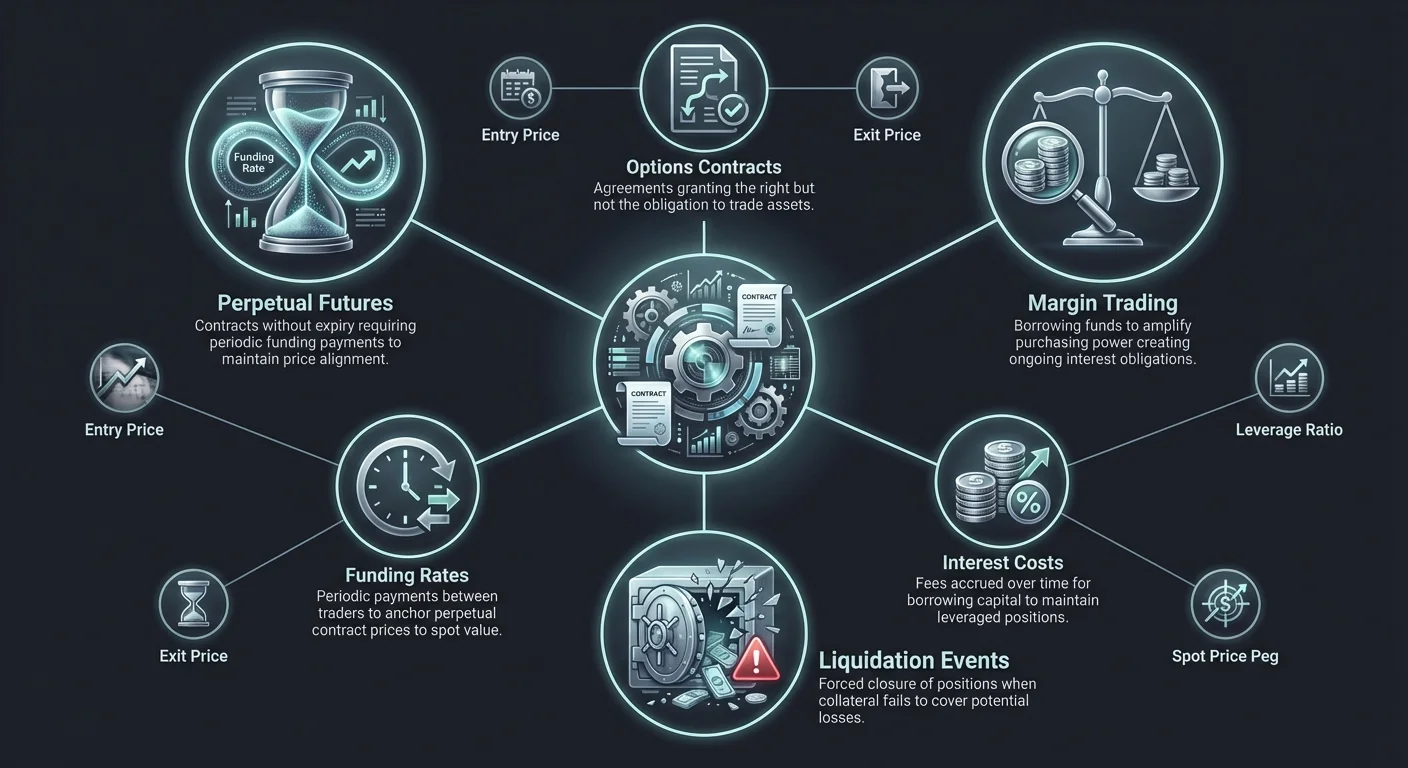
While traditional futures have set expiry dates, the crypto market has popularized a unique instrument known as the "perpetual future" or "perp." As the name implies, these contracts do not have an expiry date. A trader can hold a perpetual position indefinitely, provided they maintain the necessary margin to keep the position open. This lack of a settlement date removes the natural "closing" event found in standard futures, creating a continuous trading environment.
The mechanism that keeps the price of a perpetual contract aligned with the spot price is the "funding rate." This is a periodic payment exchanged between long and short traders. If the contract price is higher than the spot price, long position holders pay short position holders. If the contract price is lower, shorts pay longs. These payments often occur every eight hours. For a trader holding a position for weeks, this results in a massive volume of small financial transactions associated with a single trade.
Data Points for Perpetual Futures Reporting:
| Data Point | Frequency | Description |
|---|---|---|
| Entry Price | Once | The price at which the position was opened. |
| Funding Fees | Periodic | Payments made or received (e.g., every 8 hours). |
| Liquidation Price | Variable | The price level that triggers a forced closure. |
For reporting purposes, funding rates present a significant challenge. These are not capital gains or losses in the traditional sense of selling an asset. They are often treated as operational costs or income streams depending on the direction of the payment. A trader might have a position that is technically profitable on paper based on price movement, but the accumulated funding fees could reduce the net return. Accurately tracking these hundreds of small payments is vital for determining the true net performance of a perpetual position.
Margin Trading and Borrowed Capital
Margin trading involves borrowing funds to increase the size of a trading position. By using leverage, traders can amplify their buying power, controlling a larger amount of cryptocurrency than their actual account balance would allow. This borrowed capital comes from the exchange or other lenders on the platform. While this increases potential profits, it introduces "interest" or "borrowing fees" into the reporting equation.
When a trader opens a margin position, they are effectively taking out a loan. This loan accrues interest, often calculated hourly or daily. These interest charges are a direct cost of doing business. In many financial frameworks, costs directly associated with investment activities affect the calculation of net profit. Therefore, simply recording the buy and sell price of the asset is insufficient. The trader must also tally the total interest paid over the life of the trade to understand their actual financial standing.
The calculation of margin interest varies by platform. Some exchanges deduct it from the account balance automatically, while others add it to the debt ratio of the position. Regulatory compliance requires a clear view of these outflows. A profitable trade where the price of the asset rose significantly might still yield a lower net return if the position was held for a long period with high interest rates. Ignoring these fees leads to an inflated view of trading profits.
Options Trading: Rights vs. Obligations
Options contracts introduce a different set of variables for reporting. Unlike futures, which commit parties to a transaction, options give the buyer the right, but not the obligation, to buy or sell the asset by a certain date at a specified price. The seller of the option, however, remains committed to fulfilling the contract if the buyer chooses to exercise it. This asymmetry distinguishes options from other derivatives.
Key Components of Options Reporting:
- The Premium: The fee paid by the buyer to the seller to purchase the contract. This is an upfront cost that establishes the cost basis of the option itself.
- The Strike Price: The predetermined price at which the asset can be bought or sold.
- Expiration Type: Whether the option is "American" (exercisable at any time before expiry) or "European" (exercisable only on the expiration date).
Reporting for options requires tracking the premium separate from the underlying asset. If an option expires worthless (i.e., the trader chooses not to exercise it), the premium paid represents a realized loss. If the option is exercised, the premium usually becomes part of the cost basis for the acquired asset. The complexity increases with strategies that involve writing (selling) options, where the premium received is immediate income, but the obligation remains open until expiration or exercise.
Shorting Strategies and Asset Borrowing
Shorting is a strategy used to profit from the decline in an asset's price. To execute a short, a trader borrows the cryptocurrency, sells it at the current market price, and intends to buy it back later at a lower price. The difference between the selling price and the repurchase price constitutes the profit. While the concept is straightforward, the reporting involves multiple distinct steps that must be linked.
The process begins with the borrowing event. The trader does not own the asset they are selling; they owe it to the lender. When the asset is sold, cash (or a stablecoin equivalent) is received. This creates a liability (the owed asset) and an asset (the cash). The trade is not closed until the asset is repurchased and returned to the lender. This "closing" of the position is the taxable event in many jurisdictions, as it finalizes the gain or loss.
Short sellers must also account for borrowing fees. Similar to margin trading, holding a short position open requires paying interest to the lender of the assets. These fees can fluctuate based on the demand for the asset. If a specific coin is heavily shorted, borrowing fees can spike. These costs accrue over time and must be deducted from the gross profit of the trade to arrive at the net taxable figure.
Leverage and Liquidation Events
Leverage is a double-edged sword in crypto derivatives. It allows traders to open positions significantly larger than their collateral. For example, with 100x leverage, a small amount of capital can control a massive contract value. While this magnifies gains, it also magnifies losses. The most critical reporting event associated with high leverage is "liquidation."
Leverage is a double-edged sword in crypto derivatives. It allows traders to open positions significantly larger than their collateral. For example, with 100x leverage, a small amount of capital can control a massive contract value. While this magnifies gains, it also magnifies losses. The most critical reporting event associated with high leverage is "liquidation." Liquidation occurs when the market moves against a leveraged position to the point where the trader's collateral is no longer sufficient to cover the potential losses. The exchange forcibly closes the position to prevent the trader from owing more than they deposited.
Traders often view liquidation simply as losing their bet, but legally and financially, it is a transaction. The exchange sold the contract or asset on the trader's behalf at the current market price. Records must reflect the exact price at which the liquidation occurred, not just the fact that the funds are gone. This disposal price determines the magnitude of the loss that can be reported.
The Impact of Exchange Type on Compliance
The type of platform used for trading significantly influences the ease of reporting. Centralized exchanges (CEXs) typically function like traditional stock brokerages. They manage the order book, hold user funds, and facilitate trades internally. Because they act as custodians, they often provide detailed transaction histories, exportable logs, and sometimes even tax-specific reports.
Centralized platforms generally adhere to regulatory standards such as Know Your Customer (KYC) and Anti-Money Laundering (AML) protocols. This compliance framework often forces them to maintain rigorous records of user activity. For a trader, this is beneficial. It ensures that there is a centralized repository of data regarding entry prices, exit prices, fees paid, and funding rates.
Comparison of Reporting Environments:
| Feature | Centralized Exchanges | Decentralized Exchanges (DEX) |
|---|---|---|
| Data Access | Exportable CSVs/APIs often available. | On-chain data; requires block explorers. |
| Identification | KYC required (ID verification). | No KYC; wallet address only. |
| Custody | Exchange holds funds. | User self-custody via private keys. |
Decentralized exchanges (DEXs) operate differently. They use smart contracts to facilitate trading directly between users or against liquidity pools. There is no central authority to issue a monthly statement. Reporting trades from a DEX requires reading blockchain data. Every interaction with a smart contract—approving a token, opening a position, modifying margin—is a transaction. Traders must use specialized software or manually track these on-chain events to ensure their records are complete.
Regulatory Considerations for Advanced Instruments
The regulatory landscape for crypto derivatives is fragmented and evolving. Different jurisdictions view these instruments through different lenses. Some regions ban crypto derivatives entirely for retail investors, citing the high risk of leverage and volatility. Others regulate them heavily, treating them similarly to traditional financial products.
In regions with strict oversight, exchanges must be licensed to offer futures or options. These regulated entities are often required to report user activity directly to tax authorities. Traders using these platforms should assume that their transaction data is visible to regulators. This transparency reduces the room for error in personal reporting.
Conversely, unregulated or "offshore" exchanges may not report directly to local authorities, but this does not absolve the trader of their reporting obligations. Tax laws generally apply to the individual's worldwide income, regardless of where the platform is based. The lack of a formal report from an exchange does not mean the activity is exempt from taxation. It places the burden entirely on the trader to reconstruct their trading history and declare their gains or losses accurately.
Essential Record-Keeping for Compliance
To navigate the complexities of derivatives taxation and regulation, maintaining a robust system of record-keeping is paramount. The "general" advice across the industry is to keep detailed records of all trades. However, for derivatives, "detailed" means more than just dates and amounts. It involves capturing the metadata of every contract interaction.
The essential data points include the specific type of instrument (e.g., perpetual vs. quarterly future), the direction of the trade (long or short), and the leverage applied. Leverage dictates the margin requirements and liquidation thresholds, which explain specific transfers of collateral. Furthermore, fees must be broken down into their specific categories: trading fees (maker/taker), funding fees, margin interest, and liquidation penalties.
Traders should regularly export their transaction history. Relying on an exchange to keep data indefinitely is risky. Platforms can delist tokens, change interfaces, or even cease operations. Having a local backup of all CSV files or API data ensures that the trader retains their financial history regardless of the platform's status. This data is the primary evidence used to calculate capital gains and substantiate any deductions for costs and fees.
Calculating Net Profit and Loss
The ultimate goal of reporting is to arrive at an accurate Net Profit or Loss (PnL) figure. For spot trading, this is often a simple calculation of proceeds minus cost basis. For derivatives, the formula is expanded. Gross profit from winning trades must be adjusted against gross losses from losing trades.
From this figure, the trader must subtract the costs of doing business. This includes the aggregation of all transaction fees and funding payments paid out. Conversely, any funding payments received must be added to the income. Interest paid on margin loans is another deduction from the gross performance.
It is crucial to understand that the tax treatment of these various elements can vary. In some tax codes, capital gains are taxed differently than income. Funding rates, being a continuous stream of payments, might be classified differently than the profit realized from closing a contract. Because of these nuances, raw data organization is the most critical step. Without clean data distinguishing between a "trade profit" and a "funding payment," it is impossible to apply the correct tax treatment to each component.
Contract Trading and CFDs
Contract trading, often referred to as Contracts for Difference (CFDs) in some contexts, allows traders to speculate on price movements without owning the underlying asset. These are purely cash-settled instruments. The trader and the platform agree to exchange the difference in the value of an asset between the time the contract is opened and closed.
From a reporting standpoint, CFDs are often simpler than spot trading in terms of "custody" because the asset never enters a wallet. There are no blockchain network fees or transfer confirmations to track. The entire lifecycle of the trade exists within the internal ledger of the exchange.
However, the leverage inherent in contract trading brings the same reporting risks as other derivatives. High leverage means high risk of rapid liquidation. The data tracking requirements remain stringent: opening time, opening price, closing time, closing price, and overnight financing rates (swap fees). These swap fees are analogous to the funding rates in perpetual futures and represent a carrying cost for the position that must be accounted for.
Binary Options: The All-or-Nothing Instrument
Binary options represent a simplified but high-risk segment of the derivatives market. In a binary option trade, the outcome is binary: either the trader predicts the price movement correctly and receives a fixed payout, or they are incorrect and lose their entire investment. These trades often have very short timeframes, sometimes settling in minutes.
Reporting binary options differs from other derivatives because there is no "closing" decision to be made by the trader once the contract is live. The contract expires automatically with a known outcome. This creates a very clean audit trail of wins and losses. There are no lingering open positions that span tax years if the contracts are short-term.
However, the high frequency of binary options trading can generate a massive volume of transactions. A trader might execute dozens of trades in a single session. Each of these is a taxable event. The challenge here is volume management. Aggregating thousands of small wins and losses to determine a net figure requires automated tools, as manual tracking becomes unfeasible.
The Role of Stablecoins in Derivatives
Most crypto derivatives are settled in stablecoins (like USDT or USDC) or the cryptocurrency itself (inverse contracts). When trading linear contracts settled in stablecoins, the profit or loss is realized in that stable asset. This simplifies reporting slightly, as the value of the stablecoin is generally pegged to a fiat currency.
However, inverse contracts are settled in the volatile asset (e.g., a Bitcoin-margined contract). If a trader earns a profit of 0.1 BTC, the value of that profit in fiat currency depends on the price of Bitcoin at the moment the profit was realized. This adds a layer of currency conversion to the reporting process.
Every time a profit is realized in a cryptocurrency, the fair market value of that crypto at that specific time must be recorded. If the trader then holds that Bitcoin and sells it later, that triggers a second taxable event (capital gains on the Bitcoin itself). Traders must carefully distinguish between the profit from the derivative trade and the subsequent price fluctuation of the collateral currency.
Liquidity and Market Impact on Reporting
Liquidity refers to the ability to buy or sell assets quickly without affecting the price. High liquidity is essential for derivatives trading, as it allows for tight spreads and efficient execution. From a reporting perspective, high liquidity markets generally produce "cleaner" data. Orders are filled at predictable prices, and slippage is minimized.
In low liquidity markets, a large order might be filled at multiple different prices as it eats through the order book. A single "trade" in the user's mind might be broken down into twenty separate partial fills in the exchange's export data. Reporting software must be able to aggregate these partial fills into a single logical transaction to calculate the cost basis accurately.
Furthermore, liquidity impacts the borrowing fees for shorting and margin. In illiquid markets, the cost to borrow assets can fluctuate wildly. These variable costs add complexity to the "cost of carry" calculations that traders must perform to determine their net profitability.
Hedging and Strategic Reporting
Many advanced traders use derivatives for hedging—protecting an existing portfolio against downside risk. For example, a trader holding Bitcoin might open a short position to offset potential losses during a bear market. While this is a single strategic move, reporting frameworks often view the spot holding and the short position as separate entities.
Gains on the short position might be taxed, even if the value of the spot holding dropped by an equal amount. The "constructive sale" rule is a concept in some tax jurisdictions that prevents traders from locking in gains without paying taxes by hedging a position they already own. While the sources provided do not detail specific tax codes, the general requirement to keep detailed records implies that traders must be able to demonstrate which positions were speculative and which were hedges.
Clear documentation of trading intent and strategy can be valuable. Segregating hedging activities into different sub-accounts or using specific instruments for specific purposes can help clarify the trading history when reviewing records for compliance.
Audit Trails and Verification
In the event of an inquiry by tax authorities or regulators, the burden of proof lies with the trader. An audit trail is the sequence of documentation that validates a financial history. For crypto derivatives, the audit trail consists of the raw data exported from exchanges and the wallet signatures from on-chain transactions.
A robust audit trail connects the movement of funds from a bank account to an exchange, the subsequent trading activity (including all derivatives transactions), and the eventual withdrawal of funds. Any gaps in this chain can lead to scrutiny. For example, if a trader deposits a large sum into a derivatives platform but cannot show the source of those funds or the previous trading activity that generated them, it raises red flags regarding anti-money laundering compliance.
Traders should maintain a repository of all deposit and withdrawal hashes, trade IDs, and monthly statements. This digital paper trail is the primary defense against discrepancies in reporting.
Conclusion
The landscape of cryptocurrency derivatives offers traders powerful tools for managing risk and speculating on market movements. From perpetual futures with their unique funding mechanisms to options contracts that separate rights from obligations, these instruments provide flexibility that goes far beyond simple spot trading. However, this flexibility is accompanied by a significant responsibility regarding data management and reporting. The intricate mechanics of leverage, margin interest, and continuous settlement create a dense web of financial events that must be untangled for compliance purposes.
As regulatory frameworks around the world tighten, the "wild west" era of crypto trading is transitioning into a more structured financial environment. Traders can no longer rely on obscurity or the complexity of the technology to bypass reporting requirements. The integration of Know Your Customer (KYC) protocols on centralized platforms and the increasing sophistication of blockchain analysis tools mean that trading activity is more transparent than ever. Accurate, detailed record-keeping is not just a recommendation; it is a fundamental requirement for participating in these advanced markets.
Success in derivatives trading is measured not just by the profit on the screen, but by the net return after all fees, costs, and liabilities are accounted for. By understanding the specific reporting triggers of each instrument—whether it be a liquidation event, a funding fee, or an option premium—traders can ensure that their financial house is in order. Navigating the taxation and regulation of these advanced instruments requires diligence, but it is the necessary foundation for a sustainable and compliant trading strategy.
Accurate reporting requires tracking every fee, funding rate, and liquidation event, not just the final profit.