
Most people entering the cryptocurrency space for the first time harbor a fundamental misconception about how digital assets work. They often believe that a "wallet" is a digital storage container where their coins reside, much like a physical wallet holds paper cash or plastic cards. In reality, a cryptocurrency wallet does not store any money at all. The coins themselves exist exclusively as unalterable records on the public blockchain ledger.
The software or hardware device you call a wallet is actually a key manager. Its primary function is to store and protect the cryptographic credentials that prove your ownership of specific transaction outputs on that ledger. These credentials allow you to propose updates to the ledger, effectively letting you "spend" your balance by reassigning it to someone else.
Understanding this distinction is the first step toward true financial sovereignty. When you realize that your wealth is defined by data rather than physical possession, the importance of data security becomes paramount. You are not guarding a pile of digital gold; you are guarding the secret codes that authorize the movement of that gold.
If you lose access to the device running your wallet software, your funds are not necessarily lost. Because the money is on the global network, you can regain access from any device in the world, provided you possess the correct recovery information. Conversely, if you lose that recovery information, the funds remain on the ledger forever, locked away with no possibility of retrieval.
The Architecture of Ownership
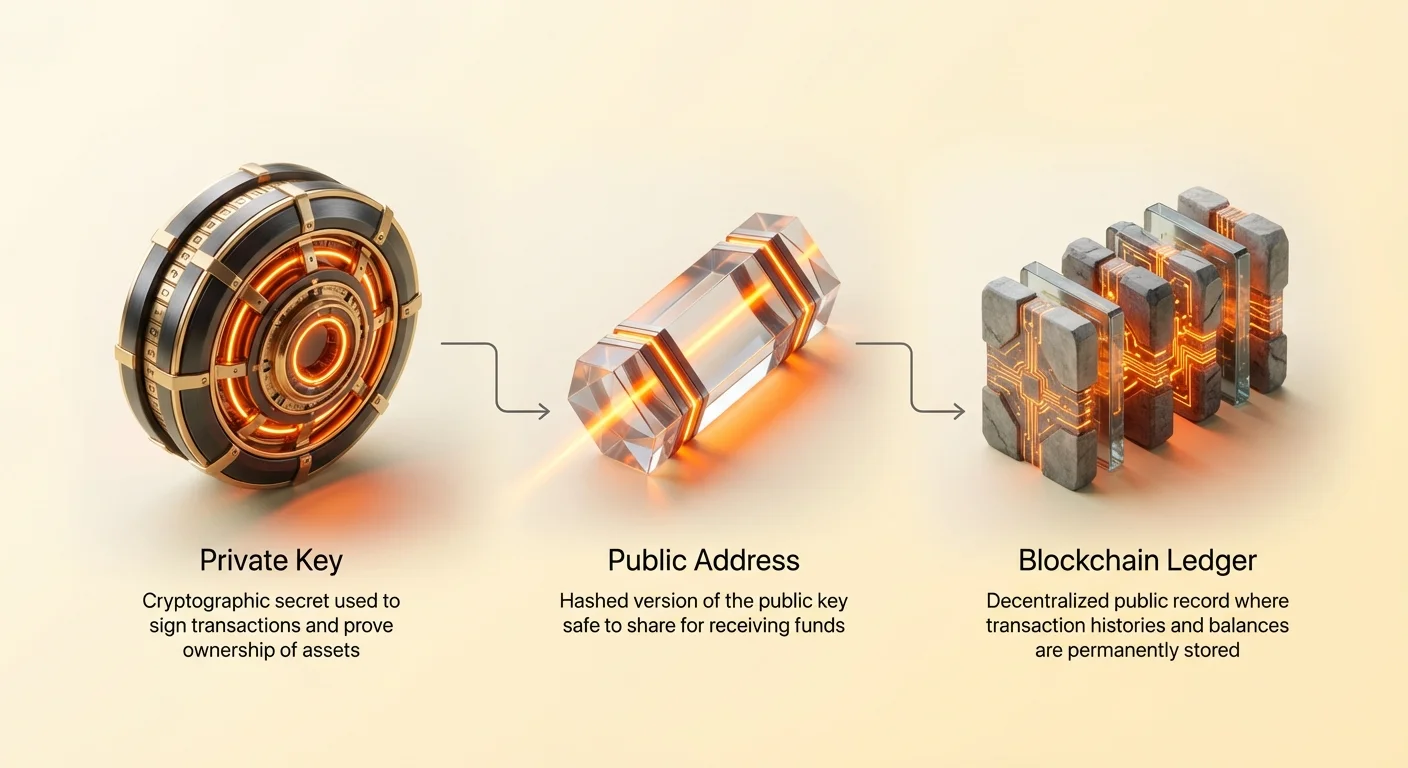
At the core of every cryptocurrency transaction lies a sophisticated system of cryptography known as Public Key Cryptography (PKC). This system uses a pair of mathematically linked keys to ensure security and ownership. This pair consists of a private key and a public key. While they are generated together and share a mathematical relationship, they serve completely different functions within the ecosystem.
The Role of the Private Key
The private key is the most critical piece of data in the entire cryptocurrency ecosystem. It is essentially a randomly generated number of immense size, typically 256 bits long. To visualize the complexity, imagine flipping a coin 256 times in a row and recording the sequence of heads and tails. The resulting combination is so unique that it is statistically impossible for another person to generate the same sequence by chance.
This secret number acts as the master control for your funds. It is used to sign transactions, providing mathematical proof that you have the right to spend the coins associated with a specific address. Crucially, the private key must remain completely secret. If anyone else gains access to this number, they can sign transactions on your behalf and drain your funds immediately.
The Function of the Public Key
The public key is derived directly from the private key using complex mathematical operations, such as Elliptic Curve Multiplication. This process is a "one-way function," meaning it is easy to compute the public key if you have the private key, but it is impossible to reverse the process to figure out the private key using only the public key.
This one-way street is what makes cryptocurrency safe. You can share your public key with the world without fear that your private key will be compromised. In practice, the public key is further processed and hashed to create your "address," which is the string of characters you give to others so they can send you money. The public key verifies that a transaction signature was created by the corresponding private key, without ever needing to see the private key itself. Anatomy of a Bitcoin Address.
The Seed Phrase Solution
In the early days of Bitcoin, users had to manage their raw private keys or back up complex digital files. This was cumbersome and prone to error, as copying a string of 64 hexadecimal characters manually is difficult and a single typo could result in total loss of funds. To solve this human usability problem, the industry adopted a standard known as BIP39.
From Math to Language
The solution introduced the concept of a recovery phrase, often called a seed phrase or secret passphrase. This mechanism takes the complex binary data of your private key and converts it into a readable series of words, typically 12, 18, or 24 words chosen from a specific list of 2,048 common dictionary words.
This format is designed specifically for human reliability. It is much easier for a person to write down, read, and type "apple river ghost" than it is to handle a string like "x8r5t9..." The words effectively represent the underlying cryptographic data in a format that reduces the likelihood of transcription errors.
The Master Key Concept
Most modern wallets are "Hierarchical Deterministic" (HD) wallets. This means your single seed phrase acts as a master root key. From this one root, the wallet can deterministically generate millions of different private and public key pairs for various cryptocurrencies.
This is why you only need to back up one set of words to protect your Bitcoin, Ethereum, and other assets simultaneously. Even though these networks are completely different, the mathematical logic used to derive keys from the master seed remains consistent. If you lose your phone or computer, you simply input those 12 or 24 words into a new wallet device. The software runs the derivation math again and re-discovers all your keys and balances exactly as they were.
How Digital Signatures Work
When you decide to send cryptocurrency to a friend, you are not actually sending a file across the internet. Instead, you are broadcasting a message to the entire network that says, "I authorize the movement of X amount from my address to this new address." For the network to accept this message as valid, it must be digitally signed.
The Signing Process
The digital signature is created by combining your transaction message with your private key. This mathematical operation produces a unique string of data—the signature—that is attached to the transaction. Because the signature depends on the specific details of the transaction message, it cannot be copied and used for a different transaction.
If someone tried to change the amount or the recipient address after you signed the message, the signature would no longer match the data, and the network would reject the transaction as invalid. This ensures that once you authorize a payment, the details cannot be tampered with during transmission.
Verification Without Exposure
The magic of this system lies in the verification process. Network participants (miners or validators) use your public key to check the validity of the signature. The mathematics allow them to confirm with 100% certainty that the signature could only have been created by the owner of the corresponding private key.
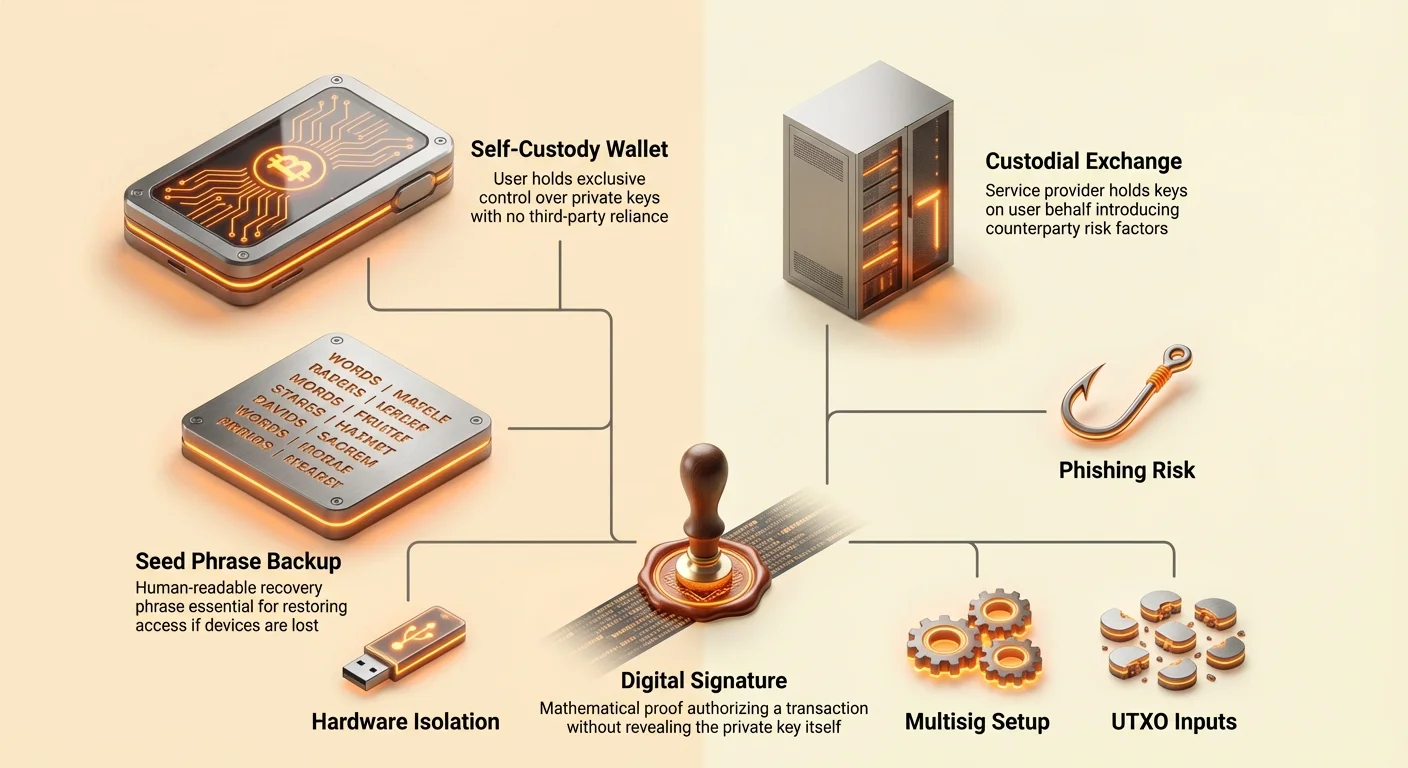
Crucially, this verification happens without you ever revealing the private key itself. You prove you know the secret number without showing the secret number. This allows you to interact with an untrusted public network safely. Even if malicious actors are watching the network traffic, they only see the signature and the public key, neither of which allows them to reverse-engineer your private authorization credentials.
Address Formats and Evolution
While your address is derived from your public key, it is not the public key itself. It is a hashed version designed for error checking and ease of use. Over time, the structure of Bitcoin addresses has evolved to support new features and improve efficiency. Understanding these formats helps you identify valid destinations and can even impact the transaction fees you pay.
| Address Format | Prefix | Characteristics |
|---|---|---|
| Legacy (P2PKH) | Starts with "1" | The original format. larger transaction sizes, higher fees. Case-sensitive. |
| SegWit (P2SH) | Starts with "3" | Compatible with older and newer wallets. improved efficiency over legacy. |
| Native SegWit (Bech32) | Starts with "bc1q" | Lower fees due to smaller data size. Not case-sensitive (easier to type). |
Legacy vs. Modern Standards
Legacy addresses are the original style used by Bitcoin. While they still work, they are less efficient in terms of data usage. Because space on the Bitcoin blockchain is limited and fees are calculated based on the data size of a transaction, using Legacy addresses can be more expensive during times of network congestion.
Segregated Witness (SegWit) was an upgrade designed to fix various issues and reduce the data size of transactions. Addresses starting with "3" (Nested SegWit) or "bc1" (Native SegWit) allow for cheaper cheaper transactions. Native SegWit addresses, also known as Bech32, are particularly user-friendly because they use only lowercase letters, eliminating potential confusion between similar characters like capital "O" and the number "0".
Privacy and Address Reuse
A common best practice in cryptocurrency is to never reuse an address. While it is technically possible to receive multiple payments to the same address, doing so degrades your privacy. Because the ledger is public, anyone who knows your address can look it up on a block explorer and see every transaction associated with it.
Modern HD wallets handle this automatically by generating a fresh public address for every new transaction you receive. All these addresses are still linked to your single master seed phrase, so the funds all arrive in your wallet interface seamlessly. However to an outside observer looking at the blockchain, the funds appear to be scattered across unconnected addresses, significantly complicating any attempt to track your total wealth or financial history.
Wallet Custody Models
The question of who controls the private keys determines the type of wallet you are using. This distinction is often summarized by the popular maxim: "Not your keys, not your coins." Understanding the difference between custodial and self-custodial models is essential for risk management.
The Custodial Trade-Off
Custodial wallets are typically provided by centralized exchanges or brokerage services. In this model, the service provider holds the private keys on their servers. When you log in with a username and password, you are viewing a balance that the company owes you, much like a traditional bank account.
The advantage of this model is convenience. If you lose your password, the company can reset it for you. However, the risks are significant. Because you do not possess the private keys, you must ask for permission to withdraw your funds. The provider can freeze your account, delay your transactions, or impose withdrawal limits. Furthermore, if the exchange is hacked or goes bankrupt, your funds may disappear entirely, leaving you as an unsecured creditor in a lengthy legal process.
The Self-Custody Standard
Self-custodial (or non-custodial) wallets give you exclusive control over your private keys. The software resides on your device, and the keys are encrypted locally. No third party, including the wallet developer, has access to your funds. This model grants you immunity from exchange hacks, bankruptcies, or arbitrary account freezes.
With this power comes absolute responsibility. There is no "forgot password" button in self-custody. If you lose your seed phrase, there is no customer support team that can recover it for you. You are acting as your own bank. For many, this independence is the primary value proposition of cryptocurrency, but it requires a disciplined approach to key management and backup security.
Advanced Security with Multisig
For individuals holding significant amounts of value, or for organizations managing a treasury, a single private key represents a single point of failure. If that one key is stolen or lost, the funds are compromised. To address this, the Bitcoin protocol supports Multisignature (Multisig) wallets.
Shared Control Mechanisms
A multisig wallet is strictly defined by a set of rules that requires digital signatures from multiple private keys to authorize a transaction. This is often described as an "M-of-N" setup, where N is the total number of keys created, and M is the number of signatures required to spend the funds.
For example, a "2-of-3" multisig wallet might be created for a family business. Three keys are generated: one held by the father, one by the mother, and one stored in a secure office safe. To move funds, at least two of these keys must sign the transaction. The father cannot spend the money alone; he must have the cooperation of either the mother or access to the safe.
Eliminating Failure Points
This structure dramatically increases security. An attacker would need to compromise two separate locations or devices simultaneously to steal the funds, which is significantly harder than stealing a single phone or seed phrase.
It also provides redundancy against loss. In the 2-of-3 example, if the office safe is destroyed in a fire, the funds are not lost. The father and mother can still combine their keys to move the funds to a new wallet. This resilience makes multisig the gold standard for institutional custody and high-net-worth individuals who need to eliminate the risk of a single physical disaster or theft wiping out their wiping out their assets.
Backup and Restoration Strategies
Since your seed phrase is the only way to recover a lost wallet, how you store it is the most critical security decision you will make. A digital asset is only as secure as its analog backup.
Manual Storage Methods
The most common method is writing the 12 or 24 words on a piece of paper. This keeps the keys offline, often referred to as "cold storage," ensuring hackers cannot access them via the internet. However, paper is fragile. It is susceptible to water damage, fire, and physical decay over time.
To mitigate physical risks, many users upgrade to metal backup solutions. These are stainless steel or titanium plates where the seed words are engraved or stamped. Metal plates are fireproof, waterproof, and corrosion-resistant, ensuring that your backup can survive extreme physical disasters that would destroy a paper note or an electronic device.
Encrypted Cloud Options
Some modern wallets offer a hybrid approach known as automated cloud backup. In this system, the wallet app encrypts the seed phrase on your device using a strong, custom password that only you know. This encrypted file is then stored in your personal cloud storage (like Google Drive or iCloud).
This offers a balance between security and convenience. If you lose your phone, you can restore your wallet by logging into your cloud account and inputting your decryption password. It is safer than storing a plain text file because the cloud provider cannot read the data without your password. However, it does introduce a potential attack vector if your cloud account is compromised and your decryption password is weak. Users must weigh this convenience against the absolute security of offline physical media.
Transaction Mechanics: The UTXO Model
To fully grasp how your private key "spends" money, it helps to understand the underlying accounting method used by Bitcoin, known as the Unspent Transaction Output (UTXO) model. Unlike a bank account that simply tracks a total balance, the blockchain tracks individual chunks of digital value.
Digital Change
When you receive bitcoin, you receive a specific "output" from a previous transaction. Imagine these outputs as digital banknotes of varying denominations. If you receive 0.5 BTC, you have a specific 0.5 BTC "coin" in your wallet. If you later receive 0.3 BTC, you now have two separate coins (UTXOs) totaling 0.8 BTC.
When you want to spend 0.6 BTC, your wallet must select distinct UTXOs to cover the amount. It might grab the 0.5 coin and the 0.3 coin to create a total input of 0.8 BTC. The wallet then creates two new outputs: 0.6 BTC going to the recipient, and 0.2 BTC coming back to you as "change." This is exactly how paying with cash works—you hand over a large bill and get smaller bills back.
Signing Inputs
Your private key is what authorizes the unlocking of these specific UTXOs. Each input in a transaction must be individually signed to prove you own that specific chunk of bitcoin. This is why transaction fees can fluctuate based on complexity.
If your 1 BTC balance is made up of one hundred tiny 0.01 BTC inputs (perhaps from mining or small payments), your wallet has to sign one hundred separate items to send that full bitcoin. This creates a large data file, which requires more space on the blockchain, resulting in a higher network fee. Conversely, if your 1 BTC is a single UTXO, the transaction is small and simple, requiring only one signature and incurring a minimal fee.
Security Best Practices
Securing your private keys requires vigilance and an understanding of common attack vectors. The irreversible nature of cryptocurrency transactions means there is no safety net if mistakes are made.
Avoiding Phishing Attacks
The most common way people lose their crypto is not through sophisticated hacking of the blockchain, but through social engineering. Phishing scams involve attackers pretending to be support agents, wallet developers, or trusted exchanges. They will contact you via email, social media, or fake websites and ask for your seed phrase to "verify your wallet" or "fix a transaction."
You must understand that no legitimate company or support agent will ever ask for your seed phrase. The seed phrase is for your eyes only. If you enter it into a website or give it to a person, you should consider those funds stolen. Always verify that you are using the official version of a wallet app and double-check URLs to ensure you haven't landed on a malicious copycat site.
Hardware Wallet Isolation
For amounts of money that you cannot afford to lose, software wallets on general-purpose devices (like smartphones or laptops) may not offer sufficient security. These devices are constantly connected to the internet and can be infected with malware or keyloggers that record your screen or keystrokes.
Hardware wallets mitigate this risk by generating and storing private keys on a dedicated physical device that never connects directly to the internet. When you want to make a transaction, the unsigned transaction is sent to the hardware device. You confirm the details on the device's small screen, and it signs the transaction internally. Only the safe, signed transaction is sent back to the computer to be broadcast. This ensures that even if your computer is completely infected with viruses, your private keys remain isolated and isolated and secure.
Conclusion
The world of cryptocurrency shifts the paradigm of financial responsibility from institutions to individuals. By understanding the relationship between private keys, public keys, and addresses, you gain the ability to truly own your assets without reliance on intermediaries. The seed phrase serves as the bridge between complex cryptography and human usability, acting as the ultimate fail-safe for your digital wealth.
Custody models and security practices are not just technical details; they are the defining features of your financial sovereignty. Whether you choose the convenience of a mobile wallet or the fortified security of a multisig hardware setup, the underlying principles remain the same. Your keys are your authorization, and your digital signatures are your commands to the network. Treating these elements with the security they demand is the price of admission for financial freedom.
When you control the keys, you control the money; safeguard your seed phrase as if it were the assets themselves, because it is.