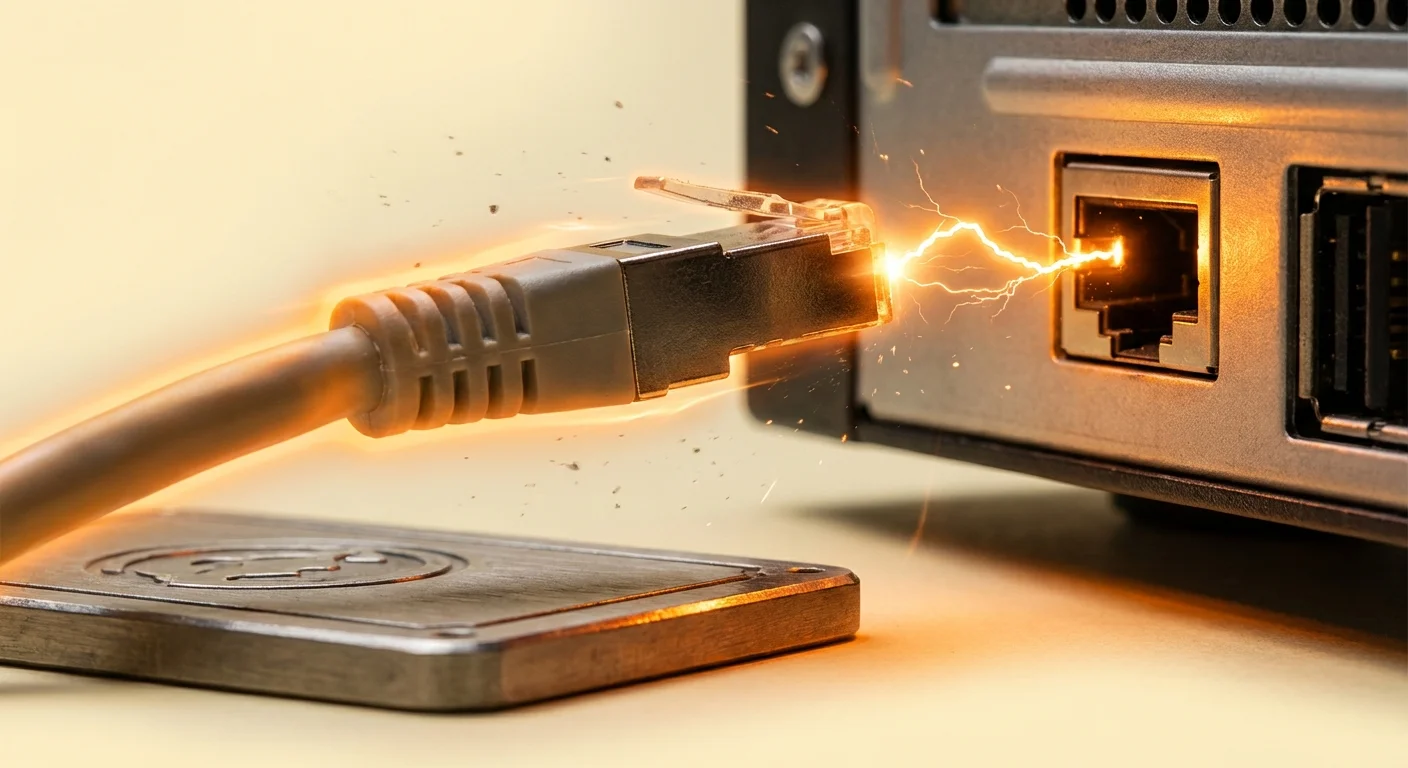
The foundation of cryptocurrency lies in the concept of self-custody. Unlike traditional banking where a third party guards your assets, digital currency empowers individuals to act as their own vault. This responsibility hinges entirely on the management of cryptographic keys. If you control the keys, you control the funds. If those keys are exposed to the internet, they become vulnerable to theft, hacking, and unauthorized access.
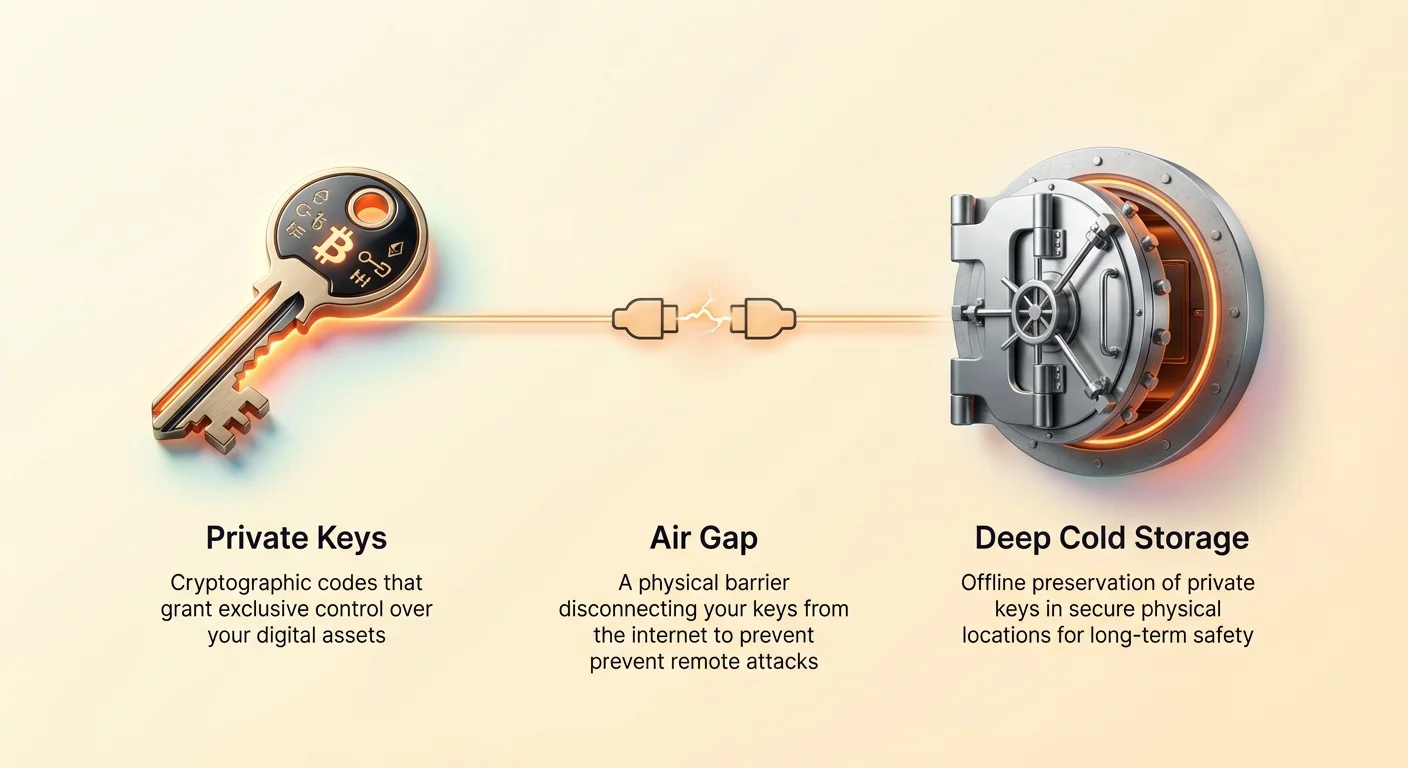
Deep cold storage represents the highest tier of asset security available to individual investors. It involves generating and storing private keys in an environment that is completely disconnected from the internet. By maintaining an "air gap" between your keys and the digital world, you eliminate remote attack vectors. The most traditional and durable form of this method is the paper wallet, though modern variations include metal seed storage and dedicated hardware solutions.
This approach is not designed for daily trading or frequent transactions. It serves the purpose of a long-term savings account or a digital vault. The primary goal is preservation. When executed correctly, deep cold storage ensures that your wealth remains inaccessible to anyone but you, regardless of the state of the internet or centralized exchanges.
The Mechanics of Offline Storage
At its core, a cryptocurrency wallet does not actually store coins. Instead, it stores the private key required to sign transactions and move funds on the blockchain. A cold storage strategy focuses solely on how this private key is generated and preserved. In a hot wallet, the key lives on a connected device like a smartphone or laptop. In cold storage, the key resides on a physical medium.
The distinction between a public key and a private key is critical here. The public key serves as your receiving address. You can share this freely, print it on business cards, or post it online. It allows others to deposit funds into your vault. The private key is the mathematical equivalent of a password and a physical key combined. It must never be shared or typed into an online device until the moment you are ready to sweep the funds.
Paper wallets operate by printing both keys onto a physical sheet. This document contains the public address for depositing funds and the private key for redeeming them. Because the generation happens offline, the private key never exists in a digital format that a hacker could intercept. It bypasses malware, keyloggers, and phishing sites entirely.
Establishing a Secure Environment
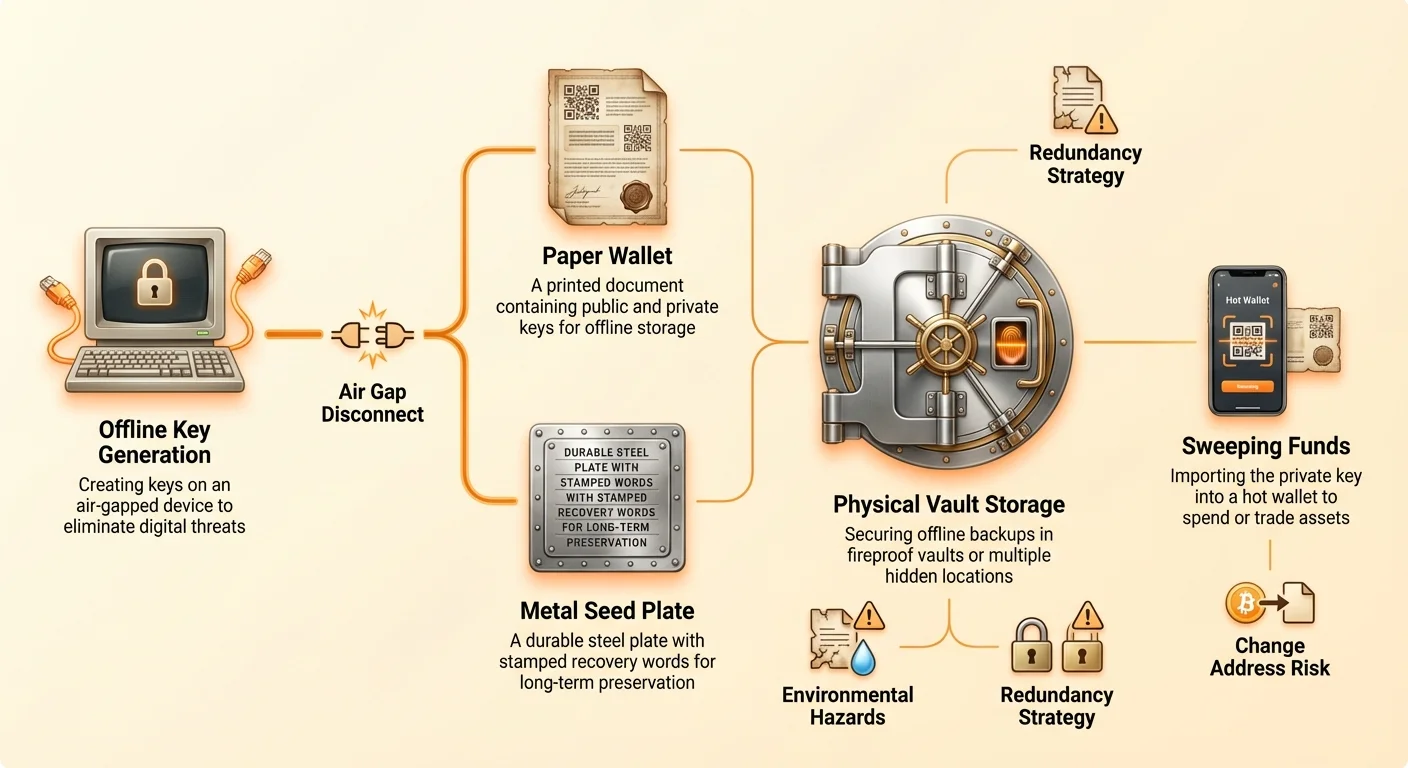
Creating a paper wallet requires a strict adherence to protocol to ensure the "cold" status of the keys. The process begins with selecting a trusted wallet generator. Sources recommend downloading the generator software or saving the webpage as an HTML file to your local computer. This step is preparatory and does not generate the keys yet.
Once the software is saved, you must disconnect your computer from the internet. This creates the necessary air gap. Disable Wi-Fi, unplug ethernet cables, and turn off Bluetooth. In this offline state, you run the generator to create a new public/private key pair. Because the machine is offline, no data transmission can occur.
After the keys are generated, they should be printed using a printer that is directly connected to the computer via a cable. Wireless printing introduces a potential vulnerability, as the data travels over a local network. Once the document is printed, you must clear the printer's memory and reboot the computer before reconnecting to the internet. This ensures no residual data remains in the cache.
| Feature | Hot Wallet | Cold/Paper Wallet |
|---|---|---|
| Connectivity | Always Online | Fully Offline |
| Security Risk | Malware, Phishing, Hacking | Physical Theft, Damage |
| Convenience | Instant Transactions | Slow Retrieval |
| Cost | Free (Software) | Free (Paper) or Hardware Cost |
Physical Preservation Strategies
Once a paper wallet is created, the threat vector shifts from digital to physical. A piece of paper is fragile. It is susceptible to water damage, fire, fading ink, and simple wear and tear. To mitigate these risks, you must treat the paper wallet as a bearer instrument of significant value.
Lamination is a common first step. Sealing the paper in plastic protects it from moisture and prevents the ink from smearing or fading over time. However, one must be careful with heat lamination if the keys were printed using thermal paper, as the heat could turn the paper black and destroy the data. Using high-quality, acid-free paper and a laser printer is recommended for longevity.
Redundancy is another pillar of physical security. Having a single copy of your private key creates a single point of failure. If that one piece of paper burns in a house fire, the funds are lost forever. A robust strategy involves creating multiple copies of the paper wallet and storing them in geographically separate locations.
Secure Storage Locations
The location of your backups dictates the safety of your funds. A home safe is a standard option, ideally one rated for fire resistance. However, relying solely on a home safe leaves you vulnerable to burglary or coercion.
Bank safety deposit boxes offer a high level of physical security and environmental control. Placing a copy of your paper wallet in a deposit box adds a layer of institutional protection without giving the bank access to your funds, as they do not hold the key itself, only the sealed paper.
For those avoiding third-party institutions entirely, hiding copies in trusted secondary locations, such as a family member's home or a buried weatherproof container, is a viable alternative. The goal is to ensure that the destruction of one location does not result in the total loss of assets.
The Role of Seed Phrases
While paper wallets store a raw private key, modern hardware wallets use a different standard known as a seed phrase. This is a sequence of 12 to 24 random words that generates the master private key for a wallet. This method is functionally similar to a paper wallet when it comes to backups.
You should write down the seed phrase on paper or stamp it into metal. Storing a seed phrase requires the same rigor as storing a raw private key. It must never be typed into a computer, taken a photo of, or saved in a cloud storage service. The only place this phrase should exist is on the physical medium you have chosen.
Metal backups offer superior durability compared to paper. Steel plates designed to hold seed phrases are fireproof, waterproof, and corrosion-resistant. They can withstand house fires and floods that would destroy a laminated piece of paper. For deep cold storage of significant amounts, upgrading from paper to metal is a logical investment in longevity.
Executing the Transfer to Cold Storage
Moving funds into cold storage is the easiest part of the process. Since the public address is safe to share, you can verify it using any block explorer. You simply send a transaction from your exchange account or hot wallet to the public address displayed on your paper wallet or hardware device.
It is advisable to perform a test transaction first. Send a small amount of cryptocurrency to the cold storage address. Verify that it has arrived on the blockchain. Once confirmed, you can proceed with transferring the bulk of your holdings. This confirmation step prevents catastrophic errors, such as sending funds to a mistyped address or a wallet that was generated incorrectly.
Once the funds are sent, the paper wallet requires no maintenance. It does not need to be updated, charged, or connected to a network. The blockchain records the balance associated with that address indefinitely. As long as you possess the private key, the funds are yours.
Risks of Non-Digital Backups
While offline storage removes digital threats, it introduces human error risks. The most common issue is the loss of the physical backup. If you misplace the paper or metal plate, and there are no other copies, the mathematics of cryptography ensure that no one can recover the funds for you. There is no "forgot password" feature in self-custody.
Another risk is physical theft. Anyone who finds your paper wallet or seed phrase has immediate, unrestricted access to your funds. They can import the key and sweep the balance in minutes. This is why concealment and obfuscation are just as important as durability. Some users utilize "tamper-evident" bags to store their keys, so they can know immediately if someone has accessed their secure storage.
Printer caching is a subtle technical risk. Some modern printers have internal hard drives that store recent print jobs. If you sell the printer or if it is compromised, a sophisticated attacker could theoretically recover the image of your private key. Using a "dumb" printer without internal storage or ensuring a factory reset after printing mitigates this.
Redeeming Funds from Paper Wallets
When the time comes to spend or sell your assets, you must bring the cold funds back into the hot environment. This process is known as "sweeping" or "importing." You will need a software wallet or mobile app that supports private key importation.
To redeem, you open your hot wallet app and select the option to add a wallet or import a key. You will then be prompted to scan the QR code of the private key on your paper wallet or type in the alphanumeric string. Once validated, the software wallet gains control over the funds.
Crucially, once you have imported a private key to a hot wallet, that paper wallet is no longer "cold." The key has touched the internet. It is now subject to the same risks as any other hot wallet. Therefore, you should never reuse a paper wallet after it has been swept.
The "Change Address" Complication
A critical technical detail regarding paper wallets is how Bitcoin handles change. When you send a transaction from a Bitcoin address, the entire balance of that address is moved. The amount you intended to pay goes to the recipient, and the remainder is sent back to a "change address."
If you import a paper wallet and spend only a fraction of the funds, the protocol might send the remaining balance to a new change address generated by the hot wallet, not back to the paper wallet. If you delete the hot wallet thinking your funds are still on the paper, you could lose the remaining balance.
To avoid this, the best practice is to "sweep" the entire balance. Sweeping sends the full amount from the paper wallet to a new address in your hot wallet. This empties the paper wallet completely, rendering it obsolete. You can then spend what you need and move the remainder to a newly generated cold storage wallet if you wish to save it again.
Hardware vs. Paper: A Strategic Comparison
Hardware wallets offering cold storage features provide a middle ground between the raw analog nature of paper and the usability of software. Devices store keys in a secure element chip that never exposes them to the computer, even when plugged in.
Paper wallets have the advantage of being completely free and requiring no electronics that can fail or degrade over time. A chip in a hardware wallet can malfunction after a decade; a piece of paper or steel plate will not. However, hardware wallets are easier to use for occasional transactions, whereas paper wallets are best suited for assets you do not intend to touch for years.
For a diversified strategy, many investors use both. They keep a small "operating stack" on a hardware wallet for accessibility and the majority of their wealth in deep cold storage on paper or metal, located in a separate secure facility. This segmentation ensures that even a physical compromise of your home does not result in total loss.
Privacy Implications
Cold storage offers significant privacy benefits. Since paper wallets are generated offline, there is no record of the creation process on any server. No email address, phone number, or identity verification (KYC) is linked to the wallet. It is purely a mathematical creation.
This anonymity is preserved as long as you are careful about how you fund the wallet. If you withdraw directly from a centralized exchange that has your ID, the link between your identity and that paper wallet is established on the blockchain. To maintain privacy, users often mix funds or use peer-to-peer acquisition methods before moving assets to cold storage.
Furthermore, because the paper wallet is offline, it does not leak IP addresses or location data. Hot wallets, by contrast, communicate with servers to check balances, potentially revealing user metadata. Cold storage remains silent until the moment of redemption.
Environmental Considerations for Long-Term Storage
When planning for storage that spans decades, environmental factors become paramount. Standard paper is acidic and will yellow and crumble over twenty or thirty years. Thermal printer ink fades rapidly. For true longevity, archival-grade paper and pigment-based inks are necessary.
Moisture is the enemy of paper. Even if not directly exposed to water, high humidity can cause mold or paper rot inside a safe. Silica gel packets or dehumidifiers are essential additions to any safe containing paper documents.
For those using metal seed backups, corrosion is the primary concern. Stainless steel is the industry standard because it resists rust and has a high melting point. Aluminum, while cheaper, has a lower melting point and provides less protection in a structural fire. Titanium offers the highest strength-to-weight ratio and corrosion resistance but is more difficult to stamp.
The Human Element of Succession
A deep cold storage strategy must account for the possibility that the owner becomes incapacitated. If you are the only person who knows where the paper wallet is hidden or how to use it, your wealth dies with you. This is a major flaw in many self-custody plans.
Creating a succession plan involves clear instructions for trusted heirs. This does not necessarily mean giving them the keys now. It could involve a "dead man's switch" or a partial key system where the lawyer holds half the coordinates and the family holds the other half.
Instructions must be non-technical. A paper wallet looks like gibberish to someone unfamiliar with cryptocurrency. You must leave a guide explaining what the document is, how to identify the private key, and the specific software steps required to redeem the funds into fiat currency or a usable format.
Conclusion
Creating an effective deep cold storage strategy requires a shift in mindset from convenience to absolute security. It demands a rigorous adherence to protocols that separate your cryptographic keys from the digital network. Whether you choose paper wallets generated on air-gapped machines or metal seed plates locked in bank vaults, the principle remains the same: isolation is security.
The fragility of physical media must be countered with redundancy and environmental protection. Multiple copies in varied locations protect against local disasters, while lamination and metal backups protect against the elements. Every step, from the offline generation of keys to the careful sweeping of funds, builds a fortress around your assets that relies on no third party.
Ultimately, deep cold storage is the truest expression of financial sovereignty. It places the entire burden of security on the owner, but in exchange, it offers an asset class that cannot be frozen, confiscated, or hacked remotely. By combining the analog durability of paper and metal with the mathematical certainty of cryptography, you secure your financial future against the uncertainties of the digital age.
True security is found in silence; keep your keys offline, your backups redundant, and your mouth shut.