
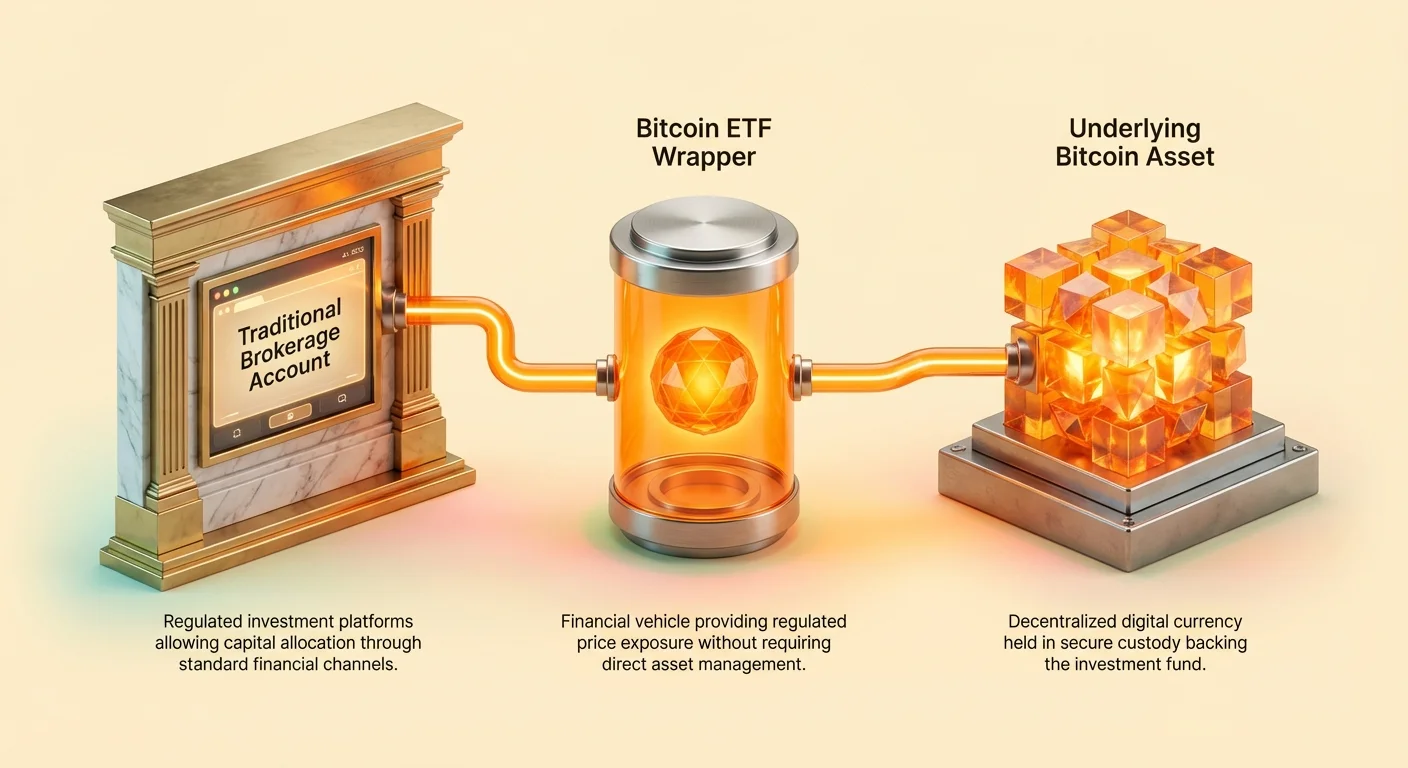
The emergence of financial products that bridge traditional markets and the cryptocurrency ecosystem represents a significant milestone in the maturation of digital assets. For over a decade, Bitcoin existed primarily within a self-contained network of peer-to-peer transactions and dedicated cryptocurrency exchanges. The introduction of Exchange-Traded Funds (ETFs) has fundamentally altered this landscape. These investment vehicles allow participants to gain exposure to Bitcoin price movements through regulated brokerage accounts, bypassing the technical requirements of managing cryptographic keys.
An ETF acts as a wrapper that holds assets such as stocks, commodities, or bonds. It trades on standard stock exchanges throughout the day, much like a regular equity. In the context of cryptocurrency, a Bitcoin ETF is designed to track the value of Bitcoin. This innovation opens the door for retirement planners, institutional managers, and traditional investors to allocate capital to the asset class without navigating unregulated platforms. However, the structure of these funds varies significantly. Understanding the nuances between products that hold the underlying asset and those that rely on financial derivatives is crucial for assessing risk, cost, and performance.
The Evolution of Regulatory Approval
The journey toward a listed Bitcoin ETF in the United States was characterized by years of regulatory hesitation. The first application was filed in 2013 by the Winklevoss twins, prominent figures in the digital asset space. For nearly a decade, the U.S. Securities and Exchange Commission (SEC) rejected dozens of similar applications. The primary concerns cited by regulators revolved around the potential for market manipulation in the underlying spot markets, extreme volatility, and the lack of sufficient surveillance sharing agreements to protect investors.
While the United States moved cautiously, other jurisdictions accelerated their adoption of these financial products. Canada emerged as a leader in this arena, approving the Purpose Bitcoin ETF in early 2021. This marked the first North American Bitcoin ETF, followed closely by other offerings from firms like Evolve and CI Galaxy. Similarly, Brazil approved its region's first Bitcoin ETF shortly after, listing it on the B3 stock exchange. Europe also developed a robust market for similar vehicles, such as Exchange-Traded Notes (ETNs), particularly in Germany and Switzerland. These international precedents provided a testing ground for the mechanics of crypto-backed funds.
The Mechanics of Price Tracking
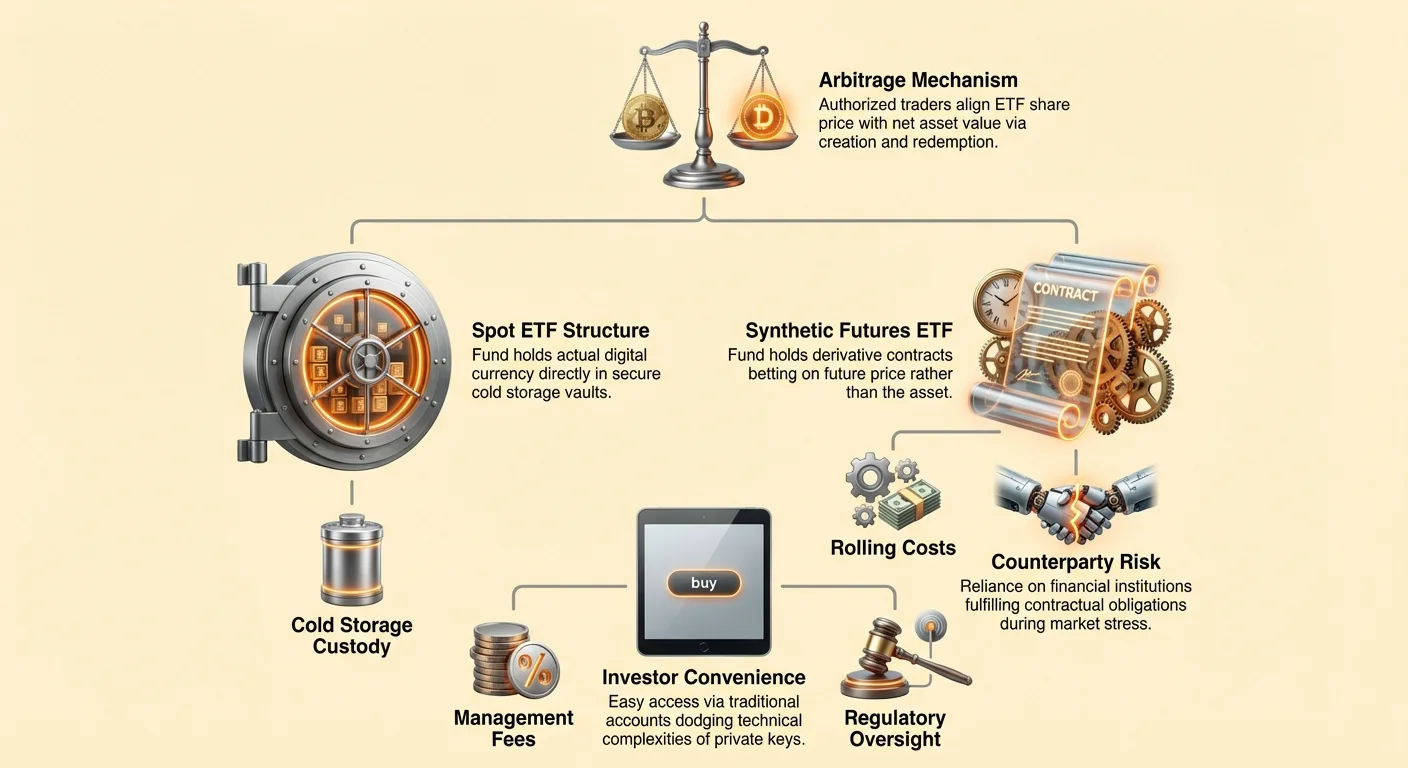
The primary function of any ETF is to mirror the performance of a specific asset or index. To achieve this, the fund generally employs an arbitrage mechanism. Specialized traders, known as Authorized Participants, can create or redeem shares of the ETF based on market demand. If the ETF share price deviates from the Net Asset Value (NAV) of the underlying Bitcoin, these participants step in. They buy or sell the underlying asset and the ETF shares simultaneously to profit from the difference, theoretically forcing the prices back into alignment.
This mechanism is essential for maintaining a tight correlation between the fund's trading price and the actual spot price of Bitcoin. However, the efficiency of this process depends heavily on the liquidity of the underlying market. In the cryptocurrency space, liquidity can fluctuate significantly. While the arbitrage system works well in calm markets, extreme volatility can occasionally lead to temporary dislocations where the ETF trades at a premium or discount to its actual asset value.
Analyzing Spot Investment Structures
A "spot" ETF structure is the most direct method of exposure. In this model, the fund typically holds the actual digital currency in secure custody. When an investor purchases a share of a spot ETF, that share represents a fractional claim on the pool of Bitcoin held by the trust. The fund manager is responsible for safeguarding these digital assets, often utilizing cold storage solutions to protect against cyber threats.
The primary advantage of a spot structure is simplicity. The value of the fund flows directly from the market price of the holdings. There is no complexity involving contract rollovers or expiration dates. For investors seeking a pure play on Bitcoin's price appreciation without technical ownership, spot ETFs offer a relatively transparent vehicle. They remove the burden of self-custody while aiming to provide a 1:1 price tracking experience, minus applicable management fees.
Synthetic and Derivative Risks
In contrast to spot funds, some ETFs utilize synthetic structures or derivatives, such as futures contracts, to replicate Bitcoin's performance. These funds do not necessarily hold the digital currency itself. Instead, they hold contracts that bet on the future price of the asset. This introduces a layer of complexity known as counterparty risk. Because the fund relies on financial agreements with other institutions, there is a risk that a counterparty could fail to meet its obligations during times of financial stress.
Synthetic ETFs also face unique performance challenges. Futures contracts have expiration dates, requiring the fund manager to constantly sell expiring contracts and buy new ones. This process, known as "rolling," can incur costs if the future price is higher than the current spot price, a condition known as contango. Over long periods, these rolling costs can create a drag on performance, causing the ETF to underperform the actual spot price of Bitcoin. Additionally, if the derivatives market faces liquidity issues, the fund's ability to track the asset accurately may be compromised.
The Cost of Convenience
Accessing Bitcoin through an ETF comes with a distinct price tag in the form of management fees. Unlike direct ownership, where the primary costs are transaction fees at the time of purchase or sale, ETFs charge an ongoing annual percentage of the assets under management (AUM). These fees typically range from 0.5% to 2% for Bitcoin products. While this may seem small on an annual basis, it compounds over time, reducing the net return for long-term holders.
Investors must weigh this recurring cost against the expenses and risks of self-custody. Holding Bitcoin directly involves network fees for transfers and potentially the cost of hardware wallets for security. However, direct holding does not incur an annual management fee. For active traders or short-term investors, the ETF fee might be negligible compared to the convenience. For multi-year holders, the management fee represents a guaranteed reduction in their total asset base, regardless of market performance.
| Feature | Spot/Direct Exposure | Synthetic/Futures Exposure |
|---|---|---|
| Underlying Asset | Actual Bitcoin held in custody | Derivatives/Futures contracts |
| Primary Risk | Custodial security, market price | Counterparty solvency, rolling costs |
| Performance | Closely tracks spot price | Can deviate due to contract pricing |
| Cost Structure | Management fee + spread | Management fee + roll costs |
Operational and Liquidation Risks
Beyond market mechanics, ETFs introduce business risks associated with the fund provider. While the legal structure of an ETF usually offers some protection against the bankruptcy of the issuing company, the reality of liquidation can be messy. If an ETF provider faces insolvency, the operational process of unwinding the fund can be time-consuming. Investors may not have immediate access to their capital during the liquidation proceedings.
Furthermore, the liquidation process might force the sale of assets at unfavorable times. If a fund shuts down during a market dip, investors are cashed out at those lows, crystallizing losses that might otherwise have been temporary. Operational disruptions can also occur. Technical glitches at the exchange or issues with the fund's custodian could theoretically halt trading or impede the accurate calculation of the Net Asset Value. These are risks that do not exist for investors who hold their own private keys and transact directly on the blockchain.
The Influence of Traditional Finance
The entry of major asset managers into the Bitcoin space via ETFs changes the flow of funds and market incentives. ETF issuers have a vested interest in marketing their products to attract assets, as their revenue is directly tied to the fees generated. This introduces a powerful marketing engine from the traditional finance (TradFi) sector, pushing Bitcoin exposure to a wider audience than ever before.
This institutional participation brings a new dynamic to Bitcoin's price discovery. Large inflows from ETFs can create significant buy pressure, potentially influencing the price of the underlying asset. Conversely, outflows can exacerbate selling pressure. The sheer scale of capital available in traditional brokerage accounts means that trends in ETF adoption can become a major driver of market cycles, possibly overshadowing the influence of retail activity on crypto-native exchanges.
Comparing Utility and Ownership
A critical distinction between ETF shares and direct Bitcoin ownership lies in utility. Bitcoin is designed as a decentralized digital currency and a store of value that can be transmitted globally without intermediaries. It functions as "unstoppable money" that is resistant to censorship. Owning an ETF share does not provide these capabilities. An investor cannot use their ETF holdings to pay a merchant, send funds to a relative in another country, or interact with decentralized finance (DeFi) protocols.
Direct ownership, facilitated by self-custody wallets, preserves the full utility of the asset. It eliminates counterparty risk entirely, placing the responsibility of security on the owner. This aligns with the "not your keys, not your coins" ethos prevalent in the crypto community. ETF investors are effectively trading utility and autonomy for convenience and regulatory protection. They gain exposure to the price action but lose the functional benefits of the technology itself.
Institutional Whales and Liquidity
The accumulation of Bitcoin by ETF providers contributes to the phenomenon of "whales"—entities holding massive amounts of currency. As ETFs grow, their backing trusts become some of the largest holders in the ecosystem. This concentration of assets in custodial vaults raises questions about centralization. While the ownership of the value is distributed among thousands of shareholders, the control of the keys sits with a few custodial institutions.
On the positive side, the presence of these institutional whales can deepen market liquidity. OTC (Over-The-Counter) trading desks, which facilitate the massive buy and sell orders for these funds, help to smooth out volatility. By executing large block trades off public exchanges, these mechanisms prevent massive price slippage that might occur if such volume hit a standard order book. This infrastructure supports a more stable market environment, potentially making Bitcoin less volatile over the long term.
Regulatory Impact on Global Markets
The regulatory environment dictates which types of products are available to investors in different regions. While some countries embraced spot ETFs early, others restricted approval to futures-based products initially. This fragmentation creates a disparate landscape where investors in one jurisdiction may have access to more efficient, lower-cost products than those in another.
Regulations also impact the banking and custody partners available to ETF issuers. Strict oversight ensures that custodians meet high standards for security and capitalization, reducing the risk of theft or loss. However, it also raises the barrier to entry for new product issuers, consolidating the market among established financial giants. This regulatory moat shapes the competitive landscape, influencing fee structures and the variety of options available to the end consumer.
Arbitrage and Market Efficiency
The arbitrage mechanism that keeps ETFs in line with spot prices serves a secondary function: it connects the fragmented crypto markets with the highly efficient traditional equity markets. When the price of Bitcoin moves on crypto exchanges, arbitrageurs swiftly adjust their positions in the ETF, transmitting that price information to the stock market, and vice versa. This creates a tighter coupling between the two financial worlds.
However, this connection also means that liquidity crises in one market can spill over into the other. If the Bitcoin network becomes congested or major crypto exchanges go offline, the arbitrage mechanism may falter. This could lead to the ETF trading at a significant spread, disconnecting from the reality of the asset's value. Investors relying on the ETF for liquidity during such times might find themselves selling at a steep discount or buying at a premium.
Conclusion
Bitcoin ETFs represent a bridge between the innovative world of cryptocurrency and the established infrastructure of traditional finance. They offer a familiar, regulated pathway for investors to participate in the digital asset economy without mastering the technical complexities of wallets and private keys. However, this convenience involves distinct trade-offs regarding cost, utility, and counterparty risk. Whether choosing a spot product or a derivatives-based fund, investors effectively outsource the custody and management of the asset to third-party institutions.
Ultimately, the choice between an ETF and direct ownership depends on an investor's specific goals and technical comfort. For those prioritizing ease of access and tax-advantaged account integration, ETFs provide a valuable solution. For those seeking censorship resistance, global transferability, and total control over their wealth, direct self-custody remains the superior option. As the market matures, both vehicles will likely coexist, serving different segments of a growing global user base.
Investment vehicles typically trade absolute control for convenience, while direct ownership trades convenience for absolute control.