
When you first dive into the world of cryptocurrency and secure your private keys using a self-custodial wallet, you quickly encounter a concept that seems simple but carries significant weight: the public address. This address, often a long string of characters, acts as your digital mailbox, allowing others to send you funds.
However, not all addresses are created equal. Just as the technology underlying your phone has evolved from bulky 1980s devices to sleek modern smartphones, the fundamental structure of Bitcoin addresses has undergone several major upgrades. These evolutionary changes were driven by the need to scale the network, reduce transaction costs, and enhance user privacy.
Understanding these different address types—from the foundational Legacy formats to the modern, efficient SegWit and Taproot standards—is critical for anyone seeking true financial sovereignty. Choosing the right address type is a direct action that can lower your transaction fees, increase the speed of confirmation, and enhance your overall privacy on the blockchain. This guide breaks down the history, mechanics, and practical benefits of each major Bitcoin address format.
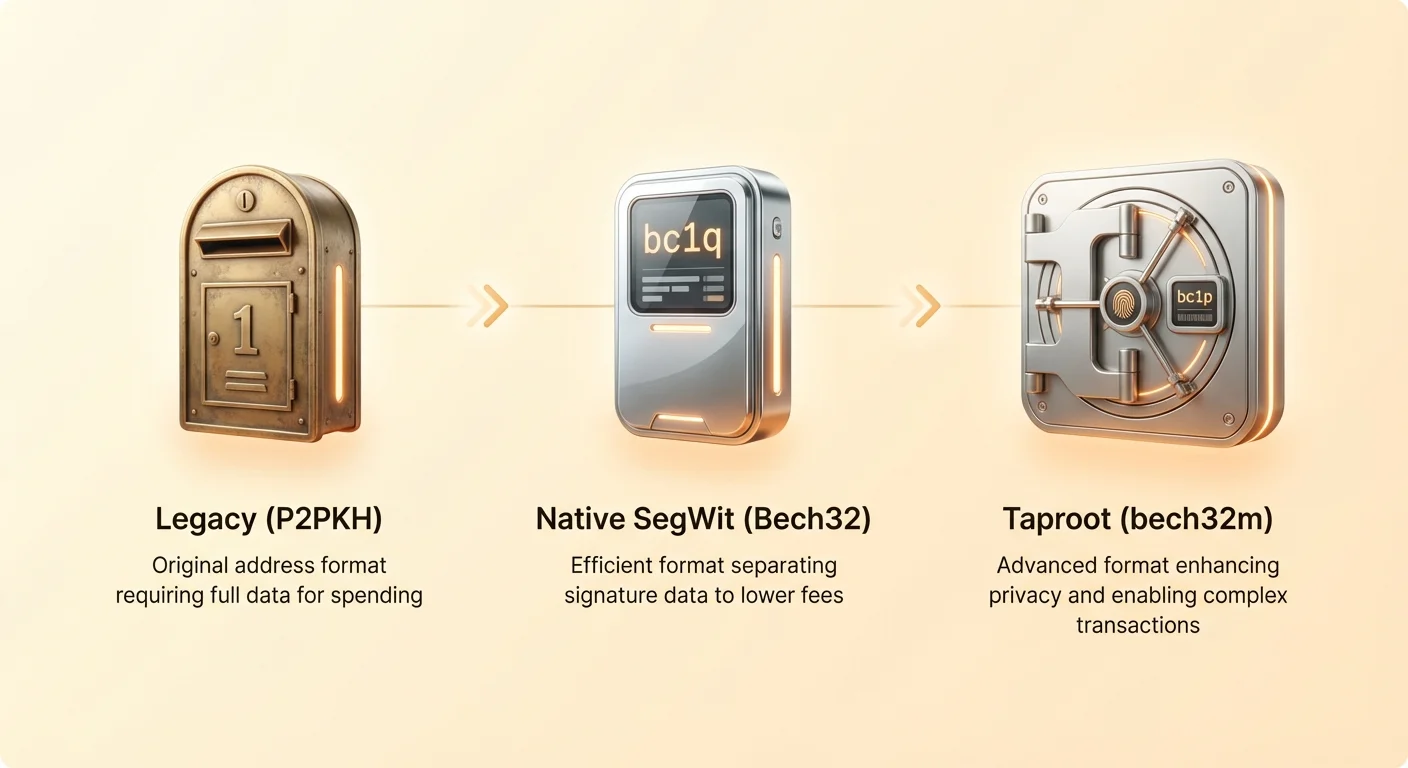
Phase 1: The Foundations of Digital Mailboxes (P2PKH)
The history of Bitcoin addresses begins with the original, foundational format, which established the rules for how funds are received and spent. This first standard, known as P2PKH, still exists today, but its limitations paved the way for future upgrades.
P2PKH: The Original Legacy Format
The first Bitcoin address format is called Pay to Public Key Hash (P2PKH). If you see a Bitcoin address beginning with the number 1, you are looking at a Legacy P2PKH address.
This format requires the entire public key and signature to be included directly within the transaction data when the funds are spent. Think of it like a traditional paper receipt: every single detail, including the store name, item lists, and total tax, must be explicitly written down every time a transaction occurs.
Key Characteristics:
- Prefix: Starts with the number
1. - Case Sensitivity: Uses both uppercase and lowercase letters.
- Security: Cryptographically secure, but less efficient than newer formats.
Identifying Legacy Limitations
While P2PKH was revolutionary for its time, two major issues arose as Bitcoin’s adoption grew:
1. Transaction Size and High Fees
Because P2PKH requires including all spending information (signatures and public keys) in the main body of the transaction, the overall data size is relatively large. In the competitive environment of the Bitcoin network—where miners prioritize transactions based on the fee-to-size ratio—larger transactions inevitably cost more to confirm. Using Legacy addresses means paying a premium compared to more compact formats.
2. Transaction Malleability
The other significant limitation was "transaction malleability." This was a flaw where certain non-essential details in the transaction (specifically, the digital signature) could be slightly modified by a third party before the transaction was confirmed, without invalidating the signature itself. While the core transaction (who paid whom) remained unchanged, the unique transaction ID (TXID) changed. This made tracking unconfirmed transactions difficult and posed problems for advanced applications built on top of Bitcoin, like the Lightning Network for transaction velocity.
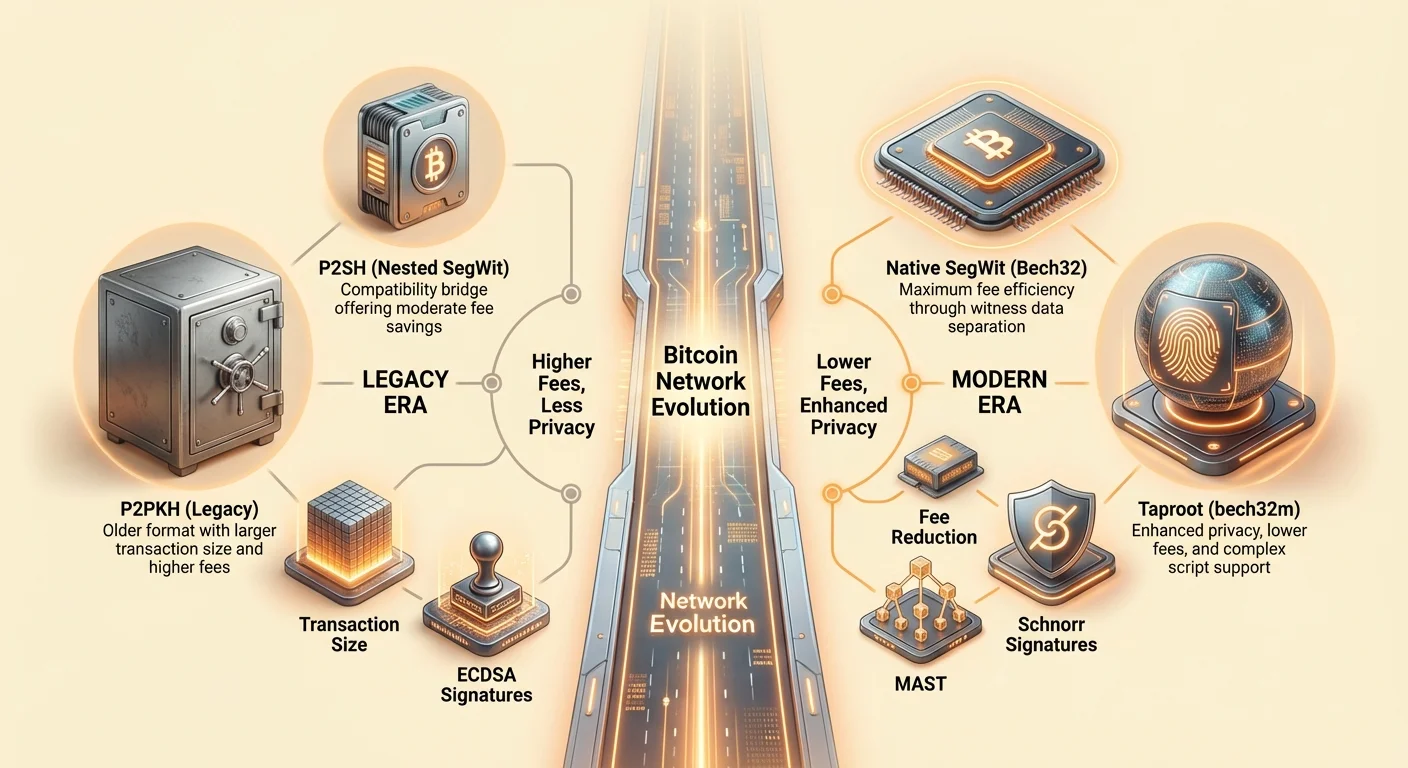
Phase 2: The SegWit Upgrade (Scaling and Efficiency)
To address the limitations of P2PKH—specifically high fees and transaction malleability—the Bitcoin community implemented a major protocol change known as Segregated Witness (SegWit) in 2017. This was the first major step toward efficient scaling.
SegWit's Core Innovation: Witness Separation
The term "Segregated Witness" means separating the digital signature (the "witness") from the core transaction data, a central component in enhancing Bitcoin transaction efficiency.
In crypto, when you spend funds, you must provide a signature to prove ownership. This signature is often the largest component of the transaction data. SegWit works by moving this signature data to a separate, discounted section of the transaction block.
This doesn’t actually make the transaction physically smaller, but it changes how the network measures the transaction size for fee calculation. The traditional data portion is weighted 4x higher than the segregated witness data. This system of weighting is tracked using a metric called "block weight." By paying less for the largest part of the data (the signature), users dramatically reduce their overall transaction costs.
Compatibility First: Nested SegWit (P2SH)
The transition to a new address format requires smooth adoption. If SegWit had forced everyone to upgrade immediately, it would have fragmented the network. To ease this transition, an intermediate compatibility format was created.
Nested SegWit addresses are known as Pay to Script Hash (P2SH) addresses that wrap the new SegWit spending logic.
- Prefix: Starts with the number
3. - User Benefit: Allows Legacy wallets (which only understood P2PKH and P2SH) to safely send Bitcoin to a SegWit address, even if they didn't understand the underlying SegWit mechanics.
- Efficiency: This format provides fee savings compared to Legacy (P2PKH), but because it is "nested" within the P2SH framework, it is slightly less efficient than the fully native SegWit format. Nested SegWit addresses served as a crucial bridge during the transition period.
Maximum Efficiency: Native SegWit (Bech32)
The most efficient address format available before Taproot was Native SegWit, which uses the Bech32 encoding standard. This is the optimal format for both low fees and robust error checking.
- Prefix: Starts with
bc1q. - Case Insensitivity: Bech32 uses only lowercase letters and numbers, eliminating the confusion and potential errors that can arise when mixing uppercase and lowercase characters.
- Built-in Error Checking: Bech32 includes a powerful checksum capability. This means if a user mistypes or misreads even a single character in the address, the wallet will almost certainly catch the error before sending the transaction, protecting funds from being sent to a non-existent or unintended address.
If your wallet defaults to a bc1q address, you are utilizing Native SegWit and benefiting from the maximum fee reduction available from the 2017 SegWit upgrade.
Phase 3: The Taproot Revolution (Privacy and Complex Scripts)
While SegWit focused on scaling the size of simple transactions, the next major upgrade, Taproot (activated in late 2021), focused on enhancing privacy and making complex transactions indistinguishable from simple ones.
Taproot addresses utilize a specialized encoding called bech32m.
The Need for Privacy in Complex Transactions
Before Taproot, if you used advanced features like multi-signature transactions (requiring 2-of-3 keys to spend funds) or smart contracts built on Bitcoin, the structure of the transaction revealed that complexity on the blockchain.
- Example: A standard single-owner transaction looks small and simple. A corporate treasury requiring three managers to approve a spend (multi-sig) looks large and complex. Anyone analyzing the blockchain could easily differentiate the two.
This lack of fungibility (where one unit of currency is perfectly interchangeable with another) was a privacy concern. Taproot solved this by introducing new cryptographic tools.
The Magic of MAST and Schnorr Signatures
Taproot relies on two core technological upgrades to achieve its goals:
1. Schnorr Signatures
P2PKH and SegWit relied on ECDSA (Elliptic Curve Digital Signature Algorithm). Taproot introduced Schnorr Signatures. Schnorr signatures have two major advantages:
- Better Privacy: They allow for signature aggregation. When multiple parties sign a transaction (multi-sig), Schnorr can combine these signatures into a single, simple signature that looks identical to a signature from a single owner.
- Smaller Size: They are inherently more compact than ECDSA signatures, further reducing transaction size and fees.
2. MAST (Merkelized Abstract Syntax Trees)
MAST is the key to complexity hiding. Imagine a contract with several spending conditions (e.g., "Condition A: Spend funds if Manager 1 signs; Condition B: Spend funds automatically after 1 year").
Before Taproot, all these conditions would be revealed on the blockchain upon creation. With MAST, all possible spending conditions are bundled into a "tree," and only the condition that is actually executed is revealed when the funds are spent. This keeps the unused conditions private and drastically reduces the data commitment for complex scripts.
Introducing Taproot Addresses (bech32m)
The result of the Taproot upgrade is a new address type that leverages these technologies to maximize efficiency and privacy.
- Prefix: Starts with
bc1p. - Encoding: Uses
bech32m(an updated version of Bech32). - User Benefit: When you spend from a Taproot address, the resulting transaction (whether it was a simple single-key spend or a highly complex multi-signature corporate treasury transaction) looks identical on the blockchain. This improves privacy for advanced users and enhances the overall fungibility of Bitcoin.
Comparing Address Types: What It Means For Your Wallet
For self-custody adopters, understanding these different address formats is not merely academic; it directly affects your operating costs and privacy profile.
| Address Type | Prefix | Adoption Year | Primary Benefit | Relative Fee Cost (High to Low) | Compatibility |
|---|---|---|---|---|---|
| Legacy (P2PKH) | 1 |
2009 | Universal Compatibility | Highest (100%) | All wallets |
| Nested SegWit (P2SH) | 3 |
2017 | Transitional Compatibility | Medium-High (70-80%) | Good, recognized by most exchanges |
| Native SegWit (Bech32) | bc1q |
2017 | Maximum Fee Reduction | Low (50-60%) | Modern wallets, most major exchanges |
| Taproot (bech32m) | bc1p |
2021 | Lowest Fees & Privacy/Script Hiding | Lowest (40-50%) | Growing, supported by cutting-edge wallets |
Transaction Fee Comparison: The Cost of Legacy
The primary practical benefit of using newer address formats is significant fee reduction. This occurs because the new formats make your transaction data smaller (or weighted less heavily) for miners.
In times of high network congestion, the difference in fees can be dramatic:
- Legacy (P2PKH): Pays the highest fees due to large transaction size.
- Nested SegWit (P2SH): Offers moderate savings, often 15-25% lower than Legacy.
- Native SegWit (Bech32): Offers substantial savings, often 30-40% lower than Legacy.
- Taproot (bech32m): Offers the lowest possible fees for standard transactions, often 40-50% lower than Legacy, and even greater savings for complex transactions.
Practical Tip: If you frequently move Bitcoin, choosing a bc1q or bc1p address type in your wallet settings can translate into hundreds or thousands of dollars saved over time.
Security and Compatibility Trade-Offs
It is important to emphasize that all four address types are fundamentally secure from a cryptographic perspective. They are all linked to a private key that only you control. The differences lie in error management and efficiency:
- Legacy (P2PKH): Highest compatibility, but lacks the modern error-checking of Bech32, making it slightly riskier if manually transcribed. It should only be used when absolutely necessary (e.g., sending to a very old, un-updated service).
- Bech32 and bech32m: These formats offer superior security against human error due to the highly robust checksum that prevents common typos from routing funds incorrectly. They are the ideal standard for self-custody.
Best Practices for Self-Custody Adopters
As someone prioritizing self-sovereignty and security, you should actively manage which address types you use. Your primary goal should be to default to the most modern and efficient standard your wallet and counterparty support.
1. Always Prioritize Native SegWit or Taproot
When setting up your wallet or generating a receiving address, check the settings. If your wallet supports all formats (as most modern wallets do), always choose:
- Native SegWit (
bc1q) if you need high compatibility with older major exchanges. - Taproot (
bc1p) if you are sending between modern wallets or using advanced applications (like the Lightning Network) where the enhanced privacy and extreme efficiency are valuable.
Actionable Step: Go into your wallet's settings immediately and verify what your default receiving address format is. If it starts with a 1 or a 3, consider moving funds to a native SegWit or Taproot address managed by the same wallet, and ensure future receiving addresses default to bc1q or bc1p.
2. Verify Counterparty Support
While modern self-custody wallets have adopted Taproot quickly, many centralized exchanges and older payment processors lag behind.
If you attempt to send Bitcoin from an exchange that doesn't recognize the bc1p (Taproot) format, the transaction will fail, or the exchange may warn you that the address is invalid.
- Best Practice: When sending to a new service, especially if using a Taproot address (
bc1p), always send a very small test transaction first to ensure compatibility before transferring a large sum. If Taproot fails, drop back to Native SegWit (bc1q).
3. Address Rotation and Enhanced Privacy
Remember that the blockchain is transparent. Every time someone sends funds to one of your addresses, that address is recorded permanently. Anyone analyzing the blockchain can track all transactions associated with that address.
Modern wallets enhance your privacy by automatically generating a new receiving address for every transaction. This is called address rotation.
- Impact: Even if you are using an older P2PKH address, rotating addresses prevents others from easily linking all your incoming funds to a single identity. When using the privacy-focused Taproot format combined with address rotation, your financial history becomes significantly harder to trace, fulfilling the promise of true financial sovereignty.
4. Understanding the Derivation Path
The address type used is determined by the specific derivation path your wallet follows. Derivation paths (defined by BIP standards like BIP-44, BIP-49, and BIP-84) tell the wallet software how to generate keys and addresses from your master seed phrase.
- BIP-44: Used for Legacy (P2PKH) addresses.
- BIP-49: Used for Nested SegWit (P2SH) addresses.
- BIP-84: Used for Native SegWit (Bech32) addresses.
- BIP-86: Used for Taproot (bech32m) addresses.
Understanding that your 12- or 24-word seed phrase can generate all these different formats is crucial. When you restore a wallet, you must tell the software which derivation path (and thus which address type) to look at to find your funds. This reinforces the idea that the seed phrase is the ultimate source of truth, and the address format is simply the presentation layer for greater efficiency.
Conclusion
The evolution of Bitcoin addresses from the legacy 1 prefix to the modern bc1p Taproot standard represents the network's continuous commitment to scaling, efficiency, and advanced utility. For the beginner, this evolution translates directly into tangible benefits: lower fees and greater protection against human error.
For the self-custody adopter, moving away from Legacy and Nested SegWit addresses and prioritizing the use of Native SegWit (bc1q) and Taproot (bc1p) is a foundational best practice. By utilizing the newest standards, you not only save money on every transaction but also actively support the long-term health, privacy, and scalability of the decentralized network you rely on for self-sovereignty.