
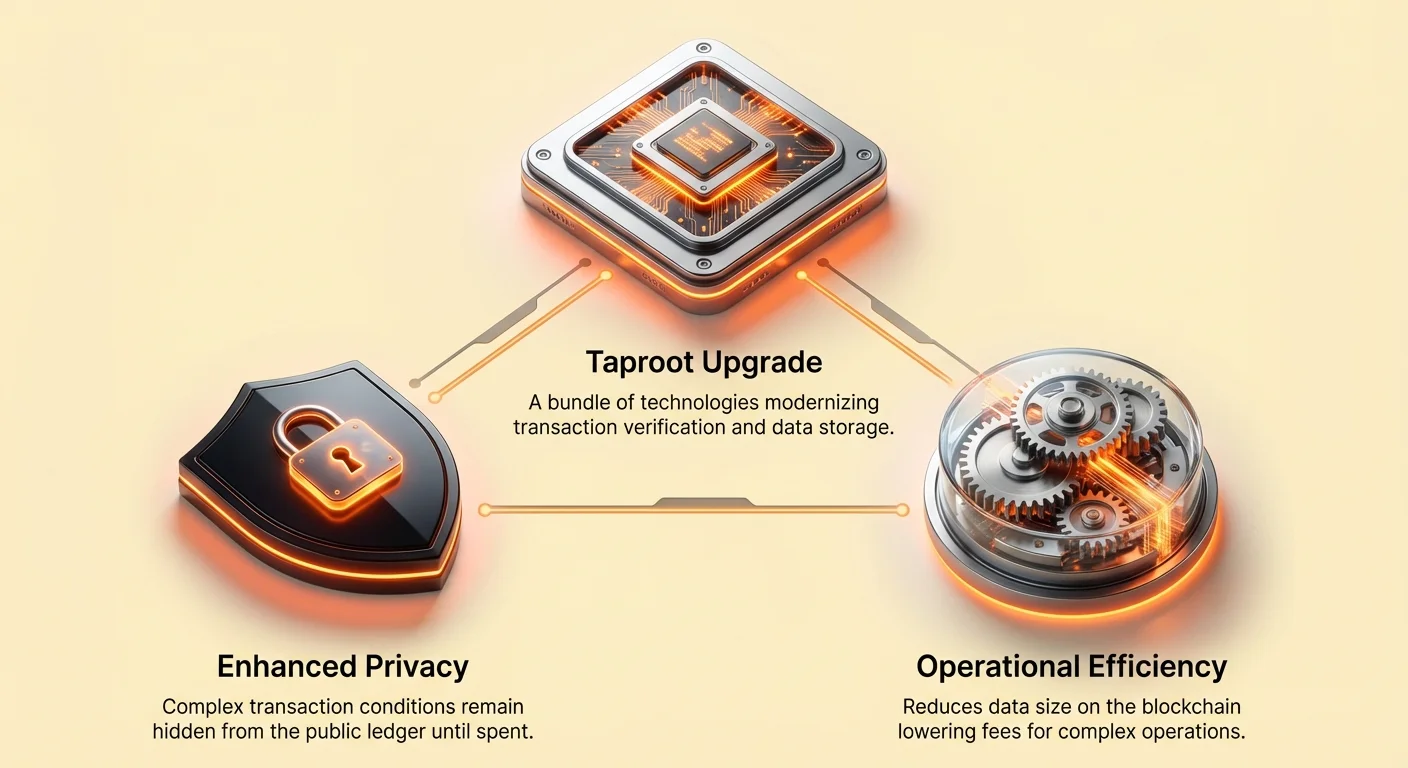
Bitcoin is often criticized for being slow to evolve, but this perception stems from a misunderstanding of how the protocol prioritizes security and stability. While updates are infrequent compared to other blockchain networks, they are profound when they occur. The activation of Taproot in November 2021 marked one of the most significant technical leaps in Bitcoin's history. This upgrade was not merely a single feature but a bundle of technologies designed to modernize how transactions are verified and how data is stored on the blockchain.
At its core, Taproot addresses two fundamental challenges: privacy and efficiency. As the network grew, users demanded more complex transaction types, such as multi-signature wallets and time-locked contracts. In the previous iteration of the Bitcoin protocol, these complex transactions were data-heavy and easily identifiable on the public ledger. This created a situation where users had to sacrifice privacy and pay higher fees to utilize advanced scripting features.
The Taproot upgrade resolves these issues by introducing Schnorr signatures, Merkelized Abstract Syntax Trees (MAST), and a new scripting language called Tapscript. Together, these technologies allow complex transactions to look indistinguishable from standard transfers on the blockchain. This creates a more private, fungible, and scalable network. Understanding these components reveals how Bitcoin is positioning itself not just as digital gold, but as a robust platform for secure, private, and efficient value transfer.
The Historical Context of Bitcoin Upgrades
To understand the magnitude of Taproot, one must look back at the Segregated Witness (SegWit) upgrade of 2017. SegWit was primarily a fix for transaction malleability, a bug that allowed transaction IDs to be altered before confirmation. However, its most lasting legacy was the change in how block space is measured. By separating the digital signature (witness data) from the transaction data, SegWit effectively increased the block size limit and paved the way for Layer-2 solutions like the Lightning Network.
SegWit introduced the concept of "block weight," allowing more transactions to fit into a single block by discounting the size of witness data. While this improved throughput, it did not fundamentally change the cryptographic signature scheme or how scripts were processed. Bitcoin continued to rely on the Elliptic Curve Digital Signature Algorithm (ECDSA), which has been the industry standard since Bitcoin's inception.
Limitations of the Legacy System
Before Taproot, complex spending conditions were handled using Pay-to-Script-Hash (P2SH). If a user wanted to create a contract that required either two of three private keys to sign or a specific time to pass, they had to hash the entire script and place it on the blockchain.
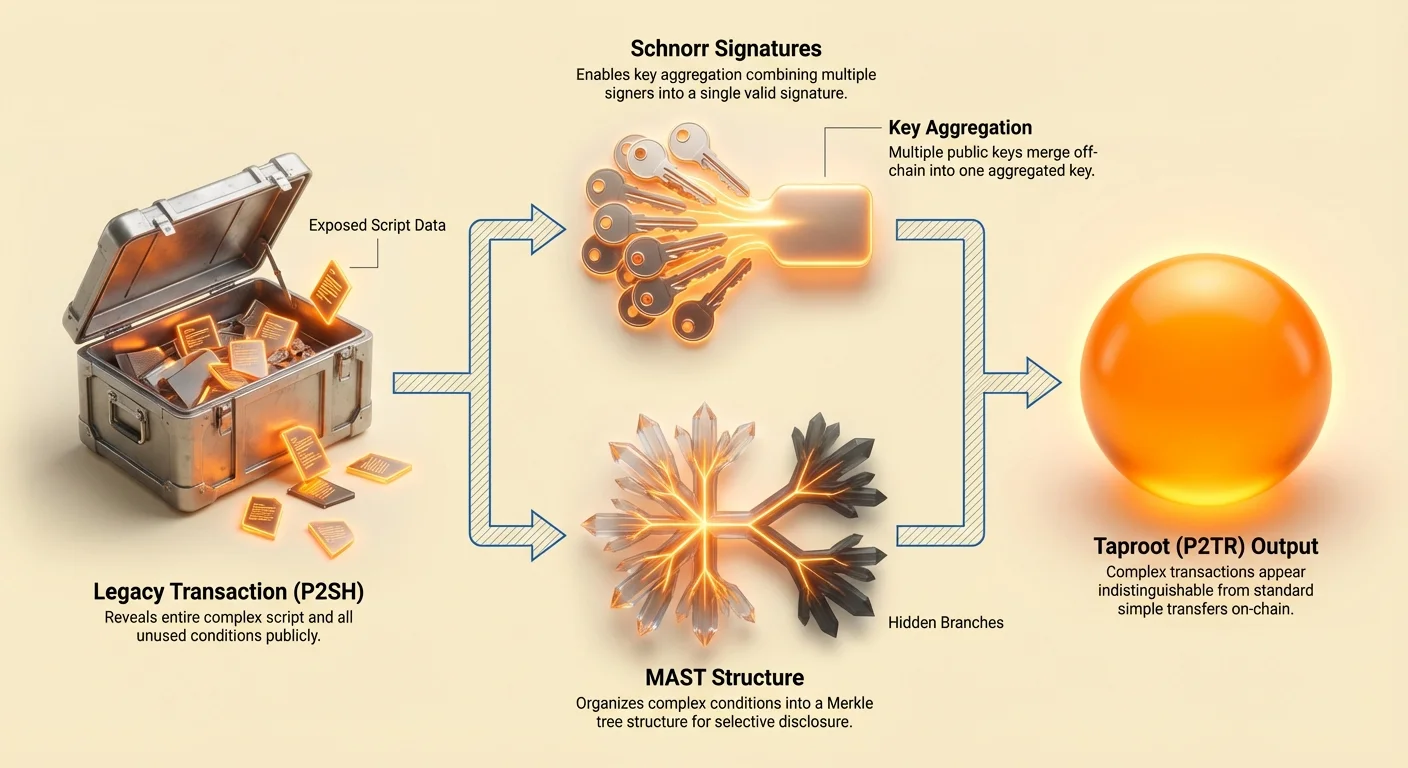
When the time came to spend those funds, the user was required to reveal the entire script, including the conditions that were not met. This system had two major drawbacks. First, it was inefficient because large scripts consumed significant block space, leading to higher transaction fees. Second, it was a privacy nightmare. By revealing every possible condition of the smart contract, users exposed their security setups to the entire world.
The Taproot upgrade fundamentally changes this dynamic. It allows users to commit to a complex script without revealing its contents until the funds are actually spent. Even then, only the specific condition used to unlock the funds is revealed, keeping the rest of the contract logic hidden from public view.
The Power of Schnorr Signatures
The first pillar of the Taproot upgrade is the implementation of Schnorr signatures (BIP 340). This replaces the legacy ECDSA mechanism for generating public keys and signatures. While ECDSA is secure, it lacks a mathematical property known as linearity. Linearity allows multiple digital signatures to be combined into a single, valid signature. This capability is known as key aggregation.
In a traditional Bitcoin multi-signature transaction, the network must verify each individual signature and store them all on the blockchain. If three people sign a transaction, three signatures and three public keys take up space in the block. This linear growth in data size makes security expensive.
Schnorr signatures solve this by allowing multiple parties to combine their public keys into a single aggregated key. When they sign the transaction, their individual partial signatures are combined into a single signature. To the Bitcoin network, this aggregated signature looks exactly like a standard single-user signature. This drastically reduces the amount of data stored on-chain, lowering fees for complex security setups.
Beyond efficiency, Schnorr enables "batch validation." This feature allows full nodes to verify signatures much faster than before. Instead of checking each signature one by one, a node can verify a batch of Schnorr signatures simultaneously. This mathematical efficiency reduces the computational load on the network, making it easier for users to run their own nodes and maintain the decentralization of the system.
Merkelized Abstract Syntax Trees (MAST)
The second major component of the upgrade is the integration of Merkelized Abstract Syntax Trees, or MAST. This technology revolutionizes how smart contracts are structured on Bitcoin. In computer science, a Merkle tree is a data structure that allows for efficient verification of large datasets without requiring the entire dataset to be present. MAST applies this concept to Bitcoin scripts.
Under the old P2SH system, a smart contract was a single linear script. If the script contained multiple spending conditions (branches), the entire script had to be processed and revealed. MAST breaks these conditions down into individual leaves on a Merkle tree. When a user spends funds, they only need to provide the specific leaf (condition) they are using and a "Merkle proof" that connects that leaf to the root of the tree.
Efficiency Through Selective Disclosure
The primary benefit of MAST is efficiency. Imagine a complex inheritance contract with ten different ways to access funds, involving various family members and time delays. In the legacy system, all ten conditions would occupy block space. With MAST, if the primary beneficiary accesses the funds using the simplest condition, only that single condition is revealed and stored on-chain.
The unexecuted branches of the tree remain hashed and hidden. This means a transaction with a hundred potential spending conditions can be as small and cheap as a transaction with only one condition. This decoupling of contract complexity from transaction cost removes the financial penalty for using advanced security measures.
Privacy Gains from Hidden Scripts
MAST offers profound privacy improvements. Because unexecuted branches are never revealed, external observers cannot learn the full details of a user's wallet configuration. An observer looking at the blockchain sees only the condition that was met, not the ones that were kept in reserve.
For example, a user might have a wallet that can be unlocked by their hardware wallet instantly, or by a trusted third party after a one-year delay. If the user spends normally with their hardware wallet, the existence of the third-party backup condition is never revealed to the public. This selective disclosure makes it incredibly difficult for chain analysis firms to fingerprint wallets or determine the sophistication of a user's security setup.
Pay-to-Taproot (P2TR) and Key Path Spending
Taproot unifies Schnorr signatures and MAST into a new transaction output type called Pay-to-Taproot (P2TR), defined in BIP 341. This structure allows a Bitcoin output to be spent in two different ways: the "key path" and the "script path." This dual capability is what makes Taproot transactions look uniform on the blockchain.
The key path leverages Schnorr's key aggregation. If all parties in a smart contract agree on a course of action, they can collaborate to create a single signature that spends the funds. This is the cooperative close scenario. To the network, this looks identical to a simple person-to-person payment. No underlying script is ever revealed because the spending authorization was handled purely through cryptography off-chain.
If the parties cannot agree, or if a specific complex condition must be met, the wallet falls back to the script path. This is where MAST comes into play. The wallet reveals the specific branch of the Merkle tree required to move the funds. The genius of P2TR is that the public key on the blockchain is actually a combination of the user's public key and the root of the MAST.
This means that every P2TR output looks the same until it is spent. An observer cannot tell if a P2TR address is a simple single-sig wallet, a multi-sig setup, or a complex smart contract. If the user spends via the key path, the existence of the script path remains mathematically hidden forever. This concept, known as "cooperative close," incentivizes parties to agree off-chain to save fees and preserve privacy.
| Feature | Legacy (P2SH/ECDSA) | Taproot (P2TR/Schnorr) |
|---|---|---|
| Signature Algorithm | ECDSA | Schnorr |
| Privacy | Reveals entire script | Reveals only executed branch |
| Multi-sig Data | One signature per signer | One aggregated signature |
| Efficiency | Cost increases with complexity | Constant cost for key path |
| Fungibility | Distinct wallet fingerprints | Uniform transaction appearance |
The Evolution of Bitcoin Smart Contracts
While Bitcoin is not a Turing-complete smart contract platform like Ethereum, it possesses a robust scripting language capable of handling sophisticated financial logic. Taproot enhances this capability significantly. By removing the cost penalty for complex scripts, it encourages developers to build more intricate applications directly on the Bitcoin base layer.
This does not mean Bitcoin is trying to replicate the functionality of other chains. Instead, it focuses on verification rather than computation. Bitcoin smart contracts are fundamentally about authorization conditions: who can spend money and when. Taproot allows these authorization conditions to be arbitrarily complex off-chain, while remaining simple and concise on-chain.
Tapscript and Future Upgrades
To support these new features, the upgrade introduced Tapscript (BIP 342), an updated version of the Bitcoin scripting language. Tapscript modifies how signatures are verified and reintroduces or alters certain "opcodes" (operation codes) to make them more flexible.
One of the critical changes in Tapscript is the removal of the strict size limit on the witness data. Previously, there was a hard cap on the size of the script that could be processed. Tapscript relaxes these constraints, allowing for larger and more complex scripts to be executed, provided they fit within the block weight limits.
Furthermore, Tapscript is designed with future upgradability in mind. It redefines how undefined opcodes are handled. In the legacy system, introducing a new opcode often required a complicated upgrade process. With Tapscript, unknown opcodes are treated as valid by default (no-ops), which makes it much easier to introduce new functionality later through soft forks without disrupting the network. This forward-thinking design ensures that Bitcoin can continue to adapt to new cryptographic innovations.
Impact on Layer-2 Solutions
The implications of Taproot extend far beyond the base layer, significantly benefiting Layer-2 scaling solutions like the Lightning Network. Currently, opening and closing a Lightning channel involves a 2-of-2 multi-signature transaction. On the legacy chain, these transactions are distinct and easily identifiable.
With Taproot, a Lightning channel open or close can use the key path. This means a Lightning transaction looks exactly like a standard user payment. This improves the privacy of Lightning Network users, as it becomes much harder to distinguish between on-chain payments and channel management operations.
Additionally, Taproot enables Point Time Locked Contracts (PTLCs) to replace the current Hashed Time Locked Contracts (HTLCs) used in Lightning. PTLCs leverage Schnorr cryptography to improve privacy along the payment route. In an HTLC, the same hash is used across the entire route, potentially allowing nodes to correlate payments. PTLCs use randomized scalars at each hop, breaking this link and making the payment route mathematically opaque to intermediaries.
Bitcoin Governance and Activation
The path to activating Taproot demonstrated the unique nature of Bitcoin governance. Unlike centralized systems where leaders dictate upgrades, Bitcoin relies on consensus among decentralized stakeholders, including miners, developers, and node operators. The activation process used for Taproot was known as "Speedy Trial."
This mechanism allowed miners to signal their support for the upgrade within their mined blocks over a three-month window. The threshold for activation was set at 90% of blocks within a difficulty epoch. This high bar ensures that upgrades only proceed when there is overwhelming consensus, preventing network splits or contentious hard forks.
The successful activation in November 2021 proved that Bitcoin could still coordinate complex upgrades despite its massive size and decentralized nature. It highlighted a cultural preference for "soft forks"—backward-compatible upgrades that do not force users to update their software immediately. Taproot nodes can continue to communicate with older nodes, ensuring no one is kicked off the network for failing to upgrade.
Unintended Consequences: The Rise of Ordinals
One of the most surprising outcomes of the Taproot upgrade was the emergence of Bitcoin Ordinals. While Taproot was designed to improve financial smart contracts, the relaxation of data limits in the witness field (via Tapscript) opened the door for storing arbitrary data on the blockchain.
Ordinals allow users to inscribe data—such as images, text, or code—directly onto individual satoshis (the smallest unit of Bitcoin). Because Taproot removed the size limit for witness data, users could suddenly transact with 4MB of data in a single block, provided they paid the requisite fees. This birthed a market for "digital artifacts" or NFTs directly on Bitcoin.
This development sparked intense debate within the community. Purists argue that this "bloats" the blockchain with non-financial data, potentially making it harder to run full nodes. Proponents argue that high fees paid by Ordinals inscriptions secure the network as the block subsidy declines. Regardless of the stance, Ordinals demonstrated the flexibility of the Taproot architecture and the unpredictability of how open-source protocols are utilized once released into the wild.
Covenants and the Return of OP_CAT
The flexibility introduced by Taproot has reinvigorated discussions about further extending Bitcoin's scripting capabilities. A major topic of current research is "covenants"—scripts that restrict where funds can be sent after they are spent. Currently, a Bitcoin script only controls authorization (who can spend), not destination (where it goes).
To enable covenants and more advanced sidechain bridges, developers are discussing the re-introduction of the OP_CAT opcode. OP_CAT allows two pieces of data to be concatenated (joined together) within a script. It was removed in the early days of Bitcoin due to concerns about memory usage, but with the modern safeguards of Tapscript, it could be safely reinstated.
If activated, OP_CAT combined with Taproot would allow for even more powerful smart contracts, such as decentralized vaults that force a waiting period before funds can be moved to a new address, effectively neutralizing theft even if private keys are stolen. This represents the continuing evolution of Bitcoin scripting, building upon the foundation laid by Taproot.
Conclusion
The integration of Taproot and MAST represents a maturation of the Bitcoin protocol. By moving complex verification logic off-chain and utilizing advanced cryptography, Bitcoin has managed to scale its functionality without compromising its core values of security and decentralization. The upgrade resolved the tension between privacy and functionality, proving that users do not have to choose between sophisticated security and financial privacy.
As the ecosystem continues to adopt these tools, we can expect a shift toward wallet standards where all transactions look identical, regardless of their underlying complexity. From enhancing the Lightning Network to enabling new asset types like Ordinals, Taproot has secured Bitcoin’s relevance in a rapidly evolving digital landscape. It serves as the bedrock for the next generation of private, efficient, and programmable money.
Taproot and MAST allow Bitcoin to hide complex transaction details, making smart contracts cheaper to use and harder to track.