The world of Web3 gaming and the Metaverse offers an entirely new way to interact with digital worlds, allowing players true ownership of in-game assets—from virtual land and unique skins to earning real cryptocurrency through the "play-to-earn" (P2E) model.
However, entering this space with a standard crypto wallet designed for simple Bitcoin storage or long-term DeFi investing can lead to immediate frustration. Unlike static finance applications, gaming requires immediate, responsive interactions. Imagine trying to execute a critical move in a fast-paced game, only to be delayed by high network fees and transaction confirmations that take 30 seconds or more. This "lag" is unacceptable in real-time environments.
Specialized Web3 gaming wallets are built specifically to handle the high throughput, multi-chain complexity, and low-latency demands of these dynamic digital economies. This guide breaks down the unique performance characteristics that define the best gaming wallets and provides a framework for selecting the right tool to manage your digital life in the Metaverse.
Why Standard Wallets Fail in Gaming Environments
Traditional crypto wallets, especially those optimized for security (like hardware wallets), prioritize safety and auditability over speed. This works perfectly for banking your funds but falls short when you need to mint an NFT instantly, bid on an auction rapidly, or transfer a digital sword to a friend during gameplay.
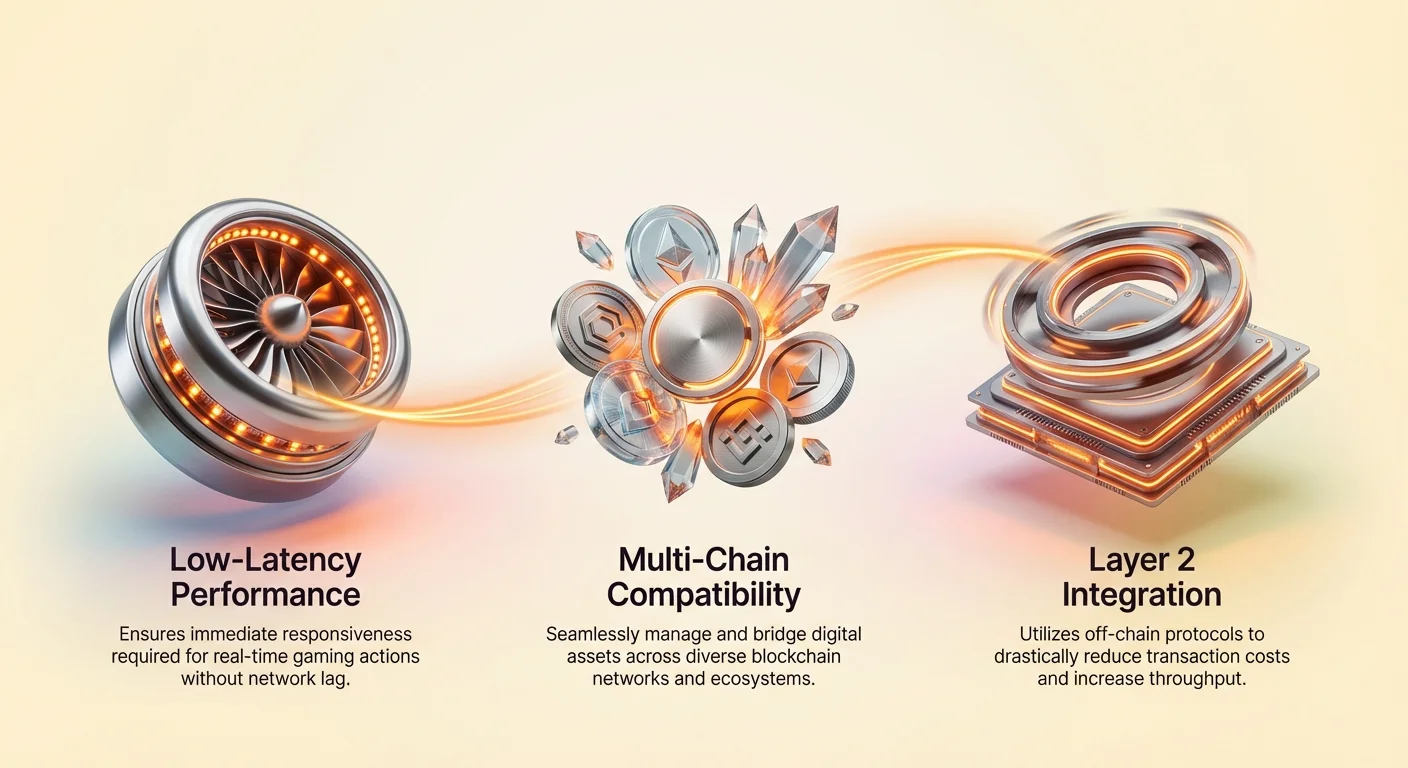
Gaming environments demand speed and efficiency, making performance characteristics the most crucial metric when evaluating wallet suitability.
Low Latency and High Throughput: The Speed Factor
Latency refers to the delay before a transfer of data begins following an instruction (i.e., how long it takes for your transaction request to reach the network). Throughput refers to how many transactions the network (and your wallet interface) can handle per second.
In Web3 gaming, low latency is non-negotiable. If you purchase a power-up, it must register almost immediately. If you accept a duel, the transaction confirming the stakes must finalize before the match starts.
Gaming wallets must therefore prioritize connectivity to blockchains and Layer 2 (L2) networks specifically designed for speed, such as Solana, Polygon, Immutable X, or Ronin. These chains offer:
- Sub-second Finality: Transactions are confirmed in less than one second, eliminating gameplay lag caused by network confirmation.
- Massive Scalability: The network can handle thousands of transactions per second (high throughput), ensuring that heavy gaming activity doesn't result in network congestion and escalating fees.
Multi-Chain and Bridging Capability: Accessing Different Games
Few major gaming ecosystems exist entirely on a single blockchain. A popular game might use a specialized chain (like Ronin for Axie Infinity) to keep costs low, but the core asset (like the high-value land NFT) might be held on the secure, expensive Ethereum mainnet.
A high-performance gaming wallet must be truly multi-chain, allowing the user to seamlessly switch networks without disconnecting or setting up entirely new accounts.
Example Use Case: A player needs to move $10 worth of Polygon (MATIC) rewards earned in Game A to the Avalanche network to buy an item in Game B. The wallet should facilitate this transfer via built-in "bridging" mechanisms, handling the complex technical steps (converting tokens and transferring ownership across chains) through a simplified interface.
Wallets that integrate native support for multiple chains (Ethereum, Solana, Polygon, Arbitrum, Optimism, BNB Chain) drastically improve the user experience, preventing the need for multiple separate wallet applications.
Solving the Fee Problem: Layer 2 Integration
The single biggest barrier to mass adoption in Web3 gaming is the cost associated with small, frequent transactions—known as "gas fees." If every action in a game (moving an item, selling a collectible, crafting a resource) costs even a small amount of crypto, the micro-transactions quickly stack up, destroying the economic viability of the game.
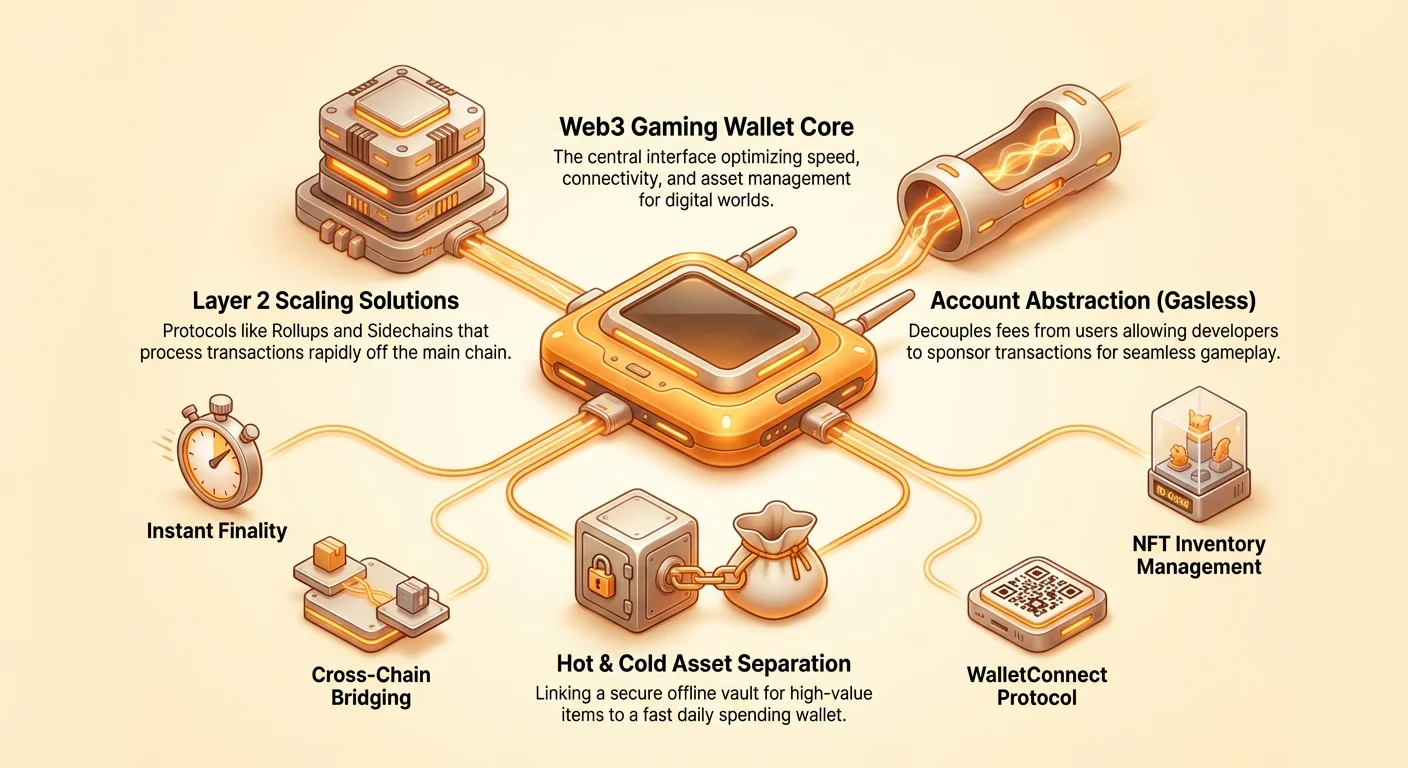
Gaming wallets solve this primarily by leveraging Layer 2 (L2) scaling solutions.
What are Layer 2 Networks (The Scaling Solution)?
The core blockchains (Layer 1, such as Ethereum) are secure but slow and expensive. Layer 2 networks are protocols built on top of the L1 network. They process transactions rapidly and cheaply off-chain, bundling thousands of these transactions together into a single, highly compressed transaction proof, which is then submitted back to the main L1 chain for final security settlement.
This process drastically reduces fees, often bringing the cost of a transaction down from several dollars to just a few cents, or even fractions of a cent.
Key L2 Technologies Supporting Gaming:
- Rollups (Optimistic & ZK-Rollups): Chains like Arbitrum, Optimism, and zkSync are popular for gaming because they maintain high compatibility with the robust security of Ethereum while providing high throughput necessary for P2E economies.
- Sidechains (e.g., Polygon): These run parallel to Ethereum and are incredibly fast and cheap, hosting a massive portion of the current Web3 gaming landscape.
- App Chains (e.g., Immutable X, Ronin): These L2s are custom-built exclusively for gaming platforms, providing maximum speed and control over transaction costs for that specific ecosystem.
A robust Web3 gaming wallet must offer native integration and fast connectivity to these critical L2 ecosystems to ensure transactions remain affordable and quick.
Gasless Transactions and Account Abstraction (Smooth Gameplay)
Even cheap transactions require the user to hold some native cryptocurrency (gas) in their wallet to pay the fee. For a true beginner, this adds a complex step: they have to buy ETH just to pay for a tiny MATIC fee, which they need to swap for a specific game token. It’s confusing and cumbersome.
The solution is Account Abstraction (AA), which allows wallets to decouple transaction fees from the user.
How Gasless Transactions Work:
- Sponsor Payment: With Account Abstraction, a service provider—usually the game developer itself—can "sponsor" or pay for the user’s transaction fees.
- Seamless Experience: The player executes an action (e.g., harvesting crops), and the transaction occurs instantly without the user seeing or needing to approve a gas fee prompt.
- Mass Adoption Potential: This makes the Web3 experience feel exactly like traditional Web2 gaming, where in-game actions are instantaneous and free from blockchain complexity.
Actionable Tip: When choosing a gaming wallet, look for features advertising "gasless transactions," "sponsoring," or explicit support for networks specializing in Account Abstraction, as this dramatically improves long-term usability.
Managing Your Digital Assets: NFTs and In-Game Items
NFTs (Non-Fungible Tokens) are the backbone of Web3 gaming, representing land, characters, unique items, and currencies. The wallet serves not just as a financial tool but as an inventory manager for these digital collectibles.
Securely Linking In-Game Assets (Decoupling Risk)
A major risk in Web3 gaming is keeping high-value assets (like rare, expensive NFTs) in the same "hot wallet" that is constantly connected to various third-party decentralized applications (dApps) for daily gameplay.
Best Practice: Separation of Duties (Hot vs. Cold Assets):
- Hot Wallet (Mobile/Browser Extension): Used for daily transactions, paying gas fees, and connecting to dApps. Only holds small, "spending" amounts.
- Cold Wallet (Hardware/Vault): Used for high-value asset storage (NFTs, major crypto reserves). Never directly connected to a game or application.
- Cold Storage (Long-Term Vault): High-value NFTs or locked crypto balances should remain in the most secure environment possible, ideally a hardware wallet (cold storage) or a self-custodial desktop wallet that is rarely connected to the internet.
- Hot Wallet (The Gaming Key): A specialized mobile or desktop wallet is used daily. This hot wallet only holds the tokens necessary for daily transactions (low-value liquid funds) and links to the high-value assets held in cold storage.
A good gaming wallet facilitates this linking process. For instance, the wallet registers that NFT #456 is owned by the user's cold storage address, but the player is granted temporary, conditional access to use that character within the game environment via the hot wallet connection. If the hot wallet is compromised, the high-value NFT remains safe because the hot wallet never possessed the actual private keys for the cold vault.
Batch Processing and Marketplace Integration (Efficiency)
Active P2E players often perform repetitive actions: transferring multiple earned items to a secondary wallet, listing several items on a marketplace simultaneously, or staking a batch of newly acquired tokens.
If each action requires a separate, manual transaction confirmation, the process becomes tedious and slow.
Batch Processing: Advanced gaming wallets feature batching capabilities, allowing the user to group multiple, similar transactions (e.g., selling 10 swords) into a single, smart contract transaction. This reduces the number of confirmations needed and often saves on cumulative gas fees.
Native Marketplace Integration: The best wallets streamline the process of buying and selling. They offer immediate visual displays of NFT metadata and value (floor price, rarity) and seamlessly integrate with major NFT marketplaces (like OpenSea or Magic Eden) and in-game trading platforms, allowing players to list items directly from the wallet interface without navigating to a separate website.
Identity and Usability in the Metaverse
Beyond assets and performance, the wallet is the user’s identity layer in the Metaverse. It manages usernames, social connections, and the overall quality of interaction within virtual worlds.
Web3 Identity Management (ENS Integration)
In the current Web3 landscape, users are identified by complex strings of alphanumeric characters (e.g., 0x89...4E6b). Remembering and sharing these addresses is impractical for a social environment like the Metaverse.
Ethereum Name Service (ENS): ENS is the foundational protocol for turning these long addresses into human-readable names (e.g., PlayerOne.eth).
Gaming wallets must prioritize seamless ENS integration. This allows players to:
- Receive Payments: Easily tell friends to send tokens to
PlayerOne.ethrather than copying a 42-character address. - Establish Identity: Use their registered ENS name as their persistent, verifiable username across different games and platforms.
- Portability: Since ENS names are held in the wallet, the user’s identity moves with them, regardless of which game or chain they are currently playing on.
Mobile vs. Desktop: Choosing the Right Form Factor
While the underlying technology (Layer 2s, Account Abstraction) dictates speed, the form factor dictates convenience and application power.
| Wallet Type | Ideal Use Case | Pros | Cons |
|---|---|---|---|
| Desktop Wallet | Serious "Grinding," High-Performance Gaming, Trading, Complex NFT Management. | Superior power and screen space for managing complex transactions; best for dedicated high-speed connections. | Less portable; riskier if the computer has malware or viruses. |
| Mobile Wallet | Daily P2E Check-ins, Claiming Rewards, Quick Transfers, Simple NFT Viewing. | Extreme portability; often features enhanced security (biometrics, secure enclaves). | Screen size limits complex trading views; potentially less secure than a dedicated desktop or cold storage device. |
| Browser Extension | Connecting to Web dApps, Quick Signing of Game Interactions. | Fastest connection point for browser-based games; widely compatible. | Must be used carefully; susceptible to phishing or malicious website interactions. |
For serious, high-speed, competitive play, the security and performance of a dedicated desktop or robust browser extension wallet are usually preferred. For convenience and reward claiming, mobile wallets offer unmatched flexibility. The best strategy is often using a single seed phrase to secure both the desktop and mobile versions of the same wallet, ensuring portability and access across all devices.
Technical Deep Dive: Wallet Connect and dApp Linking
The mechanism by which your wallet communicates with the game is crucial for low-latency performance. The industry standard is Wallet Connect, a protocol that allows a mobile wallet to securely link and authorize transactions for a decentralized application (dApp) running on a desktop browser.
How Wallet Connect Optimizes Gaming:
- QR Code Authorization: The game dApp generates a QR code. The user scans this code with their mobile wallet.
- Secure Tunnel: A secure, encrypted connection (the "session") is established.
- Transaction Signing: When the user initiates an action in the game (e.g., placing a high bid), the transaction request is instantly tunneled to the mobile device. The user authenticates (via fingerprint or PIN) on their mobile device, and the signed transaction is sent back to the game dApp for broadcasting to the network.
This separation ensures that the game application never holds the user’s private keys, maintaining security, while the instant, push-notification mechanism allows for the speedy authorization required in real-time gaming scenarios. Wallets that quickly establish and maintain stable Wallet Connect sessions are essential for an uninterrupted gaming experience.
Best Practices for Gaming Wallet Security
While speed and low fees are primary functional goals, security remains paramount, especially when handling valuable in-game assets.
1. Separate Hot Funds from Cold Assets
As detailed earlier, never store your highly valuable NFTs or significant cryptocurrency reserves in the same hot wallet used for daily gameplay. Use a dedicated, air-gapped hardware wallet (cold storage) as a vault, and only link smaller "spending" amounts (tokens needed for fees or immediate trading) to your gaming wallet.
2. Treat Your Seed Phrase Like Gold
The seed phrase (a list of 12 or 24 words) is the master key to your funds. If anyone gains access to it, they control everything in your wallet, regardless of the security measures on your computer or phone.
- Rule: Never store your seed phrase digitally (in a screenshot, cloud drive, or email). Write it down and store it securely offline.
- Warning: Be highly suspicious of any game or website prompt asking you to input your seed phrase—legitimate platforms only require you to connect your wallet, not expose the private key.
3. Vet Game Contracts Carefully
Web3 gaming requires approving smart contracts to handle certain actions (like staking, trading, or transferring assets). Before signing a transaction, always ensure you are interacting with the official game contract.
A good gaming wallet will provide clear warnings if you are connecting to a suspicious address or if a contract is asking for excessive permissions (such as unlimited approval to spend all tokens in your wallet). Review permissions regularly and revoke access for any contracts you no longer use.
4. Enable Biometric Security
For mobile and desktop wallets, always utilize native security features:
- Biometrics: Fingerprint or facial recognition for transaction signing.
- Pin Codes: A strong secondary PIN required upon launch or after inactivity.
These layers of defense prevent casual theft if your device is lost or momentarily accessed by an unauthorized person.
Conclusion
The shift from basic crypto transactions to real-time, persistent digital economies has elevated performance to the single most important characteristic of a specialized crypto wallet.
The ideal Web3 gaming and Metaverse wallet is defined by its ability to integrate with Layer 2 scaling solutions, leverage Account Abstraction for gasless transactions, and seamlessly manage assets across multiple blockchain networks. By prioritizing low latency, strong multi-chain support, and disciplined separation of hot and cold assets, players can navigate the complexities of play-to-earn games and the Metaverse safely and efficiently.