
Bitcoin began as a peer-to-peer electronic cash system designed to facilitate censorship-resistant transactions without intermediaries. Over the last decade, it has evolved primarily into a store of value, often referred to as digital gold. While this narrative has driven its market capitalization to trillions of dollars, it has also highlighted significant limitations in the network's original design. The base layer is intentionally slow and rigid to prioritize security and decentralization above all else. It processes roughly seven transactions per second and utilizes a scripting language that restricts complex programmability.
These constraints have historically prevented Bitcoin from hosting the diverse ecosystems seen on other blockchains. Developers could not easily build decentralized exchanges, lending markets, or complex automated market makers directly on the main chain. The network becomes congested during periods of high demand, leading to skyrocketing transaction fees that make smaller payments economically unviable. This creates a barrier for users who want to use Bitcoin for anything other than long-term holding.
To address these challenges without compromising the security of the base layer, the ecosystem has adopted a layered scaling approach. Layer-2 (L2) solutions and sidechains have emerged as the primary method to expand Bitcoin's utility. These protocols operate on top of or alongside the main network, handling the heavy lifting of transaction processing and smart contract execution. They periodically settle data back to the main Bitcoin blockchain, allowing users to benefit from Bitcoin’s security while accessing the speed and programmability it natively lacks.
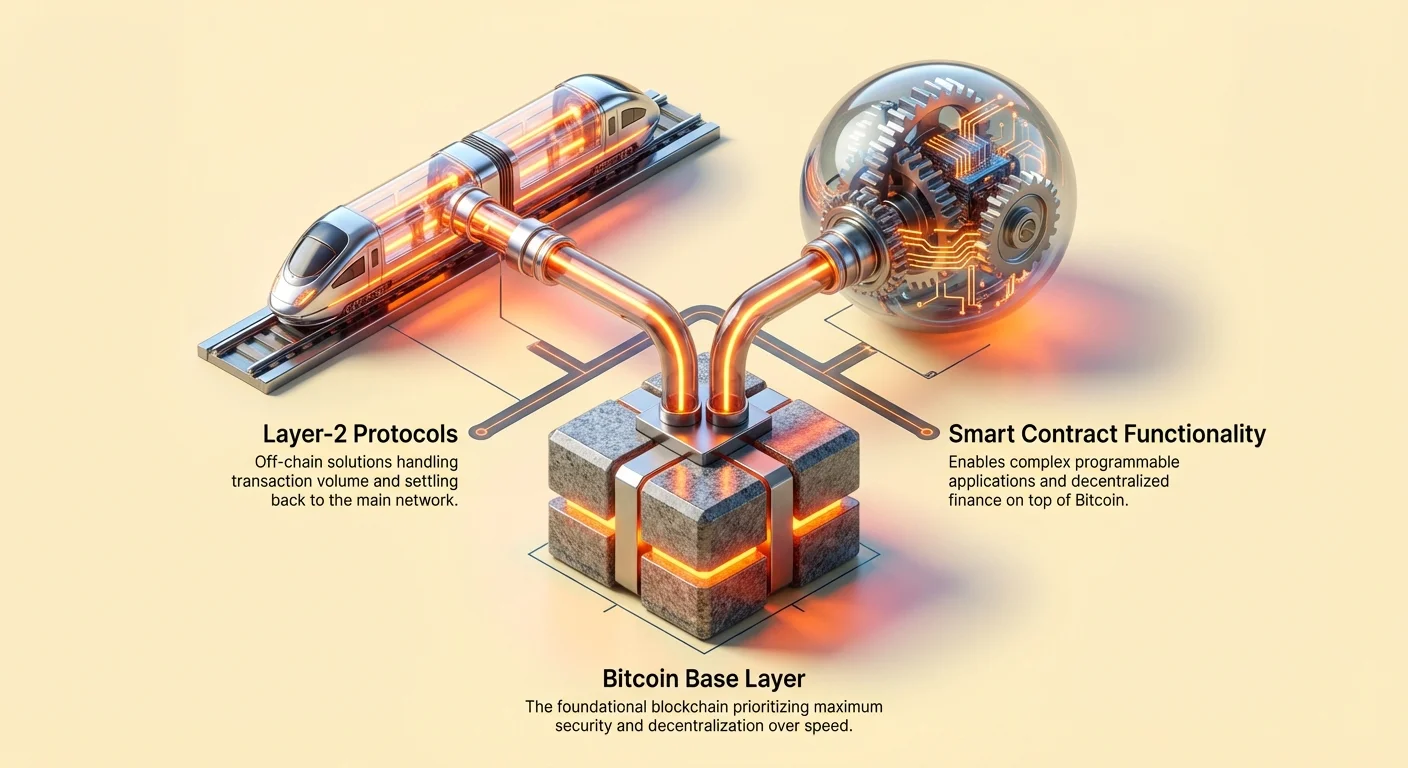
The Architecture of Bitcoin Scalability
The Technical Limitations of Layer 1
The Bitcoin network operates on a Proof-of-Work consensus mechanism that requires 10-minute block times to ensure global synchronization. Its native programming language, Script, is non-Turing complete. This means it cannot perform loops or complex logic required for advanced applications. This design choice was deliberate. By limiting functionality, Satoshi Nakamoto reduced the attack surface of the network. A simpler system has fewer potential exploits. However, this trade-off created the scalability trilemma where the network sacrificed speed and scalability to achieve maximum security and decentralization.
Evolution Through Soft Forks
While the base protocol is resistant to change, it is not static. Developers have implemented critical upgrades through soft forks, which are backward-compatible changes to the code. Segregated Witness (SegWit), activated in 2017, was a pivotal moment. It separated signature data from transaction data, effectively increasing block capacity and fixing transaction malleability. This upgrade paved the way for the Lightning Network to function securely. More recently, the Taproot upgrade in 2021 introduced Schnorr signatures and Merkelized Abstract Syntax Trees (MAST). These technologies improved privacy and efficiency while enabling more complex spending conditions, setting the stage for modern L2 innovation.
The Role of Layer-2 Protocols
Layer-2 protocols address the throughput issue by moving execution off-chain. Instead of broadcasting every cup of coffee purchase to thousands of nodes worldwide, L2s process these transactions in a separate environment. They only use the main blockchain for final settlement or dispute resolution. This hierarchy allows Bitcoin to remain the ultimate anchor of truth and security while the layers above it handle volume and innovation. Different L2s use different mechanisms, such as state channels, sidechains, and rollups, to achieve this balance between speed and security.
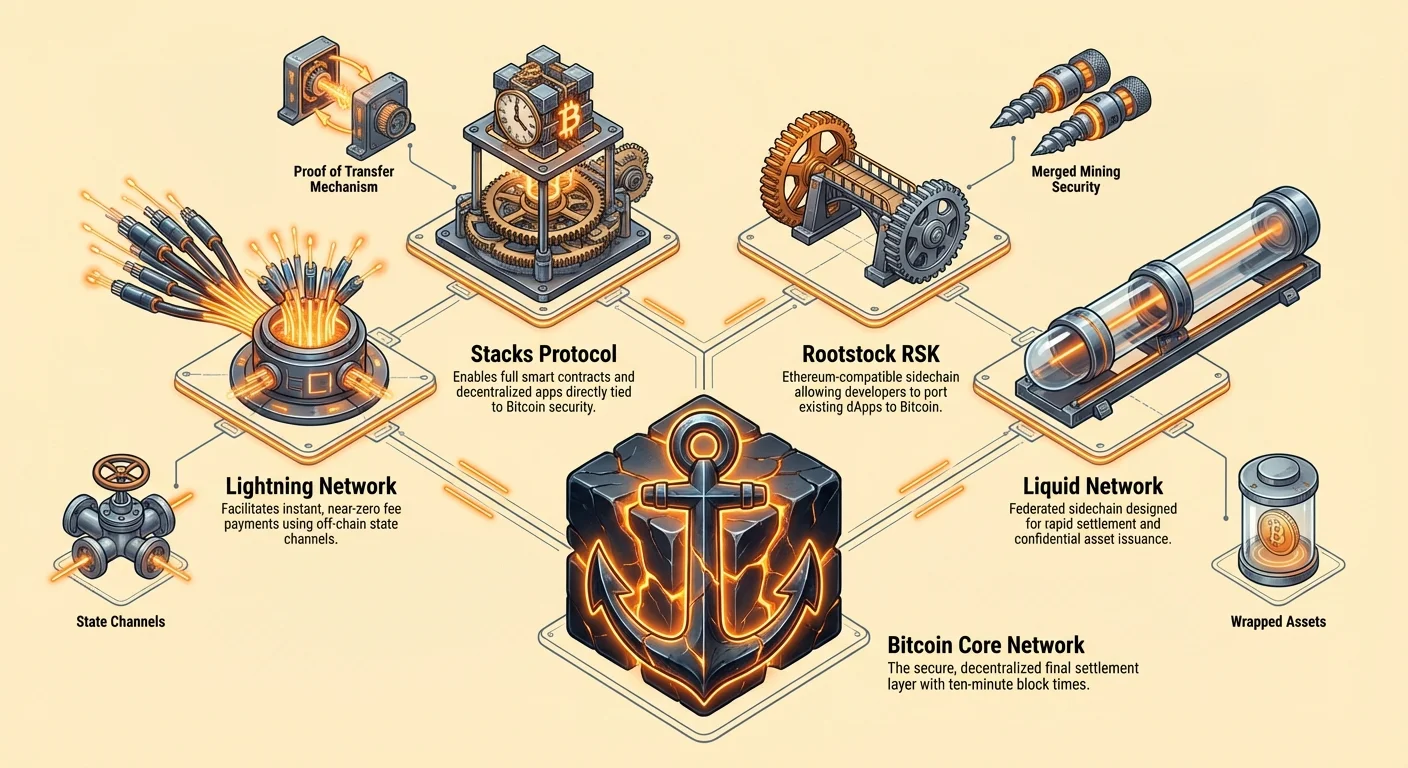
The Lightning Network: Payments at Speed
The Lightning Network represents the most established Layer-2 solution for Bitcoin. It focuses specifically on solving the payment scalability problem. Rather than writing every transaction to the blockchain, the Lightning Network uses state channels. Two parties open a channel by locking funds into a multi-signature address on the main chain. Once the channel is open, they can transact back and forth an unlimited number of times instantly and with near-zero fees. These transactions update the balance of the channel locally without touching the main blockchain.
The true power of the network lies in its routing capability. A user does not need a direct channel with everyone they wish to pay. The network routes payments through a web of interconnected nodes, finding a path from sender to receiver. This works similarly to how data packets move through the internet. When the participants are finished transacting, they close the channel. Only the final balance is broadcast to the Bitcoin blockchain. This condenses thousands of potential transfers into just two on-chain transactions.
However, the Lightning Network is not without challenges. It requires users to be online to receive funds, and managing channel liquidity can be complex for average users. If a node does not have enough funds on the right "side" of the channel, a payment cannot pass through. Despite these hurdles, it remains the primary solution for making Bitcoin a viable medium of exchange for daily commerce.
Stacks: Unleashing Bitcoin Programmability
Proof of Transfer Consensus
Stacks distinguishes itself as a Layer-2 that brings full smart contract functionality to Bitcoin through a unique consensus mechanism called Proof of Transfer (PoX). Unlike traditional sidechains that might use a federation, Stacks connects directly to the Bitcoin blockchain for security. Miners on the Stacks network do not burn electricity to mine blocks. Instead, they spend Bitcoin to bid for the chance to mine Stacks blocks. This process transfers Bitcoin to "Stackers," who are holders of the Stacks token (STX) that lock their tokens to secure the network.
The Clarity Language
The Stacks ecosystem utilizes a programming language called Clarity. This is a decidable language, meaning developers can know with certainty how a program will execute before it is run. This prevents many of the bugs and reentrancy attacks that have plagued smart contracts on other platforms like Ethereum. Stacks reads the state of the Bitcoin blockchain, allowing its smart contracts to react to Bitcoin transactions. This enables decentralized finance (DeFi) applications where Bitcoin is the primary asset, all while settling transactions on the Bitcoin blockchain.
Expanding the Economy
By enabling smart contracts, Stacks allows for the creation of decentralized applications (dApps), non-fungible tokens (NFTs), and other Web3 protocols directly tied to Bitcoin. It aims to unlock the billions of dollars in capital held in BTC that is currently sitting idle. Through Stacks, users can lend, borrow, and trade assets without leaving the Bitcoin orbit. The protocol is undergoing significant upgrades to decrease block times to mere seconds, further decoupling its speed from Bitcoin's 10-minute block intervals while retaining its security properties.
Rootstock (RSK): The EVM on Bitcoin
Merged Mining Security
Rootstock, often abbreviated as RSK, takes a different approach by implementing a sidechain that is compatible with the Ethereum Virtual Machine (EVM). This allows developers to port decentralized applications built for Ethereum over to the Bitcoin network with minimal changes. Rootstock is secured through a process called merged mining. This allows Bitcoin miners to mine RSK blocks simultaneously with Bitcoin blocks using the same hardware and electricity. A significant portion of the global Bitcoin hash rate currently secures the Rootstock sidechain, making it one of the most secure smart contract platforms in existence.
The Smart Bitcoin (RBTC)
The native currency of the Rootstock network is Smart Bitcoin (RBTC). It is pegged 1:1 with Bitcoin, meaning there is a fixed supply relationship. To use Rootstock, users send Bitcoin to a special address on the main chain. This action locks the BTC and releases an equivalent amount of RBTC on the sidechain. This "two-way peg" is managed by a federation of hardware security modules known as the Powpeg. This ensures that the value on Rootstock is always fully backed by real Bitcoin.
DeFi on Rootstock
Because Rootstock is EVM-compatible, it supports standard Ethereum wallets like MetaMask and uses the Solidity programming language. This lowers the barrier to entry for users and developers already familiar with the broader DeFi ecosystem. Applications on Rootstock include decentralized lending platforms, stablecoin issuance, and decentralized exchanges. Users can engage in complex financial activities using their Bitcoin as the base collateral, paying gas fees in RBTC. This creates a parallel economy that benefits from Bitcoin's monetary policy while utilizing the flexible architecture pioneered by Ethereum.
Sidechains and the Liquid Network
Sidechains operate as independent blockchains that run in parallel to Bitcoin. They have their own consensus mechanisms, block times, and rules. The connection between the main chain and the sidechain is maintained through a two-way peg, allowing assets to move back and forth. The Liquid Network is a prominent Bitcoin sidechain developed by Blockstream. It is designed primarily for exchanges, market makers, and institutional traders who require rapid settlement and privacy.
Liquid uses a distinct consensus model known as a Strong Federation. Instead of mining, a group of functionaries (often large exchanges and crypto companies) validate transactions and sign blocks. This allows Liquid to achieve one-minute block times and finality within two minutes. For traders arbitrage between exchanges, this speed is critical. Moving Bitcoin on the main chain could take an hour for full security, whereas Liquid enables near-instant transfers between member exchanges.
In addition to speed, Liquid offers Confidential Transactions. This feature hides the amount and type of asset being transferred from the public eye, visible only to the parties involved and those they designate. This privacy is essential for institutions that do not want to broadcast their trading strategies to the entire market. Liquid also supports the issuance of other assets, such as stablecoins and security tokens, all trading against Liquid Bitcoin (L-BTC).
Wrapped Bitcoin and Cross-Chain Bridges
Centralized Wrapping Solutions
Wrapped Bitcoin refers to tokenized versions of BTC that exist on other blockchains, primarily Ethereum. The most widely used version is WBTC. This system relies on a custodial model. A user sends Bitcoin to a centralized merchant, who then works with a custodian to lock the Bitcoin in a vault. The system then mints an equivalent amount of WBTC on Ethereum. This token complies with the ERC-20 standard, making it compatible with all Ethereum-based DeFi protocols. While this unlocks immense liquidity, it introduces counterparty risk. Users must trust the custodian to hold the reserves and honor redemptions.
Decentralized Alternatives
To mitigate the risks of centralization, protocols like tBTC (Threshold Bitcoin) have emerged. tBTC uses a decentralized network of node operators to secure the Bitcoin collateral. Instead of a single company holding the keys, the system uses threshold cryptography. A random selection of nodes holds shares of the private key, and a mathematical threshold must be met to move the funds. This creates a permissionless bridge where anyone can mint tBTC without KYC or reliance on a centralized intermediary.
The Synthetic Approach
Another variation is synthetic Bitcoin, such as sBTC. In some implementations, these tokens track the price of Bitcoin through data oracles without being directly backed by BTC reserves in a vault. However, newer iterations, particularly within the Stacks ecosystem, are developing a version of sBTC that is a non-custodial, programmable 1:1 backed asset. This aims to allow Bitcoin to move into smart contract layers in a decentralized manner, further reducing the reliance on trusted third parties.
Emerging Innovations: Ordinals and Fractals
Inscriptions and Digital Artifacts
The introduction of Ordinals has fundamentally changed how data is stored on Bitcoin. Based on Ordinal Theory, this protocol assigns a unique number to every single satoshi (the smallest unit of Bitcoin). Users can then "inscribe" arbitrary data—such as images, text, or code—directly onto that specific satoshi. Unlike NFTs on other chains that often point to an image hosted on a server, Ordinal inscriptions are stored permanently on the Bitcoin blockchain itself. This has created a booming market for digital collectibles and has driven fees up, incentivizing miners but also causing congestion.
Fractal Bitcoin Scaling
Fractal Bitcoin is a newer conceptual approach to scaling. It proposes using a multi-layered system where smaller, interconnected blockchains (fractals) operate recursively on top of Bitcoin. These fractal chains can process transactions independently while leveraging the security of the main chain. The core idea is to increase throughput by parallelizing processing power. Transactions are routed to specific fractals based on size and priority. This creates a tree-like structure of chains that can expand indefinitely to meet demand, theoretically solving the bottleneck issues of a single linear blockchain.
The Return of OP_CAT
Discussions regarding Bitcoin's programmability often lead to opcodes. OP_CAT is a specific operation code that was removed from Bitcoin in its early days due to security concerns. There is now a growing movement to restore it via a soft fork. OP_CAT allows for the concatenation of two data strings. While simple, this function would enable covenants—conditions on how Bitcoin can be spent in the future. This could vastly improve the efficiency of L2 bridges, enable secure vaults, and allow for more advanced smart contracts directly on Layer 1 without needing a full Turing-complete language.
Feature Comparison of Key Bitcoin Ecosystems
The following table highlights the distinct approaches taken by major players in the Bitcoin scaling landscape. Each protocol makes specific trade-offs regarding security, speed, and decentralization to serve different use cases.
| Project | Consensus Mechanism | Primary Use Case | Native Asset |
|---|---|---|---|
| Lightning Network | State Channels | Instant Payments | BTC |
| Stacks | Proof of Transfer | Smart Contracts / dApps | STX |
| Rootstock (RSK) | Merged Mining | EVM DeFi Compatibility | RBTC |
| Liquid Network | Federated | Trading / Issuance | L-BTC |
Challenges and Risks in the L2 Landscape
Despite the rapid innovation, the Bitcoin L2 ecosystem faces significant hurdles. The most critical is the "bridging risk." Moving assets from Layer 1 to Layer 2 almost always involves a mechanism to lock funds. If the bridge is secured by a multi-signature wallet controlled by a few humans, it introduces a central point of failure. History in the broader crypto space has shown that cross-chain bridges are frequent targets for hackers.
Furthermore, the security models of L2s are not always equivalent to Bitcoin itself. While Stacks and Rootstock anchor to Bitcoin, they still rely on their own sets of incentives and validators (or miners). If the economic incentives for these secondary layers fail, or if the federation in a sidechain colludes, user funds could be at risk. Users must understand that transacting on an L2 does not offer the exact same censorship resistance as a standard Bitcoin transaction.
Finally, liquidity fragmentation is a growing concern. As more L2s emerge, Bitcoin capital becomes fractured across different protocols. A user with funds on Stacks cannot easily interact with an application on Rootstock without bridging back to the main chain or using complex cross-chain swaps. This fragmentation reduces capital efficiency and complicates the user experience. For L2s to succeed globally, interoperability standards and seamless user interfaces will be essential to abstract away the technical complexities.
Conclusion
The Bitcoin ecosystem has moved far beyond simple value transfer. Through a combination of soft fork upgrades like SegWit and Taproot, and the relentless development of Layer-2 protocols, Bitcoin is transforming into a comprehensive platform for decentralized finance and digital ownership. Solutions like the Lightning Network have solved the speed issue for payments, while Stacks and Rootstock are bringing complex programmability and Ethereum-style applications to the Bitcoin network.
These technologies are not competing to kill Bitcoin but to save it from obsolescence. They ensure the base layer remains secure and decentralized while innovation flourishes on layers above. As technologies like Ordinals and potentially OP_CAT continue to mature, the distinction between Bitcoin as money and Bitcoin as a technology stack will blur. The future likely holds a modular Bitcoin, where users interact with fast, cheap layers, unaware that the robust, immutable Bitcoin blockchain is securing everything beneath the surface.
Bitcoin is evolving from a passive store of value into a dynamic, multi-layered economy.