
The world of cryptocurrency promises financial self-sovereignty, but often delivers a clunky, frightening user experience. For years, the foundation of interacting with blockchain networks like Ethereum has relied on the Externally Owned Account (EOA), which is tethered directly to a fragile, 12-to-24-word seed phrase. The responsibility is absolute: lose the phrase, lose the funds; expose the phrase, lose everything.
This rigid structure is a major hurdle to mass adoption. Imagine needing to know precisely which type of currency to pay transaction fees with (gas) before you even make a purchase, or requiring multiple authorizations just to perform a simple token swap. These friction points are what the next generation of wallet technology—known broadly as Account Abstraction (AA)— seeks to solve.
Account Abstraction wallets transition control from simple private key ownership to logic-based smart contracts. This shift is vital, allowing wallets to become customizable, recoverable, and exponentially easier to use. This guide explores the foundational difference between traditional EOA wallets and advanced Smart Contract Accounts, focusing specifically on the technical standard ERC-4337, which is paving the way for a revolutionary, modern crypto experience.
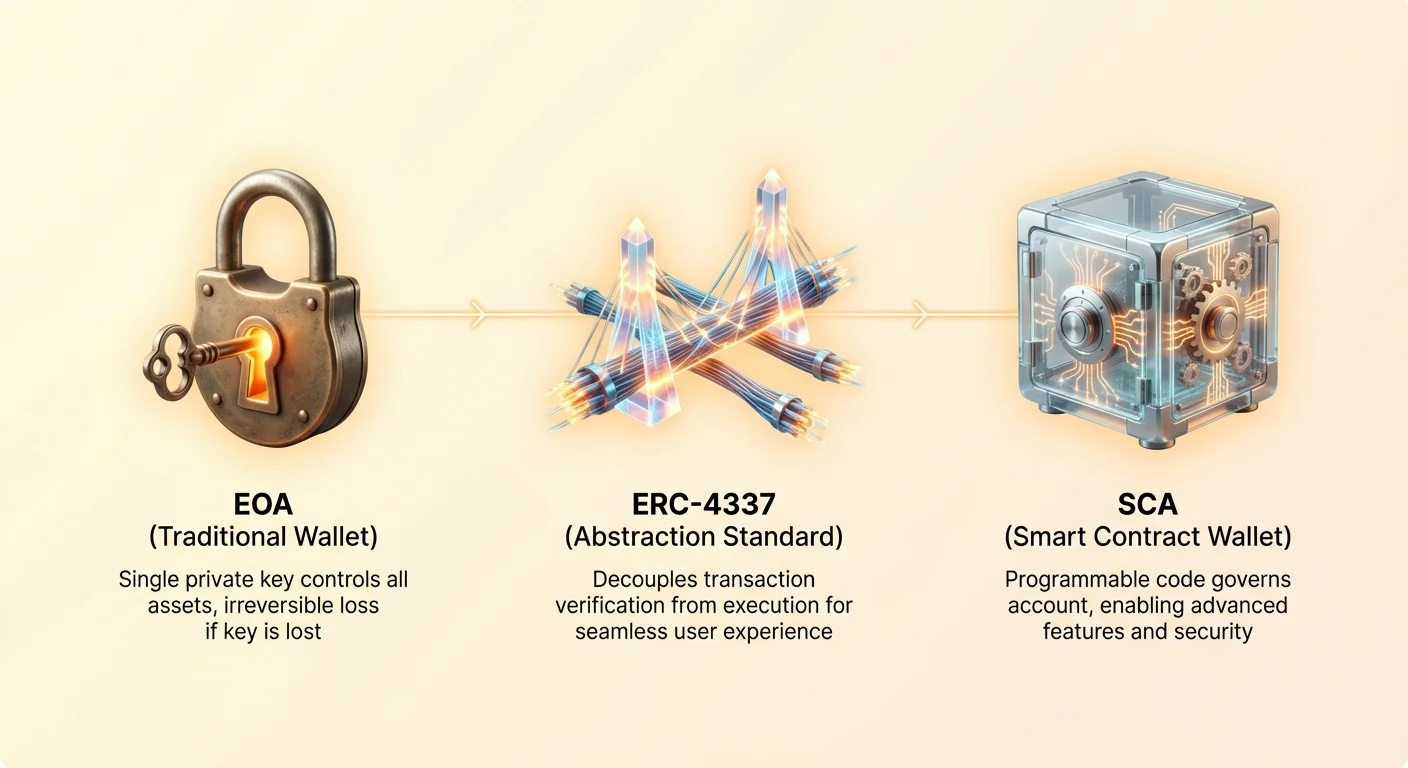
The Foundation: Understanding the EOA vs. Smart Contract Wallet Difference
Before diving into the complexities of Account Abstraction, it is crucial to understand the two fundamental ways an address can exist on the Ethereum network (and similar EVM-compatible chains).
Externally Owned Accounts (EOAs): The Status Quo
An EOA is the most common type of crypto account, exemplified by traditional wallets like MetaMask or Trust Wallet. An EOA is defined by a single private key.
Key Characteristics of EOAs:
- Direct Control: The private key is the only thing that proves ownership. The user must manually generate and securely store a mnemonic (seed phrase) derived from this key.
- Stateless: EOAs cannot execute internal code or logic. They are only capable of initiating transactions (sending funds or interacting with a contract).
- Mandatory Gas: Every transaction initiated by an EOA must be paid for in the network’s native currency (e.g., ETH on Ethereum). If the EOA runs out of ETH, all activity halts, regardless of how much USDT or USDC it holds.
- Irreversible Loss: If the private key or seed phrase is lost, there is no technical mechanism for recovery; the funds are permanently locked.
Smart Contract Accounts (SCAs): Code-Driven Ownership
A Smart Contract Account (SCA)—the foundation of Account Abstraction—is not defined by a private key but by the immutable code deployed at its address. SCAs are accounts governed by programmatic rules.
Key Characteristics of SCAs:
- Logic-Based Verification: Instead of checking for a simple signature (like an EOA), an SCA runs code to verify if a transaction is legitimate. This verification can involve multi-signature checks, time locks, spending limits, or social verification protocols.
- Programmable Security: Since SCAs are code, security features like daily spending limits, automatic key rotation, or white-listed transaction recipients can be built directly into the account.
- Account Flexibility: SCAs allow for features that were previously impossible for simple accounts, leading directly to the advanced UX features discussed below.
The core difficulty in implementing SCAs across Ethereum was standardizing how the underlying network (the decentralized validators) would interact with these programmable accounts. This standardization challenge is solved by ERC-4337.
ERC-4337: The Key to True Account Abstraction
While smart contract wallets have existed for years (often referred to as "multisig" wallets), they required significant changes to the core Ethereum protocol to function seamlessly. ERC-4337 changes this by creating a parallel system that handles the logic without changing the core network rules. This proposal is the engine driving the current wave of AA innovation.
How ERC-4337 Decouples Verification from Execution
ERC-4337 introduces the concept of a "UserOperation" (UserOp).
Think of a standard EOA transaction as a single, direct instruction to the blockchain. A UserOp, conversely, is a special object that describes what the user wants to do. This object is then processed by specialized actors in the network.
- The UserOperation (UserOp): This is the intent. It specifies the recipient, the desired action, and importantly, the fee and verification method. Crucially, the UserOp is standard, regardless of the unique logic governing the specific smart contract wallet.
- Bundlers: These are nodes that gather multiple UserOps from various smart contract accounts. They package these UserOps into a single, valid EOA transaction and submit it to the standard Ethereum network. The Bundler essentially acts as the traffic controller that introduces the UserOp into the blockchain.
- The Entry Point Contract: This contract is the universal gateway on the blockchain. When a Bundler submits a transaction containing UserOps, the Entry Point contract verifies the signature (using the SCA’s logic) and ensures the fees are paid. If valid, the Entry Point executes the action.
By moving the complexity of account validation and fee payment off-chain and standardizing it through the UserOp format, ERC-4337 achieves Account Abstraction without needing a disruptive protocol upgrade.
Key Components: UserOperations and Paymasters
Two components introduced by ERC-4337 are critical for enhancing the user experience: the UserOp (as detailed above) and the Paymaster.
The Paymaster
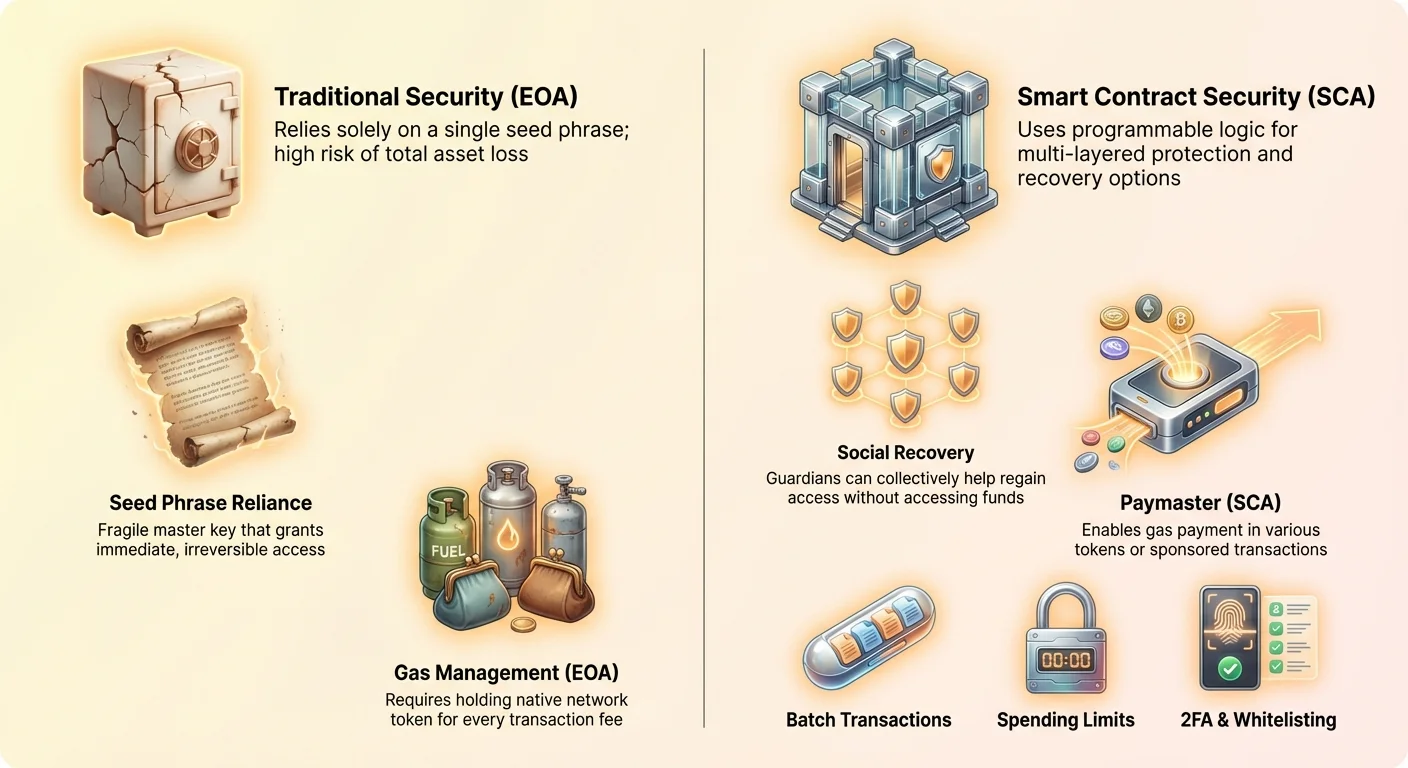
The Paymaster is a smart contract that grants the ability for accounts to pay for gas in novel ways. The Paymaster can sponsor transactions or allow users to pay transaction fees in tokens other than the network's native currency (e.g., paying gas fees in USDC, DAI, or even an application-specific token).
Practical Applications of the Paymaster:
- Gas Sponsoring: A decentralized application (dApp) or a corporate entity can choose to pay the gas fees for its users entirely. This eliminates the "cold start" problem for new users who don't yet own the native token (ETH).
- Token Conversion: The Paymaster can automatically swap a small portion of the user's stablecoin holdings to cover the necessary ETH gas fee, making gas management invisible to the user.
This functionality is arguably the single most important step toward making blockchain transactions feel like standard web payments, eliminating the need for users to constantly manage a separate gas reserve.
Revolutionary User Experience (UX) Improvements
The technical abstraction provided by ERC-4337 translates into immediate, tangible benefits for users, fundamentally reshaping how we interact with DeFi and dApps. These features directly address the clunky, multi-step processes that currently deter mass adoption.
Simplified Gas Management (Paymasters and Gas Sponsoring)
As noted, the Paymaster function is a massive UX win. For newcomers, the requirement to always hold ETH for fees, even if they only transact in stablecoins, is confusing and cumbersome.
With a smart contract wallet utilizing a Paymaster, the experience becomes seamless:
- Fee Payment Flexibility: A user can hold only USDC and still execute a complex token swap, with the Paymaster handling the micro-conversion required for the ETH gas.
- Zero-Fee Experience: For loyalty programs or subsidized applications, the dApp itself can act as the Paymaster, absorbing the transaction costs for its users. This allows services to offer promotional free transactions, similar to how traditional apps absorb payment processing costs.
Batch Transactions and Single-Click Swaps
In a traditional EOA environment, interacting with decentralized finance (DeFi) often requires multiple sequential approvals. For example, depositing tokens into a yield farm usually requires:
- Transaction 1: Approving the DeFi protocol to spend your token.
- Transaction 2: Approving the stablecoin transfer (if swapping).
- Transaction 3: Depositing the funds into the protocol.
Smart Contract Wallets use Account Abstraction to combine these steps into a single, atomic UserOperation.
How Batching Works:
The smart contract account verifies one signature and, based on that verification, executes a sequence of pre-approved actions in a single blockchain block. This dramatically speeds up interactions, reduces the potential for user error, and minimizes total gas costs by bundling multiple actions into one transaction.
Account Abstraction and L2 Scaling
Layer 2 (L2) solutions like Arbitrum and Optimism have already made transactions faster and cheaper. Account Abstraction complements L2s perfectly, focusing on usability rather than just speed and cost.
For advanced users and developers, the standardized nature of ERC-4337 means that the complex logic (social recovery, multi-factor authentication, etc.) is consistent across different L2 networks. This significantly streamlines cross-chain application development and makes asset bridging more intuitive.
For example, a user could have a smart contract wallet that implements a specific spending limit ($500 per day) across all integrated L2 networks, managed by one central piece of logic, simplifying risk management significantly.
Enhanced Security: The Power of Social Recovery
Perhaps the greatest benefit of the smart contract wallet is the elimination of the absolute reliance on the seed phrase. Account Abstraction enables highly advanced, logic-driven security features that far exceed the capabilities of EOAs.
Traditional Recovery vs. Social Recovery Explained
Traditional EOA Recovery: Recovery relies entirely on the seed phrase. If it’s lost, stolen, or compromised, the account is lost. This is a single point of catastrophic failure.
Social Recovery (SCA): This system uses a network of trusted individuals or devices (called "Guardians") to help a user regain access to their account if they lose their primary key (or device).
Instead of storing a master private key that grants immediate access, the smart contract wallet requires a certain consensus threshold from the Guardians to execute an action, such as changing the owner’s primary signing key.
Guardians and Security Thresholds
Social recovery is highly customizable. A user might set up the following structure:
- Guardians: Five trusted individuals (e.g., family members, close friends, or even a second device owned by the user).
- Threshold: A minimum of three out of five Guardians must approve the recovery transaction.
If the user loses their phone (and thus their primary signing key), they simply reach out to three Guardians. These Guardians use their own wallets (which can still be EOAs) to sign a message allowing the smart contract to replace the old lost key with a new, fresh one. The Guardians never have direct access to the user's funds; they only have the power to help reset the access mechanism.
Implementing Security Features: Multi-Factor Authentication and Spending Limits
Because SCAs are programmable, they can implement sophisticated security features that mimic familiar web2 patterns:
- Two-Factor Authentication (2FA): A standard EOA only needs one signature. An SCA can require two: a primary signature from the user's phone and a second signature from a dedicated hardware device, or even a time-based code generated by a known app.
- Whitelisting: Users can program their SCA to only allow interaction with pre-approved, safe contracts or addresses (like their primary centralized exchange withdrawal address). Any transaction attempt outside this whitelist would be automatically rejected by the contract’s logic.
- Spending Caps: Users can set daily or weekly spending limits. For example, transactions under $1,000 might execute immediately, while transactions over that amount automatically trigger a 24-hour time lock or require approval from a Guardian, adding a vital layer of protection against theft.
The EOA Migration Path: Moving to Account Abstraction
For the millions of existing users currently relying on traditional EOA wallets, the transition to Account Abstraction is not about destroying the old wallet, but rather using it as a bootstrap mechanism for the new, smarter account.
Why Migration is Necessary (The Limitations of EOA)
While EOAs are currently necessary to pay for gas and interact with basic infrastructure, they are static and unadaptable. They cannot incorporate features like social recovery or paymaster functionality because those features require executable code, which EOAs lack.
The migration path involves shifting the primary point of self-custody and daily activity from the simple EOA address to a more secure, feature-rich Smart Contract Account address.
Practical Steps for Transitioning Assets
The EOA migration process is typically straightforward and involves three main steps:
- Deployment: Using your existing EOA (e.g., MetaMask), you fund and deploy the code for your new Smart Contract Wallet. This is usually done through a dedicated wallet application interface (like Safe or Argent), which handles the technical deployment details.
- Initial Funding: Once the SCA is deployed, the user transfers the majority of their assets (tokens, NFTs, DeFi positions) from their old EOA address to the new SCA address.
- Bootstrap Maintenance: The old EOA is retained, but only in a minimal capacity. It often serves as the initial "owner" or key for the SCA, or simply remains available to fund the minimal gas required to initiate the occasional maintenance or emergency recovery process for the new SCA. The goal is to minimize the amount of value stored directly in the insecure, unrecoverable EOA.
Choosing the Right Smart Contract Wallet
As Account Abstraction matures, different wallet implementations are emerging, each offering varying levels of security and feature sets. When choosing a smart contract wallet, power users and developers should consider:
- Open Source Auditability: Is the underlying contract code open source and regularly audited? Since the funds are governed by code, trust in that code's security is paramount.
- Recovery Options: What specific recovery mechanisms are offered? Is it strictly social recovery, or is there an option for hardware key integration or multi-sig approval?
- Interoperability: How well does the wallet integrate with different dApps and Layer 2 ecosystems? Ensure it supports the networks and applications you use most often.
- Paymaster Integration: Does the wallet support paying gas in alternate tokens, and does it provide native gas sponsoring for certain transactions?
The migration represents a philosophical shift: moving from relying solely on secret words to relying on transparent, verified smart contract logic to protect assets.
Conclusion
The shift from Externally Owned Accounts to Smart Contract Accounts powered by ERC-4337 is not merely an upgrade; it is an evolution that addresses the most significant barriers to cryptocurrency adoption. Account Abstraction moves the blockchain experience from a risky, technical niche to a robust, programmable financial layer.
By enabling features like seamless social recovery, flexible gas payment, and atomic batch transactions, smart contract wallets promise to deliver a user experience that is safer, more intuitive, and highly customizable. For developers, this standard provides a predictable framework for building applications that abstract away blockchain complexity. For users, it offers genuine self-sovereignty without the persistent, paralyzing fear of losing a 12-word seed phrase—a crucial step toward realizing the promise of decentralized finance for everyone.