
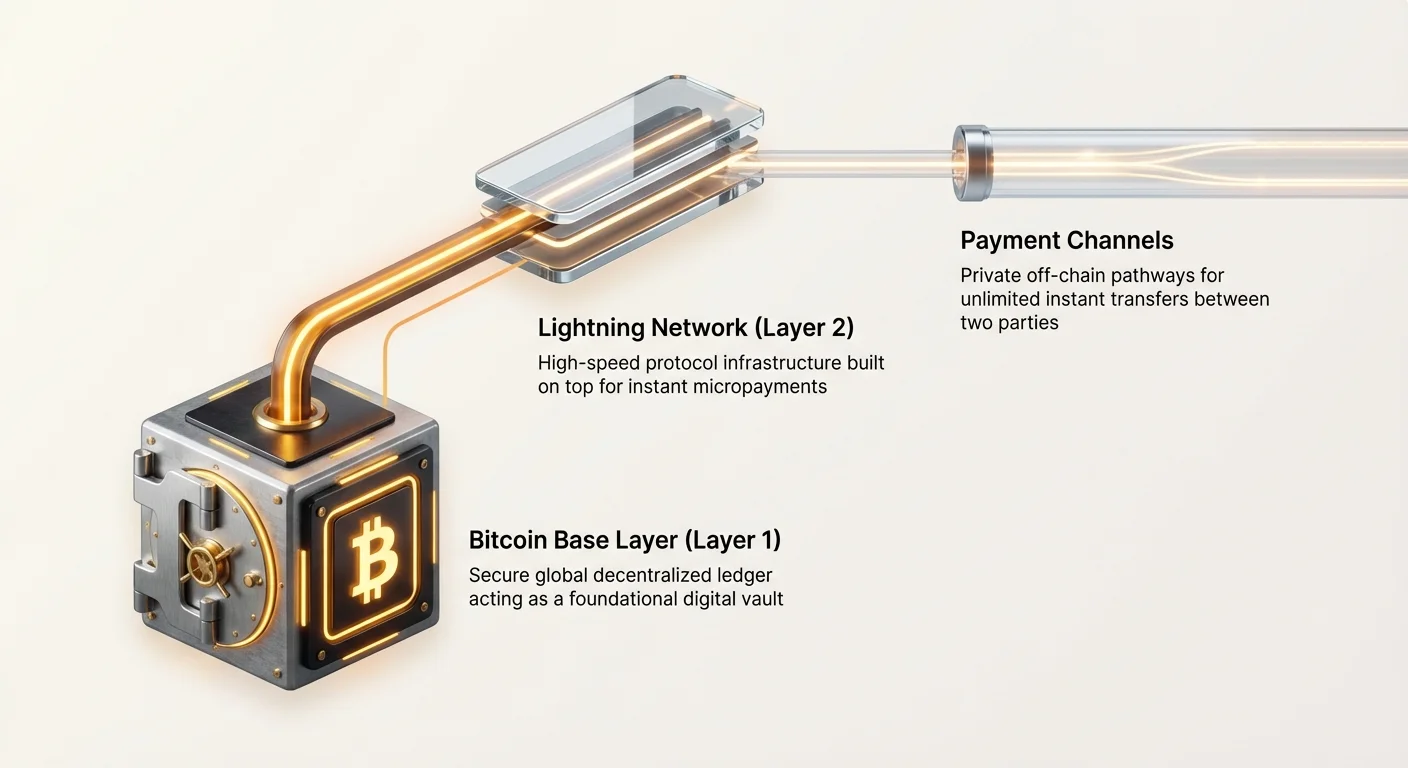
If Bitcoin is the secure, foundational “store of value” layer—like a massive, decentralized digital vault—then the Lightning Network (LN) is the high-speed rail system built on top of it. The primary Bitcoin blockchain is secure but slow and expensive for everyday coffee purchases or microtransactions. The Lightning Network solves this by creating a second layer that allows for near-instant, low-cost transfers of Bitcoin (BTC).
While the speed and affordability of the Lightning Network make Bitcoin practical for daily use, these benefits introduce a new set of challenges that users must navigate. Unlike traditional Bitcoin wallets, Lightning wallets require careful consideration of channel management, transaction liquidity, and security trade-offs related to being constantly connected to the internet.
This comprehensive guide breaks down the mechanics of Lightning wallets, focusing specifically on the technical hurdles of maintaining liquidity and managing custody. Understanding these dynamics is crucial for anyone looking to utilize the Lightning Network effectively, whether you are a high-volume shopper or simply seeking the lowest fees for small transfers.
The Need for Speed: Understanding the Lightning Network
The Lightning Network is a "Layer 2" scaling solution—meaning it doesn't change Bitcoin's fundamental security rules, but rather builds infrastructure on top of it to handle high transaction volumes off-chain.
Bitcoin’s Scaling Challenge
The core Bitcoin blockchain (Layer 1) processes transactions in blocks, roughly every ten minutes. This system is robust and secure, but limited in capacity. When network usage is high, transactions can become expensive and confirmations can take a long time (minutes or even hours).
The Lightning Network bypasses this bottleneck by moving transactions off the main blockchain. It achieves this using a system of payment channels. Think of a payment channel as a temporary, pre-funded tab between two parties.
Channels, Not Blocks: How LN Works
A Lightning channel is established by both parties locking a small amount of BTC into a multisig (multi-signature) address on the main Bitcoin blockchain. This is the only time the main chain is involved in opening the channel.
Once the channel is open, the two parties can send millions of transactions back and forth instantly and privately. They simply update a final shared ledger showing who owes what. No data is broadcast to the global Bitcoin network until the channel is intentionally closed. Only then does the net result of all those instant transactions get recorded as a single transaction on the main blockchain.
This system allows for phenomenal transaction velocity (speed), but it creates a specific requirement for the user: you must manage the channel and ensure you have funds flowing in the correct direction—a concept known as liquidity.
The Central Trade-Off: Custody and Convenience
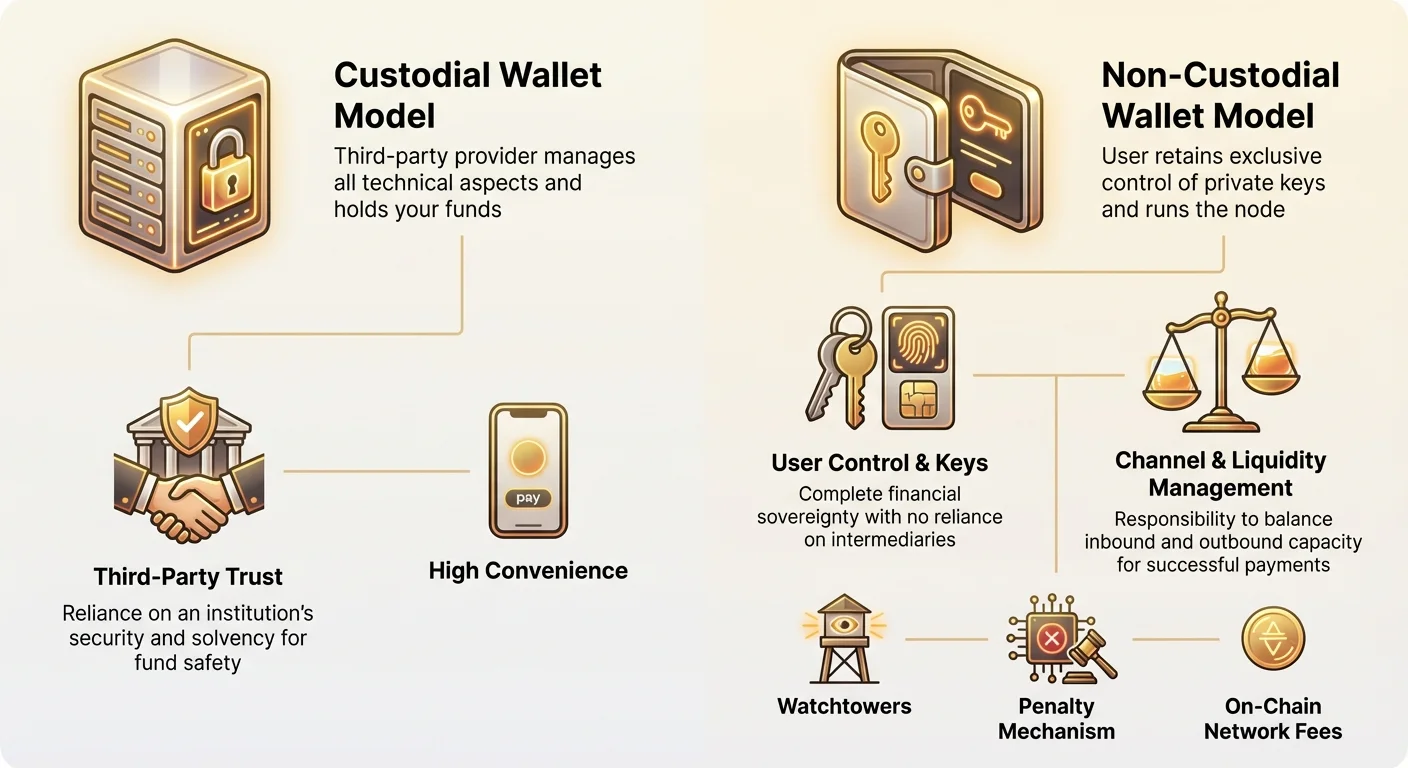
Choosing a Lightning wallet requires assessing the custody model—how you maintain control over your funds—which directly impacts how much channel maintenance you are responsible for.
Custodial Lightning Wallets Explained
Custodial wallets offer the ultimate ease of use. In this model, a third party (often an exchange or wallet provider) manages the complexity of the Lightning Network for you.
When you deposit BTC into a custodial Lightning wallet, you are effectively sending your funds to the provider’s main wallet. The provider then handles all the complex routing, channel opening, and channel closing.
The Trade-Off: Convenience for Trust
- Pros: Instant setup, zero channel management responsibility, simple user experience (feels just like a payment app), and often better uptime and liquidity provided by the institution.
- Cons: You sacrifice sovereignty. The wallet provider holds the private keys and controls the funds. If the provider is hacked, shut down, or decides to freeze your assets, your funds are at risk. This violates the core tenet of Bitcoin: self-sovereignty.
Custodial Lightning wallets are ideal for beginners, users making very small, frequent purchases (micropayments), or those who value convenience above all else, provided they only hold small, expendable amounts of BTC in the wallet.
Non-Custodial (Self-Sovereign) Lightning Wallets
Non-custodial, or self-custody, wallets ensure that only you hold the private keys. If you control the keys, you control the Bitcoin. This is the preferred method for anyone prioritizing security and financial freedom.
However, operating a non-custodial Lightning wallet means you assume full responsibility for channel management and liquidity. The wallet software helps, but the fundamental structure requires user involvement.
The Trade-Off: Control for Complexity
- Pros: Full control over your funds; no reliance on third-party trust; aligns with Bitcoin’s decentralized ethos.
- Cons: Requires technical knowledge to set up and maintain channels; you are responsible for ensuring adequate liquidity; requires the device to be consistently online to monitor channels (or requires the use of specialized services like Watchtowers, discussed below).
The Hidden Complexity: Liquidity and Channel Management
The unique technical hurdle of the Lightning Network is managing liquidity. This is the aspect most beginners overlook, leading to failed transactions or high costs.
What is Lightning Liquidity?
Liquidity, in the context of Lightning, refers to the capacity available within your open payment channels to send and receive funds.
Imagine you open a channel with a coffee shop and fund it with 0.01 BTC. This 0.01 BTC is the channel’s total capacity.
- Outbound Liquidity: If you send 0.001 BTC to the shop, you still have 0.009 BTC left on your side of the channel to send out.
- Inbound Liquidity: The coffee shop now has 0.001 BTC on their side of the channel, which they can send out to you or other connected nodes. For you to receive a payment, you need "inbound liquidity"—meaning someone else must have capacity on their side of the channel they can push to you.
If you spend all your capacity, your channel has zero outbound liquidity, and you cannot send any more funds until the channel balance is replenished (either by receiving funds or closing and reopening the channel). For self-custody wallets, achieving stable inbound liquidity can be challenging, often requiring you to pay other nodes to open channels to you.
Opening and Closing Channels: The On-Chain Cost
To use the Lightning Network, you must first interact with the main Bitcoin blockchain (Layer 1) to create and later settle the payment channels.
- Opening a Channel: This requires a Layer 1 BTC transaction, which incurs a standard Bitcoin network fee. If fees are high, opening a channel can be costly.
- Closing a Channel: When you decide to settle the total balance and record it on the main chain, another Layer 1 transaction fee is paid.
This necessity means the Lightning Network is not entirely free. It minimizes transaction fees after the channel is open, but requires an initial and final on-chain investment. If you open and close channels frequently, the cumulative network fees can easily negate the savings on transaction fees.
Automatic vs. Manual Channel Management
The biggest differentiator between non-custodial wallets is how they handle channel creation and maintenance:
1. Automatic Management (Non-Custodial, Managed)
Some self-custody wallets attempt to hide the complexity. They often use "zero-configuration" setups, relying on a trusted third-party service provider (like a service run by the wallet company) to automatically open, route, and balance your channels when you need them.
- Benefit: Easier setup, better performance for beginners.
- Trade-Off: You might incur hidden channel-management fees, and you still rely on the third-party provider’s operational efficiency for optimal routing. While they don't hold your private keys, they manage your connectivity.
2. Manual Management (Self-Sovereign, Node Operation)
This is typically reserved for highly technical users running their own Bitcoin and Lightning nodes. They select specific peers to connect with, strategically fund channels for better routing, and actively manage their liquidity balances.
- Benefit: Maximum sovereignty, potentially lowest fees, and contribution to network decentralization.
- Trade-Off: Extremely high technical complexity and time commitment required.
Mitigating Risk: Security Mechanisms on the Lightning Network
While Bitcoin Layer 1 security relies on complex cryptographic proof of work, Lightning security relies heavily on timeliness and constant monitoring.
The fundamental security mechanism of a Lightning channel is called the Penalty Mechanism. If one party attempts to settle an old, favorable channel state (i.e., tries to "cheat" by claiming they have more funds than they do), the honest party can publish the most recent transaction state to the Bitcoin blockchain. If the honest party does this within a specified time window, the cheater is severely penalized, losing all funds in the channel to the honest party.
The Importance of Being Online (The Fraud Window Problem)
This penalty mechanism means that a critical component of Lightning security is the ability to monitor the main Bitcoin blockchain frequently.
If you are using a non-custodial wallet and your device is offline for an extended period, you might miss a crucial window to detect and penalize a cheating counterparty. If a rogue peer publishes an old channel state and the time window for rebuttal expires, the cheat is successful, and your funds are lost.
For users prioritizing sovereignty, this creates a major logistical problem: how can they ensure their channels are monitored 24/7 without needing to keep their phone or computer running constantly?
Watchtowers: Delegating Fraud Protection
This problem is solved through Watchtowers—a dedicated security feature designed for the Lightning Network.
A Watchtower is a third-party service, often run by dedicated nodes, that you can outsource monitoring to.
How Watchtowers Bitcoin Function:
- When you open a channel, you delegate a small, encrypted piece of data to one or more Watchtowers.
- If your counterparty attempts to cheat while your wallet is offline, the Watchtower detects the fraudulent transaction broadcast to the Bitcoin main chain.
- The Watchtower uses the encrypted data you provided to construct the valid, punishing transaction and broadcasts it to the network on your behalf.
- The Watchtower ensures the penalty mechanism is executed, securing your funds, even while your physical device is asleep.
Watchtowers are a crucial component of lightning network wallet security for non-custodial users, offering the security of an always-online node without the operational burden.
Backup and Recovery
Just like a traditional BTC wallet, a non-custodial Lightning wallet requires you to secure your seed phrase (recovery phrase). However, because Lightning funds exist in open channels off-chain, a standard Bitcoin seed phrase might only recover the total on-chain balance, not the active channel states.
Modern Lightning wallets mitigate this with Static Channel Backups (SCB), which store encrypted information about your active channels. If you lose your phone, you use your seed phrase and the SCB to tell the network to safely close your channels and return the funds to an on-chain address controlled by your recovered seed. Without proper backups, channel balances can be difficult or impossible to recover.
Choosing Your Lightning Wallet Archetype
The optimal Lightning wallet choice depends entirely on your primary use case, security maturity, and risk tolerance, aligning with the principles of the Custody Continuum.
Use Case 1: The High-Frequency Micro-Transaction User
Archetype: The Daily Shopper or Gamer Goal: Speed, lowest fees, convenience. Typical Amount Held: Small, expendable sums (e.g., less than $100 equivalent). Recommended Solution: Custodial Lightning Wallets or non-custodial wallets with heavily automated channel management.
For users who just need to use Lightning quickly—paying a friend, tipping online, or buying small digital goods—the trust involved in a custodial solution is often an acceptable trade-off for the zero maintenance and immediate operational readiness.
Use Case 2: The Self-Sovereign Investor
Archetype: The BTC Maximist or Long-Term Holder Goal: Security, full custody, and sovereignty. Typical Amount Held: Moderate to large sums that require LN usage. Recommended Solution: Non-Custodial Lightning Wallets utilizing Watchtowers and active channel management.
For this user, the complexity of managing channels, securing a seed phrase, and potentially paying for inbound liquidity is necessary to ensure they never delegate control of their private keys. They may accept slightly slower setup times in exchange for absolute control.
Practical Tips for Maximizing Liquidity
Managing lightning channel liquidity management is the key to a seamless experience.
- Start Small, Stay Balanced: If you are using a self-custody wallet, don't open one huge channel; open several smaller channels with well-connected peers (nodes) that have good reputations. This allows you to route payments more easily.
- Determine Your Role: Do you primarily send BTC (requiring outbound liquidity) or receive BTC (requiring inbound liquidity)? If you are a merchant, you need strong inbound capacity. You may need to pay a liquidity provider service to open a large channel to you.
- Use a Service: If you are non-custodial but don't want to run your own node, utilize wallets that offer LSP (Lightning Service Provider) integration. These providers handle the routing and channel creation automatically, charging a small service fee but preserving your private key control.
- Avoid Stagnant Channels: If a channel is unused for months, the liquidity is trapped, and the setup fees were essentially wasted. If fees are low, close the channel and use the BTC elsewhere.
Conclusion
The Lightning Network is critical to Bitcoin's future as a global payment rail, offering the transaction velocity and low cost necessary for mainstream adoption. However, this Layer 2 technology introduces a new set of responsibilities centered on custody and channel maintenance.
The trade-off is clear: choosing a custodial lightning wallet offers unparalleled convenience but requires trusting a third party with your funds. Choosing a self-sovereign, non-custodial wallet demands technical engagement—specifically, the need to manage liquidity and ensure security through active monitoring or delegated services like Watchtowers.
By understanding the mechanics of channel creation, the crucial role of liquidity, and the security implications of being online, new users can confidently select the Lightning wallet that best matches their transactional needs and fundamental security goals.