
Bitcoin was originally conceptualized as a peer-to-peer electronic cash system. Its primary design focused on security, decentralization, and immutability rather than complex programmability. For years, this simplicity was viewed as a trade-off necessary to maintain the network's robustness. While other blockchains launched with Turing-complete languages capable of running complex decentralized applications, Bitcoin remained intentionally limited. However, the narrative that Bitcoin cannot support smart contracts is rapidly becoming outdated. Through a combination of clever engineering, layer-2 solutions, and proposed protocol upgrades, the network is expanding its capabilities.
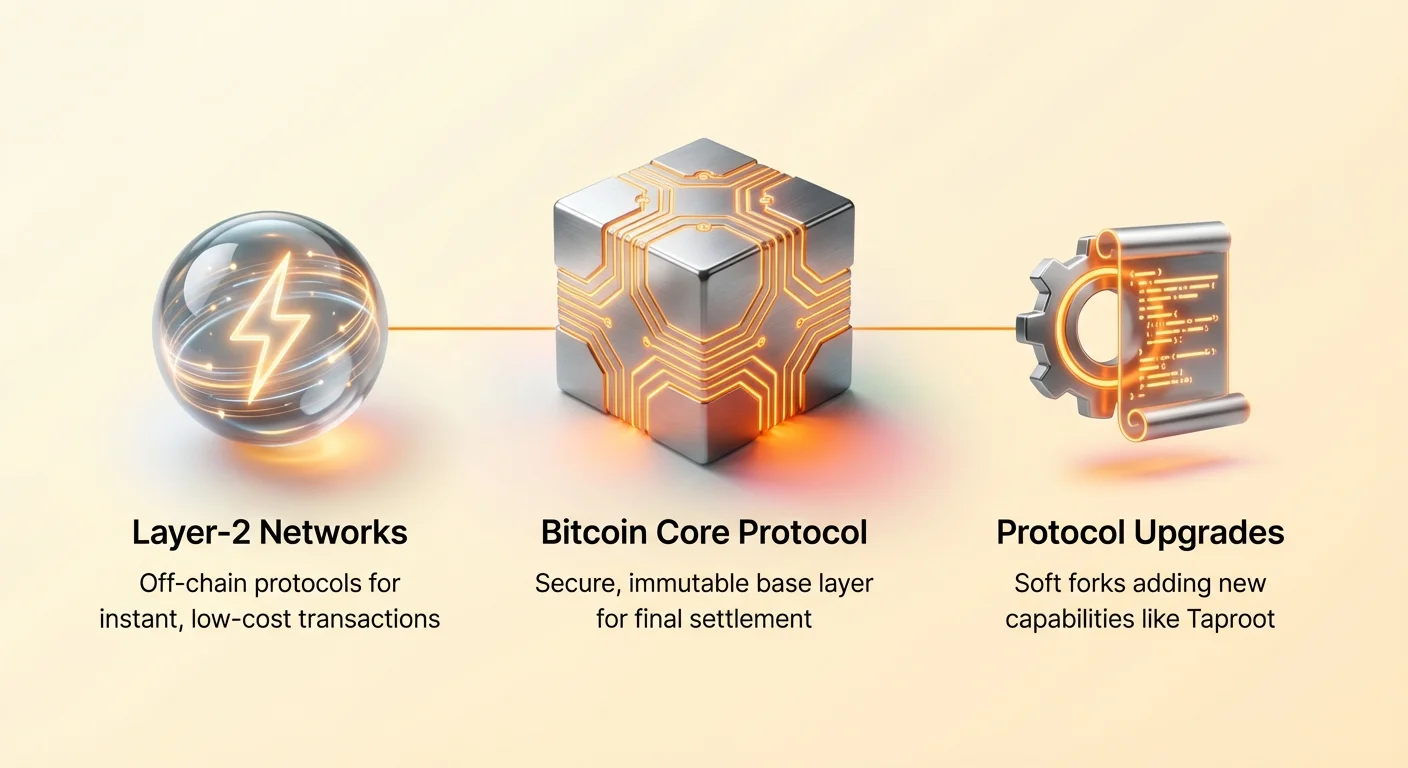
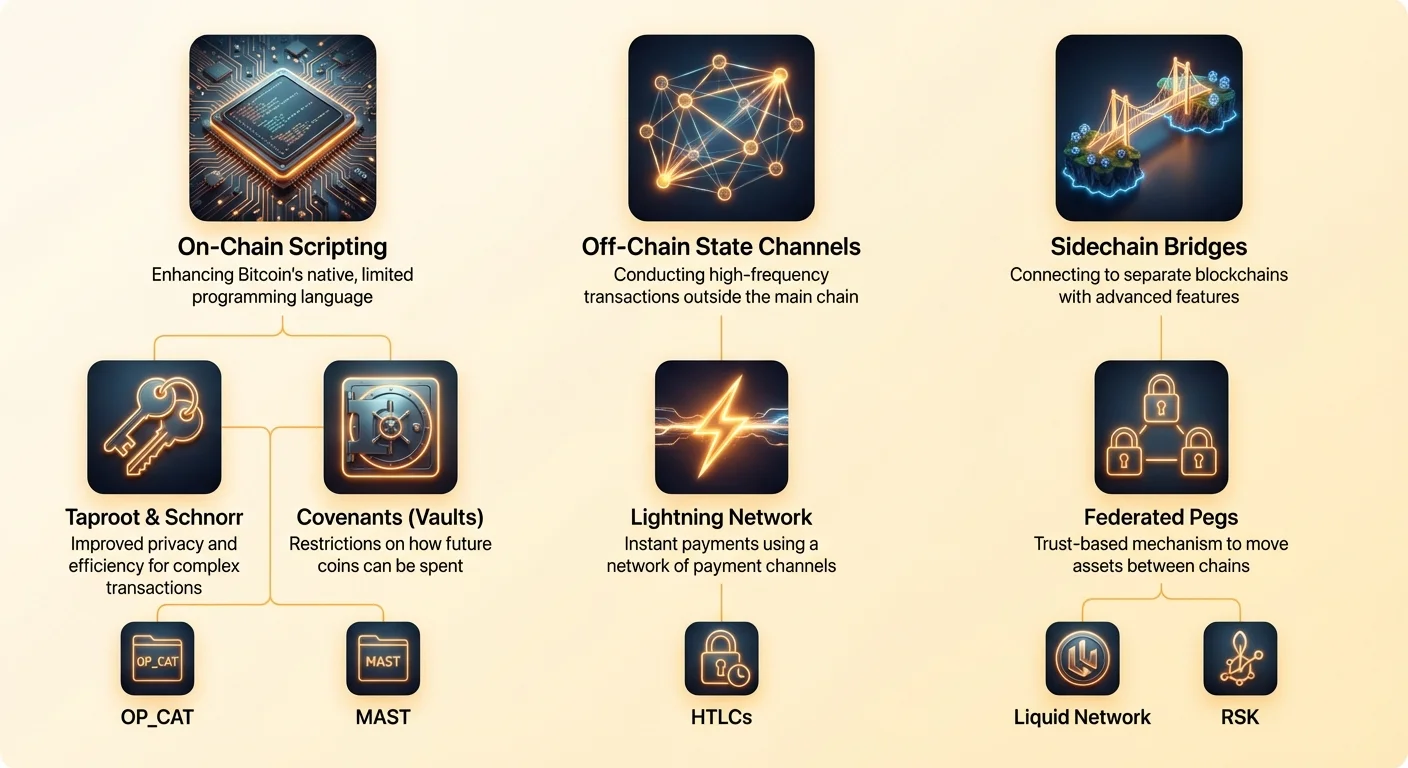
The roadmap for Bitcoin smart contracts does not rely on a single upgrade but rather a convergence of technologies. State channels have already revolutionized payment speeds, while proposed covenants could fundamentally change how ownership is defined on the blockchain. When combined with sidechains and bridge technologies, these advancements create a layered ecosystem. This approach preserves the security of the base layer while moving complex execution off-chain or into secondary protocols. The result is a modular architecture where Bitcoin serves as the ultimate settlement layer for a vibrant economy of smart contracts.
Foundational Upgrades: SegWit and Taproot
The path toward a more programmable Bitcoin began with critical upgrades to the base protocol. These changes solved technical debt and introduced new cryptographic tools. Without these foundational steps, modern innovations like the Lightning Network or Ordinals would not be possible.
Segregated Witness
Implemented in 2017, Segregated Witness, or SegWit, was a pivotal moment in Bitcoin’s history. Its primary goal was to fix transaction malleability, a bug that allowed transaction identifiers to be altered before confirmation. This issue made it risky to build second-layer protocols that relied on unconfirmed transactions. By separating the digital signature, or "witness" data, from the transaction data, SegWit and Witness Data solved this vulnerability permanently.
Beyond security, SegWit introduced a block weight parameter that effectively increased the block size limit. This allowed for more transactions to fit into a single block, improving throughput. Crucially, this separation of data laid the necessary groundwork for the Lightning Network. It also introduced a versioning system for Bitcoin script, allowing developers to add new functionality in the future without disrupting existing nodes.
Taproot and Schnorr Signatures
Activated in November 2021, Taproot represented the next major leap forward. This upgrade bundled three Bitcoin Improvement Proposals to enhance privacy and efficiency. A key component was the introduction of Schnorr signatures. Unlike the previous signature scheme, Schnorr signatures are linear. This property allows multiple signatures to be aggregated into a single one. For multi-signature wallets or complex smart contracts involving many parties, the on-chain footprint is significantly reduced.
Taproot also introduced Merkelized Abstract Syntax Trees, or MAST. Before MAST, a smart contract with multiple spending conditions required the entire script to be revealed on the blockchain. This was inefficient and bad for privacy. With MAST, users only need to reveal the specific condition that was met to spend the funds. The rest of the logic remains hidden. This makes complex smart contracts indistinguishable from regular transactions, improving privacy and fungibility while lowering fees.
State Channels and the Lightning Network
State channels represent one of the most established methods for scaling Bitcoin and enabling smart contract logic off-chain. The Lightning Network is the primary implementation of this technology. It utilizes a network of payment channels to facilitate instant, low-fee transactions. By keeping the majority of activity off the main blockchain, it allows Bitcoin to scale to millions of transactions per second theoretically.
How Channels Work
A payment channel opens when two parties commit a specific amount of Bitcoin into a multi-signature address on the main chain. This initial transaction is the "anchor" that secures the channel. Once the funds are locked, the two parties can transact back and forth instantly. These transactions are essentially updated balance sheets signed by both parties. Because these updates are not broadcast to the Bitcoin network, they incur no mining fees and confirm instantly.
The smart contract logic here ensures that neither party can cheat. If one user tries to broadcast an old balance state that favors them, the protocol has a built-in penalty mechanism. This allows the honest party to claim all the funds in the channel. This security model incentivizes honest behavior without requiring a trusted third party. The channel only interacts with the Bitcoin blockchain again when the parties decide to close it. At that point, the final balance is recorded on-chain.
Routing and Settlement
The true power of the Lightning Network lies in its routing capability. Users do not need a direct channel with everyone they wish to pay. The network finds a path through connected nodes to route the payment from sender to receiver. This creates a web of interconnected channels. The technology relies on Hashed Time-Locked Contracts (HTLCs) to ensure payments are atomic. This means the payment either succeeds completely or fails completely, with no risk of funds getting stuck in transit.
| Feature | On-Chain Transaction | Lightning Network Transaction |
|---|---|---|
| Speed | ~10 minutes (block time) | Milliseconds (instant) |
| Cost | Variable mining fees | Negligible routing fees |
| Privacy | Public ledger history | Private between parties |
This architecture transforms Bitcoin from a slow settlement layer into a platform for high-frequency programmable payments. Developers are building applications on Lightning that go beyond simple transfers. These include streaming payments for content, instant decentralized exchanges, and gaming applications where every action triggers a micro-transaction.
The Frontier of Covenants and OP_CAT
While state channels handle payments, the developer community is actively exploring ways to enhance Bitcoin’s scripting language itself. The goal is to enable "covenants," which are mechanisms that restrict how bitcoins can be spent in the future. Alongside covenants, there is renewed interest in restoring specific opcodes, such as OP_CAT, which were removed in the early days of Bitcoin.
Understanding Covenants
In standard Bitcoin transactions, the script only verifies that the sender has the authority to move the coins. It generally does not control where the coins go or how they are used after the transaction. Covenants change this paradigm. They allow a user to place specific conditions on the future use of the funds. For example, a covenant could dictate that a certain set of coins can only be sent to a specific whitelist of addresses.
This capability opens the door for "vaults." A vault is a security setup where, if a hacker steals your keys and tries to move your coins, the transaction enters a waiting period. During this time, the rightful owner can use a pre-specified recovery key to "claw back" the funds to a secure wallet. Covenants could also enable congestion control, where transaction batches are confirmed but the ability to spend the individual outputs is delayed until fees are lower.
The Return of OP_CAT
OP_CAT is a specific operation code that stands for "concatenate." It allows two pieces of data to be joined together within the Bitcoin script stack. It was available in the original Bitcoin software but was disabled by Satoshi Nakamoto in 2010 due to concerns over potential memory usage attacks. With modern understanding and security limits, developers are proposing the Case for OP_CAT reintroduction.
Re-enabling OP_CAT would vastly expand what is possible with Bitcoin Script. It would allow scripts to inspect and manipulate transaction data more deeply. This is a prerequisite for verifying complex proofs, such as those used in Zero-Knowledge Rollups. By enabling the concatenation of data, OP_CAT would allow developers to build bridges that are trust-minimized. It simplifies the creation of decentralized applications by reducing the complexity required to verify external data on-chain.
Sidechains and Layer-2 Protocols
Sidechains offer an alternative approach to bringing smart contracts to Bitcoin. A sidechain is a separate blockchain that runs in parallel to Bitcoin. It has its own consensus rules and features but maintains a connection to the main Bitcoin network via a two-way peg. This allows users to move assets between the chains, leveraging the security of Bitcoin while utilizing the advanced features of the sidechain.
The Sidechain Model
Sidechains like the Liquid Network and Rootstock (RSK) have been operational for years. Liquid focuses on faster settlements and confidential transactions for exchanges and institutions. RSK creates an Ethereum-compatible environment where developers can write smart contracts using Solidity. Since RSK is merge-mined with Bitcoin, it benefits from the hash power of the Bitcoin network without requiring miners to run additional hardware.
The bridge mechanism is the most critical component of a sidechain. To move bitcoin to a sidechain, coins are locked on the main network. Simultaneously, a corresponding amount of tokens is minted on the sidechain. When the user wants to return, the tokens are burned, and the main chain funds are unlocked. The security of this peg often relies on a federation of functionaries or a group of signers, which introduces a different trust model compared to the base layer.
Rollups and Validity
Looking forward, the industry is exploring "rollups" on Bitcoin. Rollups process transactions off-chain and bundle them into a single proof that is submitted to the main chain. This is similar to how Ethereum scaling works. However, Bitcoin currently lacks the ability to natively verify the validity proofs used by ZK-rollups. This is where upgrades like OP_CAT become relevant.
If Bitcoin can verify these proofs, it would allow for "sovereign rollups." These layers would inherit the full security of Bitcoin’s Proof-of-Work without requiring a trusted federation. Users could execute complex smart contracts on the rollup, knowing that the state of the system is mathematically anchored to Bitcoin blocks. This would bring Turing-complete programmability to the ecosystem while keeping the main chain focused on being sound money.
Bridging Bitcoin to Other Ecosystems
While Bitcoin upgrades are slow and deliberate, the demand for using BTC in decentralized finance (DeFi) is immediate. This has led to the creation of wrapped assets. Wrapped Bitcoin allows BTC to be represented on other blockchains, such as Ethereum, Solana, or various Layer-2 networks. This integration brings Bitcoin’s massive liquidity into ecosystems that already possess advanced smart contract capabilities.
Centralized Wrapping
The most common form of this is Wrapped Bitcoin (WBTC). In this model, a user sends bitcoin to a centralized custodian. The custodian holds the asset in a secure reserve and mints an equivalent ERC-20 token on Ethereum. This token can then be used in lending protocols, decentralized exchanges, and yield farming applications. While efficient, this model reintroduces counterparty risk. Users must trust the custodian and the merchant to manage the reserves honestly and securely.
Recently, other entities have entered this space, such as Coinbase with cbBTC. These products offer seamless integration for users of centralized exchanges. They allow for quick movement between the Bitcoin network and high-performance smart contract chains like Base. However, the reliance on a single company for custody contradicts the decentralized ethos of Bitcoin. If the custodian were to freeze assets or suffer a security breach, the value of the wrapped tokens could decouple from the underlying bitcoin.
Decentralized Thresholds
To address the centralization risks of WBTC, protocols like tBTC have been developed. tBTC uses a decentralized network of nodes to manage the Bitcoin peg. Instead of a single company holding the keys, the system uses threshold cryptography. The private key required to unlock the bitcoin is split among a randomly selected group of node operators. No single operator has access to the full key or the funds.
This system is permissionless and resistant to censorship. Users can mint and redeem tBTC without needing approval from a merchant or providing personal identification. The nodes are economically incentivized to act honestly through collateral requirements. If they behave maliciously, their staked assets are slashed. This creates a robust bridge that aligns more closely with Bitcoin’s principles of trust minimization and decentralization.
Innovations in On-Chain Data: Ordinals and Fractals
Beyond financial smart contracts, Bitcoin is experiencing a renaissance in on-chain data usage. The Ordinals protocol, launched in early 2023, unlocked the ability to inscribe arbitrary data onto individual satoshis. This innovation leveraged the SegWit and Taproot upgrades in ways that were not originally anticipated by the developers.
Inscriptions via Ordinals
Ordinals allow digital artifacts, such as images, text, and code, to be stored directly on the Bitcoin blockchain. Unlike NFTs on other chains that often point to external servers, Ordinal inscriptions are immutable and permanent. The data lives in the witness portion of the transaction. Because Taproot removed the data limits on witness data, users can inscribe relatively large files.
This has created a new market for digital collectibles and even rudimentary applications stored on-chain. While controversial due to the increased demand for block space, Ordinals have proven that there is significant demand for using Bitcoin for more than just currency transfers. It has revitalized the developer ecosystem and increased miner revenue through transaction fees.
Fractal Scaling
As block space becomes more valuable, scaling solutions like Fractal Bitcoin are emerging. Fractal Bitcoin proposes a virtualization method to scale the network. It recursively creates layers that mimic the structure of the main Bitcoin chain. These "fractals" can process transactions independently while remaining connected to the primary network security.
This concept differs from traditional sidechains or shards. It attempts to use the core Bitcoin code itself to create infinite scaling layers. By keeping the engineering consistent with Bitcoin Core, it lowers the barrier for developers. They can build applications that run on a fractal layer without needing to learn entirely new programming languages or consensus mechanisms. This approach aims to handle high-volume use cases without clogging the main settlement layer.
The Governance of Protocol Upgrades
Implementing changes like covenants or OP_CAT requires navigating Bitcoin’s governance process. Bitcoin has no CEO or board of directors. Evolution happens through rough consensus among developers, miners, node operators, and economic stakeholders. The primary mechanism for this is the Bitcoin Improvement Proposal (BIP) process.
A proposal begins as a draft where technical details are debated publicly. It must undergo rigorous peer review and testing. Once the technical community generally agrees on the safety and utility of a proposal, it moves toward activation. This often involves a signaling process where miners indicate their readiness to support the upgrade.
There are two main types of upgrades: soft forks and hard forks. A soft fork is backward compatible. Old nodes will still recognize the new blocks as valid, even if they don't understand the new rules. SegWit and Taproot were both soft forks. This is the preferred method for Bitcoin as it minimizes the risk of splitting the network.
A hard fork, by contrast, loosens the rules or makes changes that are not backward compatible. All nodes must upgrade, or the network splits into two different chains. This occurred in 2017 with the creation of Bitcoin Cash. Because of the risks involved, the Bitcoin community sets an extremely high bar for consensus. Upgrades are only adopted when there is overwhelming agreement that the change is necessary and safe.
Challenges in Bitcoin Smart Contracts
Bringing smart contracts to Bitcoin is not without significant challenges. The primary constraint is the limited expressivity of Bitcoin Script. It is not Turing-complete, meaning it cannot run infinite loops or complex logic inherent to platforms like Ethereum. This is a feature, not a bug, designed to prevent spam and denial-of-service attacks. However, it makes developing sophisticated applications more difficult.
Liquidity fragmentation is another hurdle. With assets spread across the main chain, Lightning Network channels, and various sidechains, capital efficiency can suffer. A user’s bitcoin locked in a Lightning channel cannot easily be used in a sidechain lending protocol without closing the channel first. Bridges and atomic swaps attempt to solve this, but they add technical complexity and latency.
Security remains the paramount concern. Smart contracts introduce new attack vectors. Bugs in contract code can lead to the loss of funds, as seen frequently in the DeFi ecosystems of other chains. Bitcoin’s conservative approach aims to mitigate this by pushing complexity to the edges of the network. However, as layers like Lightning and sidechains grow, the security of these secondary protocols becomes increasingly critical to the overall health of the ecosystem.
Conclusion
The roadmap for Bitcoin smart contracts is defined by a layered, cautious, and robust approach. Rather than compromising the security of the base layer, developers are utilizing upgrades like Taproot to build powerful tools on top of the protocol. State channels like the Lightning Network have solved the issue of instant payments, while sidechains and covenants promise to unlock complex financial logic. The potential reintroduction of opcodes like OP_CAT could further bridge the gap between Bitcoin and modern programmable blockchains.
This evolution is not happening overnight. It is a process of consensus building, rigorous testing, and gradual implementation. The emergence of decentralized bridges and fractal scaling solutions demonstrates that the ecosystem is vibrant and innovative. As these technologies mature, they will likely cement Bitcoin's position not just as a store of value, but as the secure foundation for a new decentralized financial system.
Bitcoin is evolving from digital gold into a secure bedrock for the future of programmable finance.