Bitcoin has evolved from an experimental digital currency in 2009 to a recognized global asset class. The investment thesis for Bitcoin rests on a unique combination of properties that distinguish it from traditional financial instruments. Unlike fiat currencies which are controlled by central banks, Bitcoin operates on a decentralized network with a predetermined monetary policy. This structure has attracted a diverse range of participants, from individual retail investors to publicly traded corporations.
As the asset matures, the narrative surrounding it has shifted from a medium of exchange to a store of value. This transition is driven by its mathematical scarcity and censorship resistance. Investors increasingly view it as a potential hedge against monetary inflation and a tool for portfolio diversification. Understanding the investment thesis requires a deep dive into its supply dynamics, historical market cycles, and the growing network effects that underpin its value.
The market capitalization of Bitcoin relative to the entire crypto ecosystem, known as Bitcoin dominance, serves as a key indicator of its strength. A high dominance metric suggests that capital is flowing into Bitcoin as a "safe haven" within the crypto market, while lower dominance often indicates a risk-on environment favoring alternative assets. This interplay between stability and growth potential defines the modern crypto investment landscape.
The Scarcity Narrative and Digital Gold
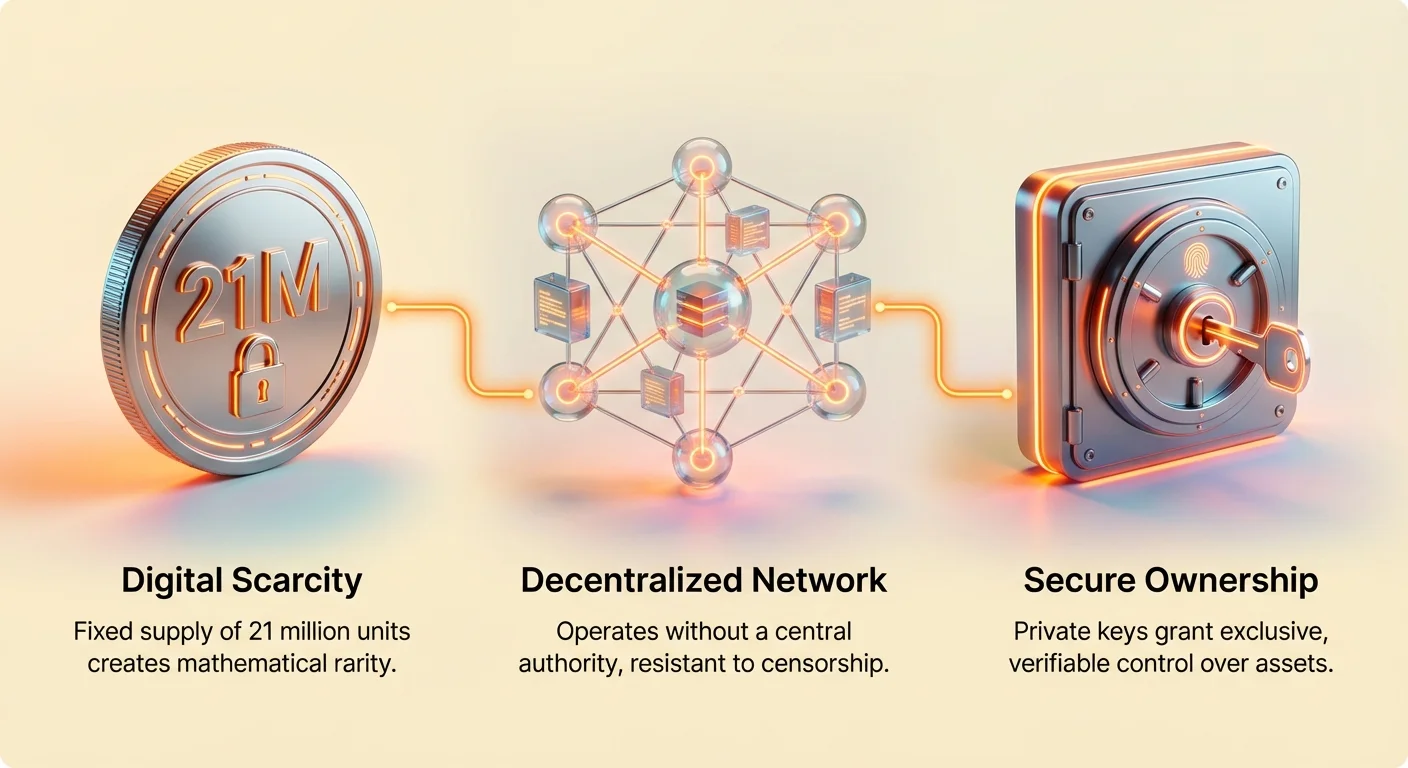
The core of the Bitcoin investment thesis is its fixed supply. The protocol is hard-coded to never exceed 21 million coins. This absolute scarcity stands in stark contrast to fiat currencies, where central banks can increase the money supply at will. Such increases often lead to the devaluation of the currency over time. Bitcoin’s predictable issuance schedule appeals to investors seeking protection against this purchasing power erosion.
Comparing Bitcoin to Precious Metals
Bitcoin is frequently described as "digital gold" because it shares key characteristics with the precious metal. Both are scarce, durable, and exist outside the control of any single government. However, Bitcoin offers distinct advantages in the digital age. While gold is heavy and expensive to transport or secure, Bitcoin is weightless and can be sent anywhere in the world in minutes.
Additionally, verification of Bitcoin is built into the protocol. Authenticating physical gold requires expensive equipment or professional services to detect forgeries. In contrast, a Bitcoin node can verify the authenticity of a transaction instantly and at virtually no cost. This verifiability eliminates the need for trust between counterparties.
| Feature | Bitcoin | Gold |
|---|---|---|
| Scarcity | Fixed (21 Million Max) | Limited but supply increases |
| Portability | High (Digital transfer) | Low (Physical transport) |
| Divisibility | High (100 million sats) | Moderate (Physical limits) |
Inflation Hedging Properties
The argument for Bitcoin as an inflation hedge relies on its "stock-to-flow" ratio. This metric compares the existing supply of an asset to the new supply entering the market. Gold has historically had a low supply increase rate, which contributes to its stability. Bitcoin’s new supply rate is currently below 2% and drops roughly every four years.
While the U.S. money supply can expand drastically, as seen in recent economic cycles, Bitcoin’s supply curve is immutable. This has led many to view it as a superior store of value over long time horizons. However, its short-term volatility means it does not always correlate perfectly with inflation data in the immediate term.
The Halving Mechanism
The mechanism that enforces this scarcity is the "halving." Approximately every four years, the reward for mining a Bitcoin block is cut in half. This event creates a supply shock by reducing the rate at which new coins enter circulation. Historically, these events have been catalysts for significant price appreciation.
When the flow of new supply decreases while demand remains steady or increases, basic economic principles suggest the price should rise. This cycle of supply shocks is central to the four-year market cycles observed in Bitcoin’s price history. It transforms the asset from merely a payment method into a deflationary store of value.
Historical Market Cycles and Volatility
Bitcoin’s price history is characterized by dramatic rises and falls. These cycles often follow a pattern of accumulation, parabolic run-ups, corrections, and consolidation. Understanding these cycles is crucial for investors, as they reflect the asset's journey toward price discovery. Volatility is a natural feature of a nascent asset growing from zero value to a trillion-dollar market cap.
Evolution of Price Trends
In the early years, Bitcoin traded for pennies. By 2011, it experienced its first major bubble, reaching around $32 before crashing. This early volatility highlighted the speculative nature of the market at that time. Subsequent cycles in 2013 and 2017 saw prices surge to over $1,000 and nearly $20,000, respectively.
Each cycle has brought increased media attention and infrastructure development. The 2017 boom was driven largely by retail frenzy and the initial coin offering (ICO) sector. In contrast, the 2020-2021 cycle, which saw prices surpass $68,000, was fueled by institutional adoption and macroeconomic concerns regarding inflation.
Interpreting Volatility
Volatility is often cited as a risk, but it is also the source of Bitcoin’s outsized returns. For long-term holders, this volatility tends to trend upward over multi-year periods. Sharp corrections often serve to flush out speculative leverage, transferring assets from weak hands to long-term believers.
Strategies like dollar-cost averaging (DCA) are commonly used to mitigate the impact of this volatility. By investing a fixed amount regularly regardless of price, investors smooth out their entry point. This approach removes the emotional stress of trying to time the market’s peaks and troughs.
Bear Markets and Maturation
Bear markets, such as the drop in 2018 and the correction in 2022, represent maturation phases. During these periods, excessive hype clears, and the focus returns to building infrastructure. These downturns often correlate with broader macroeconomic factors, such as rising interest rates or regulatory scrutiny.
Despite these drawdowns, the long-term trend has remained upward. The network continues to process transactions securely, and hash rate—a measure of network security—often hits new highs even during price slumps. This resilience reinforces the thesis that the fundamental network value is decoupling from short-term price action.
Institutional Adoption and Corporate Treasuries
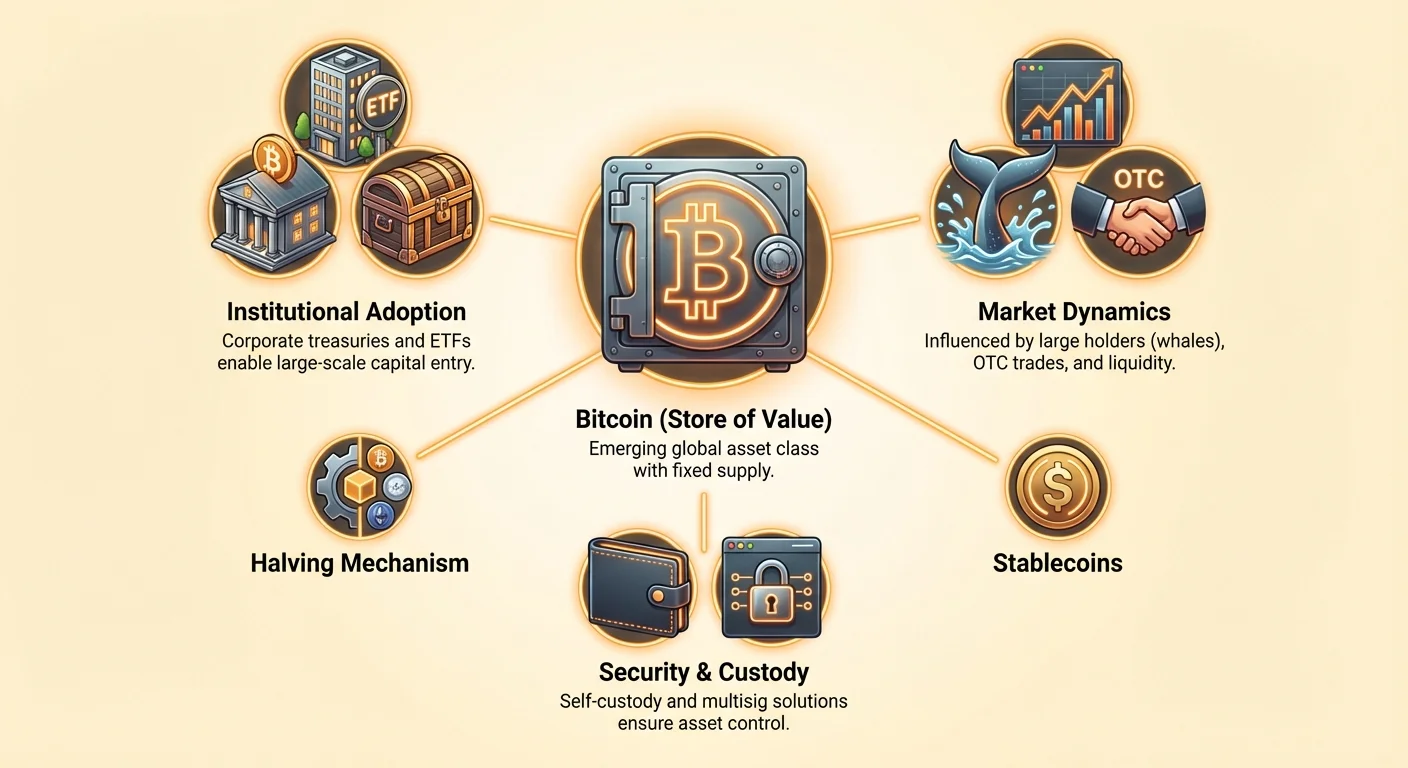
A major shift in the investment thesis has been the entry of institutional capital. Large-scale investors require different infrastructure than retail users, leading to the development of sophisticated custody solutions and regulated financial products. This institutionalization has legitimized Bitcoin as an investable asset class.
The Corporate Treasury Trend
The concept of a Bitcoin corporate treasury involves companies holding Bitcoin on their balance sheets as a reserve asset. This trend gained traction as corporations sought to protect their cash reserves from inflation. Companies like MicroStrategy and Tesla have allocated billions to Bitcoin, viewing it as a superior alternative to holding cash or short-term bonds.
Accounting standards generally classify these holdings as intangible assets. This means companies must report impairment losses if the price drops but cannot report gains until the asset is sold. Despite these accounting frictions, the strategy signals a belief in Bitcoin’s long-term appreciation potential over fiat currency.
The Role of ETFs
Exchange-Traded Funds (ETFs) have opened the door for traditional investors to gain exposure without managing private keys. A Bitcoin ETF tracks the price of the asset and trades on standard stock exchanges. This vehicle is essential for retirement accounts and institutional funds that are restricted from holding cryptocurrencies directly.
However, investing through an ETF introduces counterparty risk and management fees. The fees typically range from 0.5% to 2% annually, which can erode returns over time. Furthermore, ETF holders do not possess the actual Bitcoin, meaning they cannot use it for transactions or claim self-custody rights.
Traditional Finance Influence
The entry of traditional finance (TradFi) brings both liquidity and new dynamics. ETF managers and large funds have a vested interest in marketing the asset, potentially driving demand. However, this integration also ties Bitcoin’s price action more closely to traditional markets.
There is a debate regarding whether this influence dilutes Bitcoin’s ethos as a counter-establishment asset. While it increases adoption, it places a significant portion of the supply in the hands of regulated custodians. This creates a tension between the goal of widespread price appreciation and the founding principle of decentralization.
Market Mechanics: Whales, OTC, and Liquidity
The price of Bitcoin is not determined solely by retail traders on apps. Significant influence is held by "whales" and institutional desks that operate behind the scenes. Understanding these mechanics provides insight into how large capital moves without immediately crashing or spiking the market.
Understanding Bitcoin Whales
A "whale" is an entity that holds a massive amount of Bitcoin, typically enough to impact market prices with a single trade. Whales can be early adopters, wealthy individuals, or institutional funds. Their trading strategies often involve accumulation during quiet periods and distribution during hype cycles.
Tracking whale activity through blockchain analysis can offer clues about market sentiment. If whales are moving coins to exchanges, it may signal an intent to sell. Conversely, moving coins to cold storage suggests a long-term holding strategy. This transparency is unique to crypto markets.
Over-The-Counter (OTC) Trading
Large trades rarely happen on public exchange order books due to "slippage." If a whale tried to sell $50 million of Bitcoin on a standard exchange, the price would crash before the order was filled. Instead, these transactions occur Over-The-Counter (OTC).
OTC brokers match buyers and sellers directly. These trades are private and do not immediately appear on public charts. This allows institutions to enter or exit positions discreetly. While this protects the market from sudden shocks, it also means that public price data may not always reflect the full picture of supply and demand.
Liquidity and Market Depth
Liquidity refers to the ease with which an asset can be bought or sold without affecting its price. High liquidity is a sign of a healthy market. Bitcoin is the most liquid cryptocurrency, but liquidity can vary significantly between exchanges and OTC desks.
During periods of low liquidity, whale activity has a more pronounced effect on volatility. Conversely, as the market deepens with more participants, individual entities have less power to manipulate price action. The growth of derivative markets, such as futures and options, has also added layers of complexity to how liquidity is structured.
Comparative Analysis: Altcoins and Stablecoins
Bitcoin does not exist in a vacuum. It competes for capital with thousands of other cryptocurrencies, known as altcoins, and stablecoins. Each asset type serves a different purpose within the digital economy, and understanding these differences is vital for portfolio construction.
Bitcoin vs. Altcoins
Altcoins encompass everything from smart contract platforms like Ethereum to meme coins. While Bitcoin is primarily a store of value and money, many altcoins aim to power decentralized applications (dApps) or facilitate specific utility functions. Altcoins generally exhibit higher volatility than Bitcoin.
During "altseason," capital often rotates from Bitcoin into these higher-risk assets in search of outsized returns. However, during market downturns, altcoins typically suffer much steeper losses. Bitcoin acts as the gravitational center of the market; when it sneezes, the altcoin market catches a cold.
The Role of Stablecoins
Stablecoins are digital assets pegged to a fiat currency, usually the US dollar. They provide the benefits of cryptocurrency—speed and borderless transfer—without the price volatility. They are essential for traders who need to park capital during volatile periods without exiting the crypto ecosystem.
Unlike Bitcoin, stablecoins do not offer price appreciation potential. They are subject to counterparty risk, as the issuer must maintain sufficient reserves to back the peg. While Bitcoin is a trustless bearer asset, stablecoins rely on trust in the issuing entity or the algorithmic mechanism maintaining the peg.
| Asset Type | Primary Use Case | Risk Profile |
|---|---|---|
| Bitcoin | Store of Value / Money | Moderate-High Volatility |
| Altcoins | Utility / Tech Platforms | Very High Volatility |
| Stablecoins | Trading / Payments | Counterparty / Peg Risk |
Asset Class Performance
When compared to traditional asset classes over the last decade, Bitcoin has been a top performer. It has outperformed equities, bonds, and commodities by a significant margin. However, it currently represents only a tiny fraction of the global market capitalization of gold or equities.
This disparity suggests that Bitcoin has significant room for growth if it continues to capture market share from traditional stores of value. Its low correlation to other assets in the past made it a strong diversifier, though this correlation has increased as institutional investors treat it similarly to tech stocks.
Security and Custody Solutions
The investment thesis for Bitcoin is inextricably linked to the concept of self-custody. "Not your keys, not your coins" is a maxim that highlights the risk of leaving assets on centralized exchanges. Secure custody ensures that the investor actually owns the asset they are betting on.
The Importance of Self-Custody
Custodial wallets, such as those on exchanges, hold the private keys on behalf of the user. History is littered with examples of exchange collapses where users lost everything. Self-custody involves holding assets in a personal wallet where the user controls the private key or recovery phrase.
This approach eliminates third-party risk but introduces personal responsibility. If a user loses their recovery phrase, the funds are unrecoverable. Hardware wallets and secure software apps are the standard tools for managing this responsibility effectively.
Shared Wallets and Multisig
For large investments or corporate treasuries, relying on a single key is risky. Shared wallets, or multi-signature (multisig) wallets, offer a robust solution. These require multiple approvals to authorize a transaction, such as 2-of-3 signatures.
This setup protects against key person risk, theft, or accidental loss of a single key. It allows for complex custody arrangements, such as requiring consensus from a board of directors or family members. Multisig is the gold standard for institutional-grade Bitcoin security.
Use Cases for Advanced Custody
Shared wallets facilitate various real-world applications beyond simple security. They can be used for estate planning, ensuring heirs can access funds only with the help of a trustee. They are also used for escrow services, where a third party can arbitrate disputes between a buyer and seller.
For corporate entities, these wallets enable treasury management with built-in checks and balances. No single employee can drain the company's funds. This programmable security is a unique feature of programmable money that physical gold cannot replicate.
Conclusion
The Bitcoin investment thesis is built upon the convergence of digital scarcity, verifiable ownership, and a predictable monetary policy. It offers a modern alternative to traditional stores of value like gold, with added benefits of portability and divisibility. While volatility remains a defining characteristic, historical cycles suggest a pattern of long-term adoption and capitalization growth. The entry of institutional investors and the development of financial products like ETFs have further validated its status as a legitimate asset class.
Investors must weigh the potential for high returns against the risks of regulatory changes and market fluctuations. The ecosystem has matured significantly, offering robust tools for custody and transaction management that mitigate some operational risks. Whether viewed as an inflation hedge, a portfolio diversifier, or a technological bet, Bitcoin occupies a unique position in the global financial landscape. Its future trajectory will likely depend on continued network effects and its ability to cement its role as a sovereign store of value.
Bitcoin offers a unique combination of finite supply and global liquidity, positioning it as a potential hedge against monetary debasement.