
For many investors, the dream of "getting in early" on the next major cryptocurrency is highly appealing. Early-stage token sales—known as Initial Coin Offerings (ICOs), Initial DEX Offerings (IDOs), or Initial Exchange Offerings (IEOs)—offer the chance to acquire digital assets at the lowest possible price point, potentially leading to enormous returns if the project succeeds.
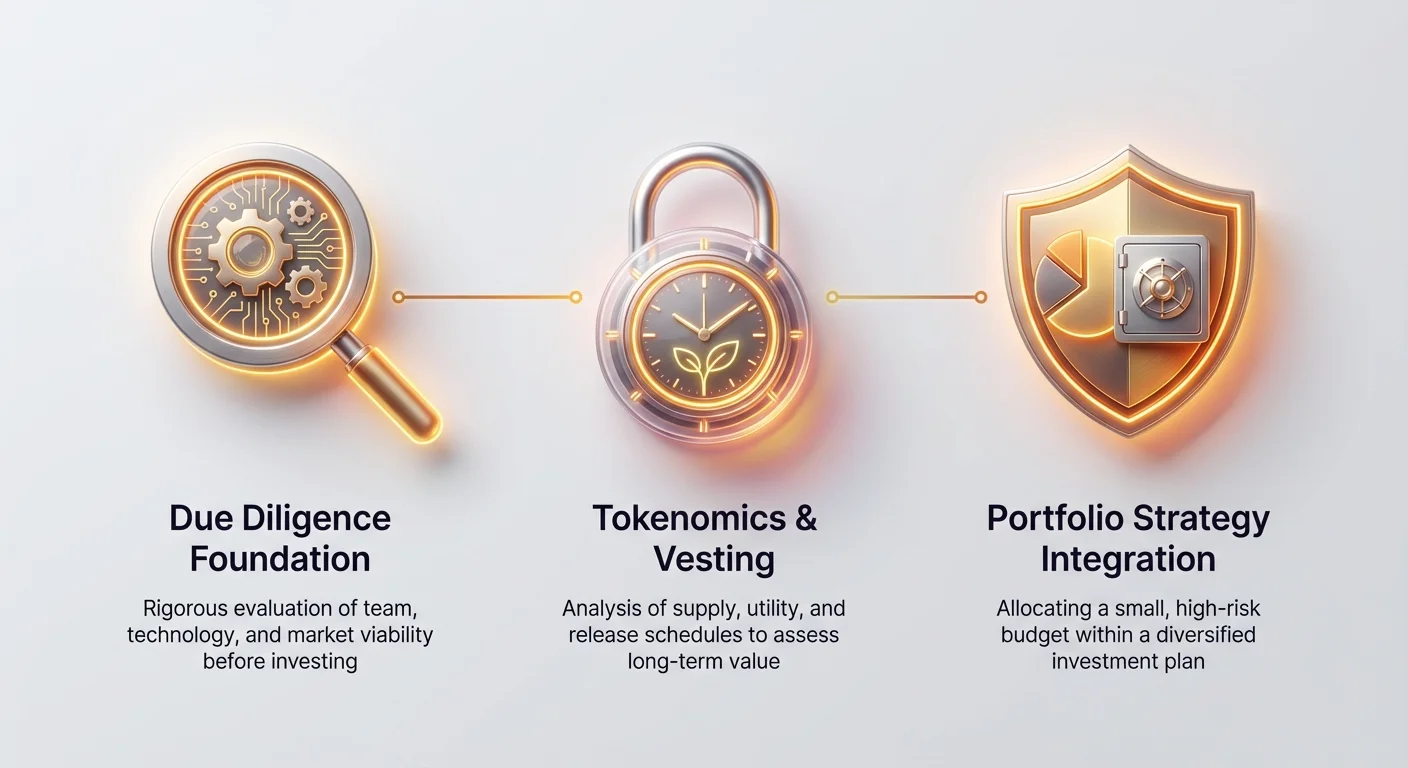
However, this sector of the market is also the riskiest. It is rife with speculation, complexity, and outright scams. Participating in a token sale requires moving beyond simple asset acquisition and embracing the mindset of a venture capital (VC) investor. This means conducting rigorous due diligence, understanding intricate token distribution schedules, and allocating capital with extreme caution.
This comprehensive guide breaks down the mechanics of early-stage crypto investments, focusing specifically on structured processes for evaluating projects, navigating launchpad platforms, and integrating these high-risk opportunities safely within a broader diversified portfolio. Our goal is to shift the focus from chasing hype to applying strategic financial discipline.
Understanding the Early Stage Investment Landscape
Before diving into a launchpad, it is essential to define the mechanisms by which new crypto projects raise capital and distribute their initial tokens. These methods have evolved significantly since the early days of Bitcoin.
What are Initial Coin Offerings (ICOs), IDOs, and IEOs?
These acronyms represent the primary ways crypto projects secure capital from investors. While their specifics vary, their function is the same: to sell newly created utility or governance tokens to fund development.
- Initial Coin Offering (ICO): The original model, popularized in 2017. Projects sold tokens directly to the public, often with minimal vetting or regulatory oversight. While effective for funding, the ICO landscape was plagued by fraud and collapsed due to regulatory pressure and market sentiment shifts. While rarely used today, the term is the historical predecessor.
- Initial Exchange Offering (IEO): These sales are conducted and vetted by a centralized cryptocurrency exchange (CEX). The exchange acts as an intermediary, listing the token sale on its platform and usually requiring users to pass Know Your Customer (KYC) identity verification. The benefit of an IEO is the implicit trust investors place in the exchange’s vetting process, which generally provides a higher standard of security and reduces the risk of blatant scams.
- Initial DEX Offering (IDO): The predominant modern model. IDOs utilize decentralized exchange (DEX) platforms, known as "launchpads," to conduct the sale. They operate on smart contracts, allowing anyone who meets the launchpad’s criteria (often holding the launchpad’s native token) to participate. IDOs democratize access but require the investor to conduct much of the project validation themselves, as the vetting is often less rigorous than that of a major CEX.
The Dynamics of Early Stage Risk/Reward
The primary appeal of early-stage investing is the potential for exponential returns, often measured by the project's Return on Investment (ROI) from the initial token sale price. A successful project might yield 10x, 50x, or even 100x gains shortly after the token lists on public exchanges.
However, this high reward comes packaged with extreme risk:
- Project Failure: A significant percentage of early-stage crypto projects never achieve their goals or deliver a functional product, leading to the total loss of invested capital.
- Market Manipulation: Low liquidity and small market capitalization upon launch make these tokens highly susceptible to large price swings and manipulation (pump-and-dumps).
- Liquidity Risk: If a project fails to gain traction, you may find it difficult or impossible to sell your tokens, leaving you holding illiquid assets.
Successful early-stage investing is therefore a game of probability; investors aim to find a small number of massive winners that offset the inevitable losses from multiple failed projects.
The Role of Crypto Launchpads
Crypto launchpads are specialized platforms designed to facilitate token sales and manage the capital raise process. They serve as a crucial interface between early-stage projects seeking funding and investors looking for opportunities.
How Launchpads Vet Projects
Launchpads perform different levels of due diligence depending on their reputation and internal standards. While the process is never foolproof, reputable launchpads typically scrutinize several key areas:
- Legal & Regulatory Checks: Ensuring the project has taken steps to comply with relevant legal frameworks, especially regarding token classification (utility vs. security).
- Team Verification: Conducting background checks on key team members, often requiring them to prove their identity (KYC) to the launchpad, even if their public profiles are pseudonymous.
- Code Audits: Requiring the project’s smart contracts to be audited by third-party security firms before the sale to identify vulnerabilities or backdoors.
- Tokenomics Assessment: Reviewing the token distribution model to ensure fair allocation and adequate measures against immediate selling pressure (often enforced through vesting schedules).
A project’s acceptance by a top-tier launchpad is often seen as a significant initial vote of confidence, but investors must remember that the launchpad’s incentive is often to generate revenue from the successful sale, not solely to guarantee investor profit.
Navigating Launchpad Participation Tiers
Most IDO launchpads utilize a tiered system to manage demand and reward loyal users. To gain access to a token sale, investors are usually required to purchase and "stake" (lock up) the launchpad’s native governance token. The size of the staked balance determines the investor's tier and, critically, their resulting allocation size.
| Example Tier Structure | Native Token Requirement (Staked) | Allocation Method | Risk/Reward Profile |
|---|---|---|---|
| Tier 1 (Bronze) | 500 Tokens | Lottery system (Low chance of winning) | Lowest capital commitment, highest randomness. |
| Tier 3 (Silver) | 5,000 Tokens | Partially Guaranteed Allocation | Moderate capital commitment, small guaranteed slot. |
| Tier 5 (Gold) | 50,000 Tokens | Guaranteed Allocation (Fixed Ratio) | High capital commitment, assured participation. |
| Tier 7 (Diamond) | 100,000 Tokens + Time Locked | Highest Guaranteed Allocation | Very high capital commitment, often required for VCs. |
The main trade-off is capital efficiency versus guaranteed participation. Entering higher tiers requires significant capital locked into the launchpad's token—a separate investment that carries its own market risk—but assures the investor a piece of the desirable new token sale.
Comparing Allocation Methods (Lottery vs. Guaranteed)
The mechanism by which you receive tokens influences your strategy:
- Guaranteed Allocation: Common in higher tiers. If you are in a Gold or Diamond tier, you are guaranteed to receive a set amount of the new token, usually calculated proportionally based on the total capital raised by participants in that tier. This is predictable and allows for precise planning.
- Lottery System: Common in lower tiers. You commit a small amount of capital and receive "tickets." A random drawing determines if you win an allocation slot. While cheaper to enter, the success rate is often low, forcing participants to enter many different sales just to secure one allocation.
Actionable Tip: If you choose the lottery route, focus on diversification across multiple launchpads and sales, as the single-sale chance of winning is minimal. If you pursue guaranteed tiers, remember that the cost of acquiring and staking the launchpad token must be factored into the overall ROI calculation for the token sale itself.
Comprehensive Due Diligence: The Investor's Checklist
The most critical differentiator between successful early investors and those who lose money is the depth and rigor of their due diligence (DD). When participating in a token sale, you are not simply buying crypto; you are funding a startup.
Evaluating the Project's Foundation (Technology and Whitepaper)
The project’s whitepaper is the foundational document, outlining the vision, technology, and execution plan. It requires a critical read.
Key Questions to Ask About the Product:
- Problem/Solution Fit: What real-world problem does this technology solve? Is the solution significantly better than existing non-crypto or crypto alternatives? If the project doesn't solve a tangible problem, it's a speculative endeavor.
- Minimum Viable Product (MVP): Does a working product or beta version exist? Projects that are only an idea on paper ("vaporware") carry exponentially higher risk than those with a functioning application.
- Technological Feasibility: Is the technology realistic, or does the whitepaper promise capabilities that are currently impossible? Look for clear, well-cited technical explanations rather than vague marketing jargon.
- Roadmap Reality Check: Is the development roadmap ambitious but achievable? Be wary of roadmaps that promise major exchange listings or full product deployment within just a few weeks.
Analyzing the Team and Advisors (Who is Building?)
The quality and credibility of the team are often the single most important factor in a high-risk startup environment. A brilliant idea executed by an inexperienced team is likely to fail.
Team Due Diligence Checklist:
- Transparency: Are core team members doxxed (publicly identified)? If the entire team is anonymous, the risk increases dramatically, as there is little accountability if the project fails or if funds are misused.
- Relevant Experience: Do team members have established backgrounds in the relevant industry (e.g., finance, gaming, software development)? Check their LinkedIn profiles and previous employment history.
- Advisors and Partners: Are the advisors and partners credible names in the crypto or traditional tech space? Be skeptical of large lists of generic "influencers" and focus on partners that suggest meaningful strategic integration.
- Community Engagement: How often do the core team members interact with the community? Consistent, professional communication suggests commitment and transparency.
Community Strength and Market Sentiment
A strong, organic community can provide critical early momentum and help sustain the project during bear markets. Fake or purchased community engagement, conversely, is a massive red flag.
- Quality over Quantity: Look past the raw follower count on Telegram or Discord. Are members asking technical questions, discussing development milestones, and providing constructive feedback? Or is the conversation dominated by "when moon?" and spam?
- Social Media Analysis: Observe the consistency and professionalism of content. A professional project treats its social media like a serious business channel, not a casual chat group.
- Media Coverage and Mentions: Has the project received genuine media coverage, or is it exclusively promoted by low-tier paid shills?
Reviewing Tokenomics (Supply, Demand, and Utility)
Tokenomics—the economics and mechanism design of the token—dictates how value will accrue to the token over time. Poor tokenomics can doom an otherwise excellent project.
Essential Tokenomics Metrics:
- Utility: Does the token have a specific, compelling use case (governance, staking rewards, fee payments, access to services)? If the only utility is speculation, its long-term viability is limited.
- Total Supply and Initial Circulating Supply (ICS): The ICS is crucial. A low ICS (e.g., less than 5% of total supply) suggests that a small market cap at launch could quickly lead to massive price appreciation, but it also means the large majority of tokens are held by insiders and subject to later unlocks (risk).
- Allocation Distribution: How is the total supply split between the team, private investors, public sale, community rewards, and treasury? A healthy distribution sees less than 20% allocated to the core team and private investors combined, preferably with long vesting periods.
- Inflation/Deflation: Is the token supply fixed, or is it perpetually inflationary (like staking rewards)? If inflationary, is there an offsetting mechanism (like token burning or high utility fees) to maintain value?
Decoding Token Release Schedules: Vesting and Unlock Risk
For the novice investor, perhaps the most confusing and high-risk element of early-stage investing is the token release schedule, governed by vesting contracts and cliff periods. Understanding these dynamics is paramount for risk mitigation.
Understanding Cliff Periods and Vesting Schedules
When you participate in an IDO, you rarely receive all your tokens immediately. Instead, your tokens are released according to a predetermined schedule.
- The Cliff: A cliff is a waiting period immediately after the Token Generation Event (TGE)—the moment the token is first minted on the blockchain. For example, a "6-month cliff" means no tokens are released to the buyer for the first six months. This mechanism prevents early team members and private investors from immediately "dumping" all their tokens, thus artificially inflating the initial price.
- Vesting: Vesting refers to the gradual release of tokens over time after the cliff ends. A common schedule might be "10% at TGE, 6-month cliff, 10% released monthly thereafter for 10 months." This ensures continuous incentives for the team and reduces massive selling pressure.
Investor Impact: The public sale investor usually receives a small initial percentage (e.g., 10% to 20%) of their total purchased tokens at TGE, allowing them to participate in the initial listing pump. The rest of the tokens are subject to the same vesting rules as other investors.
The Impact of Token Unlocks on Price Action (Vesting Schedule Risk)
The greatest recurring volatility risk for any early-stage project is a major token unlock event. These are scheduled dates when large tranches of tokens, previously locked up, are released simultaneously, often to venture capital firms, large private investors, or the core team.
When millions of tokens held at extremely low private sale prices suddenly become liquid, the incentive to sell and lock in profits is immense, regardless of the project's long-term health.
Risk Management Strategy:
- Track Unlock Dates: Use crypto research tools to find the precise vesting schedule for all investor cohorts (Seed, Private, Strategic, Public).
- Anticipate Volatility: Recognize that the weeks leading up to and immediately following a major unlock event (especially the first unlock after the initial cliff ends) are periods of high risk and potential price suppression.
- Adjust Selling Strategy: If you intend to hold tokens through the vesting period, be prepared for price dips around these events. Alternatively, selling a larger portion of your TGE allocation and repurchasing after a major unlock can be a safer long-term strategy.
Assessing Investor Allocation Splits (Private vs. Public)
The proportion of tokens allocated to different investor groups reveals much about the project's financial structure and potential selling pressure.
- Seed/Private Investors: These investors typically acquire tokens at the lowest price, meaning they have the largest profit margin and often hold the greatest threat of selling pressure. Projects that raise a vast majority of funds from private rounds before the public sale suggest that initial appreciation opportunities are highly diluted for the retail participant.
- Public Sale Investors: Your cohort. While you pay a higher price than private investors, you generally receive better immediate liquidity terms (higher percentage unlocked at TGE) to help generate positive market momentum.
A sustainable project aims for a balance, ensuring that enough tokens are distributed to the community and treasury to foster growth, rather than concentrating the majority in the hands of a few large, profit-motivated VCs.
Integrating Early-Stage Investments into Your Portfolio Strategy
Early-stage token sales are highly volatile, asymmetric bets—they offer the potential for huge returns but come with a high probability of capital loss. Therefore, they must be treated as a separate, high-risk allocation within a broader, more resilient portfolio structure.
Capital Allocation: The High-Risk Budget
The cardinal rule of high-risk investing is only to commit capital you are entirely prepared to lose.
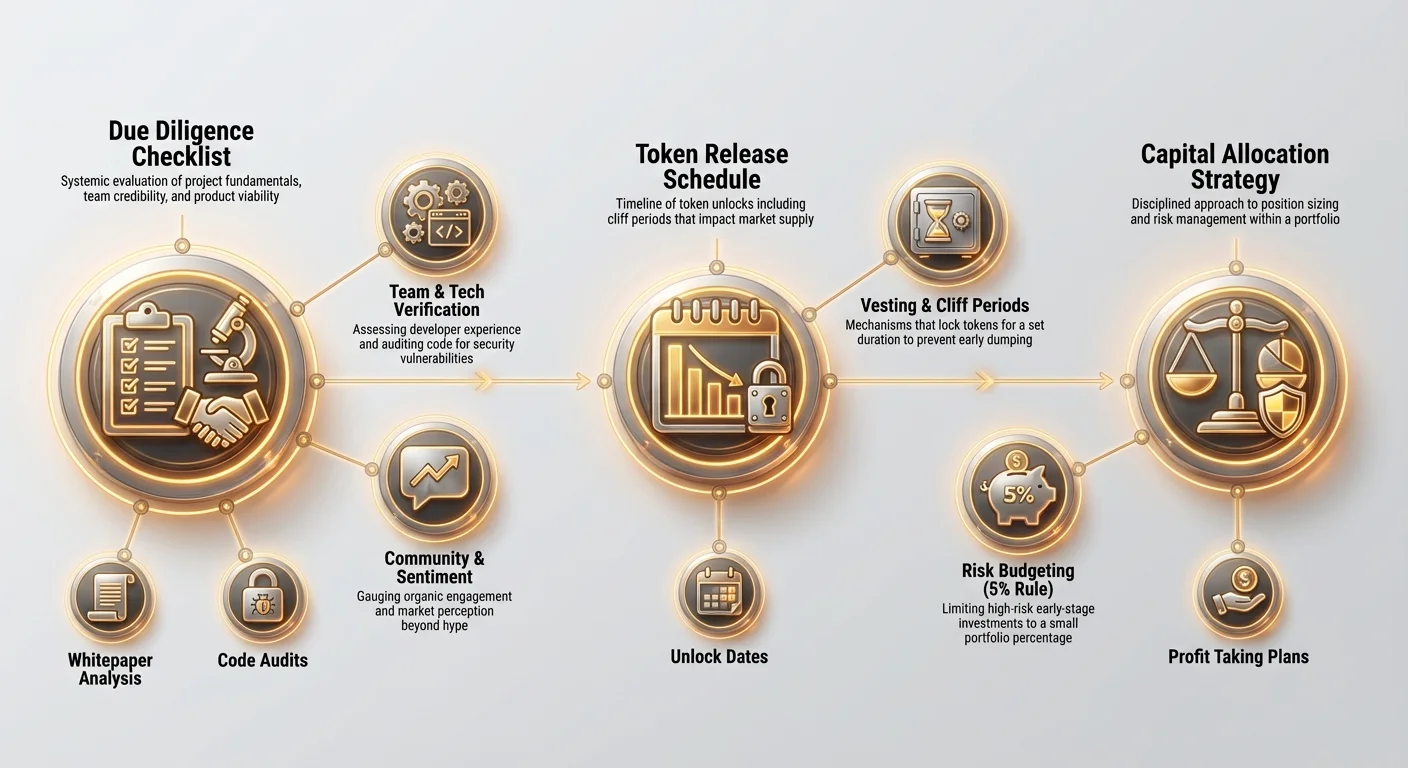
The 5% Rule: For the average retail investor, early-stage token sale participation should rarely exceed 5% of their total crypto portfolio value.
- The Foundation (70-80%): This bulk of your portfolio should be allocated to reliable, large-cap assets (Bitcoin, Ethereum, major Layer 1s) and established DeFi yield strategies. This ensures stability and preserves your principal capital.
- The Mid-Cap/Innovation Layer (15-25%): Investments in established, promising protocols with strong growth potential but higher risk than the foundation layer.
- The High-Risk/Venture Layer (0-5%): This is your token sale budget. Since you expect a high failure rate, this small portion is allocated across several projects, hoping that one or two massive winners pay for all the inevitable losers.
By strictly adhering to a high-risk budget, you ensure that a market downturn or the failure of several early investments will not jeopardize your overall financial stability.
Diversification and Sizing Your Positions
If you have allocated 5% of your portfolio to the High-Risk layer, you should aim to diversify that budget across multiple projects rather than putting all 5% into a single IDO.
- Minimize Single Point Failure: Investing in 10 separate projects with 0.5% allocation each is much safer than investing 5% in one project. If one project fails, you lose 0.5%; if the single project fails, you lose 5%.
- Portfolio Sizing: The capital committed to acquiring the launchpad token (for tier access) must also be considered part of the risk budget. Assess whether the potential gains from the small allocation are worth the risk of holding the necessary launchpad token, which can itself be volatile.
Post-Launch Strategy: Taking Profit and Managing Long-Term Holds
Many investors make the mistake of having a clear entry strategy but no exit strategy, leading them to hold on through market corrections and lose all gains. A successful early investor defines their profit targets before the tokens launch.
1. The TGE Profit Harvest
The highest trading volume and often the highest price point occur within the first hours or days of the TGE. Since most IDO tokens are sold at prices far below market value (to create demand), a pump is expected upon listing.
- Immediate De-Risking: A robust strategy is to sell enough of your initial TGE unlock (e.g., the 10% or 20% received immediately) to recover your entire initial investment.
- Example: You invested $1,000 and received 10% ($100 worth of tokens at the sale price) at TGE. If the token immediately jumps 10x, those $100 worth of tokens are now worth $1,000. Selling this amount recoups your principal, allowing you to hold the remaining 90% of your allocated tokens as pure, risk-free profit.
2. Staggered Vesting Sales
As your remaining vested tokens unlock monthly, develop a staggered selling plan.
- Sell a fixed percentage of each monthly unlock (e.g., 25% of the unlocked amount) to continue converting paper gains into tangible, stable returns (often stablecoins).
- Use significant positive news or major platform milestones as opportunities to sell an additional small tranche, capitalizing on short-term positive sentiment.
3. Defining the Long-Term Hold (LTH)
If a project meets key roadmap milestones, retains strong community engagement, and demonstrates clear product adoption, a portion of your allocation may be worth holding for several years. This should be viewed as true venture capital investment, where the value is derived from the project’s success, not just market speculation. Only the tokens remaining after you have fully recovered your initial investment should be treated as long-term holds.
Conclusion
Early-stage token sale investment, primarily through IDOs and launchpads, offers some of the highest potential returns in decentralized finance. However, it requires a mindset shift from passive buying to active, professional due diligence.
Success in this area is not about luck; it is about applying structure: rigorously evaluating the team and technology, meticulously tracking token release schedules, and, most importantly, managing capital allocation strictly. By limiting your high-risk exposure to a small, budgeted portion of your portfolio and implementing a disciplined strategy for taking profit at launch, you can safely explore the exciting, high-reward frontier of new crypto ventures while protecting your overall financial health.