
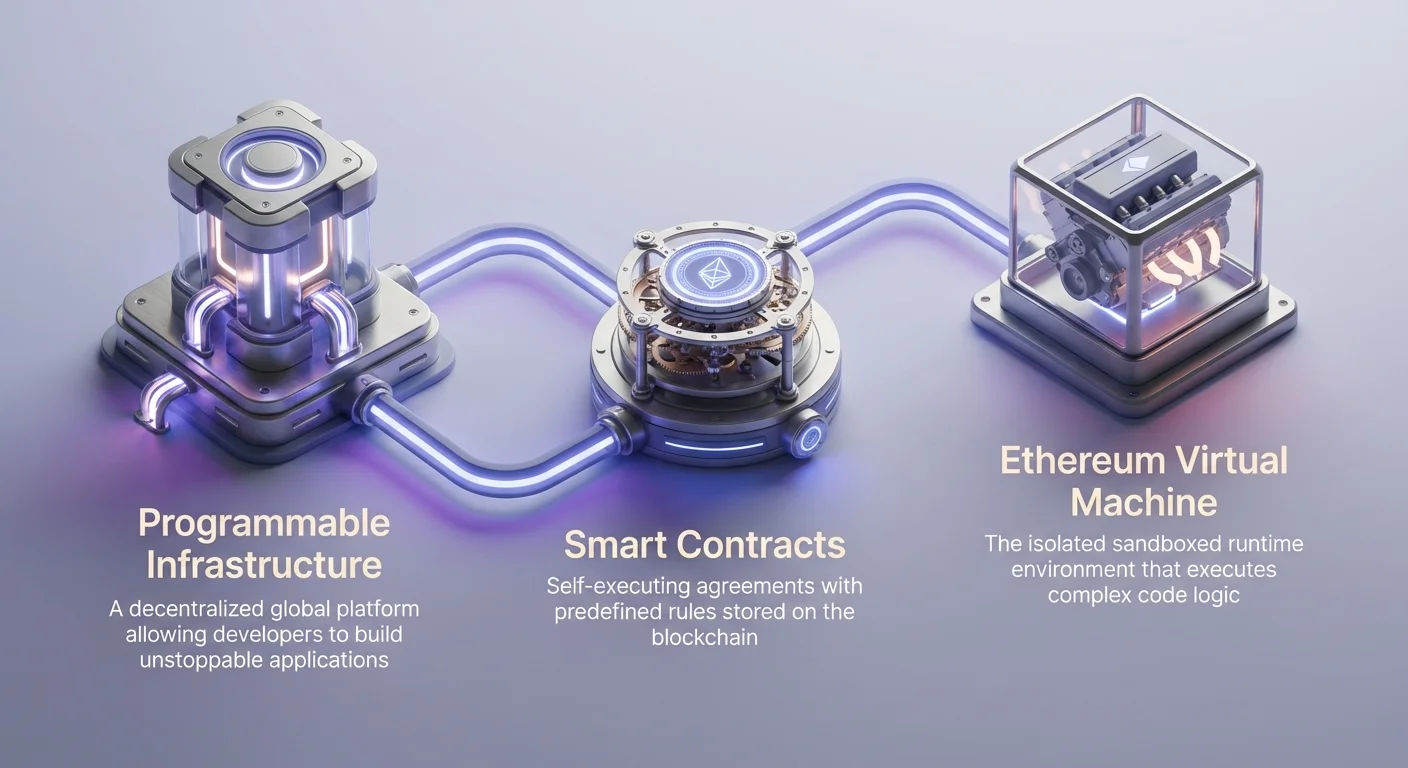
Ethereum operates as a decentralized blockchain platform that extends far beyond the capabilities of a simple digital currency. While Bitcoin introduced the world to the concept of peer-to-peer value transfer, Ethereum expanded this vision to create a programmable infrastructure. This infrastructure allows developers to build and deploy applications that run exactly as programmed without any possibility of downtime, censorship, fraud, or third-party interference.
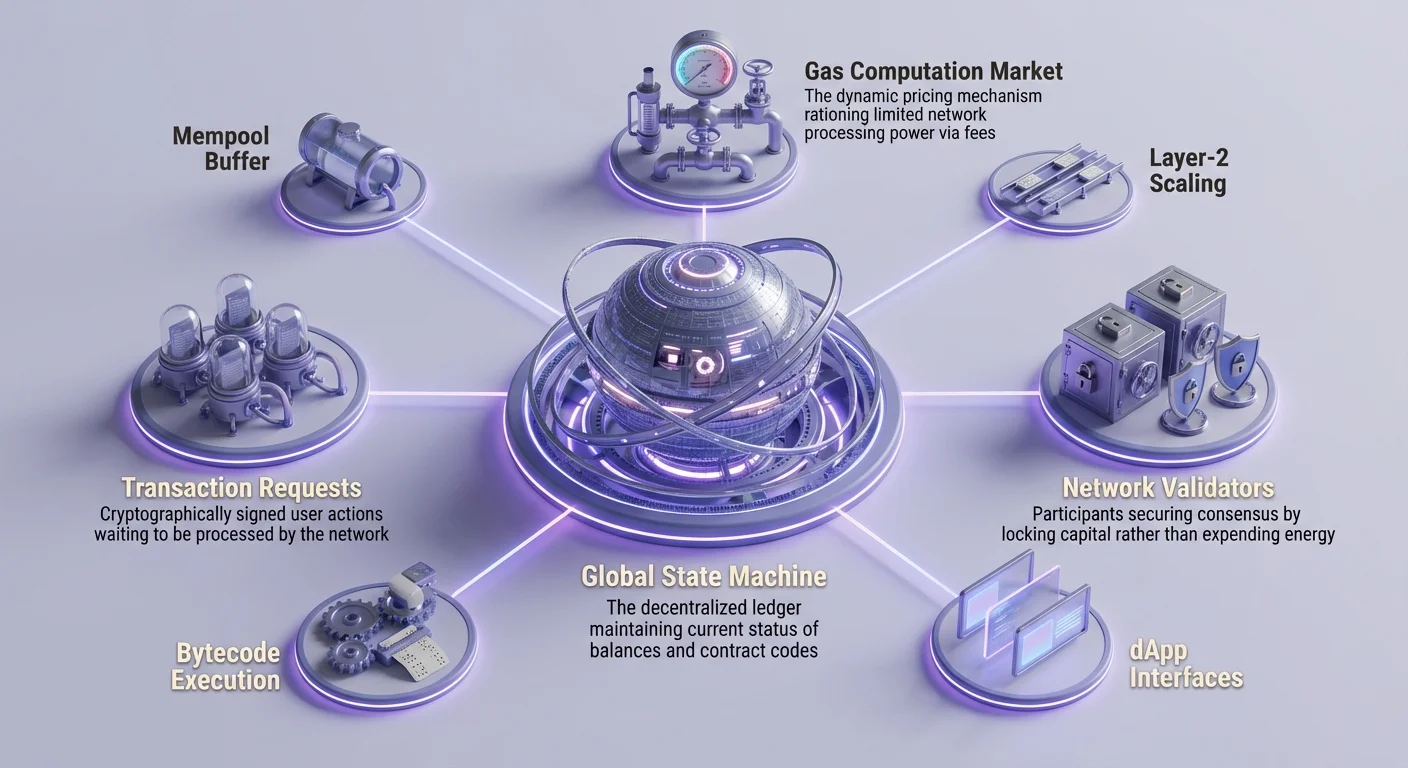
At its core, the network functions not merely as a ledger for tracking balances but as a state machine. This means the network maintains a current status of all accounts, balances, and smart contract codes at any given moment. When transactions occur, they trigger a transition to a new state. This process requires a robust economic model to manage resources and incentivize the participants who maintain the system.
The concept of the "world computer" is frequently used to describe this architecture. Unlike a traditional supercomputer that focuses on raw processing speed for complex calculations, Ethereum focuses on shared, trusted execution. It is a platform where the rules are transparent and the history of every operation is immutable.
This design choice prioritizes security and consensus over raw speed. Every node in the network must verify every transaction to ensure the integrity of the global state. This redundancy is what makes the network durable and censorship-resistant, but it also introduces specific economic constraints that users must navigate through the fee market.
The Ethereum Virtual Machine (EVM)
The Engine of Execution
The Ethereum Virtual Machine, or EVM, serves as the runtime environment for smart contracts. It is the engine that powers the Ethereum network's ability to process complex logic rather than just simple payments. The EVM is Turing-complete, which technically means it can execute any computer program given enough resources and time. This capability distinguishes it sharply from the limited scripting languages found in earlier blockchains.
The EVM operates as a sandboxed environment. This isolation is a critical security feature. It ensures that the code running inside a smart contract acts completely apart from the rest of the network's infrastructure. If a specific application contains a bug or malicious code, the sandbox prevents it from accessing the file system, network, or other processes on the host node. This containment protects the broader network from localized failures.
Developers write applications in high-level languages, but the EVM does not read these directly. The code is compiled into low-level bytecode, which the machine interprets and executes. Every node in the network runs an instance of the EVM. When a transaction triggers a smart contract, every node processes the same instructions to agree on the outcome. This massive replication of effort is what provides the network's security and decentralization.
Resource Management Through Bytecode
The execution of bytecode on the EVM is not free. Each operation, whether it is a simple addition or a complex storage request, has a specific cost associated with it. This cost is measured in a unit called "gas." The EVM tracks the gas consumed by every instruction as it executes.
This system effectively creates a market for computation. Because the EVM creates a shared resource that is distributed globally, access to its processing power must be rationed. Without a cost attached to execution, a malicious actor could create an infinite loop that would stall the entire network. The EVM solves this by requiring a fee for every step of the program.
If a transaction runs out of the prepaid gas before execution is complete, the EVM reverts the state changes. This means the transaction fails, and the network returns to its previous state as if the transaction never happened. However, the fees paid for the computation used up to that point are retained by the validator. This mechanism protects the network from denial-of-service attacks and ensures efficiency.
Smart Contracts: The Logic Layer
Smart contracts are the fundamental building blocks of the Ethereum ecosystem. A smart contract is essentially a computer program stored on the blockchain. It contains both the code that defines its functions and the data that represents its state. Once deployed, these contracts reside at a specific address on the network, ready to be interacted with by users or other contracts.
The term "trustless" is often applied to these programs. This does not mean the system is unreliable. It means users do not need to trust a central authority, such as a bank or a lawyer, to enforce an agreement. The code itself acts as the intermediary. If the pre-defined conditions of the contract are met, the execution is automatic and guaranteed by the network protocol.
For example, a smart contract could act as a decentralized escrow service. It could be programmed to hold funds until a digital asset is transferred. Once the network verifies the transfer, the contract automatically releases the funds to the seller. No human intervention is required, and neither party can cheat the other once the contract is active.
Deploying a smart contract is a transaction in itself. It requires the developer to pay a fee to write the code into the blockchain's ledger. Once recorded, the contract is immutable. This permanence gives users confidence that the rules of the application cannot be secretly changed by the developers later. It provides a transparent history of logic that anyone can verify.
The Economics of Gas
Defining the Unit of Computation
Gas is the internal pricing unit for running a transaction or contract on Ethereum. It is crucial to distinguish between "gas" and "Ether" (ETH). Gas measures the computational effort required to perform a task. Ether is the currency used to pay for that effort.
Different operations require different amounts of gas. A standard transfer of ETH from one wallet to another requires 21,000 units of gas. This is a fixed minimal effort. However, interacting with a Decentralized Finance (DeFi) protocol or minting a Non-Fungible Token (NFT) involves much more complex code execution. These actions trigger multiple checks and state changes within the EVM, resulting in a significantly higher gas requirement.
The separation of gas units from the price of Ether is an important economic design. It ensures that the computational cost of an operation remains constant regardless of the market value of ETH. The amount of work the network does to process a transaction does not change just because the price of the cryptocurrency rises or falls.
The Fee Market Dynamics
While the amount of gas needed for an operation is fixed, the price users pay for each unit of gas fluctuates. This price is determined by supply and demand. The Ethereum network has a limited amount of space in each block, meaning it can only process a certain number of transactions per second—currently around 30.
When many users want to transact simultaneously, the demand for block space exceeds the supply. To have their transactions processed, users must offer a higher "tip" or priority fee to the validators. This creates a dynamic fee market. During periods of high network congestion, such as a popular NFT launch or a significant market event, fees can spike dramatically.
Users have the ability to customize the fees they pay. A user willing to wait for their transaction to process can set a lower fee, hoping that demand will drop eventually. A user who needs immediate execution must pay the prevailing market rate or higher. This auction-style mechanism ensures that the most economically significant transactions are prioritized by the network.
Transactions and State Changes
The Lifecycle of a Request
A transaction begins when a user initiates an action, such as sending funds or interacting with a dApp. The user's wallet signs this request cryptographically, proving they have the authority to use the funds. This signed package includes the destination address, the amount of ETH to transfer, and any data payloads required for smart contract execution.
Once broadcast to the network, the transaction enters a holding area known as the mempool (memory pool). Here, it waits to be picked up by a validator. Validators are the participants responsible for proposing new blocks in the Proof-of-Stake consensus model. They select transactions from the mempool, typically prioritizing those with the highest fees, and bundle them into a block.
When the block is filled and proposed to the network, other validators verify that all transactions within it are valid. They check that senders have sufficient balances and that the smart contract interactions execute correctly according to the EVM rules. Once consensus is reached, the block is added to the chain, and the global state of Ethereum is updated.
Throughput and Scarcity
The limitation on transaction throughput is a deliberate design choice centered on decentralization. If the network allowed blocks to be incredibly large or processed thousands of transactions per second on the main layer, the hardware requirements to run a node would skyrocket. Only massive data centers could afford to participate as validators.
By keeping the requirements reasonable, Ethereum allows more individuals to run nodes, ensuring the network remains distributed and resistant to central control. However, this creates the scarcity of block space that drives the fee market. The economic trade-off is clear: security and decentralization are prioritized over cheap and fast execution on the base layer.
This scarcity has led to the development of Layer-2 scaling solutions. These technologies process transactions off the main Ethereum chain, bundling hundreds of them into a single proof that is then settled on Ethereum. This inherits the security of the main network while drastically reducing the cost and increasing the speed for the end user.
Decentralized Applications (dApps)
Building on the Platform
Decentralized applications, or dApps, are the user-facing products built on top of the Ethereum infrastructure. A dApp combines a smart contract backend with a standard user interface frontend. To the user, it may look like a regular website or mobile app, but the underlying logic runs entirely on the blockchain.
Because dApps are permissionless, anyone can create or use them. The network does not gatekeep access based on geography, identity, or credit score. This open access has spurred innovation in various sectors. Decentralized Finance (DeFi) applications allow users to lend, borrow, and trade assets without traditional banks. Gaming dApps allow players to truly own their in-game items as NFTs.
Transparency and Trust
A key economic feature of dApps is transparency. In traditional finance or gaming, the logic that determines interest rates or game odds is hidden on private servers. Users must trust the company to act fairly. In the dApp ecosystem, the smart contracts are open-source and verifiable on the blockchain.
Anyone can inspect the code of a decentralized exchange to see exactly how it calculates prices. A player in a decentralized casino can verify the randomness of the outcome and ensure the house edge is exactly what was advertised. This transparency reduces the need for regulatory oversight in some areas, as the "audit" can be performed by the community in real-time.
However, this openness also means that bugs are visible to everyone. If a developer makes a mistake in the smart contract code, hackers can exploit it to drain funds. Unlike centralized apps where a database can be rolled back, the immutability of the blockchain means these losses are often permanent. This raises the stakes for development and security auditing.
Supply, Issuance, and Inflation
The economic security of Ethereum relies not just on fees but also on the supply dynamics of the native token, Ether. Unlike Bitcoin, which has a hard cap of 21 million coins, Ethereum does not have a maximum supply limit. However, this does not mean it is subject to rampant inflation.
The issuance of new ETH is determined by the protocol's rules. New Ether is created to reward validators for securing the network. The rate of this issuance is low. Furthermore, upgrades to the network have introduced mechanisms that can make ETH deflationary.
A portion of the transaction fees paid by users is "burned," meaning it is permanently removed from circulation. During periods of high network activity, the amount of ETH burned can exceed the amount of new ETH created. This dynamic supply adjustment ties the scarcity of the asset directly to the usage of the network. As the economy of dApps and transactions grows, the supply of the currency reacts accordingly.
Comparing Network Economics
To understand the unique position of Ethereum, it is helpful to compare its economic metrics with Bitcoin. While both use blockchain technology, their design goals lead to different operational realities.
| Feature | Bitcoin | Ethereum |
|---|---|---|
| Primary Economic Role | Digital Store of Value | Decentralized Application Platform |
| Transaction Throughput | ~7 transactions per second | ~30 transactions per second |
| Supply Dynamics | Hard cap (21 million) | Unlimited cap, variable issuance |
Analyzing the Differences
Bitcoin acts primarily as a robust, secure settlement layer for value. Its simplicity is a feature, reducing the attack surface and making it an ideal "digital gold." The limited throughput and scripting capability are intentional constraints to maximize security for monetary storage.
Ethereum, conversely, functions as a utility platform. The economics are driven by the demand for computation, not just the demand for holding the asset. The value of ETH is derived partially from its role as the required currency to pay for this utility. As more applications are built and used, the demand for gas increases, driving the velocity and economic activity of the native token.
The transition of Ethereum to Proof-of-Stake also fundamentally changed its economic profile compared to Bitcoin's Proof-of-Work. In Proof-of-Stake, validators secure the network by locking up capital (ETH) rather than expending energy. This significantly lowers the issuance required to pay for security, as the operating costs for validators are lower than electricity costs for miners.
The Evolution of Network Scalability
Addressing the Bottleneck
The popularity of Ethereum has frequently led to congestion, highlighting the limitations of the EVM's current capacity. When the network handles only 30 transactions per second but thousands of users try to interact with dApps simultaneously, the user experience suffers due to exorbitant gas fees.
This scalability bottleneck is the primary technical and economic challenge facing the ecosystem. The community has prioritized upgrades to address this, aiming to increase throughput without sacrificing the decentralization that gives the network its value. If the hardware requirements for nodes become too high, the network effectively becomes centralized, defeating its purpose.
Layer 2 and Sharding
The solution currently being implemented involves a multi-layered approach. Layer 2 protocols, such as rollups, execute transactions outside the main Ethereum chain. They perform the heavy lifting of computation and data storage, then post a compressed summary of the data back to the main Ethereum network.
This creates an economic efficiency where the high cost of the main network is shared among thousands of Layer 2 users. It reduces the gas fee per user to a fraction of a cent while retaining the security guarantees of the main blockchain.
Future upgrades include sharding, which involves splitting the database horizontally to spread the load. This would allow the network to process many transactions in parallel rather than sequentially. These evolutions are critical for the economics of the network, as they aim to lower the barrier to entry and allow for mass adoption of decentralized applications.
Origins and Distribution
The Initial Crowdsale
The distribution of resources at the inception of a blockchain network has long-lasting implications for its economy. Ethereum launched in 2015, but its economic foundation was laid during a crowdsale in 2014. In this event, participants exchanged Bitcoin for the initial supply of Ether.
Approximately 60 million ETH were distributed to these early buyers, raising about $18 million for the development team. Another 12 million ETH were set aside for the development fund and early contributors. This initial distribution created a concentration of wealth that persisted for years, though it has diluted over time as coins changed hands and new supply was issued through mining and staking.
Decentralization Implications
The distribution of tokens is vital for "credible neutrality." If a small group controls the majority of the stake, they could theoretically influence the network's governance or consensus. A wide distribution ensures that no single entity can exert undue pressure on the protocol.
Over the years, the distribution of ETH has broadened significantly. The rise of DeFi and the utility of the token for gas payments have facilitated the circulation of assets. However, the initial conditions of the launch remain a point of historical and economic analysis when comparing the fairness and neutrality of different blockchain projects.
Conclusion
Ethereum represents a complex economic system where computation is the scarce resource and gas is the pricing mechanism. By creating a transparent, immutable, and programmable platform, it has enabled a new generation of digital finance and applications. The interaction between the EVM, the fee market, and the supply dynamics of Ether creates a self-regulating economy that balances security with utility.
As the network continues to evolve with scaling solutions and protocol upgrades, the economics of execution will likely become more efficient. The goal remains to provide a "world computer" that is accessible to everyone, maintaining the delicate balance between decentralization, security, and cost. The future of this digital economy depends on its ability to scale while preserving the trustless nature that makes it unique.
Gas fees are the necessary price of fairness, preventing spam and ensuring secure, decentralized computing power.