Decentralized finance offers a paradigm where individuals can access financial services without relying on traditional intermediaries. At the core of this ecosystem are specific types of digital assets that serve as foundational building blocks. These include stablecoins, which are designed to maintain a steady value (often acting as the monetary backbone of the DeFi ecosystem), and wrapped assets, which allow cryptocurrencies from one blockchain to be used on another. Acquiring these assets is a primary activity for participants in the Web3 economy.
The process of obtaining these digital assets typically occurs on a decentralized exchange, commonly referred to as a DEX. Unlike centralized counterparts that may offer fiat on-ramps, a DEX facilitates the swapping of one cryptoasset for another. This peer-to-peer structure allows for permissionless trading. It ensures that users maintain control over their funds throughout the transaction process. Understanding the mechanics of these exchanges is essential for anyone looking to acquire DeFi assets efficiently.
The Architecture of Decentralized Acquisition
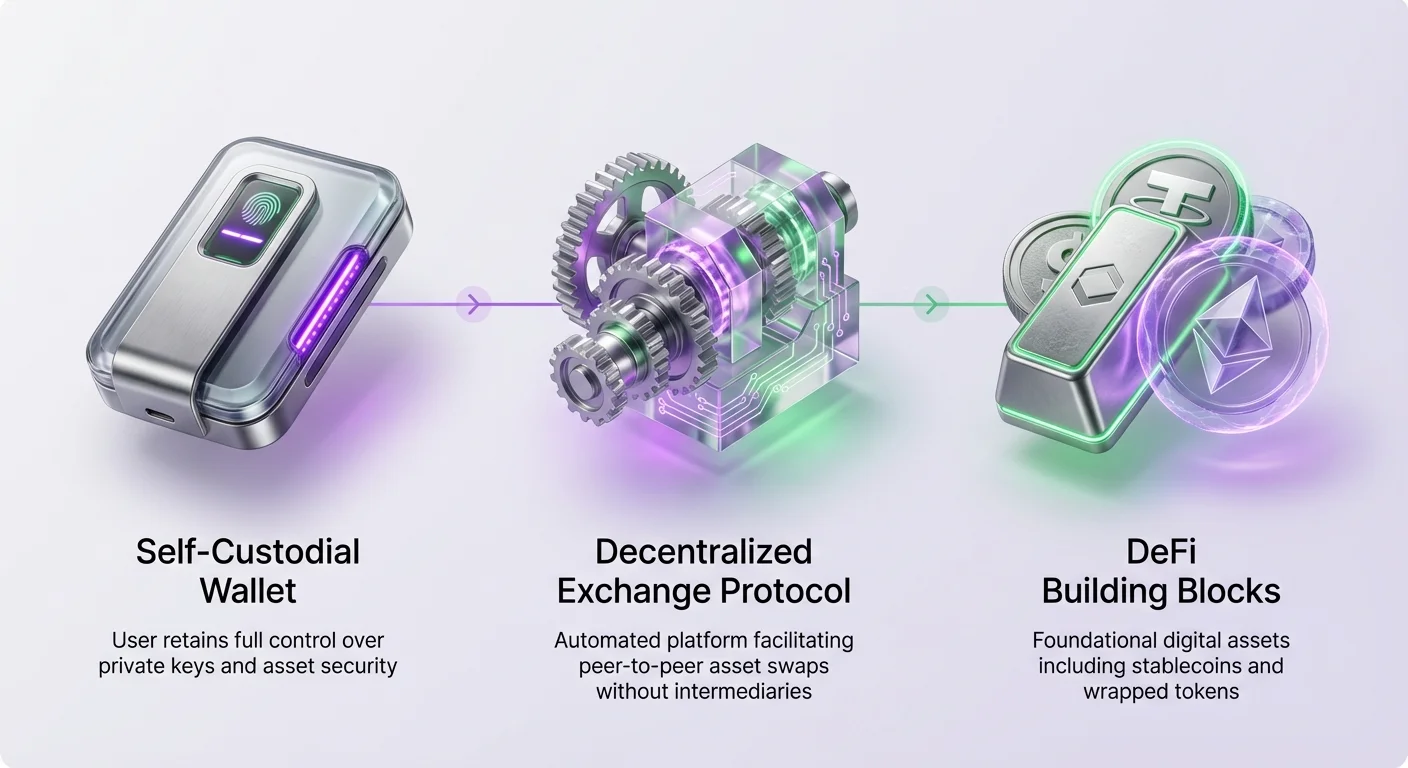
Decentralized exchanges function as the backbone of the DeFi landscape. They provide the infrastructure necessary for users to swap between different cryptocurrencies, such as converting Ethereum into a wrapped asset or a stablecoin. The fundamental action facilitated by these platforms is the swap. This mechanism is built upon smart contracts that execute trades automatically when specific conditions are met.
It is important to distinguish these platforms from centralized exchanges. In a centralized environment, a company acts as a custodian of the funds and matches buyers with sellers. In contrast, a DEX operates without a central authority. This means that the exchange does not hold user funds. Instead, trades happen directly between users or against a pool of assets smart contracts manage. This structure eliminates the risk of a platform becoming insolvent and users losing access to their deposits, a risk inherent to centralized models.
The permissionless nature of these platforms is a defining characteristic. Anyone with an internet connection and a compatible digital wallet can access the markets. There are no gatekeepers to approve accounts or restrict trading activity based on geography or status. This openness aligns with the broader ethos of cryptocurrency, which aims to democratize access to financial tools and assets.
The Role of Liquidity in Asset Availability
Liquidity is arguably the most vital metric for assessing the health of any market, whether traditional or decentralized. In the context of acquiring assets, liquidity measures how easily two assets can be exchanged without causing significant fluctuations in their prices. When a market has high liquidity, large transactions can occur with minimal impact on the asset's value.
Conversely, low liquidity can lead to volatile price shifts during a trade. For instance, consider a scenario where a trader wants to swap a volatile asset for a stablecoin like USDC. If the market lacks sufficient liquidity, the first transaction might occur at a standard market rate. However, a subsequent transaction of the same size could settle at a significantly different price. This volatility indicates a market with poor depth.
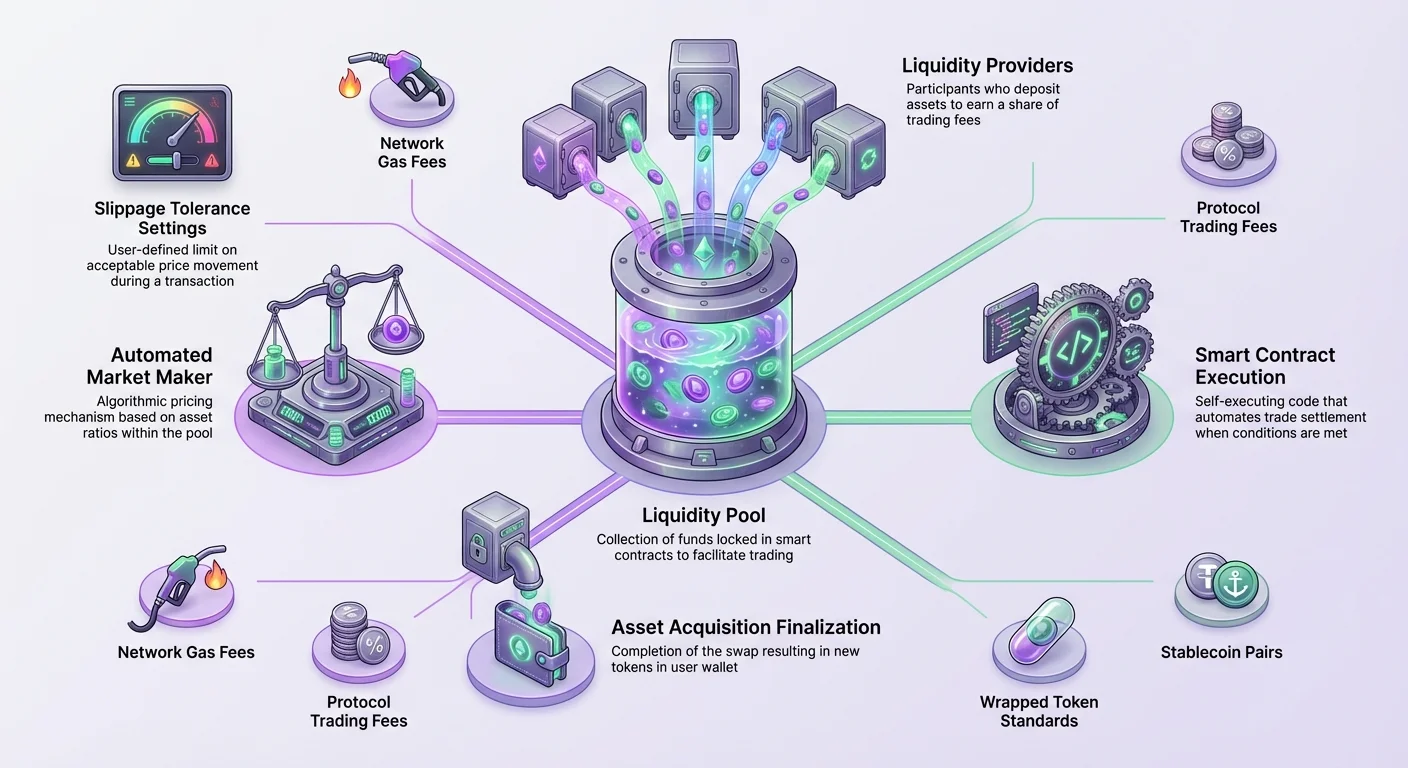
To facilitate trading, DEXs rely on liquidity pools. A pool consists of funds deposited into a smart contract for a specific trading pair, such as a pair between a governance token and a wrapped asset like WETH. These pools replace the traditional order book model used by centralized stock exchanges.
Incentivizing Market Participation
The people who deposit their assets into these pools are known as liquidity providers. They play a crucial role in the ecosystem. Without these providers, the exchange cannot fulfill its primary function of facilitating swaps. To encourage users to lock their assets into these pools, protocols offer incentives.
Liquidity providers typically earn a share of the trading fees generated by the pool. For every swap that occurs, a small percentage is collected and distributed among the providers based on their share of the pool. This creates a symbiotic relationship where the exchange gains the liquidity needed for smooth operations, and users earn yield on their idle assets.
Some exchanges provide additional incentives beyond just trading fees to attract deep liquidity. These might include governance tokens or other rewards. The depth of these pools directly impacts the efficiency of acquiring assets. A deeper pool generally results in better pricing and a smoother acquisition process for the end user.
The Essential Tools for Acquisition
To interact with a decentralized exchange and acquire stablecoins or wrapped assets, a user requires specific digital tools. The most critical of these is a digital wallet, often referred to as a web3 wallet or crypto wallet. This software serves as the interface between the user and the blockchain network.
The most secure type of wallet for these interactions is a self-custodial wallet, which requires adopting digital sovereignty and risk management. Self-custody implies that the user retains full control over the private keys and, by extension, the contents of the wallet. This stands in contrast to custodial wallets, where a third party controls the keys. Using a self-custodial wallet ensures that the user is the only entity with authority to move or approve transactions.
In addition to the wallet itself, the user must hold cryptocurrency to cover transaction costs. Every action that alters the state of a blockchain, such as a swap or a transfer, requires a fee. This fee is paid to the network validators or miners who process the transaction.
Understanding Network Fees
Network fees are paid in the native currency of the blockchain where the transaction takes place. For example, if a user is swapping assets on the Ethereum blockchain, they must hold ETH to pay for gas fees. If the transaction occurs on a different network, the native coin of that specific network is required.
It is impossible to execute a swap without a sufficient balance of the native currency to cover these fees. Therefore, the first step in acquiring any DeFi asset is often acquiring the native token of the underlying blockchain. This native token acts as the fuel for all subsequent operations, including the acquisition of stablecoins or wrapped assets. Understanding these fundamental costs is critical; learn more about how Ethereum transactions costs work for beginners.
| Component | Function | Example |
|---|---|---|
| Digital Wallet | Stores assets and signs transactions | Self-custodial app |
| Native Currency | Pays for network transaction fees | ETH, MATIC, BCH |
| DEX Interface | Facilitates the swapping process | Website or DApp |
The Mechanics of the Swap
Swapping is the primary function of a DEX and the method by which users acquire new assets. The interface for a swap is typically straightforward. It usually consists of an input field for the asset the user wishes to sell and an output field for the asset they wish to receive. The user selects the token they currently hold in the top field and the token they want to acquire in the bottom field.
Once the assets are selected, the user inputs the amount they wish to trade. The interface then calculates the estimated amount of the new asset the user will receive. This calculation is based on the current state of the liquidity pool and the ratio of assets within it.
The design of the DEX interface plays a significant role in the user experience. While the underlying technology is complex, reputable exchanges strive to make the front end intuitive. Design choices can make the process easier or harder for beginners. A well-designed DEX allows users to execute permissionless trades securely with just a few clicks.
Navigating Exchange Paths
Direct trading pairs do not always exist for every combination of assets. For example, a user may want to swap a specific governance token directly for a meme coin. If a liquidity pool for this specific pair does not exist, or if it has very low liquidity, the DEX must find an alternative solution.
This solution is known as an exchange path or route. Users can learn more about optimizing routing and gas efficiency in advanced guides. The DEX algorithm automatically searches for the most liquid and cost-effective way to facilitate the trade. It does this by routing the trade through intermediate assets.
For instance, if there is no direct market between Asset A and Asset B, the DEX might find that Asset A pairs well with a common base asset, and that base asset pairs well with Asset B. The exchange will then execute a multi-step swap in the background. It trades Asset A for the base asset, and then the base asset for Asset B.
This entire process happens automatically. The user does not need to manually execute each step of the path. The DEX finds the optimal route to ensure the user receives the best possible price for their trade. This routing capability is essential for acquiring less common assets or when moving between different types of wrapped tokens.
Analyzing Market Dynamics
Before executing a swap to acquire stablecoins or wrapped assets, it is prudent to analyze the market conditions. Decentralized exchanges provide analytics dashboards that offer insights into the state of the market. These tools allow users to view data regarding total liquidity, trading volume, and fee generation.
Users can typically access these analytics by navigating to a dedicated section of the DApp. This dashboard provides an overview of the exchange's performance. It highlights the top trading pairs and tokens, allowing users to identify which assets are seeing the most activity.
Detailed information is available at the pair level. By selecting a specific trading pair, such as a stablecoin paired with a wrapped asset, the user can see granular data. This includes the number of transactions that have occurred over the last 24 hours, the fees generated by that specific pool, and the average trade size.
Assessing Liquidity Depth
Analyzing the liquidity of a specific pair is crucial for predicting transaction outcomes. A pair with high liquidity and high volume suggests a healthy market where trades can be executed efficiently. Conversely, a pair with low liquidity might present risks regarding price stability during the execution of a large order.
Understanding these metrics helps users make informed decisions. If a user intends to acquire a large amount of a specific asset, checking the liquidity depth ensures that the market can support the trade size without excessive price impact. It validates that there is enough depth in the pool to absorb the order.
The Impact of Slippage
Slippage is a fundamental concept in decentralized trading that directly affects the acquisition cost of an asset. It refers to the difference between the expected price of a trade and the price at which the trade is actually executed. This phenomenon occurs because market prices can move between the moment a user submits a transaction and the moment it is confirmed on the blockchain.
In a liquidity pool model, large orders can also shift the ratio of assets in the pool, causing the price to move against the trader. When a buyer or seller's final sale price moves up or down more than the requested price, the price is said to "slip." This is an inherent characteristic of automated market makers.
Managing Slippage Tolerance
To manage this risk, DEX interfaces allow users to set a parameter known as slippage tolerance, a critical component of minimizing slippage during execution. This setting dictates how much price movement the user is willing to accept. It represents the maximum percentage difference between the quoted price and the execution price that the user will tolerate.
If the price changes by more than the set tolerance, the transaction will fail. This mechanism protects the user from receiving significantly fewer tokens than expected due to sudden volatility or low liquidity. However, it is important to use this setting carefully.
It is generally not advisable to increase slippage tolerance unnecessarily. If a user sets a high tolerance, they are effectively telling the protocol that they are willing to accept a worse price. In volatile markets, the execution price can change up to the full amount of the slippage limit.
For example, imagine a scenario where a user is swapping ETH for USDC. The interface might quote a rate of 1 ETH for 1500 USDC. If the user sets a slippage tolerance of 10%, they are permitting the exchange to execute the trade even if the price moves unfavorably by that amount.
In this specific example, with a 10% tolerance, the user might end up paying significantly more or receiving significantly less. They might effectively pay a price closer to 1650 USDC for the same asset value. Therefore, keeping slippage tolerance tight is a best practice for preserving value during acquisition.
Transaction Costs and Protocol Fees
Acquiring assets on a DEX involves distinct types of fees. It is crucial to distinguish between the network transaction fee and the exchange fee. As mentioned earlier, the network fee (often called gas) pays for the computation required to process the transaction on the blockchain.
The exchange fee, on the other hand, is a cost associated specifically with the trading protocol. A small percentage of every swap is charged by the exchange. This fee serves a dual purpose: it supports the protocol itself and rewards the liquidity providers.
For instance, a typical exchange fee might be around 0.3% of the trade volume. This amount is deducted from the tokens being swapped. The distribution of this fee is often split. A large majority, such as over 80%, typically goes directly to the liquidity providers who fund the pool. The remaining portion is retained by the protocol for development or governance purposes.
Users can usually view the breakdown of these fees before confirming a transaction. By tapping on details within the swap interface, the exact amount of the exchange fee is displayed. Being aware of these costs is vital for calculating the true cost of acquiring an asset.
Executing the Acquisition
The actual process of acquiring a stablecoin or wrapped asset via a swap follows a logical sequence. First, the user must connect their funded self-custodial wallet to the DEX interface. This connection authorizes the website to view the user's balances and request transaction approvals.
Once connected, the user selects the "from" asset. This is the cryptocurrency the user currently holds and wishes to sell. Next, the user selects the "to" asset. This is the target asset they wish to acquire, such as a wrapped token or stablecoin.
The user then enters the desired amount. The interface will populate the estimated return based on current market rates. At this stage, it is critical to review all transaction details. This includes checking the exchange rate, the estimated network fee, the exchange fee, and the slippage tolerance.
Finalizing the Transaction
After reviewing the details, the user initiates the swap by pressing the appropriate button on the interface. This action triggers a request to the user's digital wallet. The wallet will display a prompt asking the user to sign and confirm the transaction.
This step is the final security check. The user must approve the spending of their funds. Once signed, the transaction is broadcast to the network. After the network validators process the block, the swap is complete. The new assets will appear in the user's wallet, and the sold assets will be deducted.
Wrapped Assets in the DEX Environment
Wrapped assets differ from standard cryptocurrencies in that they represent a version of an asset from another blockchain or a different standard. For example, Ethereum's native currency is ETH. However, many decentralized applications adhere to a specific token standard known as ERC-20.
Because native ETH does not conform to the ERC-20 standard, it is often "wrapped" into WETH (Wrapped Ether) to be easily traded against other ERC-20 tokens, effectively enabling seamless liquidity in DeFi. In the context of a DEX, users will frequently encounter trading pairs involving these wrapped versions.
A popular trading pair on a DEX might be a project's token paired with WETH. When a user swaps their native ETH for another token, the protocol may handle the wrapping and unwrapping process, or the user may trade directly into the wrapped asset. Acquiring these building blocks enables participation in broader DeFi activities.
Stablecoins as a Defensive Asset
Stablecoins are another critical category of assets acquired through DEXs. These tokens are pegged to the value of an external asset, most commonly the US Dollar. Examples include tokens like USDC. They provide a way for traders to exit volatile positions without leaving the cryptocurrency ecosystem.
Acquiring stablecoins on a DEX is often used as a defensive strategy. When the market is volatile, a trader might swap a fluctuating asset like ETH for a stable asset like USDC. This locks in the value of their holdings relative to the fiat currency.
The liquidity for stablecoin pairs is often some of the deepest in the ecosystem. This is because the demand for stable, reliable assets is high. Traders rely on these pairs to manage risk. When analyzing DEX analytics, stablecoin pairs frequently appear among the top pools by volume.
Risks and Security Considerations
While decentralized exchanges offer significant advantages, they also come with responsibilities. The primary risk involves the security of the wallet and the user's interaction with the platform. Since there is no customer support to reverse transactions, errors are permanent.
One common threat is interacting with fake websites. Scammers often create replicas of popular DEXs to trick users into connecting their wallets. It is essential to verify the URL and ensure the site is reputable before interacting.
Furthermore, the concept of self-custody means the user is solely responsible for their private keys. If a wallet is compromised or keys are lost, the assets are irretrievable. There is no central entity to reset a password or recover funds.
Smart Contract Risks
Users should also be aware of smart contract risk. A DEX runs on code. While reputable exchanges are audited, bugs or vulnerabilities can exist. If a smart contract is exploited, the liquidity pools could be drained.
Using established exchanges with a history of secure operations and significant liquidity mitigates this risk to some degree. Checking the "badges" or verification status of tokens within the exchange can also help avoid buying fake or malicious tokens.
Conclusion
Acquiring DeFi building blocks like stablecoins and wrapped assets is a foundational skill in the cryptocurrency space. Decentralized exchanges provide the necessary infrastructure to perform these acquisitions without intermediaries. By leveraging liquidity pools, automated market makers, and exchange paths, users can swap assets permissionlessly and securely.
The process requires a solid understanding of digital wallets, transaction fees, and market mechanics like slippage. While the autonomy provided by these platforms is powerful, it demands a high level of responsibility regarding security and decision-making. Mastering these tools opens the door to the wider world of decentralized finance.
The ability to safely swap assets on a DEX is the primary gateway to participating in the decentralized economy.