
If you have ever explored the world of decentralized finance, you have likely encountered a token symbol that looks slightly different from the standard Ethereum ticker. This token, known as WETH, stands for Wrapped Ether. It plays a critical role in the functionality of trading apps and financial protocols. While Ether is the native currency of the Ethereum network, it was created before modern token standards were established.
This timing discrepancy creates a unique technical challenge. Decentralized applications are built to interact with a specific type of token standard that allows for uniform processing. Since the native Ether asset does not conform to these later standards, it cannot communicate directly with many automated protocols. This is where the wrapped version becomes essential.
By converting the native asset into a standardized token, users can unlock the full potential of the blockchain ecosystem. This process allows the asset to behave exactly like other tokens used in trading, lending, and borrowing. Understanding this mechanism is the first step to mastering decentralized trading and liquidity provision.
The Fundamental Role of Native Ether
Fueling the Global Computer
Ether acts as the primary fuel for the Ethereum network. This blockchain is designed as a shared global computer capable of running complex applications. Whenever a user wants to send funds or interact with an application, they must pay for the computing resources they consume. These payments are made exclusively in the native currency.
The network relies on validators to process these transactions. To incentivize these participants to include specific transfers in a block, users attach a fee. This creates a direct relationship between the native asset and the security of the network. Without this native currency, the incentive structure that secures the decentralized ledger would collapse.
The Genesis Mismatch
The Ethereum network launched with the vision of creating a programmable blockchain. However, the widely accepted standards for how digital tokens should function were not developed until later. The native currency was etched into the protocol's genesis before the community agreed upon a unified set of rules for tokens.
This historical sequence means that Ether functions differently at a code level compared to the tokens created on top of the network today. It does not have the same functions for tracking balances or approving transfers that developers rely on. This lack of conformity forces developers to write complex custom code if they wish to support the native asset directly.
Understanding the ERC-20 Standard
A Universal Blueprint for Tokens
To solve the issue of disparate coding requirements, the community introduced the ERC-20 standard. This technical specification defines a common list of rules that all Ethereum tokens must adhere to. It establishes how tokens are transferred, how data is accessed, and how total supply is managed.
Because of this standard, a digital wallet or exchange does not need to learn a new language for every new asset. If a token follows the ERC-20 rules, the software knows exactly how to handle it. This consistency is what allowed the ecosystem to expand rapidly, hosting thousands of unique assets that all share the same underlying interface.
Interoperability in Finance
Fungibility is a core component of this standard. This concept means that each token in a set is indistinguishable from another. One unit of a specific token is equal in value and function to any other unit of that same token. This is analogous to how one dollar bill effectively equals any other dollar bill in a digital bank account.
This fungibility is crucial for financial applications. It allows for the creation of liquidity pools where assets from thousands of different users can be pooled together. Since every token follows the same rules, smart contracts can swap, lend, or collateralize them without human intervention. This automation is the engine behind the entire sector of decentralized finance.
The Mechanism of Wrapping Ether
Creating the Peg
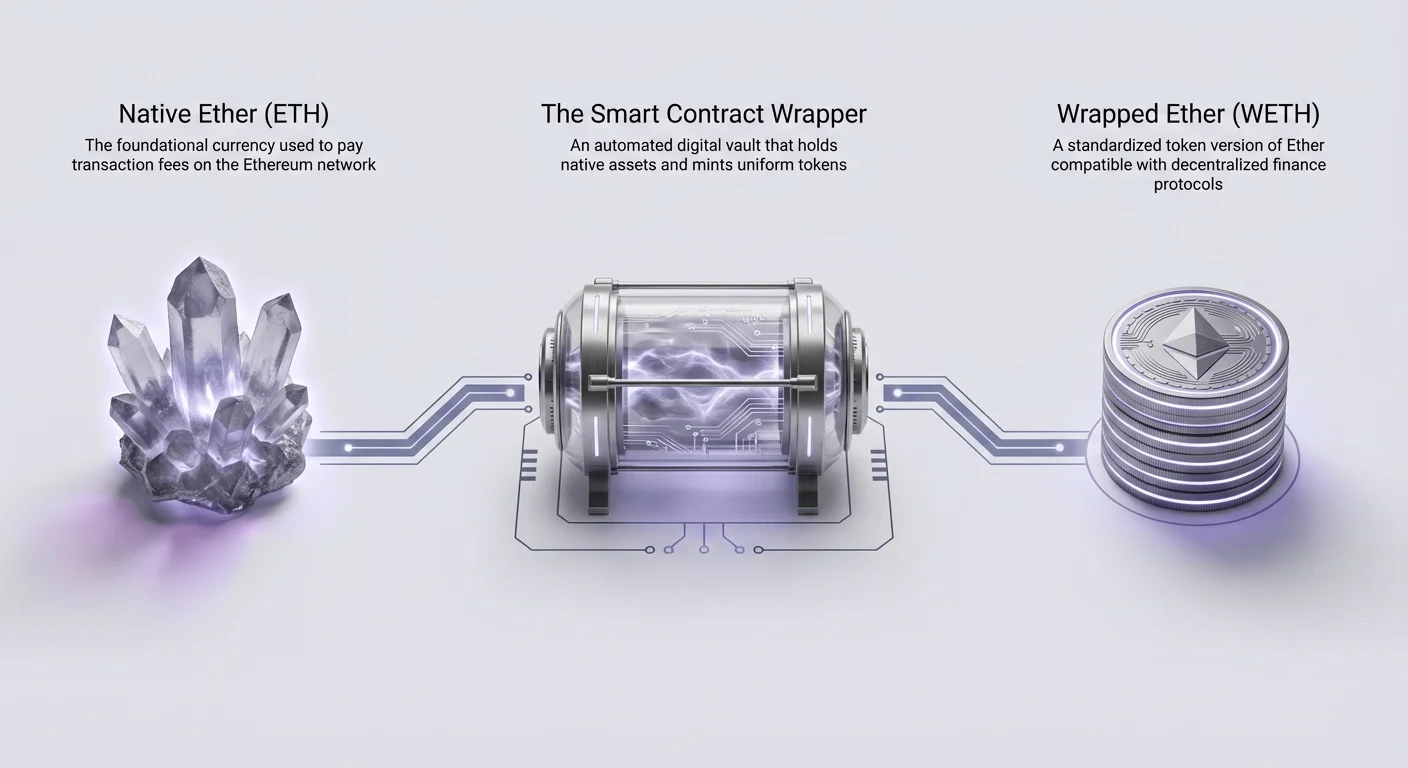
Wrapped Ether serves as a bridge between the native asset and the ERC-20 standard. It is technically a smart contract that accepts native Ether and issues an equivalent amount of the wrapped token in return. The ratio is always strictly one-to-one. There is no price discovery mechanism or exchange rate fluctuation involved in the wrapping process itself.
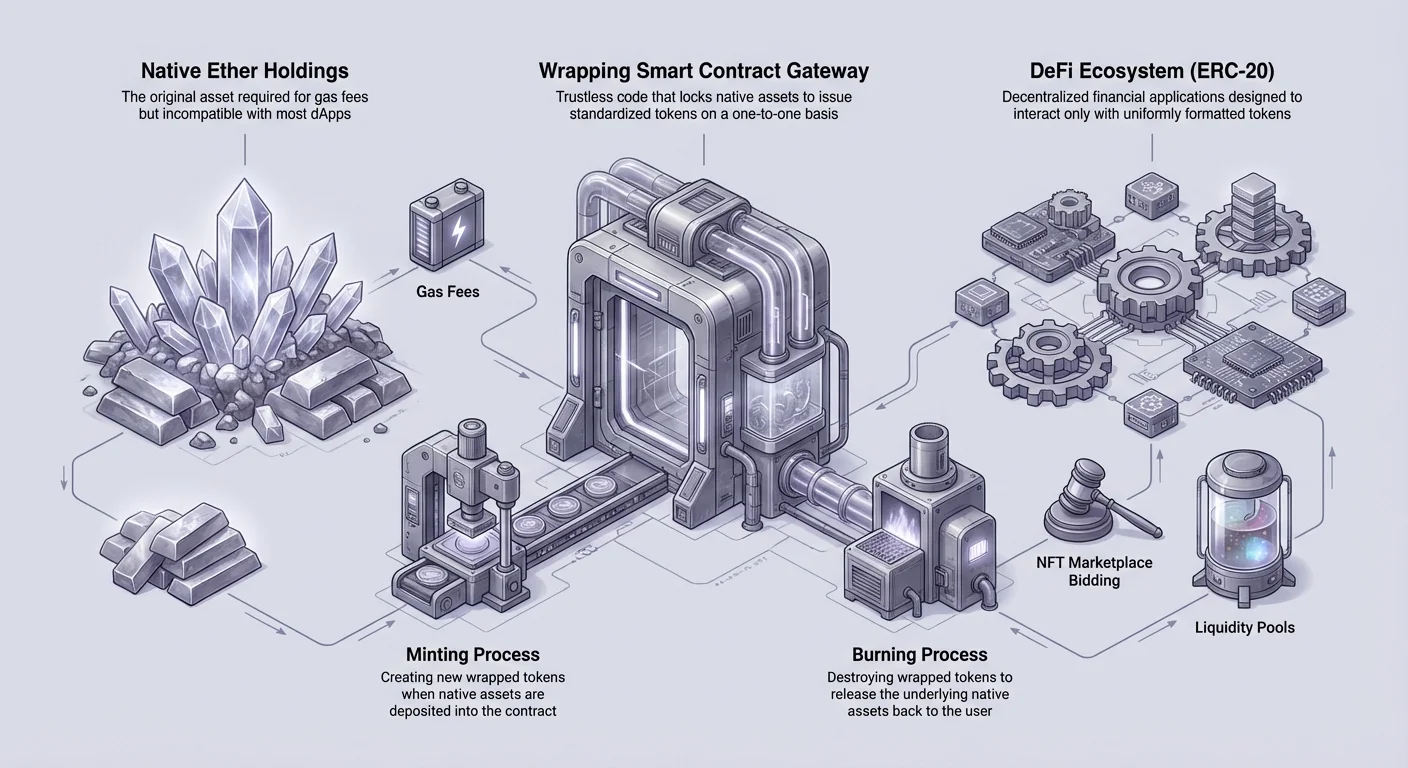
When a user sends one Ether to the wrapping smart contract, the contract locks that asset securely. Simultaneously, it mints exactly one unit of WETH and sends it to the user's wallet. This process ensures that every wrapped token in circulation is fully backed by a native unit held in custody by the code.
The Unwrapping Process
The mechanism functions identically in reverse. If a user wishes to retrieve their native asset, they send their wrapped tokens back to the smart contract. The contract then burns, or destroys, the wrapped tokens it receives. Once the destruction is confirmed, the contract releases the locked native Ether back to the user.
This cycle of minting and burning maintains the economic balance. The supply of the wrapped token expands and contracts dynamically based on user demand. Because no central authority controls this smart contract, the process is permissionless. Anyone with an internet connection and a digital wallet can perform these conversions at any time.
Why Decentralized Exchanges Require WETH
Most decentralized exchanges utilize a system known as an automated market maker. These protocols rely on pools of assets to facilitate trades rather than traditional order books. For these pools to function efficiently, the smart contracts must be able to handle both assets in a trading pair using identical logic.
If a user wanted to trade a standard token for native Ether, the exchange would need two separate sets of code: one for the token and one for the native currency. This increases the complexity of the software and introduces potential security risks. By converting the native asset to WETH, the exchange can treat both sides of the trade exactly the same.
This standardization streamlines the user experience. When you trade on these platforms, the interface often handles the wrapping process in the background or prompts you to wrap your assets before trading. This ensures that the underlying liquidity pools remain balanced and mathematically sound without requiring complex workarounds for the native currency.
Costs and Network Fees
The Impact of Gas
Every interaction with the Ethereum blockchain incurs a transaction fee, known as gas. This includes the process of wrapping and unwrapping assets. Because wrapping involves interacting with a smart contract, it is more complex than a simple transfer. Consequently, it consumes more computational resources.
Users must hold a balance of native Ether to pay for these operations. You cannot pay for the transaction fee using the wrapped token itself. This leads to a common pitfall where users wrap their entire balance and find themselves unable to pay the gas fee required to send or trade their new tokens.
Fee Structure and Burning
The cost of these transactions is determined by the network's fee market. Following the implementation of EIP-1559, fees are split into a base fee and a priority tip. The base fee adjusts dynamically based on how busy the network is. Crucially, this base fee is burned, permanently removing it from circulation.
During periods of high demand, the cost to wrap assets increases. Users can customize their fees to prioritize speed or save money, but the base fee must always be paid. This economic mechanism ensures that spam transactions are minimized and that the network allocates resources efficiently to those willing to pay for the block space.
WETH Across the Ecosystem
Integration with Layer 2 Solutions
As the ecosystem has grown, scaling solutions have emerged to handle transaction volume off the main blockchain. Layer 2 platforms often use WETH heavily. When assets are bridged from the main network to a scaling solution, they are often locked on the main chain and minted as wrapped versions on the secondary layer.
These environments allow for faster and cheaper transactions. Trading WETH on a Layer 2 network allows users to engage in high-frequency trading or smaller investments that would be prohibitively expensive on the main network. The underlying value remains tied to the native asset, but the utility is enhanced by the speed of the scaling solution.
NFT Marketplaces
Non-fungible tokens represent unique digital items, but they are often bought and sold using fungible currencies. Many NFT marketplaces require bidders to use WETH when making offers. This is because the smart contract needs to be able to automatically transfer the payment if the seller accepts the bid.
Native Ether cannot be "pulled" from a wallet by a smart contract in the same way an ERC-20 token can after approval. Therefore, to create a seamless bidding experience where the marketplace manages the transaction upon acceptance, the wrapped version is necessary. This reduces friction and allows for instant settlement of auctions.
Comparative Breakdown
The following table outlines the distinct operational differences between the native asset and its wrapped counterpart:
| Feature | Native Ether (ETH) | Wrapped Ether (WETH) |
|---|---|---|
| Primary Use | Gas fees, P2P payments | DeFi trading, dApps |
| Standard | None (Pre-dates ERC-20) | ERC-20 Compliant |
| Interoperability | Limited in smart contracts | Universal in smart contracts |
Future Developments and Standards
Evolving Token Standards
While ERC-20 is the dominant standard today, the blockchain community continues to innovate. New standards are proposed to fix limitations, such as the inability to recover tokens sent to the wrong contract type. However, WETH remains the most widely accepted standard due to its massive network effect and deep integration into existing infrastructure.
The transition to Proof of Stake and future upgrades to the network do not directly change the need for wrapping. Even as the network becomes more efficient, the fundamental code difference between the native currency and token standards remains. Therefore, wrapping will likely remain a standard practice for the foreseeable future.
Automated Abstraction
Developers are increasingly working on "account abstraction" and other features to hide the complexity of wrapping from the user. Future wallet interfaces may automatically wrap and unwrap assets in the background during a transaction. This would make the distinction invisible to the average user, even while the technical necessity remains under the hood.
These improvements aim to make decentralized finance as intuitive as traditional banking. By automating the conversion steps, barriers to entry are lowered. Users can focus on their financial strategies rather than the mechanics of token standards, moving the industry toward broader adoption.
Conclusion
Wrapped Ether serves as a vital connector in the blockchain economy, solving the technical incompatibility between the network's native currency and the smart contracts that power decentralized applications. By tokenizing Ether into an ERC-20 standard format, WETH enables the standardized, automated interactions that define modern decentralized finance. Without this innovation, liquidity pools, automated lending, and seamless exchange trading would be significantly more complex and fragmented.
As the ecosystem evolves with new scaling solutions and interface improvements, the friction of converting assets will likely decrease, but the utility of the wrapped asset will remain. It allows users to leverage the full value of their native holdings within a diverse array of sophisticated financial protocols. This bridge ensures that the foundational asset of the network remains liquid and usable across every new application built on the blockchain.
WETH acts as a translator that allows the native language of Ethereum to be understood by the complex applications built upon it.