
The landscape of finance has undergone a seismic shift with the advent of blockchain technology. For decades, traditional investing relied heavily on centralized intermediaries. Banks, brokerages, and exchanges acted as the gatekeepers of wealth generation. They facilitated transactions, held custody of assets, and determined the yield that capital providers received. In this model, the intermediary captures a significant portion of the value generated, leaving the investor with a modest return.
Decentralized Finance, or DeFi, challenges this status quo by replacing the middleman with code. Through the use of smart contracts on networks like Ethereum, investors can now interact directly with protocols. This shift has introduced new concepts such as yield farming and staking. These mechanisms offer return on investment (ROI) potentials that often dwarf those found in traditional finance accounts. However, these opportunities come with a fundamentally different risk profile and operational structure.
Understanding the comparative ROI between these new methods and traditional avenues requires a deep dive into the mechanics of how yield is generated. It is not simply about higher numbers; it is about the efficiency of capital distribution. In DeFi, the friction costs of physical branches, employee salaries, and corporate profits are removed. The result is a system where the majority of the fees and interest generated flow directly to the participants who provide the liquidity.
The Foundation of Decentralized Yield
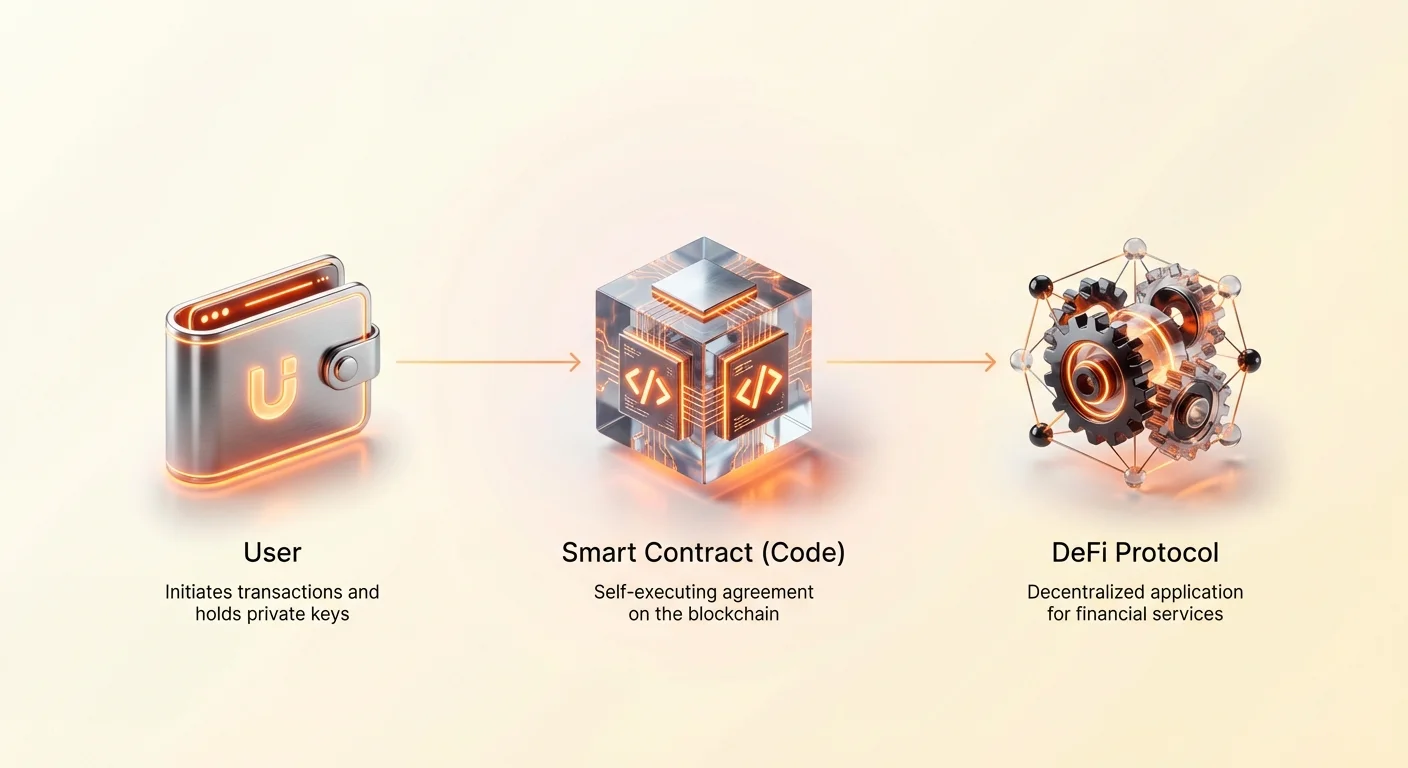
To comprehend where the yield comes from, one must first understand the vehicle that delivers it. DeFi relies on decentralized applications, or dApps. These are software programs that run on peer-to-peer networks rather than centralized servers. Unlike a traditional app that connects you to a company's database, a dApp connects you to a blockchain.
The engine powering these applications is the smart contract. A smart contract is a self-executing agreement with the terms written directly into code. It lives on a trustless network, meaning its validity does not depend on a third party. When you deposit funds into a high-yield DeFi account, you are not giving money to a banker. You are sending assets to a smart contract address that is programmed to perform specific functions automatically.
This automation is the key driver of efficiency. In traditional finance, executing a loan or a trade involves settlement layers and manual verification. Smart contracts handle these processes instantaneously and transparently. Because the code is open-source, anyone can verify how the contract functions. This transparency eliminates the "black box" nature of traditional banking, where customers rarely know how their deposits are being utilized or what the true profit margins of the institution are.
Smart Contracts vs. Traditional Agreements
The distinction between a paper contract and a smart contract is critical for investors. A traditional contract relies on legal systems and enforcement for validity. If a counterparty breaches the agreement, the remedy involves lawyers and courts. This creates a high barrier to entry and significant overhead costs. These costs ultimately eat into the returns available to the investor.
Smart contracts, by contrast, are deterministic. They execute exactly as programmed based on "if this, then that" logic. For example, a contract can be programmed to release funds only when a specific condition is met. If the condition is not met, the funds remain locked or are returned. There is no need for an escrow agent or a lawyer to oversee the transaction. The code itself acts as the impartial judge and executioner of the agreement.
This technology transforms the nature of trust. In a traditional investment, you trust the reputation of the bank or the regulatory framework of the country. In DeFi, you trust the logic of the code. While this introduces new technical risks, it removes the risk of human error, bias, or institutional fraud in the execution of the agreement. This efficiency allows for the creation of complex financial products that are accessible to anyone with an internet connection.
Mechanics of Yield Farming and Lending
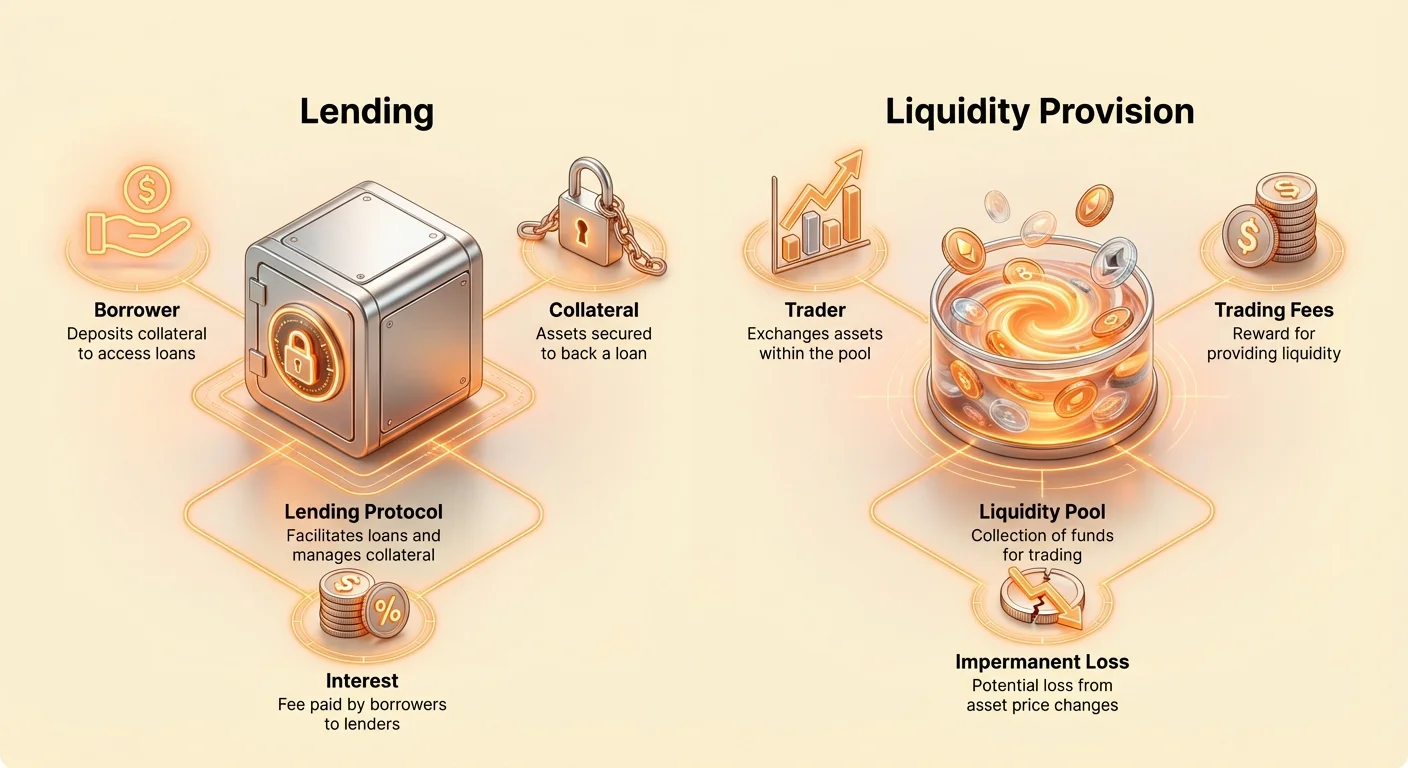
Yield farming is a term that describes the process of putting crypto assets to work to generate returns. It is analogous to a high-yield savings account but operates through different mechanisms. In the traditional world, a bank takes your deposit, lends it out at a higher rate, and pays you a fraction of the interest. In DeFi, you deposit your assets into a liquidity pool or a lending protocol, and the smart contract distributes the fees or interest directly to you.
One of the most common strategies involves smart contract-based lending. Users can deposit cryptocurrencies like Ethereum or stablecoins into a protocol to be lent out to borrowers. The borrowers pay interest, which is distributed to the lenders. Because there is no bank taking a cut for overhead, the yields can be significantly higher. However, the mechanics of securing these loans differ substantially from traditional credit.
Over-Collateralization and Risk Management
In traditional banking, loans are often secured by credit scores and legal recourse. If a borrower defaults, the bank pursues them legally. In DeFi, there are no credit scores and identities are often anonymous. To solve this, protocols use over-collateralization. This means that to borrow funds, a user must deposit more value than they wish to borrow.
For instance, a smart contract might require a user to deposit $200 worth of Ethereum to borrow $100 worth of stablecoins. The smart contract holds the Ethereum as collateral. If the value of the Ethereum drops below a certain threshold, the contract automatically liquidates the collateral to repay the loan. This mechanism ensures that the lending pool remains solvent without needing to know the identity of the borrower.
This system allows for "permissionless" participation. Anyone can become a lender and earn yield, and anyone with assets can become a borrower. The yield generated is dynamic, fluctuating based on supply and demand for the specific asset. During periods of high demand for leverage, interest rates in DeFi can spike dramatically, providing lucrative returns for lenders that are uncorrelated with traditional interest rates set by central banks.
Liquidity Provision and Trading Fees
Another primary avenue for yield is providing liquidity to decentralized exchanges (DEXs). A DEX allows users to trade one digital asset for another without a centralized order book. Instead, they rely on Automated Market Makers (AMMs). These protocols require pools of assets to facilitate trades.
Investors can deposit pairs of assets, such as ETH and USDC, into these pools. In return, they receive a portion of the trading fees generated by the platform. This is often referred to as "crowd-sourced" liquidity. In traditional markets, market making is reserved for large institutional players. In DeFi, any individual can be a market maker.
The ROI from liquidity provision comes from trading volume. The more activity a trading pair sees, the more fees are generated for the liquidity providers. However, this comes with the risk of impermanent loss, where the value of the deposited assets changes relative to holding them simply in a wallet. Despite this, the combination of trading fees and additional token incentives often results in annualized returns that far exceed traditional equity dividends.
Airdropovi: Skriveni faktor ROI
Kada se upoređuje ROI, jedna jedinstvena karakteristika kripto ekosistema je „airdrop“. Ovaj koncept nema direktnu ekvivalentu u tradicionalnom investiranju. Airdrop se dešava kada projekat distribuira besplatne tokene korisnicima koji su interagovali sa njihovim protokolom. Ovo se često radi da se decentralizuje upravljanje, nagradi rani adoptori ili promoviše projekat široj publici.
Za aktivnog učesnika u DeFi-ju, airdropovi mogu predstavljati značajan deo ukupnog povrata. Projekti mogu uzeti „snapshot“ blok-lanca na specifičan datum. Adrese koje su se angažovale sa protokolom pre tog datuma—trgovanjem, pozajmicom ili držanjem imovine—smatraju se podobnim. Distribuirani tokeni često imaju trenutnu tržišnu vrednost i ponekad se mogu prodati za značajne sume.
Mehanizmi distribucije
Airdropovi nisu nasumični; oni su meritokratski na osnovu on-chain aktivnosti. Rani modeli su samo zahtevali adresu novčanika, ali moderni airdropovi koriste sofisticirane metrike. Oni mogu gledati obim trgovanja, trajanje obezbeđivanja likvidnosti ili broj interakcija sa pametnim ugovorom. Ovo nagrađuje istinske korisnike umesto pasivnih spekulanta.
Na primer, kada velika decentralizovana berza lansira governance token, mogu retroaktivno nagraditi svakog korisnika koji je ikada trgovaо na platformi. U tradicionalnim finansijama, korišćenje brokerske kuće godinama ne daje pravo na besplatne akcije firme. U Web3-u, vlasništvo korisnika je osnovni princip, a airdropovi su mehanizam za prenos tog vlasništva.
Ovo dodaje sloj spekulativnog ROI farmanju prinosa. Korisnici često interaguju sa novim protokolima ne samo zbog trenutnog prinosa, već zbog potencijala budućeg airdropa. Iako nije garantovano, ovi „dividendi lojalnosti“ mogu značajno povećati ukupnu profitabilnost DeFi portfolija u poređenju sa statičnim portfoliom akcija.
Analiza spektra rizika
Iako je ROI u DeFi-ju privlačan, on je neraskidivo povezan sa višim rizikom. Fraza „visok prinos“ služi kao signal za visok rizik na bilo kom finansijskom tržištu, i kripto nije izuzetak. Tradicionalno investiranje u državne obveznice ili blue-chip akcije nosi rizike povezane sa kamatnim stopama i ekonomskim padovima. DeFi nosi ove tržišne rizike, ali dodaje tehničke i sistemske rizike jedinstvene za sektor.
Ranljivosti pametnih ugovora
Najistaknutiji rizik u DeFi-ju je neuspeh koda. Pametni ugovori pišu ljudi, a ljudski kod može sadržati bagove. Čak i reputabilni projekti koji su audirani od strane firmi za bezbednost mogu pretrpeti eksploate. Ako haker pronađe rupu u logici pametnog ugovora, može isprazniti sredstva okupljena u njemu.
U tradicionalnim finansijama, ako softver banke ima grešku, banka je obično odgovorna, a osiguranje (kao FDIC u SAD) štiti depozite do limita. U DeFi-ju, transakcije su nepovratne. Ako se pametni ugovor isprazni, sredstva su često trajno izgubljena. Retko postoji odeljenje za korisničku službu za poziv ili pravni recours, posebno ako napadači ostaju anonimni.
Ovaj „tehnički rizik“ znači da investitor mora verovati ne samo tržišnim uslovima već i integritetu softvera. Open-source priroda dApp-ova omogućava proveru zajednice, što jača bezbednost tokom vremena. Što duže protokol postoji bez incidenata, to je „isprobavan u boju“. Međutim, za novije protokole sa najvišim prinosima, rizik zero-day eksploata ostaje primarno zapažanje.
Zlonamerni akteri i rug pull-ovi
Pored slučajnih bagova, postoji rizik namerne prevare. Permissionless priroda blok-lanca znači da svako može rasporediti pametni ugovor. Prevaranti mogu kreirati dApp-ove koji izgledaju legitimno, ali sadrže zlonamerni kod dizajniran da ukrade sredstva. Ovo se zove „rug pull“.
U tipičnom scenariju, developeri mogu lansirati projekat sa visokim oglašenim prinosima da privuku kapital. Kada se značajna količina vrednosti zaključa u protokolu, developeri koriste zadnja vrata u kodu da povuku sva korisnička sredstva i nestanu. Alternativno, mogu držati masovnu ponudu native tokena projekta i dump-ovati ga na tržištu, rušeći cenu blizu nule.
Phishing je još jedan vektor gubitka. Napadači često kreiraju replika sajtove koji oponašaju popularne DeFi platforme. Ako korisnik poveže svoj novčanik sa ovim lažnim sajtovima, može nehotice potpisati transakciju koja daje napadaču dozvolu da isprazni njihova sredstva. Ovo zahteva od investitora da budu hiper-vigilantni u proveri URL-ova i adresa ugovora—nivo due diligence-a koji obično nije potreban prilikom logovanja u brokerski račun.
Uporedni pregled: TradFi naspram DeFi
Da bismo sumirali razlike u potencijalu ROI i strukturi, pomaže pogled na fundamentalne pokretače vrednosti u oba sistema. Tradicionalno investiranje se oslanja na rast osnovnih biznisa ili kredibilnost vlada. Investiranje u DeFi se oslanja na efikasnost tržišta, potražnju za likvidnošću i upotrebu protokola.
| Karakteristika | Tradicionalno investiranje | DeFi farmanje prinosa/staking |
|---|---|---|
| Izvor prinosa | Korporativni profiti, kamata na dug | Naknade za trgovanje, kamata na pozajmicu, inflacija tokena |
| Pristup | Permissioned (KYC, Geografija) | Permissionless (Globalno, Otvoreno) |
| Čuvanje | Treća strana (Banka/Broker) | Samostalno čuvanje (Pametni ugovor) |
„Bezrizčna stopa“ u tradicionalnim finansijama se generalno smatra prinossom na obveznice američkog trezora. U DeFi-ju, nema prave bezrizčne stope. Čak i prinosi stablecoin-ova, koji koriste imovinu vezanu za dolar, nose rizike pametnih ugovora i de-pegging-a. Stoga, premija zaradjena u DeFi-ju je nadoknada za preuzimanje ovih kompleksnih tehnoloških i sistemskih rizika.
Uloga posrednika
Odsustvo posrednika u DeFi-ju je primarni razlog za razliku u povratima. U TradFi-ju, spread između onoga što plaća posuodac i onoga što dobija uplatioca je marža profita banke. U DeFi-ju, ovaj spread je značajno smanjen. Pametni ugovori ne zahtevaju plate, bonuse ili kancelarijski prostor. Oni rade na gas naknadama plaćenim mreži.
Ova efikasnost omogućava pravedniju distribuciju bogatstva među učesnicima. Međutim, takođe stavlja teret odgovornosti potpuno na korisnika. U TradFi-ju, posrednik obezbeđuje sloj bezbednosti i podršku korisnicima. U DeFi-ju, korisnik je sopstvena banka. Ova suverenost je moćna, ali nemilosrdna. Izgubljeni privatni ključ ili interakcija sa zlonamernim ugovorom rezultira nepovratnim gubitkom.
Budućnost prinosa
Kako tehnologija sazreva, jaz između ova dva sveta može se suziti. Već vidimo pojavu „CeDeFi“ (Centralizovane Decentralizovane Finansije) i institucionalnu adoptaciju pametnih ugovora. Regulatorni okviri počinju da se hvataju, potencijalno nudeći više zaštite potrošačima za učesnike u DeFi-ju. Ovo bi moglo smanjiti rizike, ali verovatno kompresovati prinose kako se uvode troškovi usklađenosti.
Trenutno, farmanje prinosa i staking predstavljaju frontier u investiranju. Oni nude alate za generisanje bogatstva koji su pre bili dostupni samo sofisticiranim tvorcima tržišta ili bankama. Mogućnost zarađivanja prinosa na imovini bez prodaje, učešće u upravljanju i primanje airdropova kreira dinamično investiciono okruženje.
Za tradicionalnog investitora, alokacija kapitala u DeFi zahteva promenu mindset-a. Prelazi sa analize tromesečnih zarada na analizu tokenomike, ukupne zaključane vrednosti (TVL) i audita pametnih ugovora. Potencijal ROI je viši jer učesnik preuzima uloge prekočene od strane pružalaca infrastrukture.
Zaključak
Farmanje prinosa i staking nude ubedljivu alternativu tradicionalnim strategijama fiksnih prihoda i akcija. Iskorišćavanjem pametnih ugovora i decentralizovanih mreža, investitori mogu pristupiti prihodnim strimovima koji su pre bili zauzeti od finansijskih posrednika. Automatizacija pozajmice, pozajmljivanja i trgovanja omogućava skoro trenutno poravnanje i transparentnu distribuciju naknada. Ova strukturna efikasnost je primarni pokretač povišenih povrata viđenih u sektoru.
Međutim, ovi povrati nisu besplatni novac. Oni su nadoknada tržišta za navigaciju kroz kompleksno, tehničko i neregulisano okruženje. Rizici eksploata pametnih ugovora, rug pull-ova i grešaka korisnika su značajni i omniprezentni. Za razliku od tradicionalnih finansija, gde postoje mreže bezbednosti, DeFi zahteva visok stepen lične odgovornosti i tehničke pismenosti. Potencijal za veliki ROI postoji, ali je neraskidivo uparen sa rizikom potpunog gubitka kapitala.
DeFi nudi više potencijalnih povrata uklanjanjem posrednika, ali zahteva tehničku budnost i prihvatanje značajnih rizika baziranih na softveru.