
The cryptocurrency market has evolved significantly since the launch of Bitcoin in 2009. While Bitcoin established the benchmark for decentralized digital currency, the ecosystem now includes thousands of alternative cryptocurrencies, or "altcoins." This diverse market offers digital assets with unique features, goals, and technological underpinnings. Within this expanding landscape, a critical distinction has emerged that affects investors, developers, and regulators alike. This is the categorization of digital assets into specific classes, most notably utility tokens and security tokens.
Understanding the difference between these token types is essential for navigating the modern crypto economy. The classification of a digital asset determines its regulatory standing, its potential use cases, and the rights it confers to the holder. While some assets serve strictly as digital infrastructure or access passes, others function as financial investments similar to traditional stocks. As government rules and regulatory frameworks continue to develop, the line between a simple utility tool and a regulated security becomes a focal point for the industry.
To make informed decisions, market participants must grasp the technical and functional differences between these assets. This involves looking beyond the price ticker to understand the underlying technology, the intended purpose of the project, and the legal implications of holding or trading the asset. By examining the definitions, use cases, and regulatory risks associated with utility and security tokens, investors can better assess the opportunities and dangers present in the rapidly changing world of digital finance.
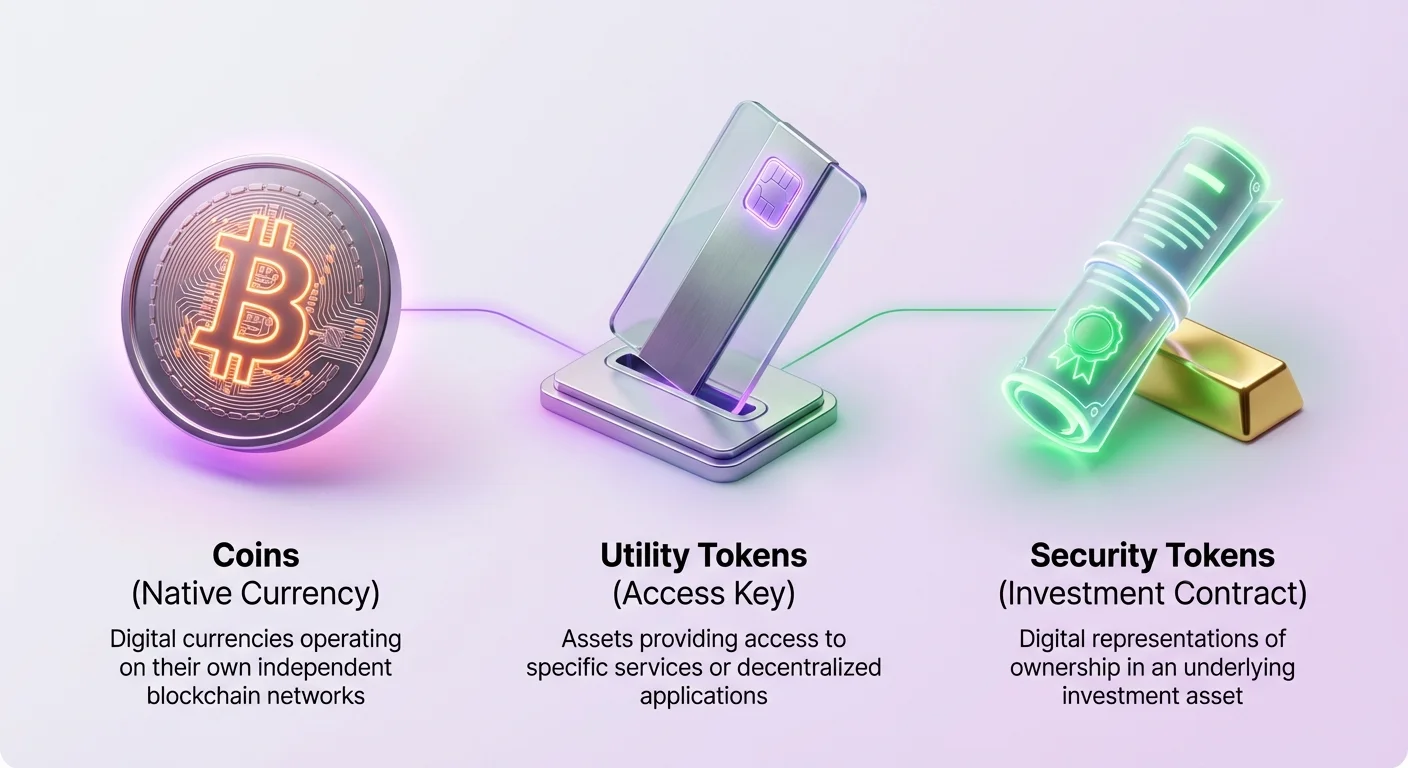
The Foundation: Coins vs. Tokens
Distinguishing the Technical Architecture
To understand the nuance between utility and security tokens, one must first clarify the difference between a "coin" and a "token." These terms are often used interchangeably in casual conversation, but they represent distinct technical realities. A coin is a cryptocurrency that operates on its own independent blockchain. Bitcoin is the prime example, existing as the native currency of the Bitcoin network. Other examples include Ethereum and Solana, which primarily serve to secure their specific networks and pay for transaction fees.
Tokens, in contrast, do not possess their own independent blockchain. Instead, they are built on top of existing blockchain platforms using smart contracts. Ethereum is the most common host for these assets, but networks like Solana and Avalanche also support them. Because tokens leverage the infrastructure of a host chain, developers can launch them more quickly and with fewer resources than would be required to build a new blockchain from scratch. This ease of deployment has led to an explosion in the variety of tokens available on the market, especially given the various Ethereum token standards.
The Role of Smart Contracts
The creation of tokens relies heavily on smart contracts. These are self-executing agreements with the terms of the code directly written into the blockchain. Smart contracts enable tokens to have complex, programmable behaviors that go far beyond simple value transfer. For instance, a token can be programmed to grant access to a specific software application or to automatically distribute a share of profits to holders.
This programmability is what allows for the vast diversity of token types we see today. While a coin like Bitcoin is primarily designed to be a store of value or medium of exchange, a token can represent virtually anything. It can be a stablecoin pegged to the US dollar, a governance vote in a decentralized organization, or a unique digital collectible known as a non-fungible token (NFT). The specific code defining the token determines its category.
Historical Evolution of Digital Assets
The history of this distinction helps explain the current landscape. Bitcoin introduced the concept of the blockchain coin in 2009. It wasn't until Ethereum launched in 2015 that the concept of programmable tokens became widely accessible. This innovation triggered a boom in asset creation, particularly during 2017, when the ERC-20 token standard made it easy for anyone to issue a new digital asset.
Since then, the market has matured. We have seen the rise of stablecoins, which aim to hold a steady value, and governance tokens, which let holders vote on project decisions. We have also seen hybrid cases, such as BNB, which started as a token on Ethereum before migrating to its own native blockchain to become a coin. This fluid history underscores why technical classification is based on current infrastructure rather than origin.
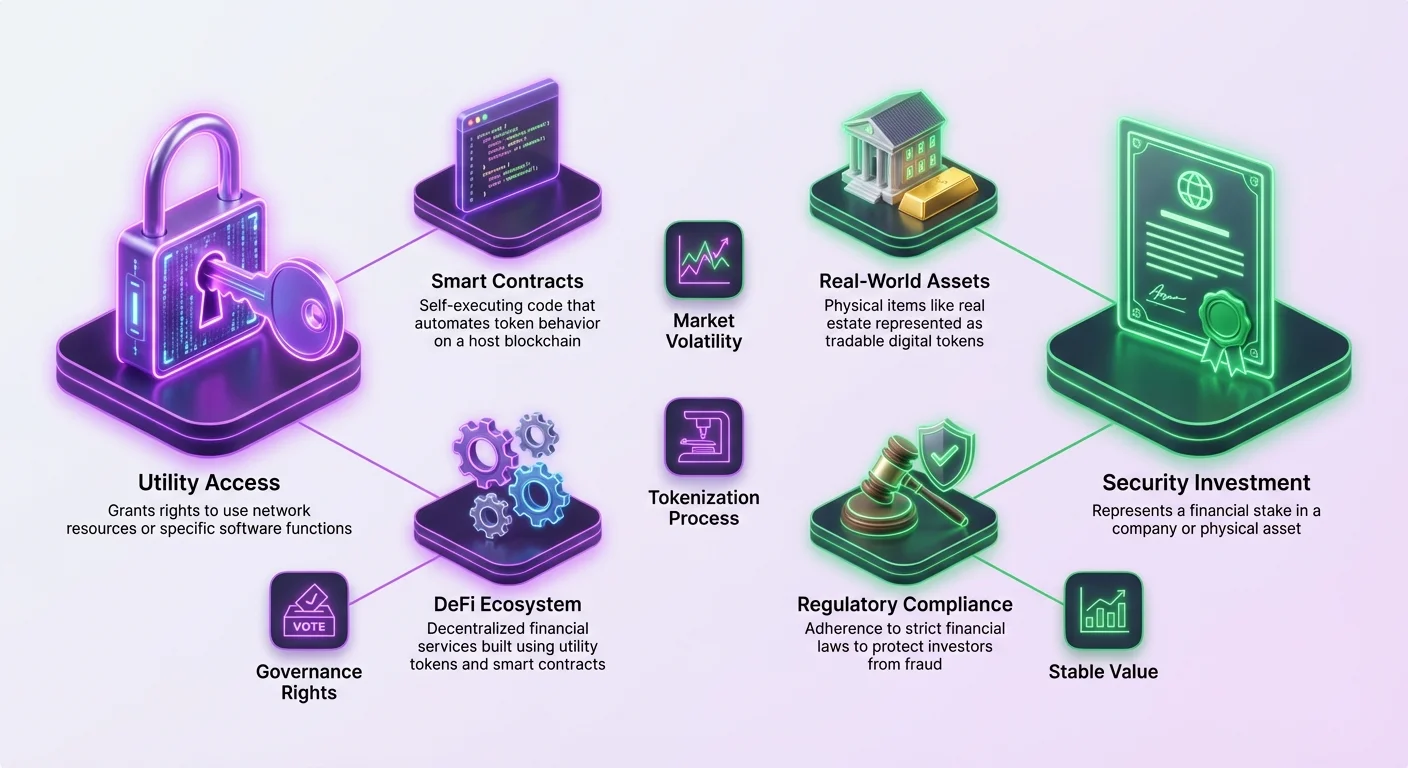
Utility Tokens: Access and Functionality
Defining the Utility Model
A utility token is a digital asset designed to provide access to a product or service within a specific blockchain ecosystem. Unlike assets held purely for speculation or store of value, utility tokens function as a necessary key or "fuel" to interact with a decentralized application (DApp). They are often compared to paid API keys or digital coupons that grant the holder the right to use a network's resources.
The primary purpose of a utility token is not to represent an investment in a company but to facilitate the operation of a decentralized economy. For example, a user might need to acquire a specific token to pay for cloud storage space on a decentralized network. Without the token, the service is inaccessible. This intrinsic link between the token and the service is what defines its "utility."
Common Use Cases in DeFi and Beyond
Utility tokens are the backbone of the Decentralized Finance (DeFi) sector. In this ecosystem, tokens are used to pay for transaction fees, interact with lending protocols, or provide liquidity to trading pools. They allow for automated transactions and agreements to be executed without intermediaries. This functionality expands the possibilities of decentralized systems, moving them beyond simple currency transactions into complex financial operations.
Another prominent example involves platform-specific services. In the world of supply chain management, a utility token might be used to track and verify the provenance of luxury goods. In the gaming sector, tokens might serve as in-game currency that allows players to purchase virtual items or unlock new levels. The value of these tokens is theoretically driven by the demand for the underlying service they provide access to.
Innovation and Ecosystem Growth
The utility model drives innovation by creating internal economies for new projects. By issuing a utility token, a project can bootstrap a network of users who are incentivized to participate in the ecosystem. This is often seen in "mining-based" or "participation-based" rewards, where users earn tokens for contributing resources like computing power or data.
These tokens also foster specific communities. Because the token is required to use the platform, holders naturally become stakeholders in the ecosystem's success, even if the token isn't technically a security. This alignment of incentives helps projects grow their user base and network effects. However, the line between "using" a token and "investing" in it can sometimes blur, which leads to the complex regulatory questions facing the industry today.
| Feature | Utility Token | Coin |
|---|---|---|
| Primary Function | Access to services/products | Medium of exchange/Security |
| Infrastructure | Built on existing chain | Native blockchain |
| Value Source | Demand for service | Network adoption/Scarcity |
Security Tokens: Digital Investment Contracts
Ownership and Investment Rights
Security tokens represent a fundamental shift from the utility model. These assets are designed to act as digital representations of ownership in an underlying asset. Much like traditional stocks, security tokens imply an investment contract where the holder expects to profit from the efforts of others. This category is explicitly financial in nature and is meant to serve as an investment vehicle rather than a tool for accessing software.
When a user holds a security token, they often possess rights similar to those of a shareholder. This can include the right to receive dividends, a share of the project's profits, or voting rights on corporate decisions. The value of a security token is directly tied to the performance and success of the entity or asset it represents, rather than the demand for a specific software utility.
Real-World Asset Tokenization
One of the most significant applications of security tokens is the tokenization of Real-World Assets (RWA). This process involves creating digital tokens that represent physical assets such as real estate, fine art, or commodities. By placing these assets on a blockchain, issuers can fractionalize ownership, allowing investors to buy small shares of high-value assets that were previously illiquid or inaccessible.
For example, a luxury apartment building could be represented by a set of security tokens. Each token would represent a specific fraction of the property value. If the property generates rental income, that profit could be automatically distributed to token holders via smart contracts. This bridges the gap between traditional finance and blockchain technology, offering increased efficiency and transparency in asset management.
Strict Regulatory Oversight
Because security tokens function as investments, they are subject to rigorous regulatory requirements. Unlike utility tokens, which may exist in a grayer legal area, security tokens usually fall under the jurisdiction of financial securities laws. Issuers must comply with strict rules regarding registration, reporting, and investor protection.
This oversight is designed to prevent fraud and ensure that investors have access to accurate information. Security tokens may provide investors with legal rights to dividends or profit-sharing, but they also impose obligations on the issuers. These tokens often cannot be traded as freely as utility tokens, as they may be restricted to accredited investors or specific trading platforms that adhere to compliance standards like Know Your Customer (KYC) protocols.
Navigating the Regulatory Landscape
The Importance of Classification
The distinction between utility and security tokens is not merely academic; it has profound legal and financial consequences. Regulators across the globe are increasingly scrutinizing crypto assets to determine whether they function as unregistered securities. If a token is classified as a security, the issuing project faces a complex web of compliance obligations that can be costly and difficult to navigate.
This classification often depends on the economic reality of the token rather than its technical design. Even if a project calls its asset a "utility token," regulators may view it as a security if it is marketed primarily as an investment opportunity. This uncertainty creates a challenging environment for developers and investors, who must carefully assess the regulatory exposure of any asset they deal with.
Regulatory Risks and "Changing Rules"
The regulatory landscape for cryptocurrencies is still developing. Government rules are constantly evolving, creating a degree of uncertainty for market participants. What is considered a compliant utility token today might face stricter oversight tomorrow as laws are clarified. This is particularly true for tokens that sit on the borderline, offering both utility functions and potential for speculative profit.
Investors face the risk that a token they hold could be delisted from exchanges if it is deemed a security by regulators. Such an event usually leads to a drop in liquidity and price. Furthermore, projects that fail to comply with securities laws may face fines or legal action, which can jeopardize the entire ecosystem. Understanding these risks is a critical part of due diligence.
Consumer Protection and Scams
Regulatory frameworks are intended to protect consumers from fraud and scams. The altcoin market, while innovative, has seen instances where developers disappear with investors' money or projects fail to deliver on promises. Security token regulations aim to mitigate this by enforcing transparency and accountability.
However, in the unregulated or loosely regulated sectors of the crypto market, investors must rely on their own research. Scams often masquerade as legitimate utility projects. Investors are urged to understand the technology behind a project, the team involved, and the true purpose of the token. Avoiding fraud requires a skeptical eye toward projects that promise guaranteed returns or lack a clear, functional use case.
The Gray Areas: Governance and Hybrid Models
Governance Tokens
Governance tokens represent a unique category that often straddles the line between utility and security. These tokens allow holders to participate in the decision-making processes of a decentralized organization or platform. Holders can propose, discuss, and vote on protocol upgrades, fee structures, or the allocation of treasury funds.
While primarily functional, governance tokens also imply a degree of control and ownership over the protocol's future. The value of these tokens is often tied to the influence they buy within the system. As Decentralized Autonomous Organizations (DAOs) become more prevalent, the regulatory status of governance tokens remains a topic of intense debate. They offer utility through voting rights but are often speculated upon like investments.
Stablecoins and Hybrids
Stablecoins present another nuance in the classification debate. Designed to hold a steady value, usually pegged to the US dollar, they are primarily used as a medium of exchange and a shield against volatility. They are crucial for everyday transactions and remittances. While they are generally not considered speculative investments, their backing mechanisms (often involving reserves of traditional assets) invite regulatory scrutiny regarding their solvency and stability.
Hybrid exchanges and platforms often utilize multiple types of tokens. A user might use a stablecoin for payments, a utility token for fees, and hold a governance token for voting rights—all within the same ecosystem. This complexity highlights why a "one size fits all" regulatory approach is difficult to implement. The market is dynamic, with new token models constantly emerging that challenge existing definitions.
| Token Type | Primary Use | Key Feature |
|---|---|---|
| Governance | Voting on decisions | Decentralized control |
| Stablecoin | Payments/Remittance | Pegged value (low volatility) |
| NFT | Digital Collectibles | Unique/Indivisible |
Investment Risks and Strategic Considerations
Volatility and Market Dynamics
Investing in any type of cryptocurrency carries significant risk, primarily due to price volatility. Altcoins, including both utility and security tokens, often experience much sharper price swings than Bitcoin. While this volatility can offer significant growth potential for smaller market cap assets, it also presents the danger of substantial losses, making managing risk essential.
Market conditions play a huge role in the performance of these assets. Factors such as inflation, macroeconomic trends, and the broader "crypto winter" cycles can depress prices across the board. Investors must consider their risk tolerance carefully. Utility tokens may lose value if the underlying platform fails to gain adoption, while security tokens are tethered to the success of the specific asset or company they represent.
Due Diligence and Research
Thorough research is the most effective defense against risk. Before acquiring any token, an investor should investigate the project's whitepaper, the team's background, and the token's specific use case. It is vital to verify whether a token is a genuine utility asset with a working product or a speculative vehicle with no underlying substance.
Understanding liquidity is also crucial. Some altcoins have low liquidity, making them hard to buy or sell quickly without affecting the price. This can trap investors in a position during market downturns. Additionally, investors should be aware of the technological risks, such as smart contract bugs or security vulnerabilities that could lead to exploits.
Portfolio Diversification
Diversification is a standard strategy for managing risk in the crypto landscape. By spreading investments across different asset classes—such as Bitcoin for long-term store of value, stablecoins for cash reserves, and a selection of utility or security tokens for potential growth—investors can lower their overall risk profile.
Strategies like Dollar Cost Averaging (DCA), where an investor buys a fixed amount of an asset at regular intervals, can help mitigate the impact of volatility. However, diversification does not eliminate risk entirely. The correlation between different crypto assets is often high, meaning that a crash in Bitcoin can drag down the entire altcoin market.
The Future of the Token Economy
The 2025 Landscape
Looking ahead to 2025 and beyond, the distinction between coins, utility tokens, and security tokens is expected to become even more relevant. The rise of Layer 2 networks and cross-chain interoperability is blurring some technical lines, but the functional and legal distinctions will likely sharpen. We are seeing the emergence of "multi-chain" tokens that can exist on Ethereum, Solana, and Avalanche simultaneously.
Technological advancements are also driving the market. Innovations in scalability and speed are making utility tokens more practical for everyday use in gaming and micro-transactions. Meanwhile, the institutional adoption of blockchain technology is paving the way for more regulated security token offerings (STOs), which could bring trillions of dollars of traditional assets onto the blockchain.
Conclusion
The cryptocurrency market has grown far beyond simple digital currency into a complex ecosystem of diverse assets. The distinction between utility tokens and security tokens is a cornerstone of this new economy, separating assets intended for software access from those designed for financial investment. Utility tokens power the decentralized applications and services of the future, while security tokens promise to modernize how we own and trade real-world value.
Navigating this landscape requires a clear understanding of the underlying technologies and the evolving regulatory environment. As government rules develop and the market matures, the lines between these categories will likely become clearer, offering safer and more structured opportunities for participants. Whether seeking access to decentralized services or looking for investment growth, success depends on rigorous research and a strong grasp of the fundamental differences between these digital asset classes.
Always research the specific purpose and regulatory status of a token before getting involved.