
Navigating the cryptocurrency landscape requires more than just identifying which digital assets to purchase. The most fundamental decision a participant must make is selecting the infrastructure they will use to interact with the blockchain. This choice dictates not only the user experience but also the security model, cost structure, and legal standing of every transaction.
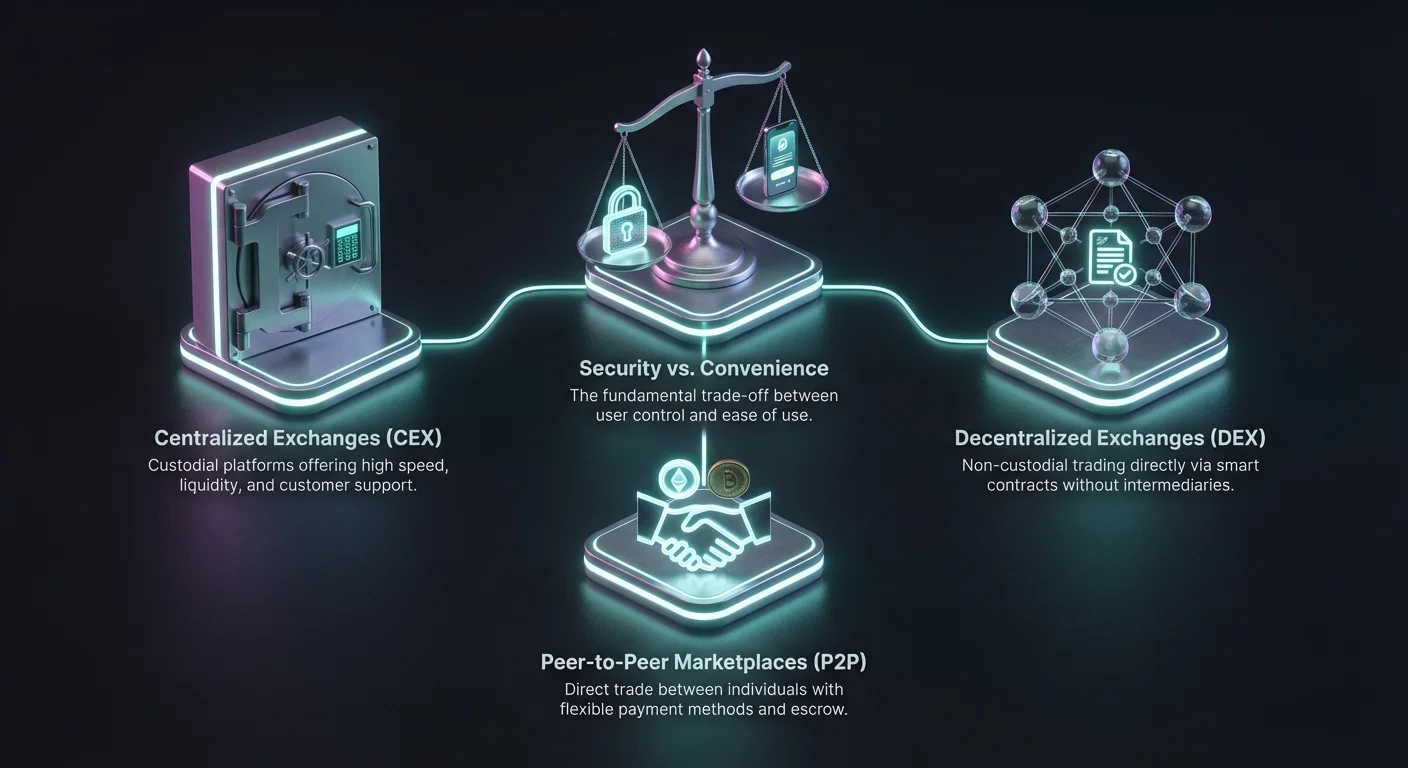
The ecosystem is broadly divided into three primary categories: Centralized Exchanges (CEX), Decentralized Exchanges (DEX), and Peer-to-Peer (P2P) marketplaces or brokers. Each acts as a gateway to the digital asset economy, yet they operate on vastly different technological and philosophical principles. Understanding these differences is the first step toward building a sustainable trading strategy.
The Role of the Intermediary
For the majority of market participants, the journey begins with an intermediary. This entity stands between the user and the blockchain, facilitating trades, securing funds, and providing a simplified interface. The level of involvement this intermediary has in your financial activities varies significantly depending on the platform type.
On one end of the spectrum, centralized entities take full custody of assets, managing them much like a traditional bank. They offer high-speed execution and recourse in the event of user error. On the other end, decentralized protocols remove the human element entirely, relying on code to execute swaps while the user retains full control.
Balancing Security and Convenience
The core tension in the decision-making process often comes down to a trade-off between security and convenience. Platforms that offer the smoothest user experience, such as password recovery and customer support, typically require users to surrender control of their private keys. This introduces counterparty risk, where the user must trust the platform not to mismanage funds.
Conversely, platforms that prioritize absolute user sovereignty require a higher degree of technical literacy. There is no customer support to reverse a transaction on the blockchain. If a user loses their private keys or interacts with a malicious smart contract, the funds are irretrievable.
The Cost of Doing Business
Beyond security mechanics, the economic models of these platforms differ. Fee structures are not uniform across the industry. Some platforms charge a flat fee for convenience, while others utilize complex maker-taker models based on trading volume.
Understanding how liquidity is sourced and how transactions are settled is essential for calculating the true cost of a trade. High fees can erode profits over time, particularly for active traders, making the choice of infrastructure a critical financial decision.
Centralized Exchanges (CEX): The Standard Gateway
Centralized exchanges represent the most common entry point for new investors and the primary liquidity hubs for institutional traders. These platforms operate as third-party intermediaries that facilitate the buying, selling, and trading of cryptocurrencies. They function similarly to traditional stock exchanges, where an order book matches buyers and sellers based on price and volume.
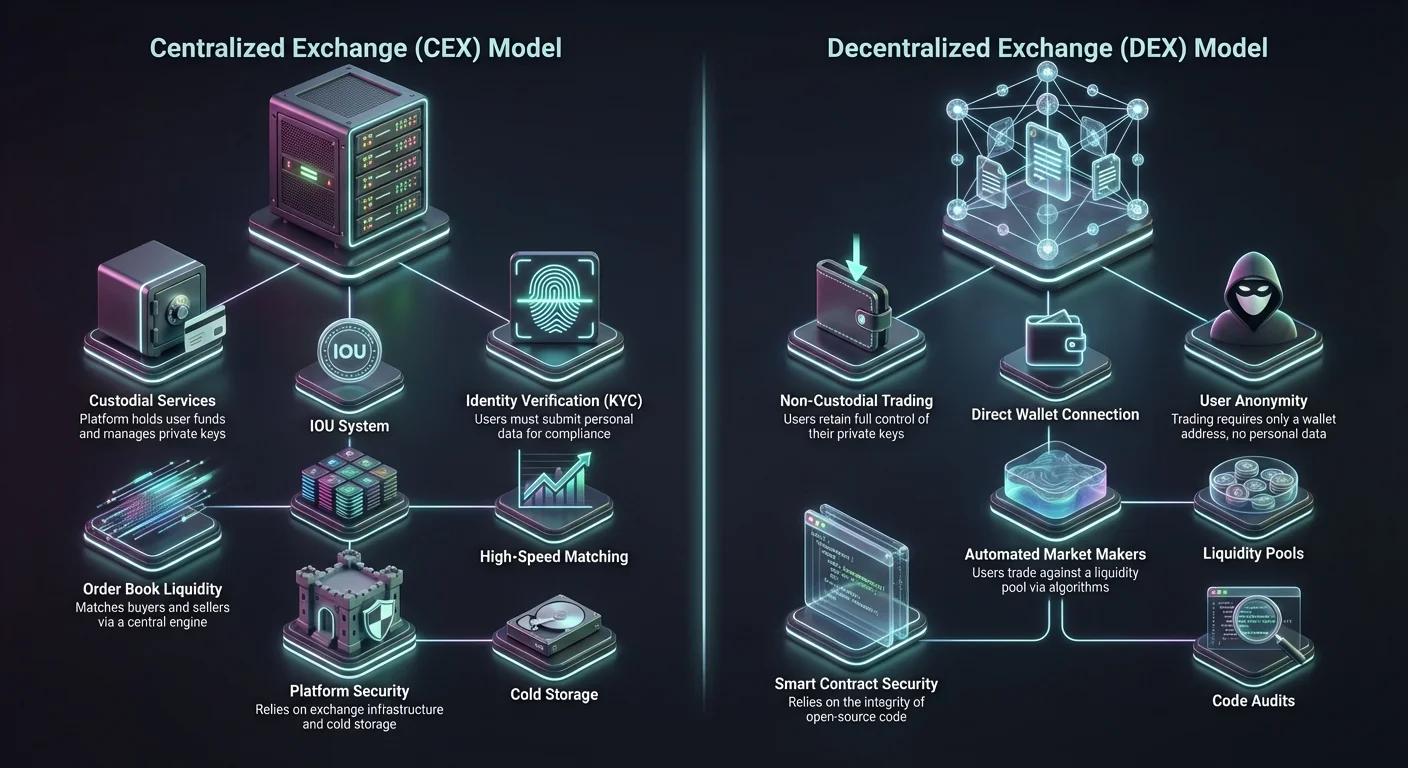
The defining characteristic of a CEX is custody. When a user deposits funds into a centralized exchange, they are essentially transferring ownership of those assets to the exchange's wallet. The exchange then issues an IOU to the user, which is represented as a balance on the screen. Actual blockchain transactions only occur when the user deposits or withdraws funds; internal trades are simply database updates.
Operational Mechanics and Liquidity
Centralized exchanges excel in providing liquidity. Because they aggregate millions of users and institutional market makers, they can offer deep order books. This ensures that trades, even large ones, can be executed almost instantly with minimal price slippage. Slippage refers to the difference between the expected price of a trade and the price at which the trade is actually executed.
The matching engine is the heart of a CEX. This software component pairs buy orders with sell orders in real-time. The efficiency of these engines allows for advanced trading types that are difficult to implement on-chain due to latency issues. High-frequency traders rely on CEX infrastructure because it offers the speed required for their strategies.
User Experience and Accessibility
One of the primary advantages of centralized platforms is their focus on user experience. They are designed to be accessible to individuals with little to no technical background in cryptography. The interfaces are intuitive, often mimicking traditional banking apps or stock brokerage sites.
| Feature | Benefit | Trade-off |
|---|---|---|
| Custody | Easy account recovery | Counterparty risk |
| Fiat Support | Direct bank transfers | KYC requirements |
| Speed | Instant execution | Off-chain settlement |
Furthermore, CEXs serve as the primary bridge between the fiat world and the crypto world. They maintain banking relationships that allow users to deposit government-issued currency via bank transfers, credit cards, or third-party processors. This "on-ramp" capability is a distinct advantage over many decentralized competitors.
Regulatory Compliance and KYC
To maintain their banking relationships and operate legally in various jurisdictions, centralized exchanges must adhere to strict regulatory frameworks. This involves implementing Know Your Customer (KYC) and Anti-Money Laundering (AML) procedures. Users are typically required to submit government identification, proof of address, and facial verification before they can trade or withdraw significant amounts.
While this compliance provides a layer of legitimacy and safety—users have legal recourse if the exchange acts fraudulently—it effectively removes anonymity. For traders who prioritize privacy above all else, the mandatory data collection of a CEX is a significant drawback.
Decentralized Exchanges (DEX): The Code-Based Solution
Decentralized exchanges represent a fundamental shift in how trading is conducted. Unlike their centralized counterparts, DEXs operate without a central authority. They are applications built on top of blockchain networks that allow users to trade directly with one another.
The defining feature of a DEX is non-custodial trading. The platform never holds the user's funds. Instead, users connect their personal digital wallets to the exchange, and trades are executed via smart contracts. These are self-executing contracts with the terms of the agreement directly written into code.
Automated Market Makers (AMMs) vs. Order Books
While some DEXs attempt to replicate the traditional order book model, the most successful innovation in this sector has been the Automated Market Maker (AMM). Instead of matching a buyer with a seller, AMMs allow users to trade against a liquidity pool.
A liquidity pool is a smart contract filled with funds provided by other users, known as liquidity providers (LPs). Prices are determined algorithmically based on the ratio of assets in the pool. This model allows for continuous liquidity without the need for a traditional market maker on the other side of the trade.
Privacy and Censorship Resistance
One of the strongest value propositions of a DEX is privacy. Because there is no central entity managing accounts, there is typically no sign-up process or identity verification. Users interact with the protocol using only their wallet address. This offers a high degree of pseudonymity, protecting the user's real-world identity.
Additionally, DEXs are censorship-resistant. Since the exchange lives on a distributed blockchain, no single entity can shut down the platform or freeze a specific user's funds. As long as the blockchain is running and the user has an internet connection, they can access the market. This alignment with the ethos of decentralization attracts users who are wary of centralized control.
The Complexity and Risk Factors
The autonomy provided by DEXs comes with increased responsibility. The user experience is generally more complex than that of a CEX. Users must understand concepts like gas fees, network congestion, and wallet management. There is no "forgot password" button; losing access to a wallet means losing access to the funds permanently.
Furthermore, the reliance on smart contracts introduces technical risks. If the code governing the exchange contains a bug or vulnerability, it can be exploited by malicious actors to drain the liquidity pools. While reputable DEXs undergo security audits, the risk is never zero.
Cryptocurrency Brokers: The Service-Oriented Approach
Cryptocurrency brokers operate differently from standard exchanges. While an exchange is a marketplace where buyers and sellers meet, a broker acts as an intermediary that buys and sells assets on behalf of the client. The broker sets the price, often including a premium, and facilitates the transaction.
This model is similar to a foreign exchange kiosk at an airport. You are not trading with another traveler; you are trading with the kiosk itself. Brokers simplify the process significantly, making them an attractive option for complete beginners or high-net-worth individuals who prefer personalized service over complex trading interfaces.
Simplified Entry and Specialized Support
Brokers often provide the most streamlined entry into the crypto market. The interfaces are stripped of complex charts and order books, presenting users with a simple "Buy" or "Sell" option. This reduces the cognitive load for new investors who may find candlestick charts and depth graphs intimidating.
Moreover, many brokerage platforms offer enhanced customer support. Unlike exchanges where support might be limited to ticket systems, premium brokers may offer direct access to account managers. This personalized guidance can be valuable for navigating the market or executing large transactions without causing market volatility.
The Cost of Convenience
The primary trade-off for this simplicity and service is cost. Brokers typically charge higher fees than exchanges. These fees are often hidden in the "spread"—the difference between the market price and the price the broker offers to the client.
While a broker might advertise "zero commission" trading, the user is likely paying a premium on the asset price itself. For buy-and-hold investors, this one-time cost might be acceptable. However, for active traders, the wider spreads offered by brokers can significantly eat into potential profits, making them less suitable for high-frequency strategies.
Peer-to-Peer (P2P) Marketplaces: Direct Interaction
Peer-to-Peer exchanges facilitate direct trade between individuals without an automated matching engine or a liquidity pool. These platforms function like a classifieds listing service for cryptocurrency. A seller posts an advertisement offering to sell Bitcoin at a specific price with specific payment terms, and a buyer accepts that offer.
P2P platforms are essential for users in regions with limited banking infrastructure or where centralized exchanges are restricted. They offer the highest degree of payment flexibility, allowing users to settle trades using methods that automated systems cannot handle.
Escrow Services and Trust
To solve the issue of trust between strangers, P2P platforms utilize escrow services. When a trade is initiated, the seller's cryptocurrency is locked in a secure digital vault managed by the platform. The funds remain in escrow until the seller confirms that they have received the fiat payment from the buyer.
Once payment is confirmed, the platform releases the crypto to the buyer. This mechanism protects both parties: the buyer knows the crypto exists and is locked, and the seller knows they won't lose their asset until they have cash in hand.
Payment Flexibility and Global Access
The defining feature of P2P exchanges is the variety of payment methods available. Because the fiat transfer happens directly between users (off-platform), almost any transfer of value can be used to settle a trade.
This includes:
- Bank transfers (domestic and international)
- Digital wallets (PayPal, Skrill, etc.)
- Gift cards
- Cash in person
- Mobile money services
This flexibility makes P2P platforms a vital infrastructure layer for global inclusion. Users without access to traditional credit cards or swift transfers can still participate in the global crypto economy by finding a local seller willing to accept local payment methods.
Analyzing Fee Structures Across Platforms
Cost efficiency is a major factor in the decision matrix. Every platform type has a distinct way of generating revenue, and these costs are passed on to the user. Understanding the nuances of these fee structures is essential for maximizing returns.
Maker and Taker Fees
Centralized exchanges typically use a maker-taker fee model. This model distinguishes between orders that provide liquidity and orders that take liquidity.
- Maker: A user who places a limit order that sits on the order book. They are "making" the market by providing liquidity. Makers often pay lower fees.
- Taker: A user who places a market order that is immediately filled by an existing order. They are "taking" liquidity off the book. Takers usually pay higher fees.
This structure incentivizes users to provide liquidity, which helps stabilize the market. Fees are usually calculated as a percentage of the trade volume, ranging from 0.1% to 0.5% on average, with discounts often available for high-volume traders or those holding the exchange's native token.
Network Fees vs. Platform Fees
It is crucial to distinguish between fees charged by the platform and fees charged by the blockchain network. On a CEX, trading fees are platform fees. However, when a user withdraws funds to a personal wallet, they must pay a withdrawal fee. This fee covers the network cost (gas) plus a margin for the exchange.
On a DEX, there are no platform trading fees in the traditional sense, but every interaction requires a network transaction fee. On congested networks like Ethereum, these gas fees can be substantial, sometimes exceeding the value of small trades. Conversely, Layer-2 networks or alternative blockchains offer significantly lower network fees, making DEX trading more affordable.
Spread Costs
Brokers and some P2P sellers rely on spreads rather than transparent commissions. The spread is the margin between the buy and sell price. For example, if the global market price of Bitcoin is $50,000, a broker might offer to sell it to you for $50,500.
The $500 difference represents the cost of the trade. While this simplifies the fee structure—you pay exactly the price you see—it can often result in higher overall costs compared to the percentage-based fees of an open exchange. Users should always compare the offered price against global spot prices to understand the true premium they are paying.
Security Architecture: Hot vs. Cold Storage
Security is the bedrock of the cryptocurrency industry. The irreversible nature of blockchain transactions means that security failures are often catastrophic. Exchanges and users alike must employ robust strategies to protect digital assets from theft and hacking.
The Cold Storage Standard
For centralized exchanges, the gold standard of security is cold storage. Cold storage refers to keeping the majority of digital assets in offline wallets that are not connected to the internet. This air-gapped approach makes it virtually impossible for hackers to access the funds remotely.
Reputable exchanges typically keep 95% to 98% of user funds in cold storage. The remaining small percentage is kept in "hot wallets"—online wallets connected to the internet—to facilitate immediate withdrawals and liquidity. This balance ensures that even in the event of a system breach, the vast majority of assets remain secure.
Two-Factor Authentication (2FA) and User Hygiene
Platform security is only half the equation; user security is equally important. Centralized platforms provide tools like Two-Factor Authentication (2FA) to protect user accounts. This requires a second form of verification, such as a code from a mobile app or a hardware key, in addition to a password.
Phishing attacks remain a significant threat. Users must be vigilant against fraudulent emails or websites designed to steal login credentials. Most exchanges offer anti-phishing codes, which allow users to set a unique phrase that appears in all official emails, verifying their authenticity.
Smart Contract Audits
For Decentralized Exchanges, security is defined by code quality. Since there is no custodian holding funds, the risk lies in the smart contracts that govern the liquidity pools. If the code contains logic errors, hackers can exploit them to drain funds.
To mitigate this, reputable DEXs undergo rigorous audits by third-party security firms. These audits involve a line-by-line review of the code to identify vulnerabilities. While audits reduce risk, they do not eliminate it. Users providing liquidity on a DEX should be aware that they are trusting the integrity of the code.
Advanced Trading Features: Beyond Spot Markets
As the cryptocurrency market has matured, the infrastructure has evolved to support sophisticated financial instruments. Basic spot trading—buying and selling the actual asset—is now just one component of the ecosystem.
Futures and Derivatives
Centralized exchanges have aggressively expanded into derivatives markets. Futures contracts allow traders to speculate on the future price of an asset without actually owning it. This enables strategies like short selling, where a trader can profit from a decline in asset prices.
Perpetual futures, a type of contract with no expiration date, have become the dominant instrument for active traders. These products often allow for high leverage, enabling traders to multiply their exposure to price movements. While leverage can amplify profits, it also magnifies losses, introducing significant risk.
Copy Trading and Social Features
To assist beginners, many platforms have introduced social trading features. Copy trading allows users to automatically replicate the trades of experienced investors. Users can browse profiles, view historical performance metrics, and allocate funds to follow specific strategies.
This democratizes access to professional trading strategies but requires due diligence. Past performance is not indicative of future results, and the risks associated with the lead trader's strategy are passed on to the copier.
Staking and Earn Products
Both centralized and decentralized platforms now offer yield-generating products. Staking involves locking up assets to support the security of a Proof-of-Stake blockchain in exchange for rewards.
Centralized exchanges simplify this process, allowing users to stake with a single click. However, the exchange typically takes a cut of the rewards. Decentralized protocols allow users to stake directly or provide liquidity to AMM pools to earn fees. This "yield farming" can offer higher returns but comes with risks such as impermanent loss, where the value of assets in the pool diverges from holding them in a wallet.
Privacy and Anonymity Considerations
The original ethos of cryptocurrency was deeply rooted in privacy. However, the intersection of crypto with traditional finance has complicated this landscape. The decision matrix must account for how much personal information a user is willing to disclose.
The "No-KYC" Landscape
For users who prioritize privacy, "No-KYC" (Know Your Customer) exchanges are highly sought after. These platforms allow trading without submitting identity documents. Decentralized exchanges naturally fall into this category, as they do not collect user data.
Some centralized exchanges also operate with tiered verification systems. They may allow limited trading and withdrawals for unverified accounts, reserving strict KYC checks for high-volume users. However, regulatory pressure is globally reducing the number of centralized venues that allow anonymous trading.
Privacy Coins and Mixing
Specialized infrastructure exists to support privacy coins like Monero or Zcash. While major regulated exchanges may delist these assets due to compliance concerns, niche exchanges and DEXs continue to support them.
Furthermore, privacy-enhancing technologies such as coin mixers are available, though they are often scrutinized by regulators. Users operating in this space must be acutely aware of the legal implications in their specific jurisdiction.
Hybrid Exchanges: Bridging the Gap
A distinct category of infrastructure has emerged that attempts to combine the benefits of CEXs and DEXs: the Hybrid Exchange. These platforms aim to offer the liquidity and speed of a centralized system with the security and self-custody of a decentralized protocol.
In a hybrid model, the order matching and trade execution might happen off-chain for speed, similar to a CEX. However, the actual settlement of funds occurs on-chain via smart contracts. This ensures that the platform never actually takes custody of the user's private keys.
While promising, hybrid exchanges often face challenges in gaining traction. They can be technically complex to build and may struggle to attract the massive liquidity found on major CEXs or the permissionless innovation of major DEXs. Nevertheless, they represent an important evolution in the quest for the optimal trading infrastructure.
Geographic and Regulatory Factors
The physical location of the user plays a decisive role in platform selection. The cryptocurrency industry is not governed by a single global law; it is a patchwork of local regulations that vary wildly from country to country.
Regional Restrictions
Many top-tier centralized exchanges are geofenced. For example, a platform based in Asia might restrict access to users in the United States due to strict securities laws. Conversely, a US-based exchange might offer a limited selection of assets compared to its international counterpart to remain compliant.
Users must verify that an exchange is legally permitted to operate in their region. Using a Virtual Private Network (VPN) to bypass these restrictions is risky; if the exchange detects the deception, they may freeze the account and the funds within it.
Banking Integration
Local banking integration is another critical geographic factor. A trader in Europe needs an exchange that supports SEPA transfers for low-cost euro deposits. A trader in Brazil needs support for the PIX payment system.
Regional exchanges often excel in this area. While they may have lower liquidity than global giants, their ability to offer seamless, low-cost fiat on-ramps and off-ramps makes them an essential part of the infrastructure for local users.
Conclusion
The landscape of cryptocurrency infrastructure is diverse, offering tailored solutions for every type of participant. Centralized exchanges provide a familiar, bank-like experience with high speed and customer support, acting as the primary bridge for new capital. They sacrifice custody for convenience, demanding trust in exchange for usability.
Decentralized exchanges offer a robust alternative for those prioritizing sovereignty and privacy. By removing the intermediary, they mitigate counterparty risk but introduce technical complexity and personal responsibility. Peer-to-peer platforms and brokers fill the remaining gaps, offering payment flexibility and personalized services that automated systems cannot match.
Ultimately, the decision is not about finding the objectively "best" platform, but rather the one that aligns with specific goals. A long-term holder might prefer the security of a hardware wallet and a DEX, while a day trader requires the speed of a CEX. By understanding the mechanics, risks, and fee structures of each option, investors can navigate the crypto economy with confidence and security.
The ideal infrastructure strategy often involves using a combination of platforms: centralized exchanges for fiat on-ramps, decentralized protocols for privacy, and cold storage for long-term security.