
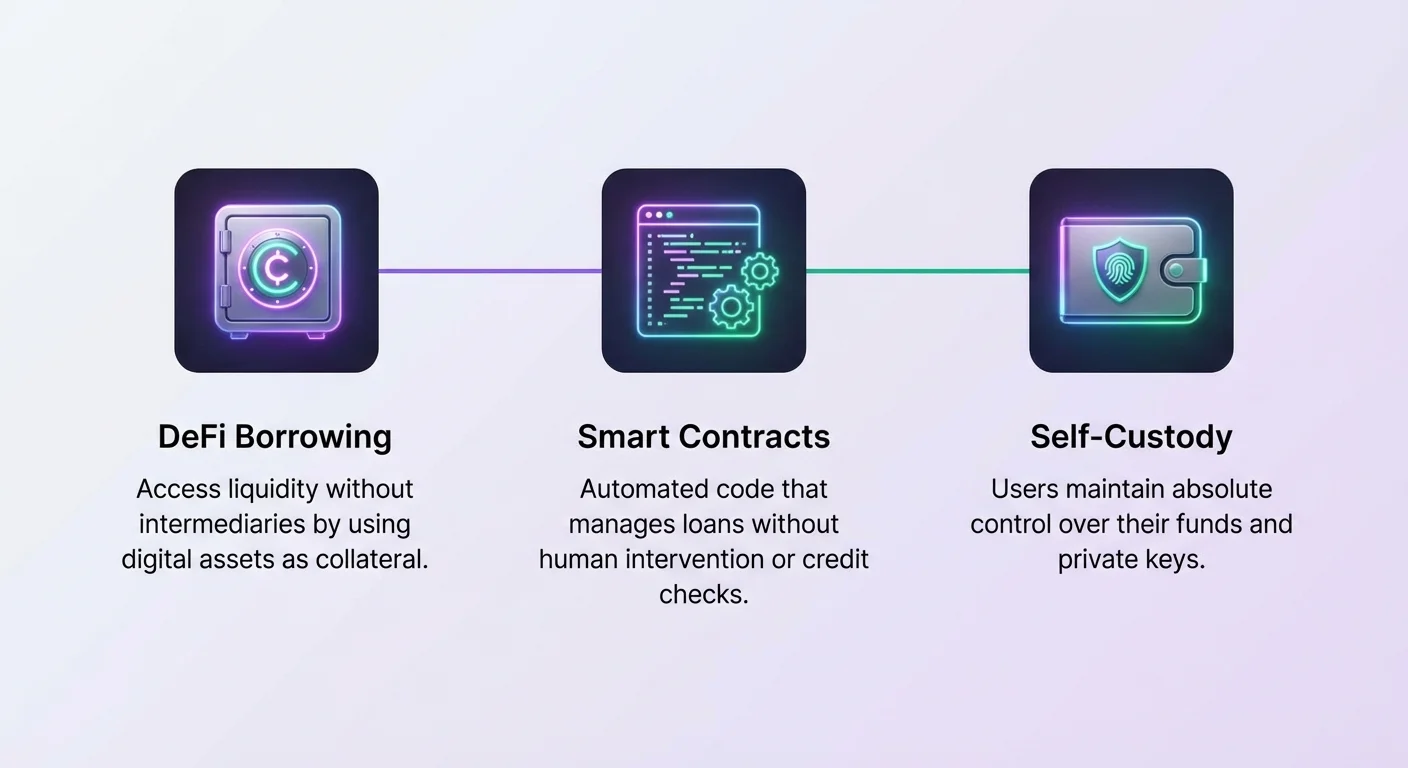
Decentralized finance has fundamentally altered how individuals access leverage and liquidity. In the traditional banking system, borrowing requires credit checks, extensive paperwork, and the approval of a centralized institution. The bank assesses your personal financial history to determine if you are a trustworthy borrower. If you fail to meet their criteria, you are denied access to capital regardless of your actual ability to repay or the assets you hold.
In the world of crypto protocols, the system operates differently. The software does not know your name, your credit score, or your employment history. It does not care about your relationship with the bank manager or your geographic location. Instead, these trustless protocols rely entirely on mathematical guarantees provided by the assets you hold. This is the foundation of collateralized borrowing. It is a system where your digital assets serve as the security for the loans you take out.
To participate in this ecosystem, you do not ask for permission. You simply interact with a smart contract. By depositing cryptocurrencies into a lending pool, you signal your intent to participate in the market. This deposit allows you to earn interest, known as yield, but it also unlocks the ability to borrow other assets against that deposit. This mechanism powers the vast majority of lending activity on networks like Ethereum, Avalanche, and Polygon.
The Mechanics of Digital Collateral
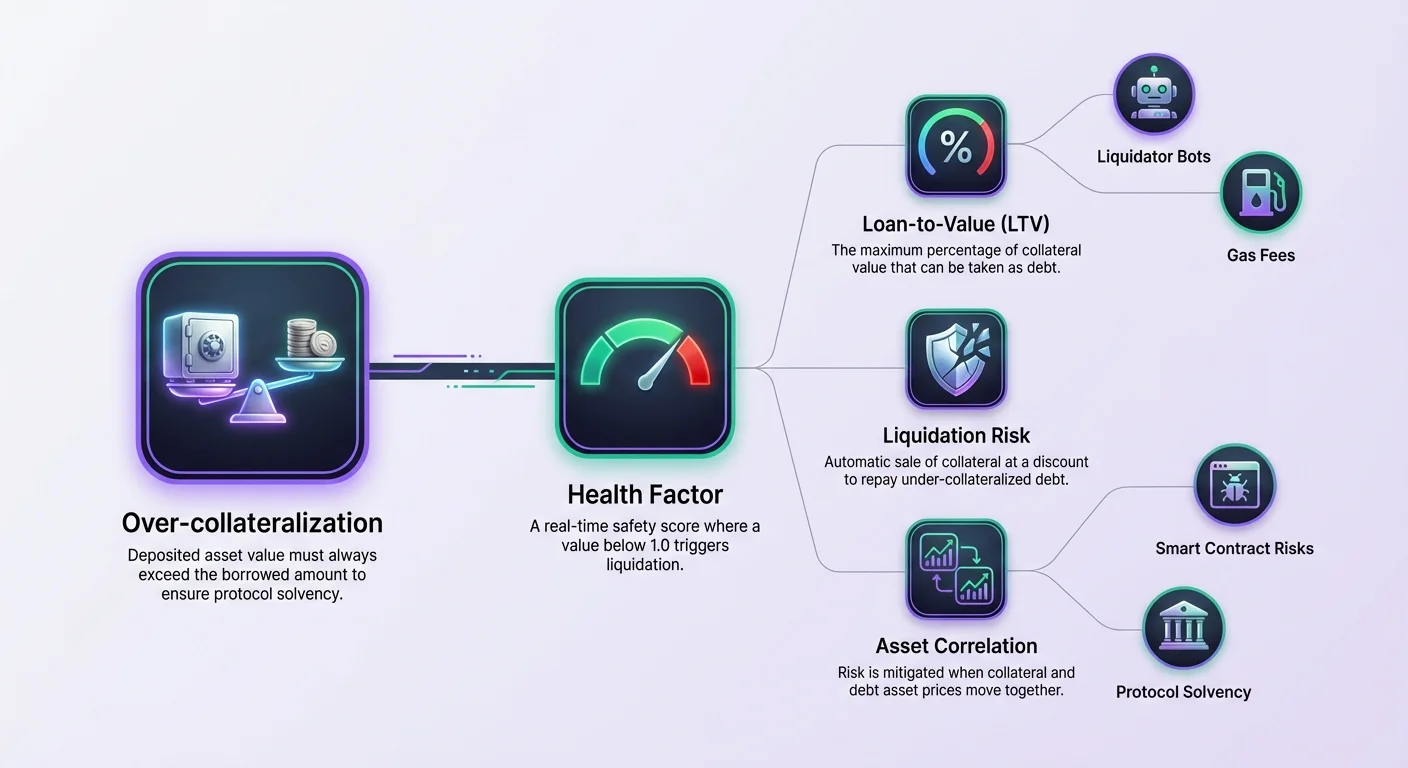
The core principle of DeFi borrowing is over-collateralization. This means that the value of the assets you deposit must exceed the value of the assets you borrow. If you wish to borrow a specific amount of cryptocurrency, you must lock up a greater value of your own holdings to secure that debt. This ensures that the lenders in the pool are always protected against default. Since there are no debt collectors to call you, the collateral itself acts as the assurance of repayment.
When you supply assets to a protocol like Aave, you are effectively putting money into a digital vault. This capital does not sit idle. It is lent out to other users who pay interest for the privilege. However, once you decide to take a loan yourself, your deposited assets become "encumbered." They are legally (in the code sense) locked as insurance for the protocol. You cannot simply withdraw them without first paying back the debt you owe.
This system resembles a digital pawn shop more than a traditional bank. In a pawn shop, you hand over a watch to receive cash. If you never return for the watch, the shop keeps it to cover the loss. In DeFi, you hand over crypto tokens to receive other tokens. The major difference is that the value of your "watch" (crypto) fluctuates constantly. This volatility introduces complex risks that every borrower must understand to avoid losing their funds.
The Role of Self-Custody
Before engaging in these lending markets, a user must have a proper setup. The foundation of all DeFi interaction is the self-custodial wallet. Unlike an account on a centralized exchange where a third party holds the keys, a self-custodial wallet gives the user absolute control over their funds. This is a prerequisite for interacting directly with lending smart contracts. Without this direct control, you cannot sign the transactions required to deposit collateral or manage your loan.
Wallets connect to decentralized applications (dApps) through protocols like WalletConnect. This bridge allows the software interface to request approval for transactions, which the user must sign cryptographically. When you decide to lend or borrow, you are approving a specific interaction between your personal wallet and the protocol's smart contract. The assets move directly from your control into the contract's liquidity pool.
This autonomy comes with significant responsibility. In a custodial environment, a support team might help you recover a password or reverse an error. In self-custodial DeFi borrowing, you are the sole risk manager. You must ensure your wallet contains enough native currency, such as ETH or AVAX, to pay for the transaction fees associated with depositing collateral or repaying loans. If you run out of gas fees, you may find yourself unable to close a position during a critical market movement.
Understanding Loan-to-Value Ratios
The Loan-to-Value (LTV) ratio is the primary metric that determines how much you can borrow. It represents the percentage of your collateral's value that can be taken out as debt. Every asset on a lending platform has a specific maximum LTV assigned to it based on its risk profile. Stable assets usually have higher LTV allowances, while volatile assets have lower ones.
For example, if a protocol sets the Maximum LTV for Ethereum at 80%, it means for every $1,000 worth of ETH you deposit, you can borrow up to $800 worth of other assets. This limit is a hard ceiling enforced by the smart contract. You physically cannot borrow more than this mathematical limit allows. The protocol prevents you from executing the transaction if it exceeds the allowable ratio.
However, borrowing up to the maximum LTV is rarely a good idea. The maximum LTV represents the absolute limit before the system considers the loan unsafe. If you borrow the maximum amount possible, even a tiny drop in the value of your collateral could push you into insolvency. Experienced DeFi users typically maintain a buffer. They might only borrow 50% or 60% of their collateral's value, leaving room for market prices to fluctuate without triggering immediate penalties.
Liquidation Risks and Triggers
Liquidation is the process the protocol uses to protect lenders when a borrower's collateral value falls too low. If the value of your collateral drops, or if the value of the asset you borrowed rises significantly, your LTV increases. If this ratio crosses a specific threshold, the protocol declares your loan under-collateralized. At this point, the system authorizes third-party liquidators to intervene.
The Liquidation Process
Liquidators are automated bots that monitor the blockchain for unsafe loans. When a user's position crosses the liquidation threshold, these bots pay off a portion of the user's debt in exchange for the user's collateral. To incentivize liquidators to perform this service, they receive the collateral at a discount. This discount effectively acts as a penalty fee charged to the borrower.
This mechanism ensures the lending pool remains solvent. If the protocol allowed the collateral value to fall below the value of the borrowed debt, lenders would lose money. Liquidation prevents this bad debt from accumulating. For the borrower, however, it means realizing a permanent loss. You lose your deposited asset, and you are left with the asset you borrowed, usually resulting in a net loss of value compared to simply holding the original asset.
Volatility Dangers
The speed of liquidation depends entirely on market volatility. In crypto markets, prices can swing by double-digit percentages in a single hour. A borrower who felt safe with a 75% LTV in the morning might find themselves liquidated by lunch if the market crashes. This is why understanding the specific liquidation threshold for each asset is vital.
Different assets have different risk parameters. A loan secured by a stablecoin like USDC is generally safer from price-drop liquidation than a loan secured by a smaller, more volatile altcoin. If you use a volatile asset as collateral to borrow another volatile asset, the risk compounds. If your collateral crashes while your debt spikes in value, the gap closes from both ends, accelerating the liquidation process.
Health Factors in Borrowing
Most modern lending protocols synthesize the complex math of LTV and liquidation thresholds into a single, easy-to-read metric called the "Health Factor." This number gives you a real-time status report on the safety of your loan. It is perhaps the most important number to watch on your dashboard.
Interpreting the Number
A Health Factor is typically a numeric value where 1.0 represents the liquidation point. If your Health Factor is above 1.0, your loan is considered safe and compliant with protocol rules. If it drops below 1.0, your position is eligible for liquidation.
| Health Factor Range | Safety Status | Recommended Action |
|---|---|---|
| Above 2.0 | Very Safe | Monitor periodically |
| 1.5 to 2.0 | Moderate Risk | Watch market closely |
| 1.0 to 1.1 | Danger Zone | Repay debt or add collateral immediately |
A high Health Factor means you have a large buffer. For instance, a Health Factor of 2.0 usually implies that your collateral value could drop significantly, often by 50%, before you face liquidation. Conversely, a Health Factor of 1.05 means a drop of just a few percentage points will trigger a loss of funds.
Managing the Metric
Your Health Factor is not static. It changes with every price tick of the underlying assets. It also changes when you accrue interest on your debt. Over time, the interest you owe increases the total debt burden, which slowly lowers your Health Factor even if asset prices remain perfectly stable.
To improve a deteriorating Health Factor, a user has two primary options. The first is to deposit more collateral. By adding more assets to the "supply" side of the equation, you increase the total value securing the loan. The second option is to repay part of the loan. Returning the borrowed funds reduces the debt burden, instantly boosting the safety score.
Withdrawal Mechanics and Risks
One of the most common mistakes new DeFi users make involves improper withdrawal of assets. In a standard wallet, you can send or move funds whenever you like. However, when those funds are acting as collateral, they are encumbered. While the protocol allows you to withdraw "excess" collateral, doing so increases your risk profile immediately.
When you navigate to the withdrawal page of a lending protocol, the interface will typically show you which assets are available to claim. If you have an active loan, the system should prevent you from withdrawing collateral that is essential to maintain the minimum required LTV. However, you might still be able to withdraw funds that bring you dangerously close to the limit.
Source guidelines emphasize being very careful when withdrawing assets associated with loans. A user might see a balance of ETH and decide to withdraw it to sell or move to another wallet. If that ETH was keeping their Health Factor above 1.0, the withdrawal could instantly drop the Health Factor into the danger zone. In some cases, if the price moves slightly during the seconds it takes for the withdrawal transaction to confirm, the user could be liquidated immediately after the withdrawal is processed.
Strategic Asset Management
It is crucial to check the impact on your Health Factor before confirming any withdrawal transaction. Most interfaces provide a "simulation" or "preview" showing what your new Health Factor will be after the withdrawal. If the preview shows the number dropping below 1.5 or 1.2, it is generally wise to reconsider or to repay some debt first.
Users must also remember that transaction fees are paid in the native chain currency. If you deposit all your ETH as collateral, you might not have enough ETH left in your wallet to pay the gas fee required to withdraw it later. This creates a "dust" lock situation where you have funds but cannot access them. Always keep a reserve of the native token in your wallet for future fees.
Asset Choice and Correlation
The relationship between the asset you deposit and the asset you borrow plays a massive role in risk management. This relationship is often described in terms of correlation. If the prices of the two assets move together, the risk is somewhat mitigated. If they move in opposite directions, the risk is amplified.
Consider a user who deposits Wrapped Bitcoin (WBTC) to borrow Ethereum (ETH). These two assets are highly correlated; generally, when the crypto market moves up, both go up. If the market crashes, both likely crash. This means the ratio between your collateral and your debt might remain relatively stable, even in a downturn.
Contrast this with a user who deposits a stablecoin (like USDC) to borrow a volatile asset (like ETH). If ETH doubles in price, the dollar value of the debt doubles. The collateral (USDC) remains flat at $1.00. The user's LTV skyrockets because the debt is getting heavier while the collateral stays the same. This is a common way short-sellers get liquidated. They borrow an asset hoping it goes down, but if it goes up, they are squeezed out of the position.
Stablecoin Borrowing
Borrowing stablecoins against volatile collateral is the most common use case. A user holds ETH and believes it will appreciate. They deposit ETH and borrow USDC to pay for real-world expenses. This allows them to keep their exposure to ETH's potential upside.
However, this strategy is highly sensitive to price drops. Since the debt (USDC) does not decrease in value, any drop in the collateral (ETH) directly hurts the Health Factor. There is no buffering effect from the debt losing value simultaneously. Users employing this strategy must monitor their positions actively and be ready to add collateral during market dips.
Viedo līgumu un protokola riski
Papildus LTV un likvidācijas finanšu matemātikai ir tehniski riski, kas saistīti ar DeFi protokolu izmantošanu. Kad jūs aizdot vai aizņemat, jūs uzticaties viedā līguma kodam. Lai gan protokoli kā Aave ir kaujas pārbaudīti un auditēti, neviena programmatūra nav pilnībā imūna pret kļūdām vai ekspluatācijām.
Koda auditi un vēsture
"Aizdevuma platformas vietnes" izvēle ir kritiska. Lietotājiem jāpiestrādā pie uzticamām aizdevuma protokoliem ar ilgu darbības vēsturi un ievērojamu likviditāti. Platforma, kas gadu gaitā ir nodrošinājusi miljardus dolāru bez lieliem incidentiem, parasti ir drošāka nekā jauns, ne pārbaudīts protokols, kas piedāvā nedaudz augstāku ienesumu. Jūsu nodrošinājuma drošība atkarīga no līguma spējas novērst hakeru baseina iztukšošanu.
Atļauju pārvaldība
Kad jūs pirmo reizi mijiedarbojaties ar aizdevuma dApp, jūs piešķirat tai atļauju tērēt jūsu žetonus. Tas ir standarta apstiprinājuma darījums. Tomēr lietotājiem jābūt uzmanīgiem pret neierobežotām atļaujām. Periodiskas maciņa atļauju pārbaudes var palīdzēt uzturēt drošību. Ja protokols ļaunprātīgi uzlabotu savus līgumus vai ciestu no pārvaldības uzbrukuma, atvērtās atļaujas teorētiski varētu būt zaudējumu vektors, lai gan tas ir rets uzticamajos zilo čipu DeFi projektos.
Secinājums
DeFi aizņemšanās piedāvā spēcīgus finanšu rīkus, kas iepriekš bija nepieejami vidējam indivīdam. Izmantojot digitālos aktīvus kā nodrošinājumu, lietotāji var piekļūt likviditātei bez ilgtermiņa turējumu pārdošanas. Tas rada iespējas svirai, nodokļu plānošanai un elastīgai kapitāla pārvaldībai. Tomēr šīs spējas nāk ar stingrām atbildībām riska pārvaldībā.
LTV attiecību, likvidācijas sliekšņu un veselības faktoru mehānika ir neizbēgami sistēmas noteikumi. Protokols izpildīs likvidācijas necilāti, lai aizsargātu savu solventumu, neņemot vērā lietotāja nodomu vai apstākļus. Veiksme šajā telpā prasa nepārtrauktu modrību, skaidru iesaistītās matemātikas izpratni un disciplīnētu pieeju drošības buferu uzturēšanai. Izmantojot uzticamas platformas un pašpārvaldības maciņus atbildīgi, lietotāji var efektīvi navigēt šajos tirgos.
Nekad neaizņemies vairāk, nekā vari atļauties zaudēt, un vienmēr uzturi savu veselības fatoru krietni virs likvidācijas zonas.