
Tūkstošiem gadu nauda ir balstījusies uz uzticību. Neatkarīgi no tā, vai mēs izmantojām zelta monētas, papīra fiat valūtu vai mūsdienu digitālo bankošanu, ikviens darījums prasīja centralizētu trešās puses starpnieku — uzticamu banku, valdību vai maksājumu procesoru —, lai apstiprinātu, kam pieder kas. Šī paļaušanās uz uzticību radīja vājās vietas, cenzūras riskus un atkarību no institūcijām, kas bieži darbojās bez pilnīgas pārredzamības.
Kad 1990. gados internets revolucionizēja komunikāciju, tehnologi sāka sapņot par patiesi digitālu naudas formu, ko varētu sūtīt no vienaudža uz vienaudzi, tāpat kā e-pastu. Tomēr fundamentāls trūkums, kas pazīstams kā „dubulttērēšanas problēma“, kavēja ikvienu mēģinājumu. Kā nodrošināt, ka digitāls žetons, kas ir bezgalīgi kopējams kā JPEG attēls, tiek iztērēts tikai vienreiz?
2008. gada beigās anonīma persona vai grupa, kas darbojās ar pseidonīmu Satoshi Nakamoto, publicēja whitepaper, kurā izklāstīta „A Peer-to-Peer Electronic Cash System“. Šis dokuments ne tikai ierosināja jaunu valūtu; tas prezentēja pilnīgi jaunu informācijas arhitektūru — blokķēdi —, kas atrisināja dubulttērēšanas problēmu un tādējādi novērsa nepieciešamību pēc institucionālas uzticības. Radusies inovācija Bitcoin ieviesa digitālo retumu un pavēra ceļu pašsuverēnām finansēm.
The Trust Crisis of Digital Cash (Pre-Satoshi)
Before Bitcoin, digital money was difficult to handle. If you sent $100 through a modern banking app, you weren't actually sending digital dollar bills. You were sending an instruction to the bank, and the bank updated two centralized ledgers (yours and the recipient's) to reflect the transaction. The bank acts as the ultimate arbiter of truth, ensuring the $100 leaves your account and only goes to one destination.
The problem for early digital currency pioneers was figuring out how to achieve this secure verification without the central bank.
The Ghost in the Machine: The Double Spend Problem
Imagine you have a single, unique digital token worth $10. In a centralized system (like PayPal), PayPal ensures that once you send that token to Alice, your balance is reduced, and you cannot send the same token to Bob.
In a purely digital, decentralized environment, the token is just a file—a string of code. If you try to send the token to Alice, what stops you from copying the code and sending the exact same token to Bob moments later?
This vulnerability is called the Double Spend Problem. It means that if a medium of exchange is easy to duplicate, it loses all value, just as a physical counterfeited currency does. To have real monetary value, a digital asset must be scarce, meaning it must be demonstrably difficult or impossible to spend the same unit twice.
Failures of Centralized Digital Money
Many smart people, particularly in the cypherpunk movement of the 1990s, attempted to solve the digital cash problem. Projects like Hashcash, B-Money, and DigiCash introduced crucial concepts, but they ultimately failed to gain traction or achieve true decentralization.
Their central flaw was often the reliance on a single, trusted issuer or a central server to stamp and authorize transactions. If a single entity controlled the ledger:
- It became a single point of failure: If the server went down or was seized by a government, the entire system collapsed.
- It maintained the need for trust: Users still had to trust the issuer not to print too much money or block their transactions.
- It remained centralized: The core philosophical goal of creating peer-to-peer, censorship-resistant money was never met.
The challenge was unprecedented: create a system where individuals who don’t know or trust each other can agree on a shared, immutable record of transactions, globally, without any trusted third party overseeing them.
Satoshi’s Breakthrough: A System Without Trust
Satoshi Nakamoto’s 2008 solution was elegant because it didn’t try to prevent the copying of the digital file; instead, it established an authoritative, shared history of who owns the file at any given moment.
Satoshi’s innovation was less about the currency (Bitcoin itself) and more about the invention of the mechanism that tracks it: the blockchain.
Who is Satoshi Nakamoto? The Power of Anonymity
The mystery of who Satoshi Nakamoto is remains one of the greatest technological riddles of the 21st century. Whether Satoshi is one person or a group, their identity has been fiercely protected.
The decision to remain anonymous was arguably just as crucial as the technology itself. By disappearing shortly after launching Bitcoin, Satoshi ensured that the project could not be centrally controlled, targeted by governments, or influenced by the personality or wealth of a single founder.
The removal of the creator guaranteed the system’s longevity and decentralization. The code became the authority, not the individual who wrote it.
The Core Blueprint: The Blockchain as a Distributed Ledger
The blockchain is fundamentally a Distributed Ledger Technology (DLT). Think of it as a shared, public bank ledger, except:
- It is Distributed: This ledger isn’t kept on one bank’s server; it is copied and simultaneously updated across thousands of independent computers (nodes) all over the world.
- It is Public: Anyone can download the software and view the ledger's complete history.
- It is Immutable: Once an entry is written into the ledger, it cannot be edited or deleted.
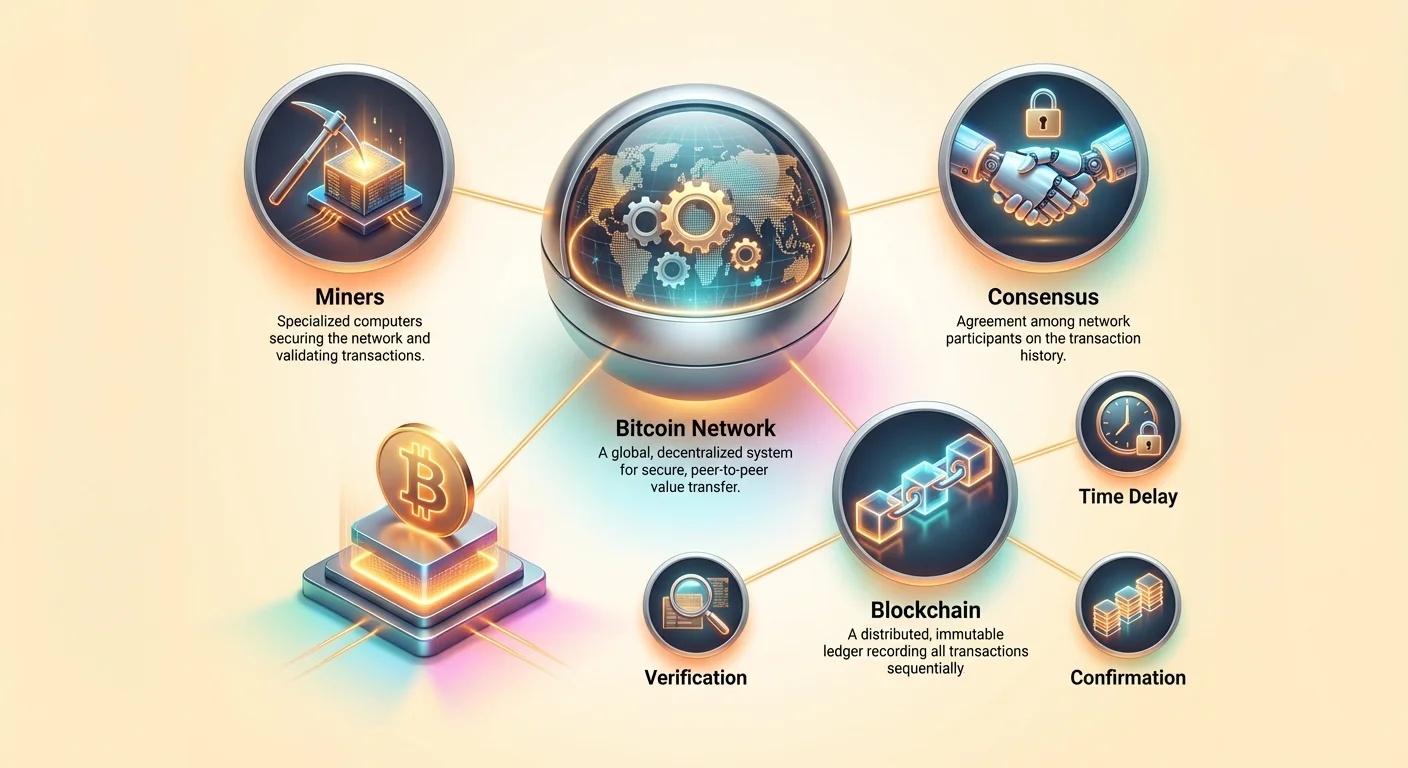
The consensus of these thousands of independent computers replaces the central authority. If 9,000 computers say you sent Alice 1 BTC, and 1 computer tries to say you sent it to Bob instead, the network instantly rejects the minority report.
This shared, verifiable agreement on the state of the system is called consensus. Because the ledger is distributed, attacking or corrupting it would require simultaneously corrupting more than 50% of all the computers running the Bitcoin software—an economically prohibitive task.
How the Blockchain Eliminates the Intermediary
Moving beyond the high-level concept, the actual mechanics of how Bitcoin transactions are processed and verified are what enforce the rules of trustlessness and scarcity.
When you transact in Bitcoin, you don't interact with a bank; you interact with the network protocol itself, secured by advanced cryptography.
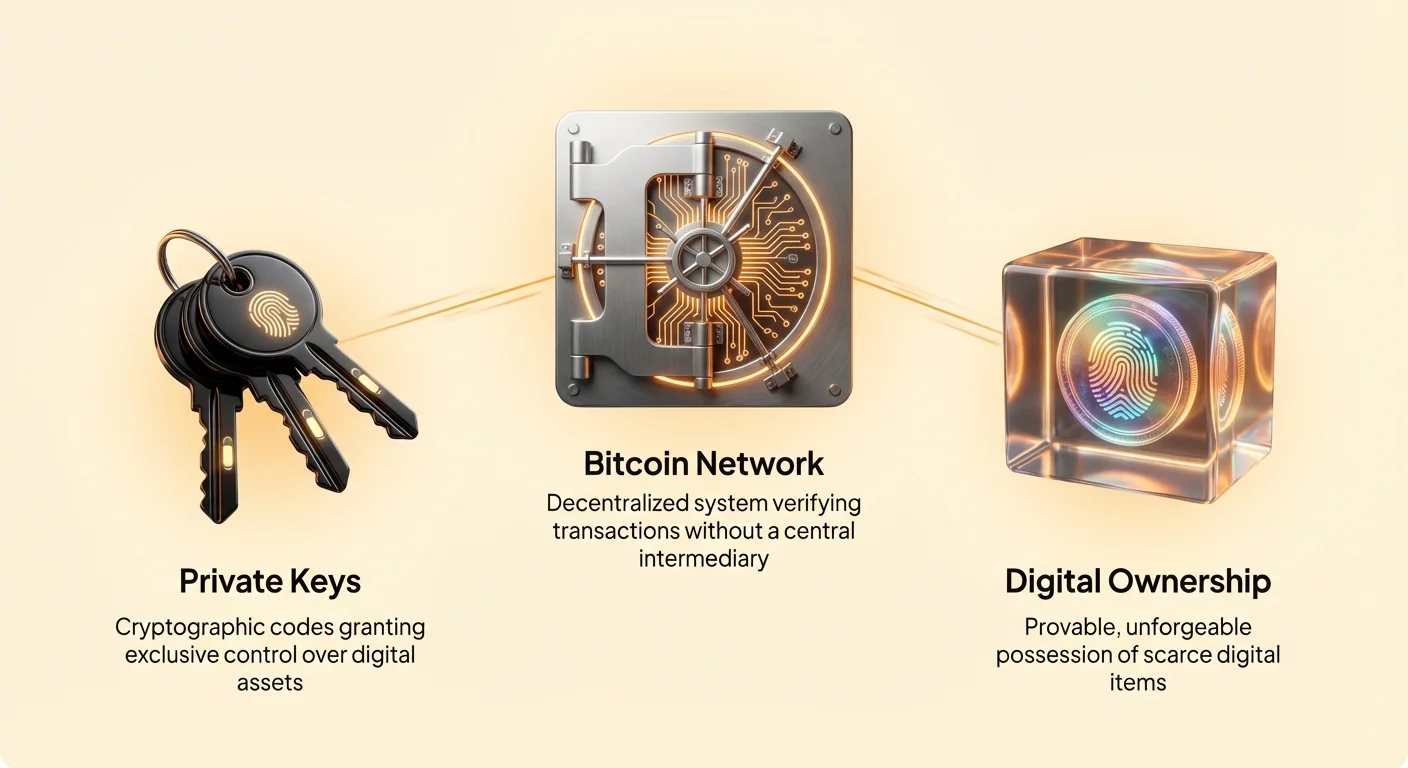
Digital Fingerprints: Cryptography and Wallet Keys
The security of Bitcoin relies entirely on public-key cryptography. This is the method used to establish ownership and authorize transactions without needing an intermediary to check your ID.
When you set up a Bitcoin wallet, two primary components are generated:
- The Public Key (Your Address): This is like your public email address or bank account number. You can share this key with anyone so they can send you Bitcoin.
- The Private Key (Your Signature/Password): This is the secret, highly sensitive password that proves you own the Bitcoin associated with the public address. When you want to spend money, you use this private key to digitally sign the transaction.
Crucially, ownership in Bitcoin is self-sovereign. If you lose your private key, you lose access to your funds forever. Conversely, if you keep your private key secure, nobody can ever take your funds, block your transactions, or freeze your account, regardless of their institutional power.
Transactions, Blocks, and the Chain
A Bitcoin transaction is simply a message broadcast to the global network. The message says: "I, the owner of this Private Key, authorize the transfer of X amount of Bitcoin from Address A to Address B."
Here is the sequential process:
- Initiation: You sign a transaction with your private key and broadcast it.
- Verification Pool (The Mempool): The transaction lands in a pool of unconfirmed transactions (the Mempool). Network nodes immediately verify two things: that your digital signature is valid (signed by the legitimate private key) and that you actually have enough Bitcoin to spend (checking the public ledger history).
- Grouping into a Block: Once verified, the transaction is bundled with thousands of others into a "block" by special network participants called Miners.
- Linking the Chain: This new block must then be permanently attached to the previous block in the chain, creating a continuous, chronological, and immutable history. This linking process is the ultimate solution to the double-spend problem, and it is achieved through the mechanism of Proof-of-Work.
Enforcing Scarcity: Solving the Double Spend with Proof-of-Work (PoW)
The true genius of Satoshi’s design was realizing that if the cost of verifying and adding transactions to the shared ledger was greater than the reward for cheating, the system would remain honest. This economic incentive and penalty structure is encapsulated in the Proof-of-Work (PoW) consensus mechanism.
PoW is what ensures that the thousands of nodes distributed globally agree on the same history and follow the rules of the protocol.
The Role of Miners and the Network Consensus
In the Bitcoin system, miners are the specialized network participants responsible for securing the network and validating transactions. They perform three critical functions:
- Verification: They check all transactions in the Mempool to ensure they are valid (signatures are correct, and no double spending has occurred).
- Bundling: They organize verified transactions into a block.
- Securing the Block: They compete to solve a complex computational puzzle required to "seal" the block and add it to the blockchain.
When a miner successfully seals a block, they broadcast it to the rest of the network. If the majority of the nodes agree that the block is valid and follows all the rules, they accept it and immediately begin working on the next block in the chain.
The PoW Puzzle: Making Verification Expensive
The computational puzzle that miners solve is the core of Proof-of-Work. This puzzle requires them to expend immense amounts of computational power and energy to find a specific numerical output (a hash) that meets the network’s current difficulty requirement.
Why is this necessary?
This competitive, resource-intensive process serves two major purposes:
- It Creates a Time Delay: It ensures that new blocks are only found roughly every 10 minutes. This gives the network time to distribute the block and synchronize the ledger globally, preventing transactional chaos.
- It Establishes Costly Proof: The energy expended is the "work." By requiring miners to prove they spent energy, the network ensures that the resulting block is honest. If a miner attempted to cheat (e.g., creating a block that includes a double-spend transaction), they would have wasted significant time and resources competing to solve the puzzle, only to have the honest network reject their dishonest block. The economic reward (the block subsidy plus transaction fees) only goes to honest miners who successfully add blocks following the consensus rules.
The cost of mounting a sustained, dishonest attack (known as a "51% attack," where an entity controls a majority of the hashing power) becomes astronomically high, creating an economic deterrent to cheating. This is the mechanism that enforces trustlessness—you don't need to trust the miners; you just need to trust the economics and mathematics that govern their behavior.
Transaction Finality: The Six-Block Confirmation Rule
Even after a miner adds your transaction to a new block, it’s not instantly considered irreversible. For true finality, the network waits for subsequent blocks to be added on top of the block containing your transaction.
Every time a new block is successfully added, it mathematically reinforces all previous blocks. The network considers a transaction "confirmed" after it is embedded in the chain. Most services, exchanges, and serious merchants wait for six confirmations (meaning six additional blocks have been chained on top of the original) before considering the transaction irreversible.
This "chaining" process directly solves the Double Spend Problem:
- If you attempt to broadcast a second, conflicting transaction (spending the same coins twice) immediately after the first, the network will quickly identify the conflict.
- Only the first valid transaction that is successfully incorporated into an honest block and begins receiving confirmations will be accepted by the network.
- The deeper a transaction is buried under new blocks, the more computationally difficult it becomes to rewrite that history. Rewriting six blocks takes massive, coordinated computational power, making the transaction practically immutable.
(For a deeper dive into how this layered security makes transactions irreversible, please read our guide: Transaction Finality: Understanding the Immutability of Bitcoin Transactions.)
The Philosophical Shift: Trustlessness and Self-Sovereignty
The technical achievement of the blockchain and Proof-of-Work fundamentally changed what digital money means. Bitcoin is not just a payment network; it is a political and philosophical statement that shifts control over money from institutions back to the individual.
Open-Source and Transparent
Bitcoin’s protocol operates on a completely transparent set of rules. The code is open-source, meaning anyone can review exactly how it functions. There is no hidden mechanism for printing money or altering the transaction history. The rules are enforced by the code, which everyone can see, and by the consensus of the network, which anyone can join.
Contrast this with traditional finance, where central banks can make crucial decisions (like setting interest rates or increasing the money supply) behind closed doors, affecting the value of every person's savings without their direct input or consent.
Decentralization and Censorship Resistance
Because the Bitcoin ledger is distributed across thousands of independent nodes, no single entity—not a corporation, not a government, and not even a massive group of miners—can unilaterally shut the network down or decide to block an individual's transactions.
- If a government tries to shut down all the nodes in their country, the network simply continues operating elsewhere.
- If a bank decides you are politically undesirable, they can freeze your account. If you hold Bitcoin, your funds cannot be frozen, provided you control your private keys.
This censorship resistance is the ultimate fulfillment of the promise of peer-to-peer electronic cash. Bitcoin provides a global, neutral settlement layer that treats every transaction request equally, relying only on mathematical proof, not institutional privilege.
(To understand the economic differences of this system, see our related article: Bitcoin vs. Fiat Currency: A Core Feature Comparison Guide.)
Praktiski secinājumi iesācējiem
Izpratne, kā darbojas Bitcoin — kā Satoshi atrisināja double-spend problēmu —, ir būtiska, lai novērtētu tā vērtību un drošību.
| Koncepts | Tradicionālās finanses (centralizētas) | Bitcoin (decentralizēts) |
|---|---|---|
| Autoritāte | Uzticamas bankas un valdības | Kriptogrāfija un tīkla konsenss |
| Virsgrāmatas atrašanās vieta | Viens, proprietārs serveris | Izplatīta tūkstošiem mezglu |
| Uzticības modelis | Uzticība nepieciešama (Banka ir godīga) | Bez uzticības (Matemātika nodrošina godīgumu) |
| Galīgums/Nemaināmība | Atgriezenisks ar bankas/tiesas rīkojumu | Neatgriezenisks (pēc pietiekamiem apstiprinājumiem) |
| Atslēgas atbildība | Konta drošība pārvaldīta bankas | Atslēgas drošība pārvaldīta lietotāja (Pašuzglabāšana) |
Galvenais praktiskais padoms: Aizsargājiet savas privātās atslēgas
Tā kā Bitcoin ir bez uzticības, drošības atbildība pilnībā gulstas uz jums. Jūs aizstājat bankas drošības komandu ar savu paša rūpību.
Pirmais numurs pašsuverenitātei kripto ir vienkāršs: Nezaudējiet un nedalieties ar savām privātajām atslēgām (bieži attēlotām kā Seed Phrase).
Ja jūs izmantojat centralizētu biržu (kā Coinbase vai Binance), viņi tur atslēgas jums (darbojoties kā tradicionāla banka). Bet īstai pašsuverenitātei jums jāizmanto pašuzglabāšanas maciņš, kur atslēgas ir tikai jūsu. Pierakstiet savu 12 vai 24 vārdu seed phrase, glabājiet to droši bezsaistē un izturieties pret to ar absolūtu slepenību, ko dotu savas mājas īpašumtiesības vai seifa galvenajai atslēgai.
Secinājums
Desmitgade pirms Bitcoin bija atzīmēta ar neapmierinātiem mēģinājumiem izveidot digitālu naudu bez centralizētas uzticības. Satoshi Nakamoto veiksmīgi beidza šo ēru, ieviešot blockchain — mehānismu, kas izveidoja digitālo retumu, nodrošinot noteikumus ar skaitļošanas pierādījumu un izplatītu konsensu, nevis institucionālu autoritāti.
Risinot Double Spend problēmu ar Proof-of-Work, Satoshi ne tikai izveidoja jaunu naudas formu; viņš aizsāka fundamentālu maiņu digitālās pārvaldības un vērtības pārskaitīšanas struktūrā. Bitcoin ir bezvalstisks, atvērtā koda protokols, kas ļauj indivīdiem veikt darījumus un uzglabāt bagātību bez atļaujas lūgšanas.
Iesācējam izpratne par šo pamatkonceptu — ka matemātiska verificēšana aizstāj cilvēcisko uzticību —, ir pirmais un visnozīmīgākais solis pašsuverenitātes ceļa kartē. Tas ir apziņa, ka pirmo reizi jūs patiesi piederat savai naudai, jo jūs turat atslēgas, un tīkls nodrošina, ka tās ir vienīgais veids, kā pārvietot vērtību.