
Bitcoin (BTC) revolucionēja finanses, ieviešot uzticamu, decentralizētu digitālo naudu. Tomēr tā pamatdizains, kas prioritizē drošību un nemaināmību, padara galveno Bitcoin blokķēdi salīdzinoši lēnu un bez iebūvētām viedu līgumu iespējām, kas nepieciešamas pilnvērtīgai līdzdalībai mūsdienu decentralizēto finanšu (DeFi) protokolos, kuri bieži darbojas tīklos kā Ethereum vai Solana.
Šī tehnoloģiskā atdalīšana rada nozīmīgu izaicinājumu: kā atbloķēt milzīgo Bitcoin likviditāti un uzticamību un integrēt to bezšuvēm ātrajā, programmējamā DeFi pasaulē?
Risinājums slēpjas mērogošanas un tilta tehnoloģijās. Šis ceļvedis pārsniedz Lightning Network izmantošanas pamatkonceptu mazām, ātrām maksājumiem un iedziļinās tā progresīvajā pielietojumā: kā būtiski ātrā kanāla lomā BTC likviditātes ievadīšanai sarežģītās DeFi ekosistēmās. Mēs izpētīsim mehānismus — no uzticamajiem iesaiņošanas servisiem līdz bezuzticības starpķēžu atomiskajām apmaiņām un novatoriskiem federētiem glabāšanas risinājumiem —, kas ļauj Bitcoin kļūt par pamata aktīvu starpķēžu ienesīguma ģenerēšanai un progresīvām decentralizētām stratēģijām.
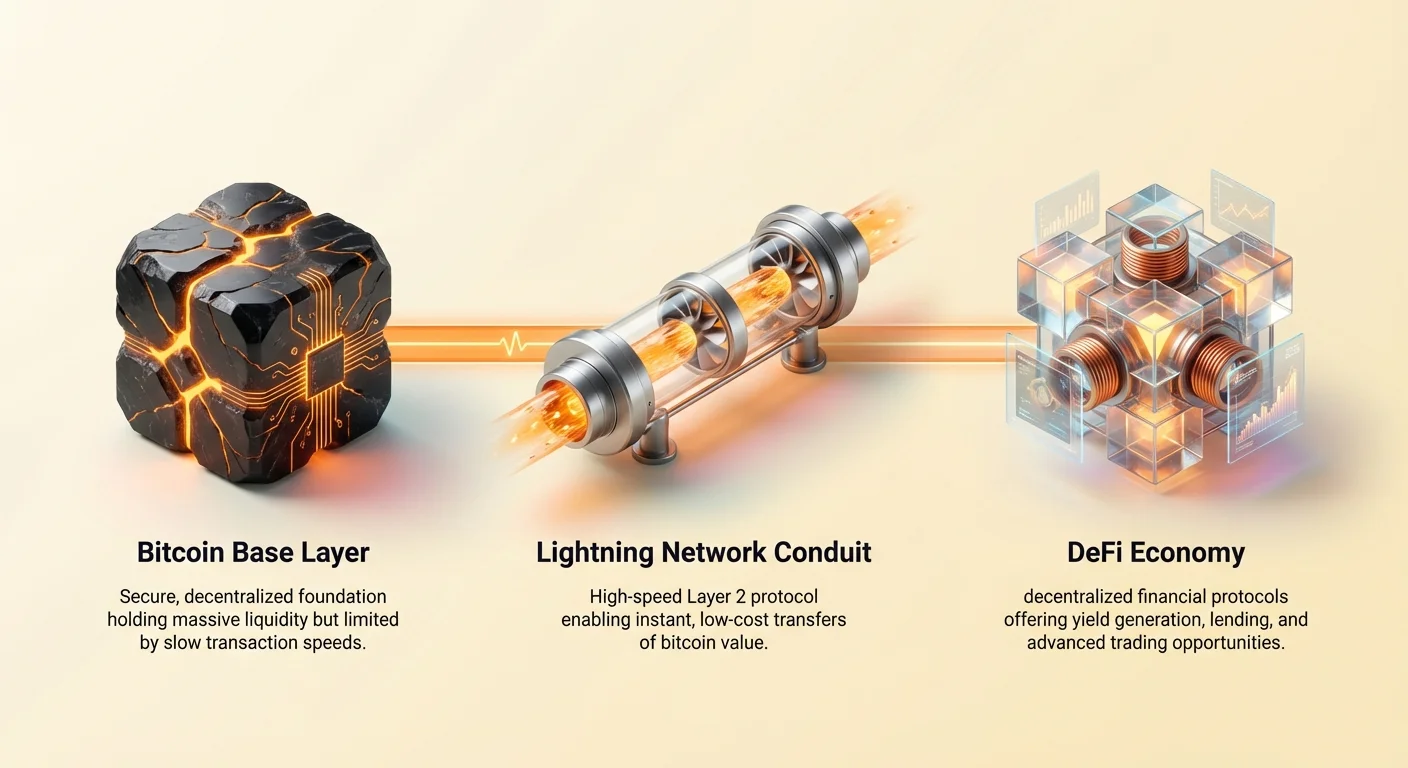
Kodolproblēma: Bitcoin likviditātes atbloķēšana
Lai saprastu Lightning progresīvās pielietojumus, mums vispirms jāatzīst fundamentālā barjera, kas atdala Bitcoin no pārējās DeFi pasaules.
Bitcoin stiprās puses un ierobežojumi
Bitcoin bieži dēvē par digitālo zeltu, jo tā arhitektūra ir izstrādāta maksimālai drošībai un pretestībai izmaiņām. Darījumi tiek apstiprināti lēni (apmēram ik pēc 10 minūtēm), un tīkls apzināti ierobežo skriptu sarežģītību, ko tas var izpildīt. Šī dizaina izvēle padara to ārkārtīgi drošu, bet inerenti ierobežo tā izmantojamību vidēs, kas prasa ātrus, sarežģītus darījumus, piemēram, ienesīguma lauksaimniecību, decentralizēto aizdevumu vai sarežģītu derivātu tirdzniecību.
Ja Bitcoin likviditāte — lielākais vērtības baseins kripto ekonomikā — paliek ieslēgta oriģinālajā lēnā ķēdē, plašākās DeFi ekosistēmas potenciāls ir ierobežots.
Mērogošanas risinājumu loma
Mērogošanas risinājumi risina bāzes slāņa (1. slānis vai L1) caurlaides ierobežojumus.
Lightning Network (L2): Lightning ir 2. slāņa (L2) protokols, kas būvēts virs Bitcoin L1. Tas ļauj gandrīz tūlītējus, gandrīz bezmaksas darījumus, ļaujot lietotājiem veikt darījumus ārķēdes caur izveidotiem maksājumu kanāliem. Šī ātrums ir kritisks tilta veikšanai, jo tas samazina laiku un izmaksas, kas saistītas ar BTC pārvietošanu uz sākotnējo konversijas punktu, kas bieži ir galvenais pudeles kakls DeFi integrācijā.
DeFi L2 (Ethereum u.c.): Tīkli kā Ethereum izmanto arī L2 risinājumus (Optimism, Arbitrum), lai mērogotos. Runājot par tiltiem, bieži domājam par Lightning izmantošanu BTC ātrai pārvietošanai, pēc tam konvertējot šo BTC formātā (piemēram, iesaiņoto BTC), kas var mijiedarboties ar L1/L2 viedu līgumu vidi, piemēram, Ethereum.
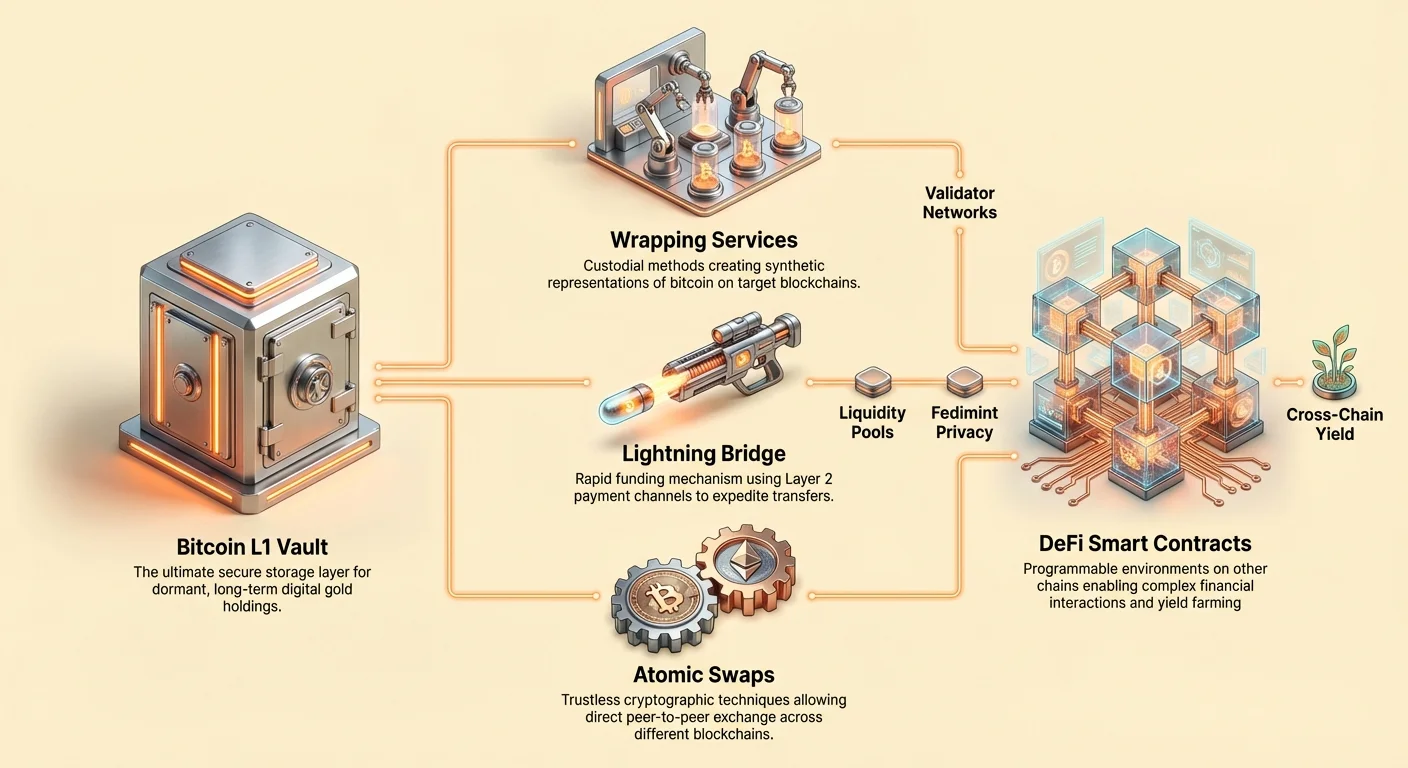
Mechanism 1: Bridging BTC to DeFi via Wrapping
The most common and currently most liquid method for bringing Bitcoin value into a separate smart contract ecosystem is through "wrapping." This process effectively creates a digital receipt representing your underlying BTC, which can then be used on other blockchains.
Understanding Wrapped Bitcoin (wBTC)
Wrapped Bitcoin (wBTC) is an ERC-20 token that is collateralized 1:1 by real Bitcoin held in custody. Think of it like taking physical gold to a secure vault and receiving a paper certificate (the wBTC token) that proves ownership. This certificate can be instantly traded, lent, or staked on Ethereum-based DeFi protocols.
The Wrapping Process:
- A user sends BTC to a custodian (or a network of decentralized custodians/merchants).
- The custodian locks the BTC in a secure vault.
- The custodian mints the corresponding amount of wBTC on the Ethereum network and sends it to the user's DeFi wallet address.
- The user can now use this wBTC just like any other Ethereum token.
The Custodial vs. Non-Custodial Debate
While wrapping is effective, it introduces a layer of trust.
- Custodial Models (e.g., wBTC): This model relies on a consortium of regulated institutions (the custodians) to ensure the 1:1 backing. The risk here is counterparty risk: the possibility that the custodian fails, is hacked, or operates fraudulently, leaving the wBTC unbacked.
- Non-Custodial/Decentralized Models (e.g., renBTC, tBTC): These protocols attempt to minimize trust by using decentralized networks, cryptography, or staking mechanisms to guarantee the collateralization. While mathematically more secure in theory, they often introduce different complexities, such as reliance on external validator networks or potentially complex smart contract interactions.
Strategic Tip: Always research the specific wrapping mechanism (the ‘bridge’) you use. Look at the asset’s market cap, audit history, and the reputation of the institutions or decentralized networks that secure the locked BTC.
Practical Use Case: Yield Generation on Ethereum
Once BTC is wrapped, its possibilities expand exponentially.
A self-custody adopter can take their BTC, wrap it into wBTC, and then participate in DeFi lending protocols. For example, they could deposit wBTC into a platform like Aave or Compound, earning passive interest. This allows the user to maintain exposure to the value of Bitcoin while simultaneously generating a yield—a powerful tool for managing capital efficiency.
Mechanism 2: True Cross-Chain Swaps (Atomic Swaps)
While wrapping requires creating a new derivative asset (wBTC), atomic swaps offer a method for users to exchange one native cryptocurrency for another native cryptocurrency on a different blockchain without needing a centralized intermediary or custodial risk.
This represents the ideal trustless integration method.
How Hashed Timelock Contracts (HTLCs) Work
Atomic swaps are based on a cryptographic primitive called a Hashed Timelock Contract (HTLC). This technology ensures that the trade either happens completely (atomically) or doesn't happen at all.
Imagine Alice has 1 BTC and wants 10 LTC from Bob.
- Alice's Action: Alice creates a secret key (a preimage) and hashes it. She locks her BTC in a contract on the Bitcoin blockchain using this hash and a deadline (timelock).
- Bob’s Action: Bob sees Alice's locked contract and uses the same hash to lock his 10 LTC on the Litecoin blockchain, also with a slightly shorter deadline.
- The Swap: Alice needs to reveal the original secret key to claim Bob's LTC before her timelock expires. When she does this, the secret key is made public on the Litecoin network.
- Completion: Bob, monitoring the Litecoin network, instantly grabs the public key and uses it to claim Alice's BTC on the Bitcoin network before his shorter timelock expires.
If either party fails to complete their side or the time runs out, the funds automatically return to their original owners, guaranteeing zero counterparty risk.
The LTC to BTC Swap Example
Litecoin (LTC) is often cited in atomic swap examples because its codebase is very similar to Bitcoin's, making the implementation of HTLCs relatively straightforward.
By facilitating a direct, trustless, native swap between LTC and BTC, atomic swaps prove the technical feasibility of true cross-chain exchange. This is a foundational step toward more complex DeFi integrations.
Limitations and Advanced Atomic Swap Protocols
The primary limitation of classic atomic swaps is that they require both blockchains to support specific cryptographic operations (like HTLCs) and are cumbersome for high-frequency trading. They are also limited to direct P2P (peer-to-peer) trades, lacking the efficiency of centralized exchanges or deep DeFi liquidity pools.
Newer, advanced protocols aim to abstract this complexity, potentially allowing for atomic swaps between BTC and assets on chains like Ethereum or Solana through specialized relayers or decentralized networks that manage the timelock process across disparate environments.
Lightning Network’s Role in Enhanced DeFi Access
While wrapping handles the asset conversion and atomic swaps handle trustless exchange, the Lightning Network provides the necessary speed and low cost to make these processes economical and practical for frequent use.
Using Lightning for Rapid Wrapped BTC Acquisition
When a user decides to wrap their BTC, they typically send their L1 BTC to the custodian’s address. This transaction can take up to an hour and incur significant network fees.
Lightning changes this dynamic:
Instead of sending L1 BTC, a user can deposit L1 BTC into a Lightning wallet and then use a service (often a dedicated broker or exchange with a Lightning node) that accepts Lightning payments and instantly sends wrapped assets back on the target DeFi chain (e.g., Ethereum).
Example: A user wants to quickly acquire $1,000 worth of wBTC to capitalize on a fleeting yield opportunity. They can pay the $1,000 equivalent via a Lightning invoice, and the service, acting as the wrapper, mints and sends the wBTC to their Ethereum address almost instantaneously, bypassing the slow, expensive L1 confirmation time for the initial funding.
This integration transforms Bitcoin from a slow-moving reserve asset into a high-velocity capital asset ready for immediate deployment in DeFi strategies.
Introduction to Lightning Liquidity Pools
Lightning Network relies on "channels" being sufficiently funded. If a channel doesn't have enough liquidity on one side, payments can fail. To address this, specialized protocols are emerging that allow users to pool their BTC to provide liquidity for these payment channels.
How Liquidity Pools Facilitate Scaling:
- Efficient Channel Balancing: Users deposit BTC into a Lightning liquidity pool. This pool then dynamically opens and balances channels, ensuring that sufficient incoming and outgoing capacity exists across the network.
- Yield Generation for L2: Users who contribute their BTC to these liquidity pools earn fees from the routing payments. This means that L2 liquidity providers (LPs) are earning yield merely by keeping the Lightning Network efficient.
- Cross-Chain Benefit: These highly liquid, efficient Lightning channels make the rapid conversion and bridging process (as described above) cheaper and more reliable, enhancing the overall experience of moving BTC value into other ecosystems.
Uzlecošie risinājumi: Federēta glabāšana un 3. slāņa integrācija (Fedimints)
Pārsniedzot pamata L2 mērogošanu un tiltus, parādās nākamās paaudzes koncepti, lai uzlabotu Bitcoin privātumu un pārvaldītu tā izmantošanu augsti sarežģītās L3 (3. slāņa) vidēs. Fedimint ir izcilais šīs progresīvās tendences piemērs.
Kas ir Fedimint un kā tas darbojas
Fedimint (Federated Mint) ir protokols, kas ļauj grupām kopīgi glabāt Bitcoin, izmantojot federētu Chaumian Ecash sistēmu. Iedomājieties mazu digitālo kredītu savienību vai kooperatīvu.
Galvenās sastāvdaļas:
- Federācija: Uzticamu personu grupa (sargi), kas kolektīvi pārvalda federācijas kopīgo Bitcoin multisig maciņu. Neviens atsevišķs sargs nevar nozagt līdzekļus.
- Ecash: Kad lietotāji iemaksā BTC federācijā, viņi saņem "Ecash žetonus" (bieži sauktus par akliem parakstiem), kas pārstāv viņu iemaksu. Šis Ecash ir augsti privāts; federācija zina kopējo turēto summu, bet nezina, kuram indivīdam pieder kāds konkrēts Ecash žetons.
- Lightning integrācija: Fediminti bieži savienojas tieši ar Lightning Network, ļaujot biedriem ātri sūtīt un saņemt maksājumus, izmantojot savus privātos Ecash žetonus, neizpaužot savu identitāti vai darījumu vēsturi federācijai vai publiskajai Bitcoin blokķēdei.
Fedimint potenciāls privātai, augstas frekvences tirdzniecībai
Fedimint struktūru ieviešana fundamentāli maina BTC-DeFi integrācijas pieeju, īpaši progresīvām stratēģijām, kas fokusētas uz privātumu:
- Uzlabots privātums DeFi: Lietotājs var pārvietot savu BTC caur Fedimint, izmantot augsti privātos Ecash žetonus mijiedarbībai ar specializētu, privātumam veltītu DeFi tiltu un pēc tam piedalīties starpķēžu aizdevumos vai ienesīguma lauksaimniecībā ar papildu maskēšanas slāni.
- Mikrotransakciju mērogošana: Tā kā Ecash žetoni darbojas kā iekšēji kredīti federācijā, tos var izmantot ārkārtīgi augstas frekvences mikrotransakcijām, kas nepieciešamas sarežģītām tirdzniecības stratēģijām, neaizskarošot Bitcoin L1.
- Kopienas vadīta glabāšana: Šis modelis decentralizē glabāšanas risku salīdzinājumā ar vienu wBTC glabātāju, izplatot uzticību mazākā, kopienas izvēlētā sargu grupā. Tas atbilst pašsuverenitātes mērķiem progresīvajiem kripto piekritējiem.
Strategic Considerations for BTC-DeFi Integration
Moving value across chains introduces risks and complexities that require careful planning, particularly for self-custody adopters and finance professionals.
Managing Counterparty Risk in Wrapped Assets
The greatest risk when bridging BTC to DeFi is the security of the locked collateral.
- Audit Protocols: Only use wrapped assets or bridges that have undergone rigorous security audits by reputable third-party firms. Review the bridge's documentation to understand the mechanism for "unwrapping" (redeeming) your original BTC.
- Decentralization Score: Evaluate how decentralized the wrapping mechanism is. Does it rely on 3 out of 5 multisig signers, or 15 out of 20? The more decentralized the control, the lower the single point of failure risk.
- Liquidity Risk: Ensure that the wrapped asset you hold (e.g., wBTC) has high liquidity on the target chain. If liquidity is low, you might face difficulties or high slippage when trying to sell or swap it back to stablecoins or unwrap it back to native BTC.
Transaction Cost Analysis (Gas vs. Lightning Fees)
The decision to use Lightning for the initial transfer versus using the L1 Bitcoin chain is purely economic, based on current network congestion.
| Transfer Method | Cost Driver | Speed | Use Case |
|---|---|---|---|
| Bitcoin L1 | Miner Fees (dependent on block space) | Slow (10 mins+) | Large, infrequent transfers; cold storage. |
| Lightning Network | Routing Fees (near zero) | Instant | Rapid funding of wrappers; small, frequent transactions. |
| Ethereum L1/L2 (for wBTC use) | Gas Fees (dependent on network congestion) | Variable | Interacting with smart contracts (lending, swapping). |
Actionable Tip: Use Lightning for any transfer under $5,000 intended for immediate deployment into a DeFi protocol. Reserve L1 transfers only for institutional-scale movements or movements directly to hardware wallets for long-term storage.
Best Practices for Securing Bridged Assets
When using Lightning to fund a cross-chain strategy, you are moving from one security model (Bitcoin's UTXO) to another (Ethereum's account model).
- Use Dedicated Wallets: Never mix the wallet you use for rapid Lightning transfers (which may be a mobile hot wallet) with the wallet holding your long-term DeFi collateral (which should be a hardware wallet).
- Verify Bridge Addresses: Before initiating any wrap or swap, triple-check the recipient address and the specific smart contract address of the wrapping service. Phishing and scam sites that redirect funds to malicious contract addresses are common risks in bridging.
- Test Small Amounts: Always test the entire process—funding the Lightning channel, initiating the wrap, using the wrapped asset, and unwrapping it back to L1 BTC—with a small, disposable amount first. This confirms the functional pathway before committing significant capital.
Secinājumi
Lightning Network integrācija ar DeFi un starpķēžu apmaiņām pārstāv kritisko nākamo kripto pieņemšanas posmu. Tā pārvērš Bitcoin no tīri statiska vērtības uzglabātāja dinamiskā mērogojamā aktīvā, kas spēj darbināt augstas caurlaides, programmējamās finanšu sistēmas.
Izprotot pamata mehānismus — nepieciešamo uzticību, ko ievieš iesaiņošana, tīru bezuzticību, ko piedāvā atomiskās apmaiņas, un ātrumu un efektivitāti, ko nodrošina Lightning Network un novatoriskas struktūras kā Fedimint —, lietotāji var pārliecināti atbloķēt BTC likviditāti. Tas pavada ceļu progresīvām pašglabāšanas stratēģijām, kur jūsu Bitcoin nav tikai dīkstāve digitālā zelta, bet aktīvs, ienesīgumu ģenerējošs nodrošinājums globālajā decentralizētajā ekonomikā.