
Bitcoin tīkls, kas balstīts uz izturīgas drošības un maksimālas decentralizācijas principu, apstrādā transakcijas apzināti un droši. Tomēr šī veltība drošībai notiek uz ātruma un augstu transakciju komisiju rēķina maksimālās slodzes laikā — tas ir nepieciešams kompromiss 1. līmeņa (L1) norēķinu slānim.
Lightning Network (LN) tika ieviests kā 2. līmeņa (L2) risinājums, kas nav paredzēts, lai aizstātu Bitcoin kodolu, bet gan lai uzlabotu tā izmantojamību ikdienas tirdzniecībai. Darbojoties virs Bitcoin blokķēdes, LN nodrošina tūlītējus, zemas izmaksas mikro maksājumus, kas galvenajā ķēdē ir nepraktiski.
Šis ceļvedis pārsniedz Lightning Network teorētisko definīciju, lai izpētītu tā praktiskās darbības realitāti. Jebkuram, kas vēlas vadīt mezglu, integrēt LN biznesā vai vienkārši saprast, kāpēc viņu mobilā maciņa dažreiz nevar pabeigt maksājumu, ir būtiski izprast maršrutēšanas, kanālu pārvaldības un likviditātes nianses. Lai gan LN piedāvā fenomenālu ātrumu, tas ievieš jaunas drošības kompromisus un arhitektūras sarežģītības, kas prasa proaktīvu pārvaldību.
The Core Mechanics: How Lightning Enables Speed
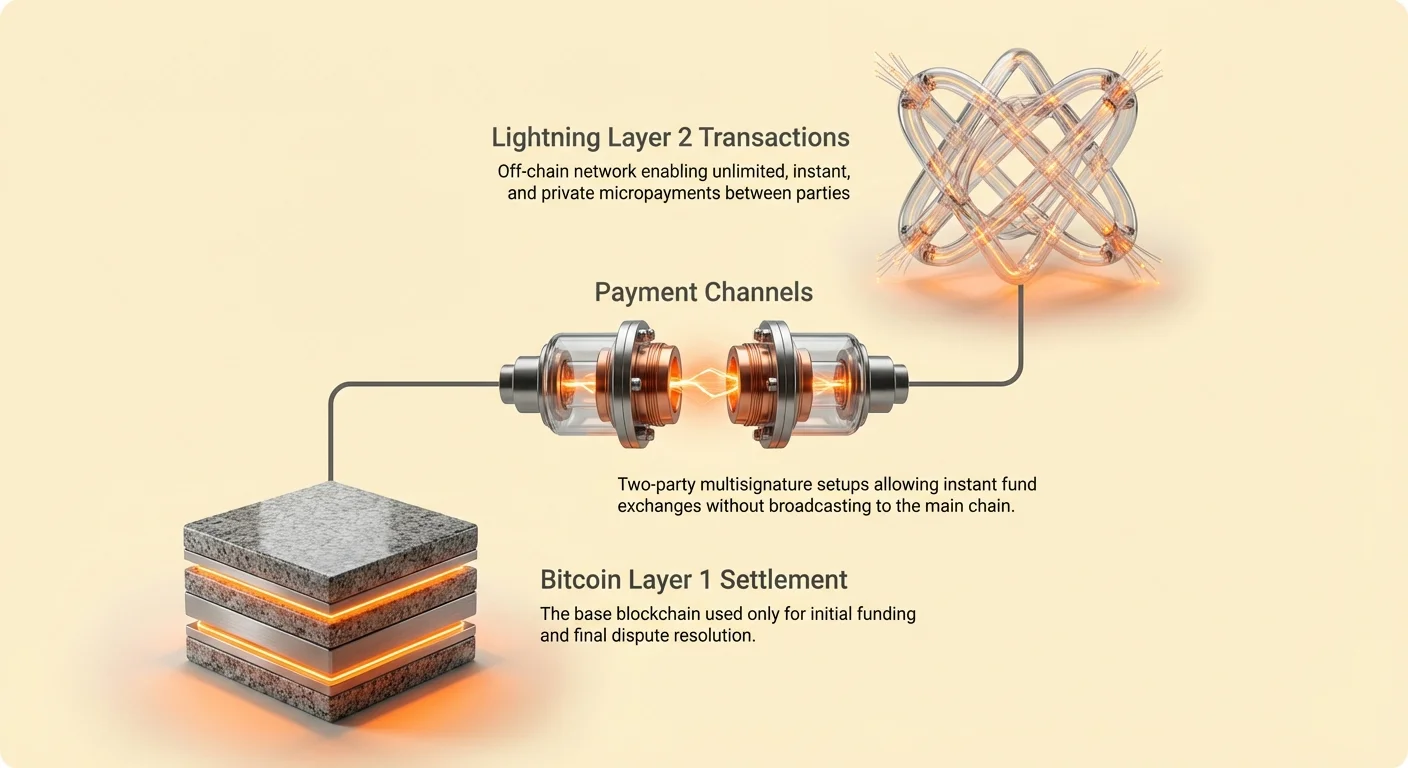
The fundamental innovation of the Lightning Network is moving the vast majority of transactions off-chain and only using the Layer 1 blockchain (Bitcoin) for initial channel establishment and final dispute resolution. This architecture allows two parties to conduct an unlimited number of transactions privately and instantly, without needing to broadcast every single one to the global network.
Payment Channels: The Practical Analogy
A payment channel is simply a two-party, multi-signature wallet established on the Bitcoin blockchain. Think of it like opening a secured tab at a bar with a friend:
- Opening (Funding) the Channel: Alice and Bob agree to lock a certain amount of Bitcoin (the channel capacity) into a joint address on the main chain. This is the only transaction that requires L1 confirmation.
- Transacting (Off-Chain): Once the channel is open, Alice and Bob can exchange funds instantly within that channel's capacity. They don't update the blockchain; they simply update the latest balance sheet they mutually agree upon. These updates are called commitment transactions.
- Closing (Settling) the Channel: When they are done transacting, they broadcast the final, latest commitment transaction back to the Bitcoin L1 chain. This single transaction reflects the net outcome of potentially thousands of off-chain transactions.
The key security mechanism is that either party can unilaterally close the channel at any time by broadcasting the latest agreed-upon state. If one party tries to cheat by broadcasting an old, favorable state, the other party has a limited time window (the "revocation period") to punish the cheating party and claim all funds in the channel.
Hash Time Locked Contracts (HTLCs): Ensuring Trustless Transit
While channels allow Alice and Bob to transact directly, the real power of LN comes from routing payments through a chain of channels, even if Alice and Carol don't have a direct channel between them. If Alice is connected to Bob, and Bob is connected to Carol, Alice can pay Carol via Bob.
This process is secured using Hash Time Locked Contracts (HTLCs). An HTLC is a critical cryptographic mechanism that acts as a secure, conditional escrow for multi-hop payments.
How an HTLC works in practice (The Atomic Swap):
- Secret Creation: Carol (the recipient) generates a cryptographic secret (the pre-image) and hashes it. She gives only the hash (the key lock) to Alice.
- Conditional Payment: Alice initiates the payment to Bob, setting up an HTLC that says: "I will pay you (Bob) if you can present the secret corresponding to this hash, OR if the payment times out after 48 hours."
- Routing the Secret: Bob passes the payment and the condition to Carol, setting a slightly shorter time lock (say, 46 hours).
- Completion: When Carol receives the conditional payment, she unlocks it using her secret (the pre-image). By revealing the secret to Bob, she claims the funds.
- Backward Resolution: Bob now has the secret. He uses it to claim the funds Alice put in escrow for him. The payment resolves instantly backward along the path.
Crucially, because of the time lock conditions, Bob cannot simply run away with the funds. If the payment fails to resolve, the funds return to the sender after the time lock expires. This ensures that multi-hop payments are "atomic"—they either succeed entirely or fail entirely—without any need to trust the intermediate routing nodes (like Bob).
The Network Backbone: Routing and the Gossip Protocol
The Lightning Network is a mesh network, where nodes are interconnected by bilateral payment channels. For a payment to succeed, the network must find a path, or route, between the sender and receiver that has sufficient capacity in every single segment.
Mapping the Network: How the Gossip Protocol Works
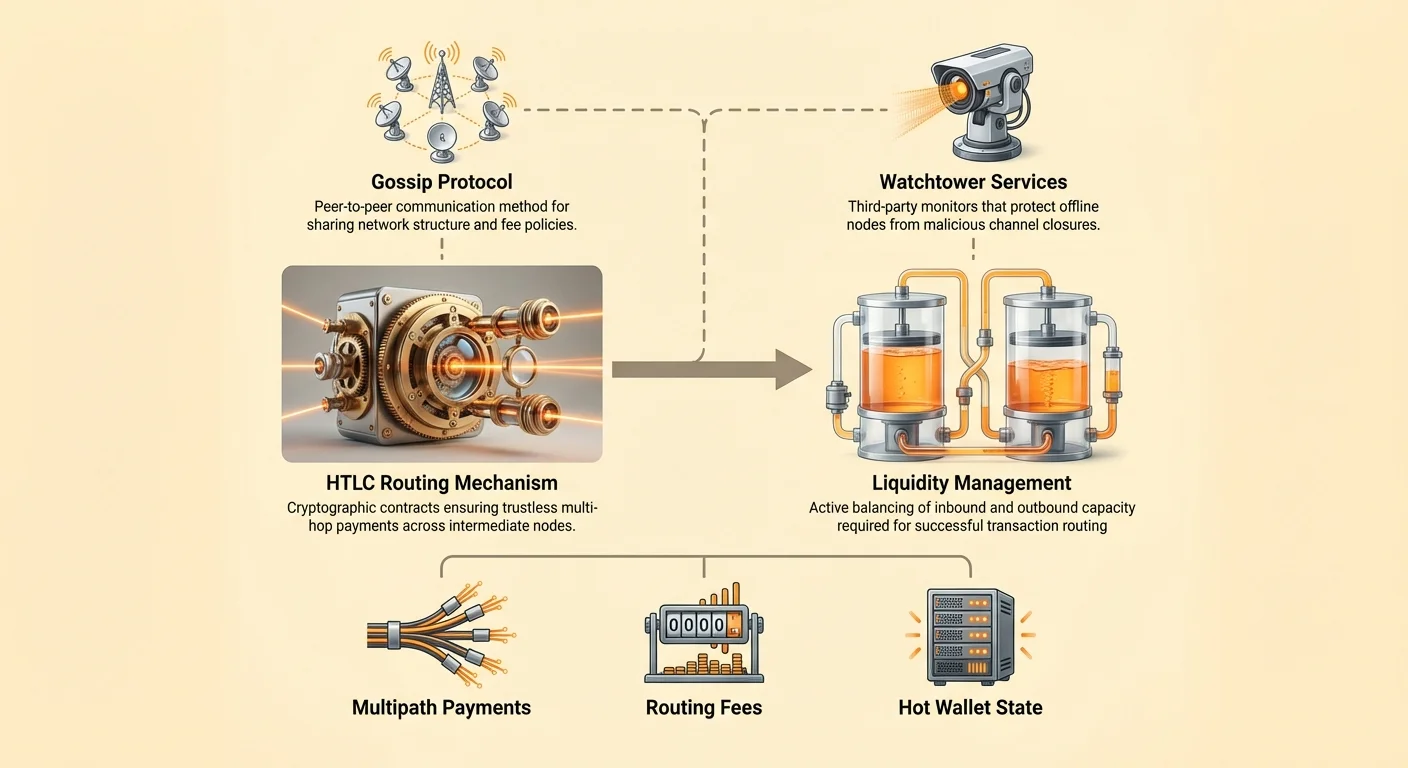
Unlike the Bitcoin main chain, which requires every node to store every transaction, the LN topology (the map of connections) is not globally known or stored by every participant. Instead, nodes use the Gossip Protocol to share information about the network's structure.
The Gossip Protocol is essentially a continuous, low-bandwidth communication method where nodes announce:
- New Channels: When a node opens a new channel, it announces the channel's capacity and the L1 funding transaction ID.
- Channel Updates: Nodes continually update their peers about fee policies (the cost to route through them) and whether their channels are currently active or closed.
Practical Implication: This decentralized information sharing is fast but often incomplete. A node's view of the network map is only as good as the information it has received through gossip. This means routing attempts might fail simply because the routing node's map is slightly outdated, showing a channel as available when it is actually down.
The Practical Challenge of Routing Efficiency
Successfully finding a path for an LN payment is the single biggest operational challenge today. Sending a payment requires solving a complex logistical puzzle that combines network topology, capacity, and cost in real-time.
Three Primary Causes of Routing Failure:
- Insufficient Liquidity: The most common failure. Even if a channel exists, it might be imbalanced. If Alice sends 1 BTC to Carol via Bob, Bob must have 1 BTC of outbound capacity toward Carol, and 1 BTC of inbound capacity available from Alice. If any link in the chain lacks the necessary funds on the correct side of the channel, the entire payment fails.
- Stale Information: The routing node attempts a path based on its gossiped map, but a channel along that path may have recently closed or temporarily failed to respond (offline).
- Maximum Hop Limit: LN payments are limited in the number of hops (typically around 20) to prevent latency issues and complicated time-lock management. Long-distance routing requires highly efficient, direct connections between major hubs.
To overcome these issues, modern LN software uses probabilistic routing. Instead of attempting just one path, the sender breaks the payment into multiple small chunks (Multipath Payments, or MPP) and sends them simultaneously along different routes. This significantly increases the chance of success, lowers latency, and makes the network more resilient.
Routing Fees: The Cost of Speed
While the Lightning Network is often described as "free," that is inaccurate. Routing fees exist to compensate intermediary nodes for the capital (liquidity) they risk and the computational power they expend validating and forwarding HTLCs.
Routing fees are crucial for two practical reasons:
- Incentivizing Node Operators: Fees encourage individuals and businesses to run high-uptime, well-connected nodes and keep their channels properly balanced, thus providing crucial liquidity to the ecosystem.
- Preventing Network Spam: Small fees discourage malicious actors from spamming the network with failed or tiny HTLCs that consume bandwidth without providing economic value.
Fee Structure:
A node’s routing fee typically consists of two parts:
- Base Fee: A fixed, flat fee applied per forwarded payment, regardless of amount (e.g., 1 satoshi).
- Proportional Fee: A percentage of the total payment amount (e.g., 0.001% of the transfer amount).
For end-users, these fees are extremely low, often amounting to only a few cents even for large transactions, making the cost negligible compared to L1 fees. However, node operators must constantly adjust these fees based on market demand and the required balancing effort, treating their nodes as small, active financial businesses.
The Crucial Factor: Managing Liquidity and Capacity
For L1 Bitcoin, simply holding the coins (custody) is enough. For L2 Lightning, holding coins is only half the battle; managing their availability and direction (liquidity) is the greater operational challenge. Liquidity management is the biggest barrier to entry for businesses adopting LN and the reason why simple non-custodial wallets can sometimes struggle to receive funds.
Defining Liquidity in Lightning Terms
Liquidity on the Lightning Network refers to the distribution of funds within a payment channel. It determines how much a node can send or receive.
- Outbound Capacity (Sending): This is the amount of funds the local node has on its side of the channel. If Alice has a channel with Bob with 1 BTC, and all 1 BTC is currently on her side, she has 1 BTC of outbound capacity to Bob.
- Inbound Capacity (Receiving): This is the amount of funds the remote peer has on their side of the channel, which Alice can receive. If Bob holds 1 BTC on his side, Alice has 1 BTC of inbound capacity (she can receive 1 BTC from anyone who can route through Bob).
The Operational Catch: Unlike L1 where receiving is passive, receiving on LN is an active requirement. If you have a brand-new node and have just opened several channels, all the funds are on your side. You have excellent outbound capacity, but zero inbound capacity. You can send easily, but you cannot receive any Bitcoin until you spend some funds or acquire inbound liquidity.
Strategies for Acquiring Inbound Liquidity
For a business that primarily wants to accept payments via LN (e.g., an e-commerce store), maximizing inbound capacity is critical.
1. Spending Funds to Balance Channels
The most natural way to gain inbound liquidity is by using your node’s existing outbound capacity. When you send 0.1 BTC to a merchant, your side of the channel decreases by 0.1 BTC, and the merchant’s side increases by 0.1 BTC (on the final hop). This shift creates 0.1 BTC of new inbound capacity for your node.
- Practical Tip: If your node is new, making a few small, genuine purchases (e.g., buying a gift card or paying for a VPN) can effectively "push" the funds away from your side and create room to receive future payments.
2. Paying for Inbound Capacity (Liquidity Providers)
For major nodes or businesses that cannot rely on organic spending, they can explicitly pay a major routing node to open a channel to them.
- Liquidity Providers: Large, well-established nodes (sometimes called hubs) act as liquidity providers. A smaller business can request that a hub open a 5 BTC channel to them. The hub funds the channel entirely, giving the business 5 BTC of instant inbound capacity. The business often pays a small, upfront fee for this service.
- Benefits: This guarantees high-quality inbound liquidity, usually through a major, high-uptime peer, improving routing reliability.
3. Opening Channels to Major Peers
While not a direct inbound strategy, opening channels to major, well-connected hubs is essential. While opening the channel funds your side (outbound), it connects you efficiently to the wider network. A well-connected node with multiple large, balanced channels is more likely to be used for routing, which helps keep the channels naturally balanced through routing fees.
Balancing Channels: Maintaining a Healthy Node
Channel balancing is the continuous process of adjusting funds within your channels to ensure you maintain adequate inbound and outbound capacity simultaneously.
The Rebalancing Trade-off:
If a channel becomes heavily used in one direction (e.g., you keep sending payments out), you eventually run out of outbound capacity. If you try to receive too much, you run out of inbound capacity.
Rebalancing involves using one channel to push funds into another. If your Channel A (with Bob) is low on funds (low outbound), and your Channel B (with Carol) is full (high outbound), you can execute a loop payment where you send funds from Channel B, through the network, and back to yourself via Channel A.
- Cost: Rebalancing is expensive because it consumes network routing fees without achieving an external goal (it’s a closed-loop transaction).
- Automation: Sophisticated node operators use automated software tools to monitor channel capacities and trigger rebalancing attempts when capacity falls below a certain threshold, minimizing manual intervention.
Operational Security and Node Management
Running a Lightning Node introduces security considerations that differ significantly from simple L1 self-custody. Because LN involves time-sensitive, off-chain state updates, the private keys controlling the funds must be accessible, which fundamentally changes the cold storage paradigm.
Cold Storage vs. Hot Wallet Concerns for L2 Use
The security architecture of L1 Bitcoin strongly favors cold storage (keeping private keys completely offline, typically on a hardware wallet). This provides maximum protection against online theft.
However, the Lightning Network fundamentally requires your keys to be "hot" (online, or easily accessible) for two critical reasons:
- State Monitoring: Your node must constantly monitor the Bitcoin blockchain for any unauthorized or old channel closures initiated by a cheating peer. If a malicious peer broadcasts an old commitment transaction, your node has a limited time window (the dispute period) to broadcast a penalty transaction, claiming all the channel funds. This requires the private keys to sign the justice transaction immediately.
- Routing and Forwarding: A routing node must be online and ready to sign HTLC updates instantly to facilitate multi-hop payments.
The Operational Trade-Off: LN users must accept a trade-off: higher utility (speed, low cost) in exchange for keeping a portion of their funds in an accessible, hot environment.
Best Practices for L2 Security:
- Limit Hot Funds: Never commit all your Bitcoin holdings to the Lightning Network. Only move the funds necessary for active commerce or routing into L2 channels. The vast majority of savings should remain in L1 cold storage.
- Dedicated Hardware: Use a dedicated, air-gapped machine or specialized hardware device (like some modern hardware wallets with LN support) to manage the node's keys, separating them from general-purpose computing devices.
- Robust Network Isolation: Ensure your LN node runs on a stable, secure network that is resilient against DDoS attacks or unauthorized access attempts.
Watchtowers and Disaster Recovery
Since your node must be constantly online to defend your funds, what happens if your internet connection fails or your node server crashes right when a malicious peer tries to cheat?
This is where Watchtowers come in.
A Watchtower is a third-party service (or another node you trust) that monitors the Bitcoin blockchain on your behalf.
- Function: You securely transmit the required penalty transaction data to the Watchtower. If the Watchtower detects that your peer attempts to broadcast an old channel state while your node is offline, the Watchtower steps in, broadcasts the penalty transaction, and protects your funds.
- Trust Model: Watchtowers are typically "trust-minimized." They see the channel breach data, but they cannot steal your funds; they only know how to punish a cheating peer.
Disaster Recovery: A robust LN setup requires regular backups of the channel.backup file (or equivalent) provided by your node software (e.g., LND, c-lightning). This file contains the data needed to force-close your channels and recover your funds back to L1 in a worst-case scenario (e.g., a complete server failure). However, relying on backups alone means waiting for the mandatory timelock period, emphasizing that being online is always the preferred method of channel defense.
Node Implementation: Practical Software Choices
To run a dedicated, feature-rich LN node, operators typically choose between several implementations, each optimized for different needs:
- LND (Lightning Network Daemon): Developed by Lightning Labs, LND is perhaps the most widely used implementation. It is popular for its developer focus, API flexibility, and ease of integration into larger platforms. LND is often favored by businesses and larger routing hubs.
- c-lightning (Core Lightning): Developed by Blockstream, c-lightning is known for being highly modular and resource-efficient. It is often preferred by those running a node on low-power devices (like a Raspberry Pi) and those who value a clean, minimalist approach to the code base.
- Eclair: A Scala-based implementation known for its strong mobile integration and focus on simplicity.
For new users, bundled solutions like Umbrel or RaspiBlitz simplify the process by providing a plug-and-play operating system that includes the Bitcoin Core, an LN implementation (usually LND), and a user-friendly web interface for managing channels and monitoring fees.
The User Experience Today (UX) and Future Outlook
While routing and liquidity management are complex architectural problems for node operators, the goal of L2 is to abstract this complexity away from the end-user. The practical user experience (UX) is rapidly improving, but fundamental trade-offs remain.
Wallet Types and Usability
The user experience often depends on the chosen wallet type, which dictates whether the user is actively managing channels and liquidity, or passively relying on a custodian.
1. Custodial Wallets (The Easiest Path)
Custodial wallets (e.g., wallets provided by major exchanges or specialized services) hold the private keys and manage all the complex routing and liquidity for the user.
- Pros: Seamless UX. Payments are almost always instant and successful. No need to worry about channel balancing or Watchtowers. It feels like using Venmo or PayPal.
- Cons: You sacrifice sovereignty. You must trust the custodian not to run away with funds or monitor your spending. This defeats the core purpose of self-sovereignty that Bitcoin provides.
2. Non-Custodial Wallets (The Sovereign Path)
Non-custodial wallets put the user in control of the keys and, therefore, the channels.
- Hassle-Free Non-Custodial (e.g., Phoenix, Muun): These wallets employ advanced techniques like "trampoline routing" or built-in service nodes to abstract away channel management. They often just work but may impose a slightly higher routing fee or rely on a centralized service provider to open channels on your behalf (though you still hold the keys).
- Full Node Wallets (e.g., Zeus, Zap connected to a home node): Requires the user to run their own dedicated node. Provides maximum privacy and lowest fees but demands the user manage liquidity and keep their node online 24/7. This is the optimal experience for the dedicated adopter.
Real-World Use Cases: Micro-payments and Streaming Money
The practical benefits of LN are most visible in use cases where L1 Bitcoin simply cannot compete:
- Micropayments (Tipping & Content Access): Paying fractions of a penny (a few satoshis) to unlock an article, tip a creator, or pay for API access is economically viable only through LN. This opens up new business models that bypass traditional paywalls.
- Streaming Money (Value 4 Value): LN allows for "streaming money," where money flows continuously based on time or consumption. A podcast listener can pay 1 satoshi per second listened, creating a dynamic, continuous economic relationship between consumer and creator.
- Gaming: Instant, near-zero fee transactions are ideal for in-game currency exchanges, allowing players to cash in/out instantly without waiting 10 minutes for block confirmations.
Addressing the Pain Points: UX Solutions and Future Upgrades
The complexity surrounding inbound liquidity and channel management remains the biggest practical hurdle for mass adoption. Future protocol developments aim to simplify these issues:
1. Channel Jams and JIT Channels
If a network path is congested (a "channel jam"), the transaction fails. Developers are working on smarter routing algorithms that automatically try more exotic paths or temporarily use channels with slightly higher fees to increase success rates.
"Just-in-Time" (JIT) channels are emerging where liquidity providers open a temporary channel mid-payment to ensure high-value transactions succeed, charging a premium for the guaranteed service.
2. Splicing
Currently, changing the capacity of an existing channel requires closing and reopening it (consuming time and two L1 fees). Splicing is a future LN feature that allows nodes to non-disruptively add or remove funds from an existing channel by conducting a single atomic transaction on L1, without needing to close the channel entirely. Splicing will dramatically simplify liquidity management by allowing operators to adjust capacity dynamically as demand changes.
3. Taproot Benefits
The implementation of Taproot on the Bitcoin main chain improves the efficiency and privacy of complex transactions. For Lightning, Taproot simplifies the structure of the commitment transactions. This means that opening and closing an LN channel will look indistinguishable from a standard, single-signature L1 transaction, increasing privacy and potentially lowering transaction weight (cost) on the L1 blockchain.
Secinājums
Lightning Network ir dziļš risinājums Bitcoin mērogošanas izaicinājumiem, veiksmīgi sasniegts tūlītējs norēķins un ultra-zemas transakciju izmaksas. Tomēr pārejot no 1. līmeņa stingrās pārliecības uz 2. līmeņa dinamisko, reāllaika vidi, nepieciešama operacionālā fokusa maiņa.
Galamlietotājam praktiskā pieredze kļūst arvien bezšuviskāka, pateicoties progresīviem nekustīgajiem maciņiem, kas abstraktē maršrutēšanas sarežģītību. Bet uzņēmumiem, servisa sniedzējiem un ikvienam, kas vada veltītu mezglu, Lightning Network operacionālais panākums pilnībā balstās uz proaktīvu likviditātes pārvaldību, rūpīgu drošības uzraudzību caur karstajiem maciņiem un Watchtowers, kā arī nepārtrauktu maršrutēšanas efektivitātes optimizāciju.
Šo praktisko arhitektūras kompromisu izpratne — ātrums un izmantojamība apmaiņā pret aktīvo operacionālo slogu un karsto atslēgu drošību — ir atslēga pašsuverenitātes apgūšanai jaunajā digitālajā ekonomikā un Bitcoin L2 slāņa patiesā potenciāla izmantošanai.