
Kad jūs pirmo reizi ieejat kripto pašuzglabāšanas pasaulē, jūsu līdzekļu nodrošināšana ir prioritāte. Bet, kad jūs progresējat, jūs ātri saprotat, ka jūsu kripto maciņš ir vairāk nekā tikai uzglabāšanas konteiners; tas ir portāls. Lai droši mijiedarbotos ar decentralizētām lietojumprogrammām (dApps), pārvaldītu vairākas kriptovalūtas un bezšuvēm pārslēgtos starp aparatūras un mobilajām ierīcēm, jums ir vajadzīgi standarti.
Kāpēc viens maciņš atpazīst jūsu Bitcoin, bet cits, izmantojot tieši to pašu slepeno frāzi, neredz jūsu Ethereum? Kāpēc jūsu mobilais maciņš var savienoties ar decentralizēto biržu (DEX), kas darbojas jūsu darbvirsmas pārlūkprogrammā? Atbildes slēpjas kopā ar kodoltehniskajiem noteikumiem — sauktajiem Bitcoin Improvement Proposals (BIPs) — un svarīgo komunikācijas standartu, kas pazīstams kā WalletConnect.
Šis ceļvedis pārsniedz pamata maciņu definīcijas, piedāvājot visaptverošu pārskatu par pamata arhitektūru, kas regulē kripto pašuzglabāšanu. Šo jēdzienu apgūšana — no BIP standartiem līdz atvasināšanas ceļiem un WalletConnect V2 — ir būtiska jebkuram lietotājam, kurš mērķē uz patieso pašsuverenitāti un bezšuvju mijiedarbību decentralizētajā tīmeklī.
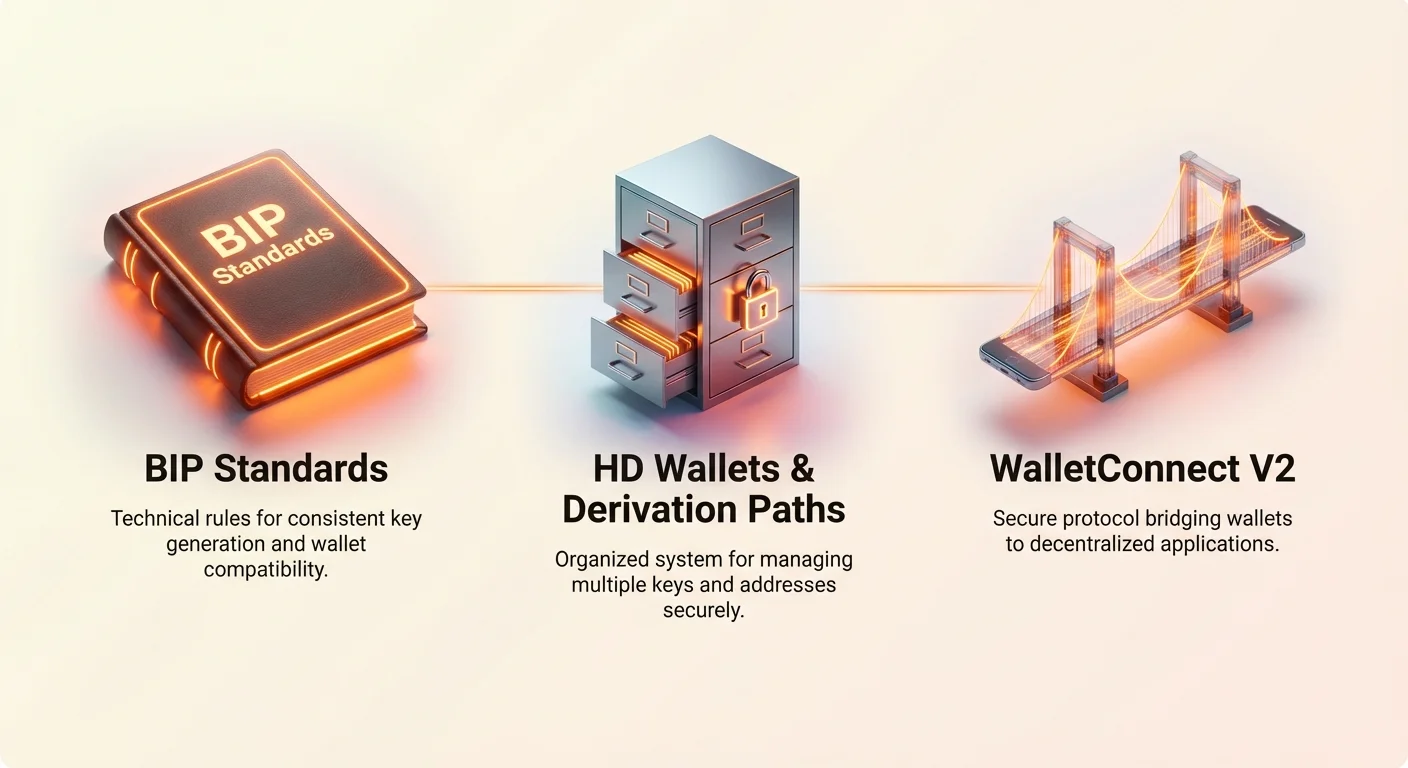
The Foundation of Wallet Construction: BIP Standards
Before digital wallets were standardized, moving your funds between different software could be a nightmare. Every wallet manufacturer had its own way of generating keys, meaning your backup phrase from Wallet A might be useless in Wallet B. Bitcoin Improvement Proposals (BIPs) solved this. BIPs are the technical rulebook established by the Bitcoin community, acting as industry-wide standards that ensure consistency, security, and interoperability across all compliant wallets.
If a wallet adheres to a specific BIP, you can generally trust that your funds are accessible across any other compliant wallet, regardless of the brand or format (mobile, hardware, or desktop).
Understanding BIP-39: The Seed Phrase Standard
BIP-39 is arguably the most important standard for newcomers, as it defines the mechanism for creating and managing your recovery seed phrase (sometimes called a mnemonic phrase).
In simple terms, BIP-39 takes the long, complex string of numbers and letters that make up your cryptographic private key and converts it into a human-readable list of 12, 18, or 24 common words. This process makes the critical backup step much easier and less prone to transcription error.
How BIP-39 Works:
- Entropy: The wallet generates a high degree of random data (entropy).
- Word List: This data is mapped to a pre-defined list of 2048 words (the BIP-39 wordlist).
- Checksum: A few bits are added to check for typos.
- Mnemonic: The final list of words is presented to the user.
Any wallet that uses the BIP-39 standard will generate the exact same keys from the exact same word sequence. This standardization is why you can safely restore your funds from a Trezor wallet onto a mobile app like Exodus, or vice versa.
The Significance of BIP-44: Multi-Coin Consistency
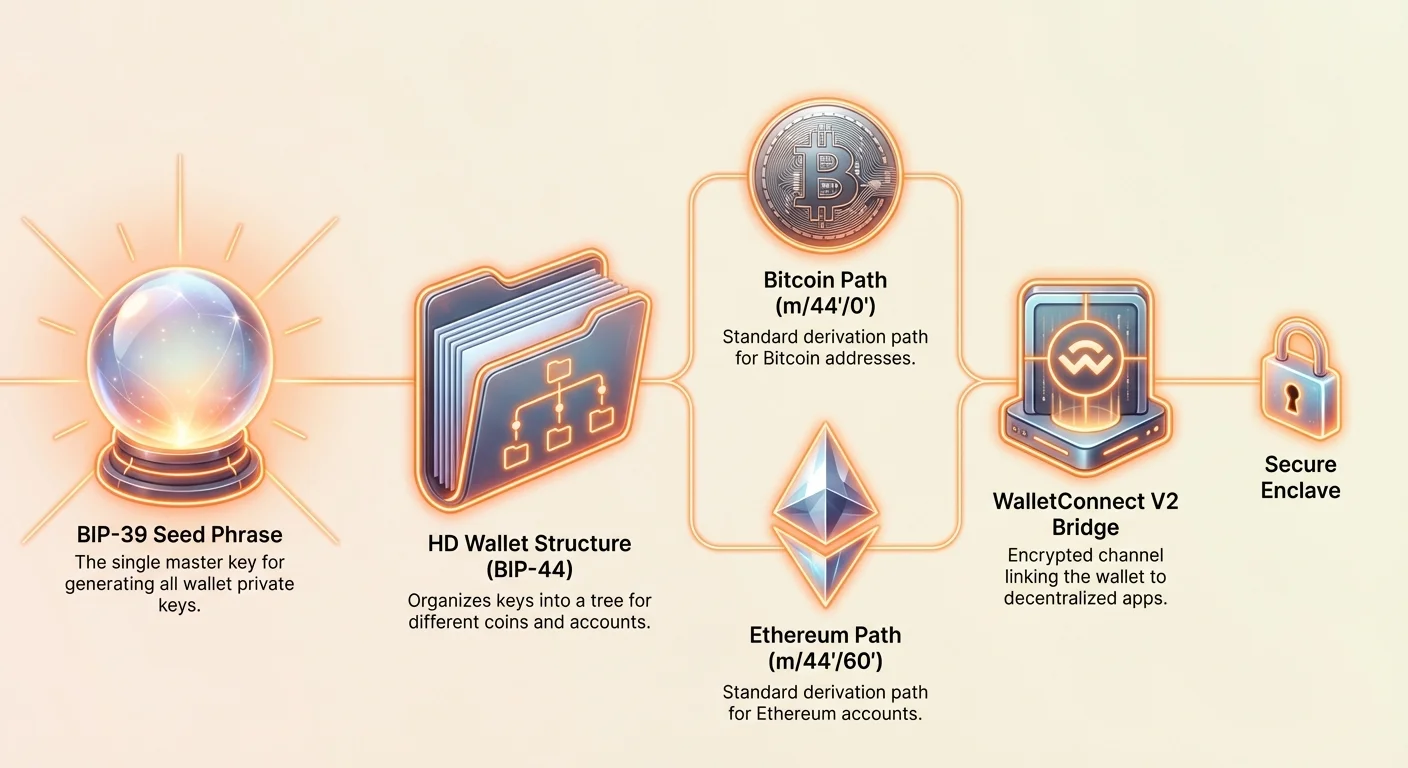
While BIP-39 gives you the master key (the seed phrase), BIP-44 gives you the master map for organizing your funds.
In the early days of crypto, wallets were typically "single-key," meaning they held one private key for one address. If you wanted a new address for better privacy, you needed a new private key and a separate backup. This became unmanageable, especially as users started holding multiple cryptocurrencies (Bitcoin, Ethereum, Solana, etc.).
BIP-44 establishes a specific, five-part structure for organizing all the private keys derived from your single BIP-39 seed phrase. This structure ensures that a single seed can manage hundreds of different coins and countless addresses, all neatly categorized.
The primary benefit of BIP-44 is predictability. If Wallet A uses BIP-44, it knows exactly where to look for your Ethereum addresses (folder 60) and where to look for your Bitcoin addresses (folder 0). Without BIP-44, every multi-currency wallet would have to guess the correct location for each coin, making interoperability impossible.
Hierarchical Deterministic (HD) Wallets: The Filing Cabinet Approach
BIP standards define the why (interoperability), and Hierarchical Deterministic (HD) wallets define the how (the architecture).
An HD wallet is a system that allows a single master seed (the BIP-39 phrase) to deterministically generate a virtually unlimited tree of keys (private and public). Think of your seed phrase as the secure lock on a massive filing cabinet, and the HD structure as the organized system of folders, sub-folders, and documents inside that cabinet.
Why HD Wallets Are Superior to Simple Wallets
HD wallets offer profound advantages in security and convenience over their predecessors:
- Single Backup: You only need to back up the 12 or 24-word seed phrase. If you lose your device, restoring this one phrase restores every coin, every account, and every address you have ever generated.
- Improved Privacy: An HD wallet can generate a new receiving address for every transaction you receive. Crucially, the public addresses are created using an extended public key (xPub), which can be shared with auditors or services without revealing the private key.
- Efficiency and Speed: Because all keys are generated mathematically from the root seed, wallets can quickly "derive" (calculate) the necessary private keys on demand, rather than storing hundreds of individual keys separately.
In essence, HD wallets separate the critical asset (the master seed) from the operational components (the individual addresses), vastly improving security protocols, especially for hardware wallets (cold storage).
Decoding Derivation Paths (The Map to Your Funds)
The "hierarchical" part of the HD wallet is managed by the derivation path. This is the specific sequence of instructions that tells the wallet where to look within the key tree to find the private key corresponding to a specific cryptocurrency address.
The derivation path is represented by a sequence of numbers separated by slashes, usually starting with m/ (or M/ for the extended public key). It looks something like this:
Let's break down the standard BIP-44 structure:
| Element | Description | Example Value |
|---|---|---|
| m | Denotes the Master Seed Key. | m |
| Purpose | Always 44' for BIP-44 wallets. |
44' |
| Coin | A unique number identifying the cryptocurrency (e.g., Bitcoin is 0', Ethereum is 60'). |
0' or 60' |
| Account | Allows users to separate accounts for different purposes (e.g., 0' for savings, 1' for trading). |
0' |
| Change | Specifies if the key is for receiving funds (0) or for change addresses (1). |
0 |
| Index | The specific address number within the account. | 0 (the first address) |
Example of a Standard Bitcoin Path: m/44'/0'/0'/0/0
This path tells the wallet: "Start at the master seed, use the BIP-44 standard, look for Bitcoin keys (0'), find the primary account (0'), look for a receiving address (0), and pull up the first address (0)."
Pielāgošana atvasināšanas ceļiem progresējušiem lietotājiem
Atvasināšanas ceļa izpratne ir izšķiroša, jo tas ir galvenais iemesls, kāpēc savietojamība dažreiz sabrūk. Ja jūs importējat savu BIP-39 sēklas frāzi jaunā maciņā un tas maciņš izmanto nedaudz citu atvasināšanas ceļu jūsu izvēlētajai monētai, jūsu līdzekļi šķitīs pazuduši — patiesībā maciņš tikai skatās nepareizajā mapē.
Izplatīti ceļu variācijas un to izmantošana
Kamēr BIP-44 nodrošina vispārēju standartu, kripto ekosistēma ir attīstījusies, radot dažādas ceļu konvencijas specifiskiem mērķiem, galvenokārt efektivitātes optimizēšanai vai jaunu kriptogrāfisko prasību atbalstam:
1. Bitcoin specifiskie ceļi (BIP-49 un BIP-84)
Kad Bitcoin attīstīja jaunas adrešu tipus (piemēram, SegWit), kopiena ieviesa jaunus BIP, lai regulētu šīs specifiskās ceļu struktūras, nodrošinot atpakaļsaderību:
- BIP-49 (P2SH-SegWit): Izmanto vecākām SegWit adresēm, kas sākas ar '3'. Ceļš maina mērķa lauku:
m/49'/0'/0'/0/0. - BIP-85 (Native SegWit): Izmanto mūsdienīgām, zemāko maksas SegWit adresēm, kas sākas ar 'bc1'. Ceļš atkal maina mērķa lauku:
m/84'/0'/0'/0/0.
Ja jūs saņemat Bitcoin Native SegWit adresē, izmantojot Maciņu A, bet Maciņš B pēc noklusējuma izmanto veco BIP-44 ceļu, Maciņš B nerādīs jūsu atlikumu, kamēr jūs manuāli nepasakīsiet tam skenēt BIP-84 ceļu.
2. Ethereum un EVM ceļu variācijas
Ethereum ieviesa savu konvenciju, izmantojot monētu kodu 60'. Tomēr, atšķirībā no Bitcoin, Ethereum konti parasti netiek atdalīti pēc maina/indeksa, bieži izmantojot vienkāršāku ceļu konta ģenerēšanai:
- Standarta Ethereum (BIP-44):
m/44'/60'/0'/0/0(Visbiežāk izmantots, īpaši aparatūras maciņos). - Ledger Live Ethereum: Ledger bieži izmanto nedaudz citu ceļa notāciju dažādiem konta uzstādījumiem, prasot lietotājiem izvēlēties pareizo tipu importējot.
Rīcības padoms: Ja jūs migrējat savu sēklas frāzi un līdzekļi pazūd, pirms panikas, pārbaudiet vecā maciņa atbalsta dokumentāciju, lai redzētu, vai tie izmanto nestandarta vai alternatīvu atvasināšanas ceļu jūsu specifiskajai monētai vai konta tipam. Lielākā daļa progresējušo maciņu (piemēram, Electrum, Trezor Suite vai MetaMask) ļauj manuāli izvēlēties vai ievadīt pielāgotu ceļu skenēšanai.
Maciņu savietojamības problēmu risināšana
Nesaderība atvasināšanas ceļos ir galvenais tehniskais šķērslis pašuzglabāšanas pieņemšanai. Šeit ir karkass problēmu risināšanai:
| Scenārijs | Problēmas identificēšana | Risinājums |
|---|---|---|
| Trūkst Bitcoin līdzekļu | Jaunais maciņš skenē noklusējuma legacy ceļu (BIP-44), bet līdzekļi tika nosūtīti uz jaunāku Native SegWit adresi. | Pārbaudiet maciņa iestatījumos opcijas pievienot Native SegWit (BIP-84) konta tipu. |
| Trūkst altkoīnu/tokenu līdzekļu | Oriģinālais maciņš izmantoja pielāgotu ceļu (piem., stekinga kontiem), bet jaunais maciņš izmanto tikai standarta BIP-44 ceļu. | Konsultējieties ar vecā maciņa dokumentāciju par specifiskās monētas ceļu. Izmantojiet jaunā maciņa "importēt pielāgotu ceļu" funkciju (ja pieejama). |
| Aparatūras maciņa savienojuma problēmas | Aparatūras maciņš ģenerē pareizās atslēgas, bet programmatūras interfeiss (piem., MetaMask) meklē atslēgas nepareizā vietā. | Pārliecinieties, ka maciņa interfeiss ir konfigurēts uz specifisko HD ceļu, ko izmanto jūsu aparatūras maciņa zīmols (piem., Ledger bieži izmanto citu secību nekā Trezor specifiskiem tokeniem). |
Uztverot savus līdzekļus nevis kā fiziskas monētas, kas uzglabātas maciņā, bet kā datu punktus, kas atrodas specifiskās koordinātās uz masīvas kartes (atvasināšanas ceļš), jūs iegūstat tehnisko ieskatu, kas nepieciešams jebkura migrācijas vai savietojamības izaicinājuma pārvaldībai.
Connecting the Ecosystem: Mastering WalletConnect V2
While BIPs define how wallets are built internally, WalletConnect defines how wallets securely interact with the outside world—specifically with decentralized applications (dApps).
WalletConnect is an open-source protocol that allows mobile wallets, desktop wallets, and hardware-backed wallets to securely link to and communicate with any dApp or Web3 application running in a desktop browser or another mobile application. It acts as an encrypted communication channel, ensuring that your private keys never leave the secure environment of your wallet device.
How WalletConnect Bridges Wallets and dApps
Imagine you want to use a DEX (like Uniswap) on your desktop computer, but your crypto assets are stored securely on a mobile app or a hardware wallet that cannot be plugged directly into the browser.
WalletConnect solves this using a standardized handshake protocol:
- Initiation: The dApp displays a QR code containing the WalletConnect URI (a cryptographic connection string).
- Scanning/Linking: You scan the QR code with your mobile wallet app (or link the URI if using desktop-to-desktop).
- Encrypted Session: A secure, end-to-end encrypted connection is established between the dApp interface (the signing requestor) and your wallet (the signing authority).
- Transaction Authorization: When you initiate a swap on the dApp, the dApp sends the raw transaction data securely through the WalletConnect bridge to your wallet.
- Confirmation: Your wallet displays the transaction details (what you are spending, where it is going) for your review. You approve and sign the transaction using your private key within the wallet’s secure enclave.
- Broadcast: The signed transaction is sent back through WalletConnect to the dApp interface, which then broadcasts it to the blockchain.
The critical security advantage is that the dApp never touches your private keys. It only receives the signed, completed transaction data.
Key Improvements in WalletConnect V2 (Security and Multi-Chain)
WalletConnect V1 was functional but lacked robust multi-chain support and session stability. WalletConnect V2 was introduced to address these limitations, making it the standard for advanced Web3 interaction today:
1. Multi-Chain Interoperability
V1 was primarily focused on single-chain sessions. V2 introduced a flexible structure that allows a single WalletConnect session to maintain connections across multiple blockchains simultaneously (e.g., connecting to both Ethereum and Polygon with one QR code scan). This is vital for modern DeFi usage, where users frequently bridge assets or interact with applications deployed across several networks.
2. Enhanced Session Persistence
V2 utilizes a decentralized messaging relay network that provides much greater reliability. If your internet connection drops or you close the browser, the V2 session can often be restored quickly, preventing the need to re-scan the QR code for every interaction.
3. Optimized Permissions and Security
V2 allows wallets to request specific permissions from the user upfront, such as requesting access to only one specific chain or method. This clear delineation of permissions enhances security and prevents malicious dApps from attempting to operate on chains you didn't explicitly approve.
Actionable Tip: Always verify the dApp URL directly in your mobile wallet when using WalletConnect. The connection request will display the URL it is linking to. This simple step prevents connection to phishing sites that mimic legitimate applications.
Secinājums: Pašsuverenitātes arhitektūra
Maciņu standartu un savietojamības mehānismu izpratne pārvērš jūs no pasīva kripto tehnoloģijas lietotāja uz aktīvu dalībnieku, kurš saprot arhitektūru aiz skatuves.
BIP standarti (BIP-39 un BIP-44) nodrošina, ka jūsu kriptogrāfiskās atslēgas tiek ģenerētas un organizētas deterministiski, nodrošinot galīgo dublēšanas aizsardzību un ļaujot viegli pārvietot jūsu līdzekļus starp dažādiem atbilstošiem maciņiem. Atvasināšanas ceļa (HD maciņi) jēdziena apgūšana dod jums spēju risināt savietojamības problēmas, pārvietojot līdzekļus pāri dažādām programmām, kas var izmantot unikālas adrešu struktūras.
Visbeidzot, WalletConnect V2 kalpo kā būtisks, drošs tilts starp jūsu izolēto, aizsargāto maciņu un aktīvo, interaktīvo Web3 dApps pasauli.
Izprotot, kā šie trīs komponenti — BIPs, atvasināšanas ceļi un WalletConnect — darbojas kopā, jūs iegūstat tehnisko pārliecību, kas nepieciešama progresīvu kripto stratēģiju izpildei, sarežģītu vairāku ķēžu portfeļu pārvaldībai un patiesas pašsuverenitātes uzturēšanai digitālajā ekonomikā.