
経験豊富な投資家であれ、熱心な新規参入者であれ、リスクを理解することは成功する投資テーシスの基石です。通常の金融市場は金利、信用デフォルト、マクロ経済ショックに関連するリスクを伴いますが、ビットコインのような分散型資産は独自の脅威の集まりに直面しています。これらはネットワーク全体の長期的な存続可能性と価値提案に挑戦する可能性のあるシステムリスクです。
この文脈でのシステムリスクとは、ビットコインエコシステム全体に連鎖的な失敗を引き起こす可能性のある脆弱性を指し、セキュリティ、デセントラライズ、または検閲耐性というその核心的な特性を根本的に損なうものです。日々のボラティリティを超えて、私たちは3つの主要な存在脅威のカテゴリを批判的に評価する必要があります:突然の規制変更(ブラック・スワン)、技術的ブレークスルー(量子コンピューティング)、および内部構造的脆弱性(51%攻撃)。これらの危険に対する包括的な分析は弱気な演習ではなく、新たなデジタル経済で自己主権的なポジションを構築するために必要な重要なデューデリジェンスです。
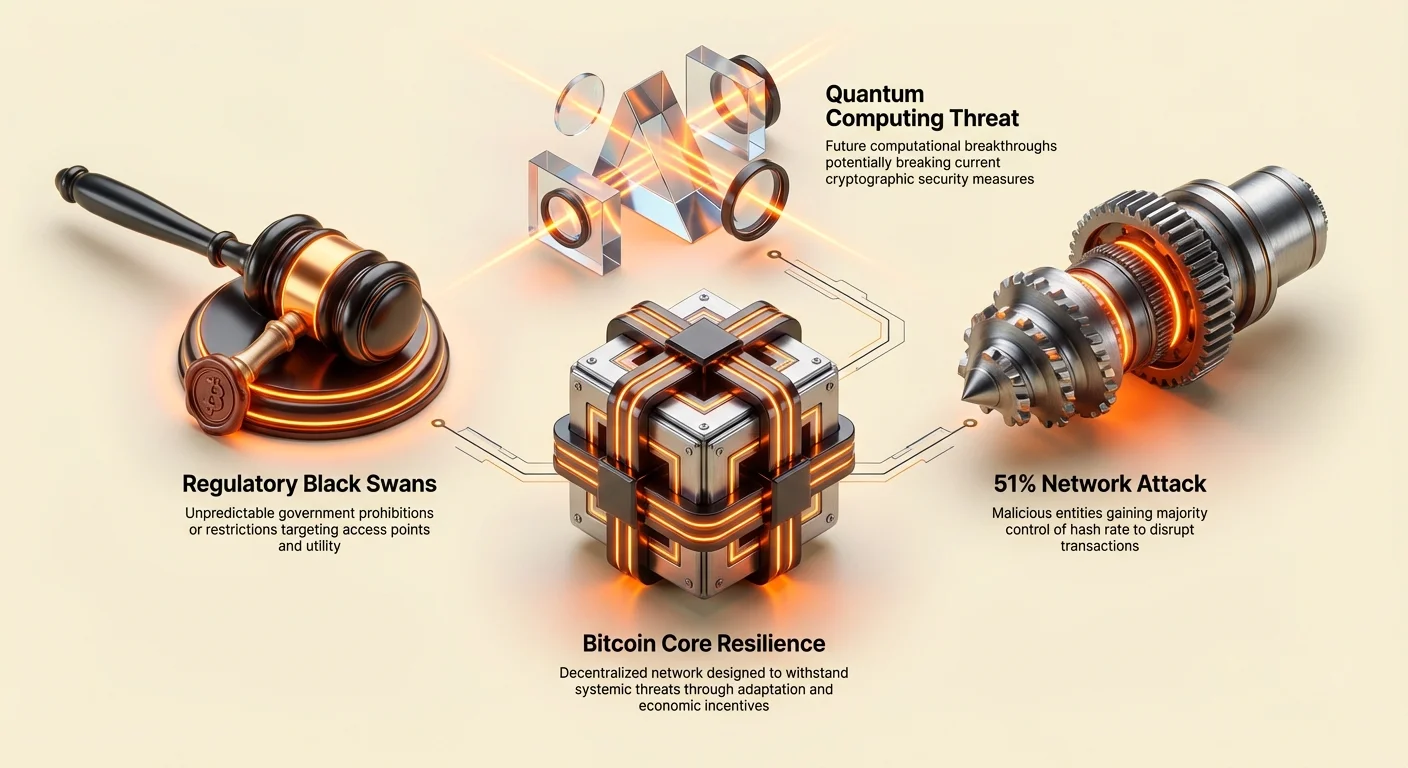
The Regulatory Landscape: Analyzing Black Swan Events
Regulation poses the most immediate and complex systemic risk to Bitcoin, primarily because it is governed by unpredictable political cycles and the competing interests of global sovereign nations. A regulatory "Black Swan" event is an unforeseen, high-impact policy decision—such as a sudden, coordinated global prohibition—that fundamentally restricts the utility or exchangeability of cryptocurrencies.
Global Fragmentation and Policy Inconsistency
Currently, the regulatory environment is fragmented. Different major jurisdictions treat Bitcoin in vastly different ways, creating both opportunities and friction points. This inconsistency is a systemic risk in itself because it prevents Bitcoin from achieving seamless global integration.
In regions like the European Union, comprehensive frameworks like the Markets in Crypto Assets Regulation (MiCA) aim to provide clarity, consumer protection, and operational certainty for crypto firms. This institutional adoption, while positive for market maturation, creates centralized chokepoints—the exchanges and custodians that serve as the main on- and off-ramps between fiat currency and Bitcoin.
Conversely, the United States has operated under a patchwork system of enforcement actions and conflicting definitions from multiple agencies (SEC, CFTC, IRS). This uncertainty creates policy risk, driving development and capital overseas and introducing the possibility of severe, market-crushing rulings.
Analyst Focus: The Chokepoint Strategy Governments rarely attempt to ban the holding of Bitcoin, which is technically difficult to enforce due to self-custody. Instead, the greatest regulatory systemic risk lies in the regulation of access points. If major countries impose restrictions on banks interfacing with crypto exchanges, or enforce strict KYC/AML (Know Your Customer/Anti-Money Laundering) requirements that compromise privacy, the fungibility and utility of Bitcoin as a permissionless monetary network could be severely curtailed.
The Institutionalization Paradox: Mitigation vs. Exposure
The massive influx of institutional capital, particularly through mechanisms like Bitcoin Spot Exchange Traded Funds (ETFs), presents a paradox.
On one hand, institutional adoption acts as a political firewall. As pension funds, corporations, and major Wall Street players gain exposure to Bitcoin, they acquire a powerful lobbying voice. This increased political capital helps mitigate the risk of outright prohibition in democratic nations, as a ban would negatively impact a significant portion of the financial establishment and their clientele.
On the other hand, institutionalization introduces new centralized points of failure. When billions of dollars of BTC are held by a handful of regulated custodians (required for ETF operations), these holdings become targets for:
- Regulatory Seizure: A court order or emergency mandate could force these custodians to freeze or transfer assets, effectively centralizing control over a large portion of the circulating supply.
- Compliance Burden: The rules imposed on institutional custodians (e.g., specific rules on the source of funds) could indirectly blacklist certain "tainted" coins, potentially hurting Bitcoin's fungibility.
The long-term resilience of Bitcoin depends on its ability to serve users outside these regulated channels, maintaining its permissionless nature even if institutional pathways become heavily restricted.
The Coordinated Global Ban Scenario
While highly improbable due to conflicting national interests, the theoretical systemic risk of a coordinated global ban requires assessment. For such a "Black Swan" to occur, the world’s major economies (US, EU, China, India) would need to simultaneously declare Bitcoin illegal and successfully enforce that ban.
Why it’s Difficult to Execute:
- Political Consensus: Achieving this level of global political alignment on any issue, let alone a complex technological one, is historically difficult. Nations view crypto as a strategic tool—either for financial innovation (EU/UK) or capital control circumvention (smaller economies).
- Technical Resistance: Banning the underlying protocol is impossible. The network would continue to operate as long as nodes and miners exist anywhere in the world, shifting to jurisdictions that remain permissive.
- Economic Cost: Banning a multi-trillion-dollar asset would lead to massive economic disruption, potential capital flight to less restrictive jurisdictions, and the rise of robust peer-to-peer dark markets, undermining the ban's effectiveness.
Actionable Tip for Due Diligence: Focus on where you hold your keys. The regulatory risk is drastically reduced if you utilize robust self-custody (hardware wallets) rather than relying on regulated, centralized exchanges (where assets are held in the name of the exchange and subject to their jurisdiction).
技術的陳腐化:量子脅威とその先
すべての現代のデジタルセキュリティは暗号技術に依存しています。ビットコインは、世界の銀行システムやインターネットセキュリティと同様に、取引の保護と所有権の検証に暗号アルゴリズムを使用しています。最もよく引用される技術的システムリスクは、現在の暗号化標準を破るのに十分な性能を持つ量子コンピュータの出現です。
量子コンピューティング脅威の理解
ビットコインは主に2種類の暗号機能を使用しています:
- ハッシュ化(SHA-256):マイニング(Proof-of-Work)とブロックの連結に使用されます。量子コンピュータは特定の検索アルゴリズム(グローバーのアルゴリズム)を高速化しますが、SHA-256への脅威は管理可能であり、ハッシュ出力の倍増(例:SHA-512への移行)でセキュリティを回復できます。これは一般的に実存的脅威とは見なされません。
- デジタル署名(楕円曲線デジタル署名アルゴリズム、ECDSA):これが決定的な脆弱性です。ECDSAはあなたの秘密鍵を保護します。ビットコインを送金する際、秘密鍵を使用して所有権を証明する一意の数学的署名を生成します。
決定的な脅威はショアのアルゴリズムから来ます。ショアのアルゴリズムを実行する量子コンピュータは、対応する公開鍵から秘密鍵を効率的に逆算できます。
攻撃ベクトル: 現在のビットコインの慣行では、送金時に公開鍵(コインが送られるアドレス)が公開されます。公開鍵がブロックチェーン上に公開されると、十分に強力な量子コンピュータは理論上、ほぼ瞬時に秘密鍵を推定でき、攻撃者がそのアドレスに関連するすべての資金を盗むことが可能です。
脆弱性と緩和策
量子脅威は実存的ですが、即時的なものではありません。専門家は一般的に、「暗号学的に関連する」量子コンピュータ——ショアのアルゴリズムを効率的に実行できる機械——は10年以上先であると推定しています。これにより、ビットコイン開発者コミュニティに緩和のための重要な機会の窓が与えられます。
緩和計画:ポスト量子暗号(PQC)
量子脅威に対する主なシステム的防御は、PQCアルゴリズムへのプロトコルアップグレードです。PQCは、古典コンピュータと量子コンピュータの両方に対して安全に設計された新しい暗号手法を指します。
ビットコインへのPQCの実装は、ソフトフォーク(後方互換性のあるネットワークアップグレード)またはハードフォーク(必須アップグレード)を伴います。この移行は、ECDSAを量子耐性署名スキーム(例:NIST標準化プロセスで開発されたスキーム)に置き換えます。
現在の脆弱性:
- レガシーアドレス:公開鍵を即座に公開する古いプロトコルを使用したビットコイン送金はより脆弱です。「量子決算」が到来する前に、これらのアドレスに保持された資金をPQC準拠アドレスに積極的に移す必要があるかもしれません。
- 進行中取引:ネットワークにブロードキャストされた取引は、ブロックで確認される前に公開鍵を公開します。量子攻撃者は、正当な所有者の取引が確認される前に理論上、資金を中途で盗むことが可能です。
アナリストの焦点:ソフトフォークの実現可能性 決定的な質問は、開発者コミュニティがこのような大規模な変更に合意して実装できるかどうかです。量子アップグレードの必要性は普遍的に受け入れられるでしょうが、数百万のユーザー、ノード、マイナーを新しい標準に調整し、チェーン分裂を避けることが課題です。これはそれ自体がシステム危機となります。ビットコインの論争的なアップグレード(SegWitなど)を管理した歴史を考えると、能力は存在しますが、調整失敗のリスクはシステム的脆弱性として残ります。
量子を超えて:ユーティリティの陳腐化
もう一つの、あまり公表されていない技術的リスクは、ビットコインのコアユーティリティ——決済レイヤー——の優れた代替による陳腐化です。
ビットコインと同等のセキュリティと分散化を提供しつつ、劇的に速い最終性、手数料ゼロ、エネルギー効率が桁違いに優れた新しい分散型台帳技術が登場すれば、市场は徐々にビットコインから移行する可能性があります。
しかし、ビットコインのこのリスクに対する最大の防御は、そのリンディ効果(存在が長ければ長いほど存続する可能性が高い)とネットワーク効果です。それは最高のハッシュレートと最大の確立された金融インフラを有します。新技術は、15年にわたる継続運用で築いたビットコインの同規模の信頼とセキュリティを達成する必要があるため、参入障壁が高いです。陳腐化には、限定的ではなく根本的な技術的飛躍が必要です。
Internal Network Risks: Resilience Against the 51% Attack
While external forces like regulation and quantum physics pose threats, Bitcoin must also secure itself internally. The most critical internal systemic risk is the 51% attack, where an attacker gains control over the majority of the network's hash rate (the collective computational power used by miners).
Defining and Executing the 51% Attack
In a Proof-of-Work system, miners validate transactions and secure the network. Controlling 51% of the hash rate allows the attacker to:
- Double-Spend: The attacker can confirm a transaction (say, sending Bitcoin to an exchange), receive goods or services in exchange for that BTC, and then use their majority hash power to secretly build a longer, competing version of the blockchain without that transaction. Once the attacker’s secret chain is revealed and validated, the original transaction is erased, and the attacker retains both the BTC and the goods—a successful double-spend.
- Censor Transactions: The attacker can prevent specific transactions (or all transactions from specific users) from being confirmed into blocks.
Crucially, a 51% attack cannot create new Bitcoin, steal funds from wallets they don't control, or change the underlying protocol rules (like the 21 million supply limit). The danger lies solely in undermining transaction finality and network integrity.
The Economics of Defense: The Cost of Acquisition
For smaller, lesser-known cryptocurrencies (altcoins) with low hash rates, 51% attacks are unfortunately common because the necessary hash power can be rented cheaply. Bitcoin, however, is secured by an unprecedented amount of dedicated computational power, making the attack economically infeasible.
The economic security of Bitcoin relies on the sheer, staggering cost of acquiring and maintaining 51% of the global hash rate:
- Hardware Cost: The initial investment required to purchase the necessary specialized mining hardware (ASICs) would run into the tens or hundreds of billions of dollars. This equipment is supply-constrained, meaning a single entity could not acquire it without raising massive alarm bells.
- Energy Cost: The attacker would need continuous, industrial-scale energy consumption—enough to power small countries—with daily operating costs in the tens of millions of dollars.
- Opportunity Cost: The attacker, having invested this capital, is forfeiting the legitimate revenue they would earn by simply mining honestly.
Game Theory and Rationality: For a 51% attack on Bitcoin to succeed, the attacker must spend astronomical sums only to commit a temporary double-spend and, in the process, permanently destroy the value of the asset they just invested billions into securing. If the value of Bitcoin crashes to zero because of a successful attack, the attacker's investment in hardware and energy becomes worthless. Bitcoin's security is thus ensured by rational, self-interested economic actors.
The Death Spiral Theory and Miner Incentive
A more subtle internal risk relates to the long-term incentive structure of the network. Bitcoin's security is funded by two sources: the block reward (newly minted BTC) and transaction fees. The block reward halves approximately every four years (the Halving), reducing the incentive for miners to secure the network.
The "Death Spiral" Hypothesis: The theory suggests that as block rewards diminish towards zero, transaction fees might not be sufficient to compensate miners, leading many to shut down. If the total hash rate drops precipitously, the cost to mount a 51% attack would fall to an affordable level, leading to a breakdown in security, and further price erosion—a downward spiral.
Counter-Arguments and Systemic Resilience:
- Fee Market Dynamics: As the network matures and transaction volumes increase (especially through scaling layers like the Lightning Network), fees should naturally rise to compensate miners. The security cost is priced into the utility of the network.
- Price Resilience: Historically, every Halving has been followed by a significant rise in the price of BTC. A higher BTC price makes even a smaller block reward highly lucrative in dollar terms, sustaining the hash rate.
- Security Adjustment: Bitcoin's difficulty adjustment mechanism ensures that mining remains profitable (or at least competitive) regardless of how many miners are active. If many miners leave, the difficulty of finding a block automatically decreases, making it easier and cheaper for the remaining miners to earn the block reward, thus stabilizing the network.
The system is designed to be dynamically self-correcting. The cost of a 51% attack remains proportional to the value of the network—if the value is high, the cost of attack is prohibitively high, reinforcing security.
Actionable Tip for Investment Analysis: When assessing systemic risks, distinguish between Bitcoin (the heavily secured, market-leader protocol) and other cryptocurrencies. For smaller chains, the 51% attack is a current and practical threat; for Bitcoin, it remains primarily a theoretical one minimized by robust economic reality.
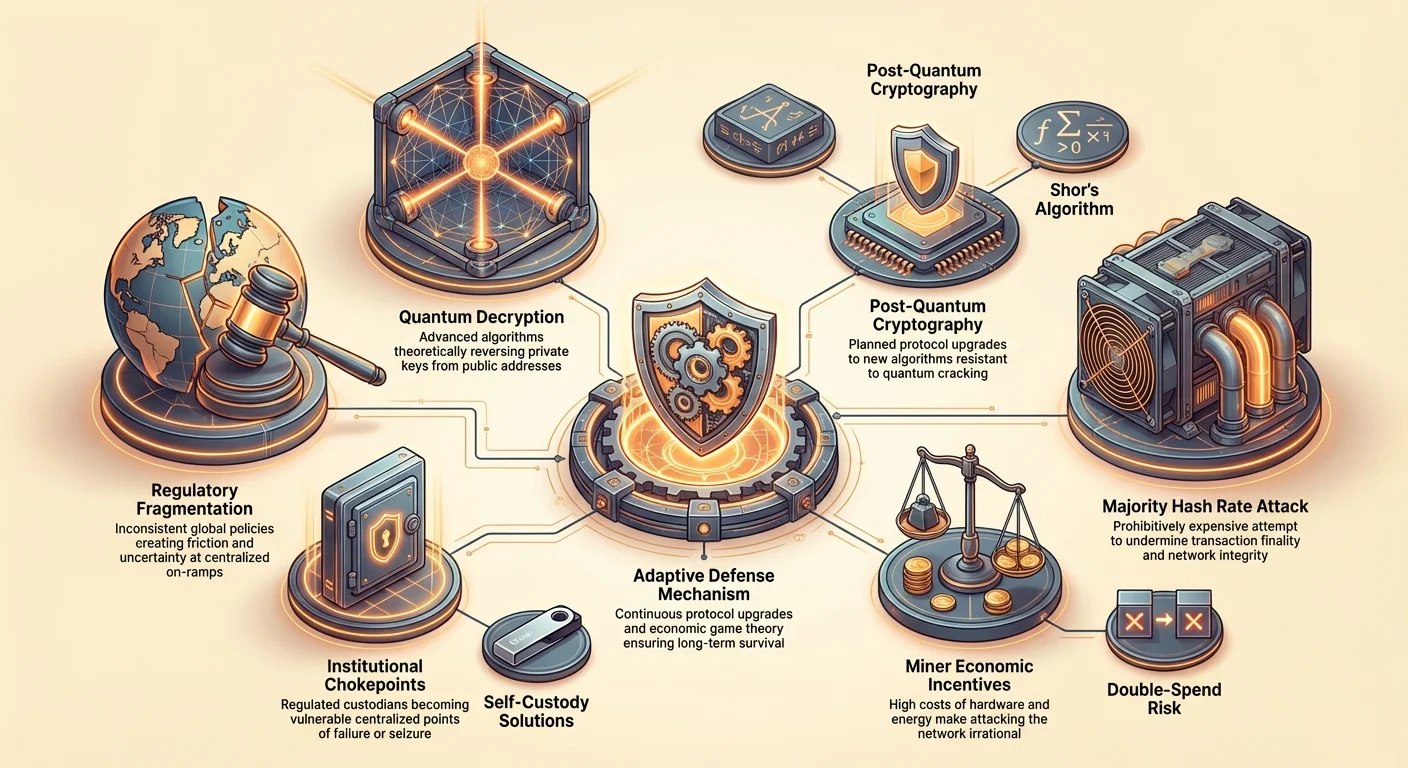
結論:デューデリジェンスと適応型防御
ビットコインが直面する体系的リスク——規制の予測不可能性、量子脅威、内部のインセンティブ対立——は現実のものであり、継続的な監視を必要とする。しかし、批判的な評価は、ビットコインがそれぞれに対して強力な内在的な防御メカニズムを有していることを明らかにする:
- 規制のブラックスワンに対する: 分散化とセルフカストディは、中央集権的な執行に対する技術的回復力を提供する。制度化は新たなボトルネックを導入する一方で、政治的な対抗レバレッジも生み出す。
- 技術的陳腐化に対する: リスクは可視化されており、開発者コミュニティに適応型アップグレード(PQC)を実施する十分な時間を与え、ネットワークの堅牢なコンセンサスメカニズムを活用する。
- 内部攻撃に対する: プルーフ・オブ・ワークシステムに組み込まれた膨大な経済的コストとゲーム理論的な抑止力により、壊滅的な失敗は極めてあり得ない。
真剣な投資家にとって、これらの体系的リスクを認識することは撤退の理由ではなく、資産の本当の長期的な価値提案を理解するための重要なステップである。ビットコインの耐久性は静的な状態を維持することに依存するのではなく、技術的アップグレード、コミュニティのコンセンサス、そして揺るぎない経済原則を通じてこれらの存在的脅威に適応し克服する能力に依存する。デューデリジェンスはこの適応的回復力に焦点を当てることを要求する。