暗号通貨マイニングの世界は、しばしば複雑なコンピュータコードや巨大なサーバーファームのイメージを喚起します。技術的には正しいものの、この見方は重要な現実を見逃しています。つまり、ビットコインマイニングは、何よりもまずハイステークスで激しく競争的な産業ビジネスなのです。
マイナーは単に数学的パズルを解いているわけではありません。彼らは、グローバルな兆ドル規模のネットワークを保護しつつ利益を最大化するよう設計された複雑な運用を行っています。マイナーがどのように収益を上げ、運用コストがどれほどかかるか、そしてプログラムされた収益削減(「半減期」と呼ばれるもの)にどのように適応するかを理解することは、非中央集権的なセキュリティの経済的基盤を把握する上で不可欠です。
このガイドは、単純な定義を超えて、マイニングセクターの経済的インセンティブ、効率指標、長期的な持続可能性を分析します。私たちは、初期のブロック補助金——マイナーへの保証された支払い——が必然的に縮小する中、ビットコインネットワークがセキュリティ予算をどのように維持するのかを批判的に評価します。これにより、取引手数料への依存という根本的なシフトが強制されます。
The Miner's Role: Securing the Network for Reward
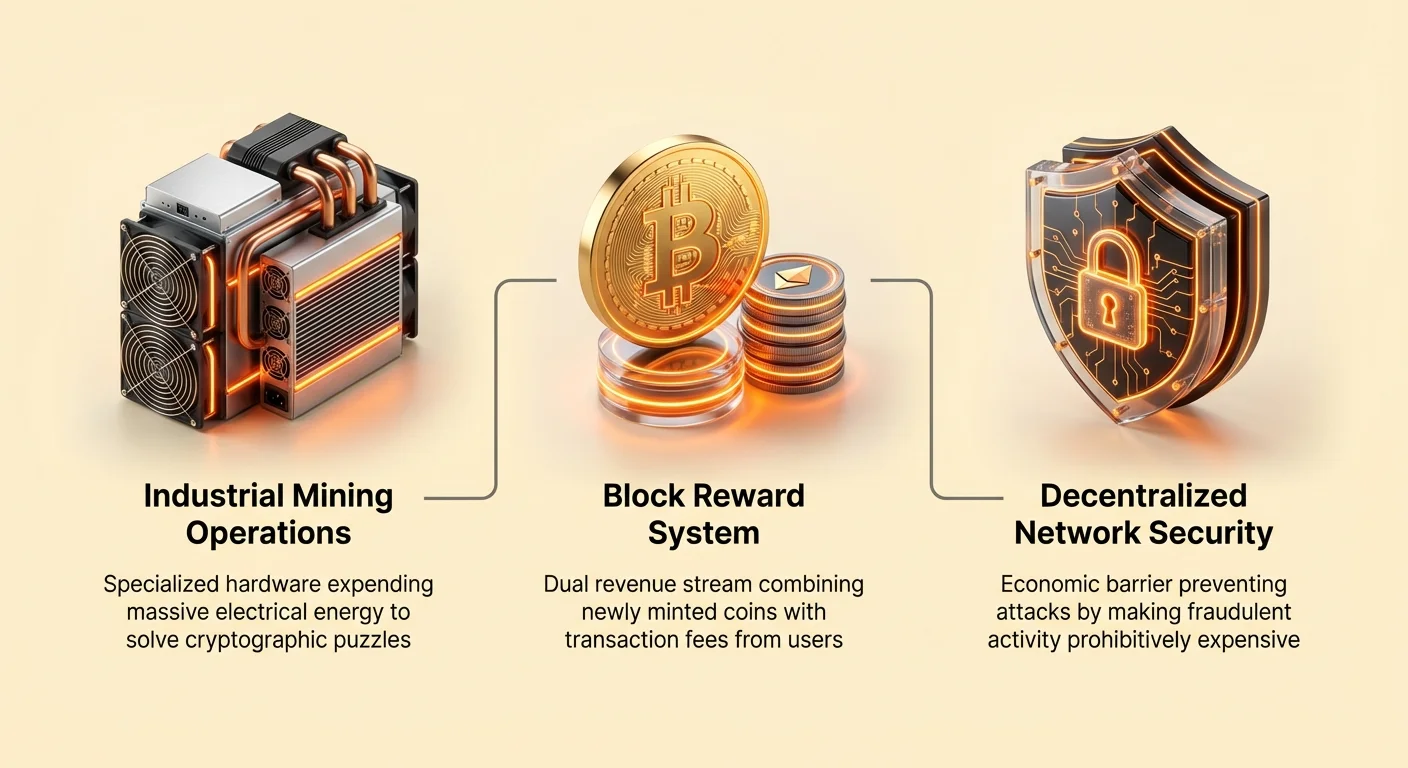
Miners are the lifeblood of a Proof-of-Work (PoW) blockchain like Bitcoin. Their job is to expend real-world resources (electricity and hardware) to validate transactions, bundle them into blocks, and add these new blocks to the immutable ledger known as the blockchain. This process ensures the integrity of the network and prevents fraudulent double-spending.
This labor is not free; it is driven entirely by economic reward, known as the block reward.
The Dual Revenue Stream: Subsidy and Fees
A miner’s total income stream comes from two primary sources, which together form the Block Reward:
- The Block Subsidy: This is the primary revenue stream today. It represents brand-new coins minted by the protocol and awarded to the miner who successfully adds the next block to the chain. This subsidy is predetermined and decreases over time according to a fixed schedule.
- Transaction Fees: These are small fees paid by every user who sends a transaction on the network. The user pays this fee to incentivize miners to include their transaction in the next block. These fees are collected by the winning miner along with the subsidy.
For Bitcoin, the long-term design anticipates a complete shift, moving from the block subsidy being the dominant incentive (as it is currently) to transaction fees eventually covering the entire cost of network security.
The Function of Proof-of-Work (PoW)
Proof-of-Work is the fundamental mechanism that underpins Bitcoin’s security. It demands that miners prove they have performed computational work by attempting to solve an extremely difficult, random cryptographic puzzle.
The network is essentially holding a massive, continuous lottery. The cost of buying a "lottery ticket" is the electricity consumed by the mining hardware.
- Security: By requiring miners to spend real energy (and thus incur high costs), PoW makes it economically prohibitive for any single bad actor to seize control of the network. Attacking Bitcoin would require expending more energy than the rest of the honest network combined, an act known as a 51% attack.
- Decentralization: Because the puzzle is solved randomly, PoW ensures that any miner, anywhere in the world, who can afford the necessary hardware and energy, has a chance to win the reward and propose the next block.
ビットコインのブロック報酬の理解
マイニングの収益性を分析するには、まずビットコインの収益モデルの予測可能な性質、特にブロック補助金のプログラムされた減少を把握する必要があります。
ブロック補助金の定義
サトシ・ナカモトがビットコインを設計した際、2100万コインの固定供給上限を設定しました。これらのコインの発行を管理し、時間とともに公平に分配するために、ブロック補助金を作成しました。
当初、ブロックごとに50 BTCの補助金でした。新たなブロックは平均して10分ごとに発見されます。この構造化されたリリースレートは、コイン導入の予測可能なスケジュールと、ネットワークの初期段階でのマイナーの堅固で保証された支払いを提供します。
この保証された補助金は、初期のビットコインセキュリティモデルの基盤であり、広範なトランザクション利用が競争的な手数料市場を支える前に、ネットワークがセキュリティをブートストラップすることを可能にします。
ハルビングメカニズム:経済の時計
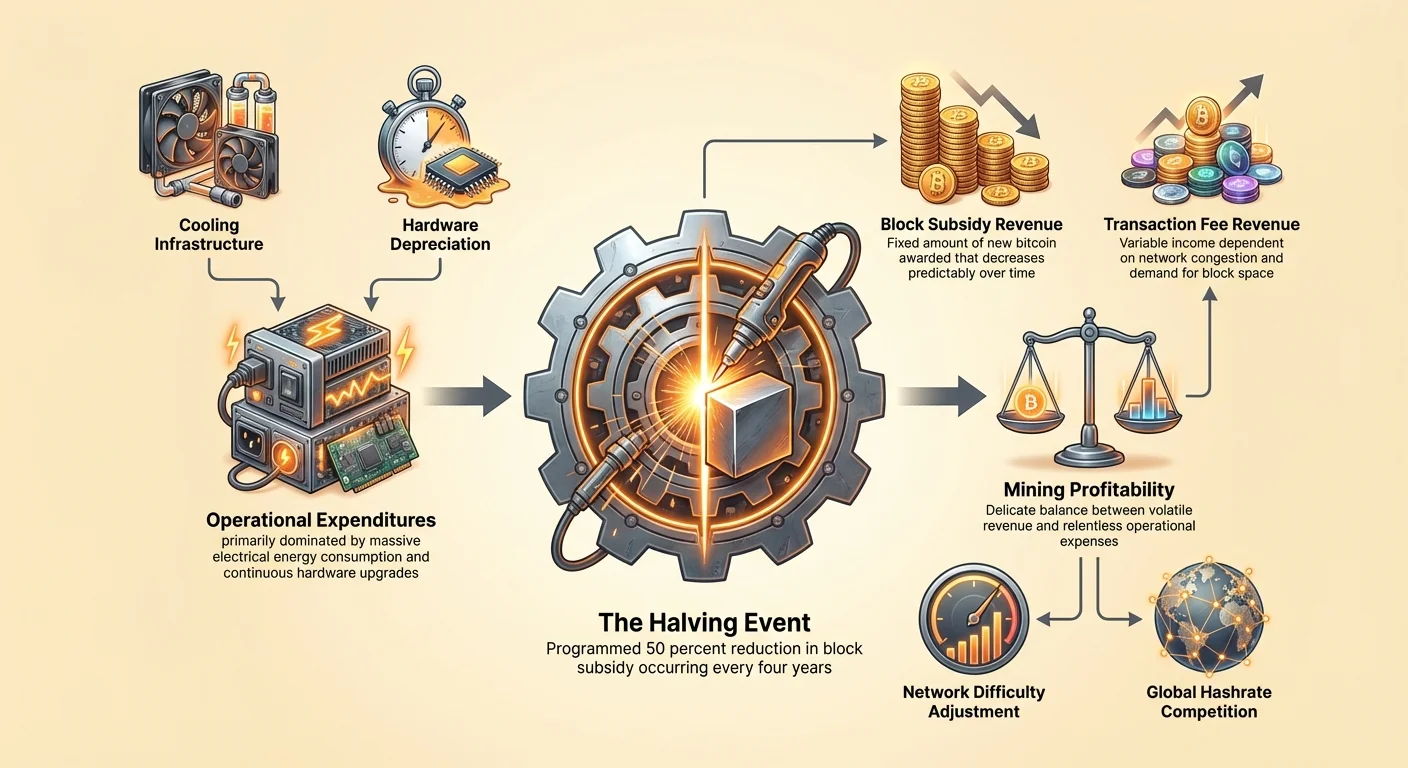
マイニングビジネスモデルに影響を与える最も重要な要因は、ハルビングです。ハルビングは、ブロック補助金が半分に削減されるプログラムされたイベントで、約4年ごと(具体的には210,000ブロックごと)発生します。
| ハルビング年 | ハルビング前補助金 | ハルビング後補助金 |
|---|---|---|
| 2009 (ジェネシス) | 50 BTC | |
| 2012 | 50 BTC | 25 BTC |
| 2016 | 25 BTC | 12.5 BTC |
| 2020 | 12.5 BTC | 6.25 BTC |
| 2024 | 6.25 BTC | 3.125 BTC |
ハルビングは2つの核心的な経済機能を果たします:
- 制御された希少性: 予測可能な不インフレを確保し、時間とともにビットコインの希少性を高めます。
- ストレステスト: マイナーを継続的に効率化させ、保証された報酬への依存を減らし、手数料主導の経済への最終的な移行を道筋づけます。
各ハルビングは巨大な経済的衝撃波を生み、マイナーの主要収益源を即座に50%削減します。このイベントが、より高い効率と低い運用コストへの絶え間ない産業的需要を駆動します。
トランザクション手数料の中心性
補助金がゼロに向かって縮小するにつれ(2140年頃と予測)、トランザクション手数料がネットワークセキュリティの資金調達の全負担を引き継がなければなりません。
トランザクション手数料は、転送をマイナーに確認してもらいたいユーザーによって支払われます。トランザクションを送信すると、まずmempool(メモリプール、未確認トランザクションの待機エリア)に着地します。
マイナーはデータバイトあたりの提供手数料に基づいてトランザクションを優先します。これにより、ネットワークが混雑しブロックスペースの競争が高まると手数料が劇的に上昇する市場が生まれます。
- 手数料のボラティリティ: 固定補助金とは異なり、手数料収益は非常に変動性が高いです。高市場活動やイノベーションの時期(NFTの成長やレイヤー2ソリューションなど)に急増し、静かな市場の低迷期に急落します。
- インセンティブ問題: 長期的な課題は、低利用期でも総収益(補助金 + 手数料)がネットワークをセキュアにするために必要なマイナーを補償するほど十分に高いことを確保することです。収益が低すぎると、マイナーが停止し、ネットワークのハッシュレートが低下し、51%攻撃のコストが低下し、セキュリティが低下します。
Calculating Mining Profitability: The Economics of Competition
Mining is a highly optimized game of margins. Understanding profitability requires moving beyond the simple price of Bitcoin and analyzing the specific costs and efficiencies of the operation.
Key Input Costs (The Operating Ledger)
A successful mining operation runs like any energy-intensive industrial business. The main variable costs are relentless and must be optimized hourly:
- Electricity (The Dominant Cost): This is the single largest expense, often accounting for 70% to 90% of a miner’s operating budget. Profitability is critically dependent on the cost per kilowatt-hour (kWh). Operations often locate in areas with stranded energy (e.g., natural gas flaring sites, remote hydroelectric dams) to secure the lowest possible prices.
- Hardware Depreciation (The Capital Expenditure): Mining uses specialized hardware known as Application-Specific Integrated Circuits (ASICs). These machines are costly, but their lifespan is short, typically only 2-4 years before newer, more powerful models make them obsolete (a process called obsolescence by efficiency). Miners constantly budget for upgrading their fleet.
- Infrastructure and Cooling (Overhead): This includes the physical structure (the warehouse or modular data center), networking gear, security, and crucially, cooling systems. The constant heat generated by thousands of ASICs requires substantial capital and energy input for climate control.
- Maintenance and Labor: While automated, large facilities require technicians for repair, monitoring, and optimization.
The Profitability Equation: Revenue vs. Difficulty
A miner's ability to turn a profit is a race against two moving targets: the market price of Bitcoin and the network difficulty.
Revenue is straightforward: (BTC Mined per Day) * (BTC Price).
The Challenge of Difficulty: As more miners join the network (attracted by high profitability), the total combined computing power (hashrate) increases. Bitcoin’s protocol automatically adjusts the puzzle's difficulty every 2,016 blocks (roughly every two weeks) to ensure that, regardless of how much computing power is on the network, a block is found, on average, every 10 minutes.
- Impact: When difficulty rises, an individual miner, using the same hardware and energy as before, mines fewer coins. This immediately squeezes margins and forces the least efficient miners to shut down until the difficulty falls again, or until the Bitcoin price rises to absorb the increased cost.
The Profitability Hurdle: A miner only stays in business if:
\text{Revenue} > \text{Variable Costs (Electricity) + Fixed Costs (Overhead)}
When the electricity cost to produce one Bitcoin exceeds the market price of one Bitcoin, the operation becomes instantly unprofitable and must be curtailed.
Introducing Hashrate and Efficiency Metrics
Miners measure their output using two key terms:
- Hashrate: This is the rate at which the mining hardware can perform cryptographic calculations. It is measured in hashes per second (H/s), typically scaled up to Terahashes (TH/s) or Petahashes (PH/s). A miner’s goal is to maximize their total hashrate contributing to the network.
- Joule per Terahash (J/TH) or Watt per Terahash (W/TH): This is the measure of the hardware's energy efficiency. It tells a miner how much energy (Joules or Watts) is required to perform one unit of computation (Terahash). Modern ASIC manufacturers relentlessly compete to lower this number. The lower the J/TH, the more profitable the machine, regardless of the price of Bitcoin.
Example Scenario:
- Old Miner A: Produces 100 TH/s at 50 W/TH (5,000 Watts total).
- New Miner B: Produces 100 TH/s at 25 W/TH (2,500 Watts total).
Miner B is twice as energy-efficient, meaning they pay half the electricity cost to secure the same revenue. This efficiency gap is the reason why older machines must be consistently retired or relocated to areas with nearly free energy sources.
Energy Efficiency Metrics: The Industrial Reality
For financial professionals and serious investors analyzing the mining sector, two key metrics—PUE and EROEI—are essential for assessing the operational excellence and true cost of securing the network.
Power Usage Effectiveness (PUE) Explained
PUE is an industry standard metric used in data centers to measure energy efficiency. It is the ratio of the total energy entering the mining facility to the energy actually consumed by the mining equipment itself.
- Interpretation: A PUE of 1.0 would mean that 100% of the energy is going directly to the miners, with zero energy lost to cooling, lighting, or ventilation. This is physically impossible.
- Real-World Goal: Most well-optimized industrial mining facilities aim for a PUE between 1.05 and 1.2. A facility with a PUE of 1.2 means that for every 100 Watts consumed by the ASICs, an extra 20 Watts are spent on supporting systems (cooling, fans, etc.).
- Optimization: Miners attempt to lower their PUE by deploying specialized cooling solutions, such as immersion cooling (submerging ASICs in non-conductive liquid) or locating operations in cold climates, which dramatically reduces HVAC overhead. PUE determines the true operational cost of maintaining a facility.
Energy Return on Energy Invested (EROEI)
EROEI (Energy Return on Energy Invested) is a concept derived from traditional energy analysis, but it is highly relevant to crypto mining economics. It measures the ratio of usable energy (or value equivalent) delivered by an energy-producing process to the energy consumed to deliver it.
In the context of Bitcoin mining, we adapt this metric to understand the economic sustainability: How much value (in BTC) is produced relative to the energy consumed?
A true EROEI analysis requires calculating the energy input for:
- Operational Energy: The electricity needed to run the ASICs.
- Embodied Energy: The energy required to manufacture the ASIC hardware, build the data center, and maintain the supply chain.
As the difficulty rises and the subsidy shrinks, the EROEI of mining must remain high enough that the economic benefit (the security provided by the BTC reward) justifies the massive real-world energy expenditure. If the EROEI falls too low, the security provided by the system is compromised because the economic incentive is insufficient to attract high levels of capital investment.
The Arms Race in ASIC Hardware
The competition to maintain profitability is not just fought through cheap electricity; it is fought through innovation in chip design.
Manufacturers of ASICs (like Bitmain or MicroBT) are in a constant technological arms race to produce chips with lower J/TH ratings. A new generation of miners can instantly wipe out the margins of older machines, even if those older machines have the advantage of cheaper electricity.
This dynamic creates massive capital expenditures for miners. They must constantly forecast Bitcoin's future price and difficulty to determine if investing millions in the latest hardware will generate enough ROI before that hardware becomes economically obsolete due to the next technological leap. This rapid technological obsolescence is a unique feature of the mining business model.
半減期の影響:ビジネスモデルのストレステスト
半減期は、マイニングセクターで最も重要な周期的なイベントです。これは厳しい経済的ストレステストとして機能し、市场の統合を強制し、大規模な効率向上を促進します。
短期的な痛み:即時の収益削減
半減期が発生すると、ブロック報酬の補助部分が即座に50%減少します。主要な短期的な影響は即時的で残酷です:
- 即時のマージン喪失: 薄いマージンで運用している多くのマイナー、特に電力コストが高いものや古いハードウェアを使用しているものにとって、収益削減により運用が即座に非収益化します。
- 「降伏」イベント: 非収益的なマイナーは機械を停止せざるを得なくなり、これをマイナーの降伏と呼びます。このアクティブハッシュレートの急減により、ネットワーク全体のハッシュレートが急落します。
- 難易度再調整: ハッシュレートの低下後、ネットワークの難易度アルゴリズムが最終的に下方調整されます(2,016ブロック期間後)。この調整により、残存マイナーがブロックを発見しやすくなり、失われた収益性のいくらかを取り戻します。このショックと回復のサイクルは予測可能です。
長期的な持続可能性:価格上昇または手数料増加の必要性
長期的には、半減期後のマイニング産業の存続は、以下のいずれか、または両方が発生することに依存します:
- ビットコイン価格の上昇: 歴史的に、すべての半減期の後にビットコインの法定通貨価格が大幅に上昇しています。BTC価格が2倍になれば、マイナーは経済的に元の状態に戻り、BTCの受取量が半分になっても半減期前の法定通貨収益を維持できます。
- 取引手数料の増加: 価格が十分に上昇しない場合、失われた補助を補うために手数料が上昇する必要があります。これにはネットワークの利用増加とブロックスペースの競争を生む採用の拡大が必要です。
成功した適応の最終的な指標は、市场が少ないマイニングコインに対してより高い法定通貨価値を提供するかどうか、または利用増加がより高い手数料収益を提供するかどうかです。
統合効果:半減期を生き残るのは誰か?
半減期は産業の統合を加速させるダーウィン的なイベントとして機能します:
- 勝者: 安価でしばしば再生可能エネルギー(kWhあたり0.04ドル未満)の電力にアクセスできる大規模で資金豊富なマイニング企業、そして最新で最も効率的なASICを保有する企業が繁栄します。彼らは苦境資産(降伏マイナーから安価に売却された古いハードウェア)を取得し、マージンが低い間に市場シェアを拡大できます。
- 敗者: 小規模趣味マイナーや高価なグリッド電力に依存する機関マイナーは競争できません。彼らはハードウェアを売却して市場から退出せざるを得ず、次の価格サイクルで運用が再び可能になるまでネットワークのセキュリティに割り当てられた全体のハッシュレートを減少させます。
この統合トレンドにより、マイニングは分散型趣味から、地理的に集中した専門産業へと移行しており、金融、エネルギー管理、データセンター運用における深い専門知識を必要とします。
長期的なセキュリティ予算:手数料依存への移行
ビットコインの将来に直面する最も重要な経済的問題は、ブロック補助金がほぼゼロに減少した後、ネットワークがセキュリティをどのように支払うかです。これをしばしばセキュリティ予算問題と呼びます。
手数料依存の必然性
ブロック補助金が4年ごとに半減し続けるにつれて、マイナーの総収益プールの無視できる部分になります。プロトコルは根本的に、セキュリティ資金を完全にトランザクション手数料に移行するように設計されています。
この移行には、堅牢で流動性が高く競争的なブロックスペース市場が必要です。十分な手数料収益がない場合、総ブロック報酬は51%攻撃を抑止するための十分なハッシュレートを促すコスト閾値を下回ります。
例:ブロック報酬が0.5 BTCで、グローバルネットワーク全体がそのブロックを生成するための運用コストが0.75 BTCに相当する場合、マイナーは即座にシャットダウンを開始します。ハッシュレートが低下し、難易度が調整されるか価格が回復するまでネットワークが一時的にセキュリティが低下します。
したがって、ビットコインの長期的なセキュリティは、ベースレイヤーでのトランザクションの継続的な有用性と高い需要に依存します。Lightning Network(レイヤー2スケーリング)のようなイノベーションは日常のトランザクションを安価に処理するために重要ですが、マイナーへの手数料収益を生成し続けるために、ベースレイヤーで高額トランザクションを時折決済する必要があります。
手数料主導の未来におけるゲーム理論とインセンティブ
手数料への移行の基盤となるゲーム理論は複雑です:
- 良い点:ビットコインがグローバルリザーブステータスを達成した場合、高価値で頻度の低いベースレイヤートランザクション(国家間の銀行送金決済など)の小さな手数料でも、今日のブロック補助金をドルベースで大幅に上回る巨大な総収益を生み出す可能性があります。
- リスク(共有地の悲劇):手数料が長期間低い場合、マイナーは手数料収益の自分たちの小さなシェアを最大化するために共謀したり、自己中心的なマイニング戦略を優先したりする誘惑を受ける可能性があり、网络の安定性を損なう可能性があります。しかし、マイニング市場のオープンで競争的な性質と51%攻撃の試行にかかる膨大なコストは、これらの短期的な貪欲なインセンティブを克服するように設計されています。
- 究極のインセンティブ:大規模マイニングオペレーションの大部分は多額のビットコインを保有しています。彼らの究極のインセンティブは、保有資産(貸借対照表)の価値を守るためにネットワークの完全性とセキュリティを維持することです。この既得権益は敵対的行動に対する強力な抑止力として機能し、彼らの自己利益をネットワークの長期的な健全性と一致させます。
マイニング投資分析のための実践的なヒント
金融専門家やマイニングセクターに参入しようとする真剣な個人投資家にとって、単に価格チャートを見る以上の、微妙な分析フレームワークが必要です。
1. コスト分析:生存の真の指標
マイニング事業や株式を評価する際は、生のハッシュレート容量よりも、生産されたコインあたりのコストを優先してください。
- 透明性を求める: 彼らのPUEに関するデータを要求してください。PUEが1.2を大幅に上回る施設は非効率に運営されており、不況時に高いリスクにさらされます。
- 電源を特定する: kWhあたりの具体的な価格は企業の最も守られた秘密です。長期電力契約を固定する戦略的パートナーシップや、フレアガス、火山地熱などの苦境エネルギー資産を利用するものを探してください。これらは本質的に安価で、グリッドの変動にさらされにくいです。
2. ハードウェア構成の管理
展開されたハードウェアの平均効率を分析してください。
- J/THベンチマーク: マイニング企業の平均J/TH効率を最新世代のASICと比較してください。構成が2-3世代前のマシンに大きく依存している場合、次の難易度上昇に対して脆弱で、ハルビング後に急速で高コストのアップグレードを余儀なくされます。
- 資本支出(CapEx)計画: 堅固なマイニング事業は、競争力を維持するために構成を継続的に更新するための明確で資金化された計画を持っているべきです。
3. 手数料ダイナミクスの予測
困難ですが、収益モデリングに手数料の変動性を組み込むことが重要です。
- 補助金だけでモデル化しない: 将来のキャッシュフロー・モデルは、手数料収益をますます考慮する必要があります。歴史的な高額手数料期間を分析して、会社のネットワーク混雑への露出と依存を理解してください。
- ネットワークユーティリティを分析: セカンドレイヤーソリューションの成長や1日あたりの取引数増加などの、ブロックスペース需要の増加を示すデータを探してください。これらは高い平均手数料収益を予兆します。
結論
ビットコインのマイニングは、現実世界のエネルギーをデジタルな希少性と分散型セキュリティに変換する経済エンジンです。それは単なる技術的プロセスではなく、極めて薄い利益率と周期的な経済ショックによって定義される、熾烈な競争を伴う高資本の産業ビジネスです。
ハルビングメカニズムはマイニング経済のマスタークロックであり、マイナーを体系的にストレステストし、低いPUEと高いEROEIの運用を採用することで継続的な効率向上を強制します。ビットコンネットワークのセキュリティ予算の長期的な持続可能性の成功は、高いブロック補助金への依存から堅牢で流動的な取引手数料市場へのシームレスで最終的な移行に完全に依存しています。
投資家とネットワーク参加者双方にとって、これらの基本的な経済的圧力—コスト競争、ハードウェアのアームレース、そして手数料依存への必然的なシフト—を理解することは、ビットコインの自己主権を維持し、それをグローバル資産としての未来を確保する核心的なメカニズムを把握する鍵です。