
暗号通貨の世界への旅は、しばしばシンプルな行動から始まります:ビットコインやイーサリアムを購入して保有することです。「HODL」戦略は長期投機に効果的ですが、真の金融の洗練は、受動的な蓄積を超えて積極的で戦略的な資産管理に移行することを要求します。伝統的な金融では、成功は何を買うかだけでなく、どのように保有資産の配分、リスク露出、資本効率を管理するかによって決まります。
デジタル資産の高速で変化する世界では、戦略的管理がさらに重要です。市場のボラティリティは、初期投資目標を急速に歪め、慎重に計画された60/40ポートフォリオを一夜にして偶発的な90/10配分に変えてしまいます。さらに、暗号通貨の固有のプログラマビリティにより、ステーキングや貸付などのイールドメカニズムを通じて資産がリターンを生成可能になります—正しく活用すれば強力な最適化ツールとなり、誤った管理では重大なリスクとなります。
このガイドは、基本的な暗号通貨保有から最適化された資産制御への移行のための、中級実践者のロードマップとして機能します。私たちは、最適なポートフォリオ比率を定義・維持する方法、信頼できるイールド生成の統合、先進的な資産展開に関連する複雑な税務およびセキュリティリスクのナビゲーションを検討します。
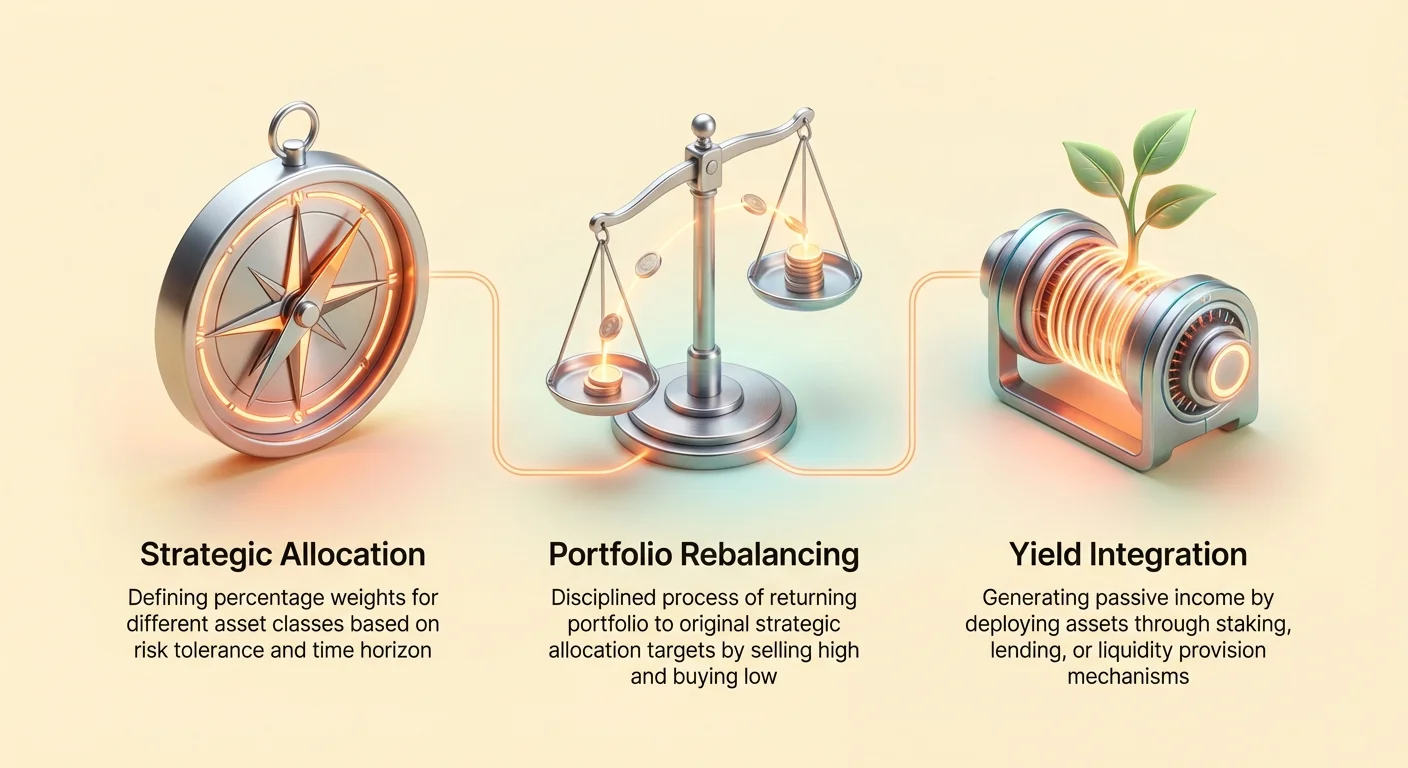
戦略的配分の基盤
戦略的資産管理は、市場の動きを予測することから始まるのではなく、ポートフォリオのための明確で構造的なルールを定義することから始まります。これらのルールは、異なる資産クラス(例:Bitcoin、ステーブルコイン、DeFiトークン、NFT)に割り当てるパーセンテージのウェイトを規定し、すべての将来の買い、売り、利回り統合の決定のための枠組みを作成します。
リスク許容度と投資期間の定義
特定のトークン目標を設定する前に、投資家は自身の基本的な投資パラメータを客観的に評価する必要があります。これらのパラメータは、ポートフォリオがどれほど積極的または保守的であるかを決定します。
リスク許容度のマッピング
リスク許容度とは、投資家が損失に耐えられる感情的・財務的な能力を指します。クリプトでは50%のドローダウンが一般的であるため、この閾値を理解することが重要です。高リスクの投資家はボラティリティの高いミッドキャップトークンに多額を割り当てるかもしれませんが、低リスクの投資家はBitcoinと規制されたステーブルコインのみに限定するかもしれません。
リスク許容度は、以下の3つの主要な次元にマッピングできます:
- 損失耐容量:生活に影響を与えずに失ってもよい金額はどれくらいですか?
- 心理的快適さ:大幅な市場暴落時にパニック売りをする可能性はどれくらいですか?
- 流動性ニーズ:この資金を短期(2年未満)で必要としますか?
流動性ニーズが高い場合や心理的快適さが低い場合、ポートフォリオはステーブルコインのような低ボラティリティ資産やBitcoin (BTC) のような確立された資産に大きく偏らせる必要があります。
投資期間の影響
投資期間—資産を保有する予定の期間—は、即時の利回りや資本保全の必要性を決定します。退職まで数十年ある若い投資家は、最大の資本増価のために高ボラティリティで非利回り資産を保有できます。一方、退職間近の投資家は、収入を補うために資本保全と信頼できる利回り(例:低リスクのステーキングや貸付)を優先すべきです。
目標比率の設定:コア vs. サテライト
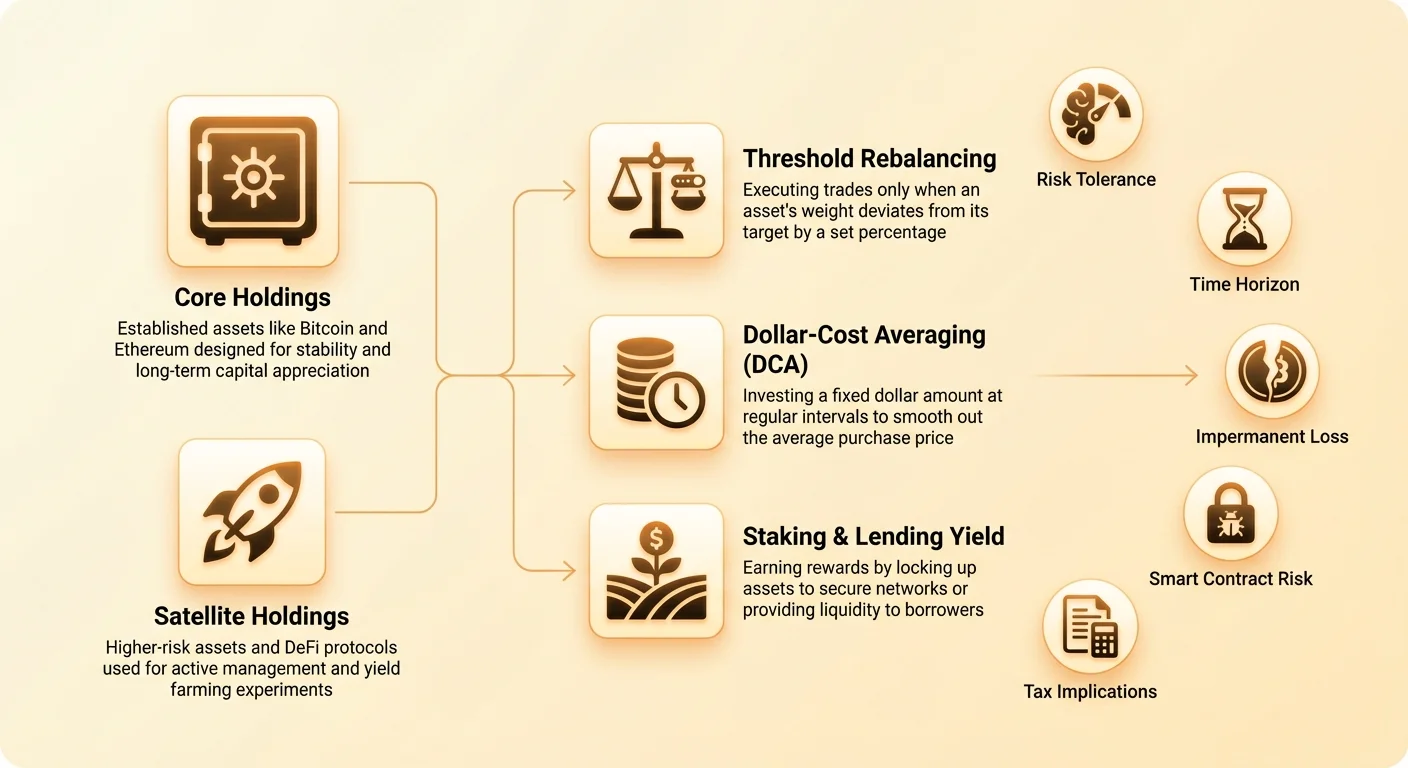
耐久性のあるポートフォリオを構築する一般的な方法は、コア-サテライトアプローチです。このフレームワークは、総投資をリスクの異なる2つの部分に分けます。
コア保有資産
コアはポートフォリオの最大の構成要素(通常60–80%)です。安定性と長期的な資本増価のために設計され、最高の採用率とセキュリティを持つ最も確立された資産を保有します。コアの目標は保全と着実な成長であり、投機の影響を最小限に抑えます。
- 典型的なコア資産: Bitcoin (BTC)、Ethereum (ETH)、および潜在的に高度に規制され完全担保付きのステーブルコイン(例:USDC)。
サテライ保有資産
サテライト部分(20–40%)は、高リスク・高リターンの機会に充てられます。これらの資産には、新興DeFiプロトコル、特定のセクタートークン(例:Layer 2ソリューション、RWAトークン)、またはスモールキャップ暗号通貨が含まれます。サテライト部分はアクティブマネジメントと利回りファーミングの実験が行われる場所ですが、その失敗がコアを危険にさらすことは決してあってはなりません。
初心者の一般的な配分例は以下のようになります:
- コア (75%): 50% BTC、25% ETH
- サテライト (25%): 10% ブルーチップDeFi(例:プロトコルトークン)、10% 新興L2、5% ステーブルコイン利回り。
Implementing Portfolio Rebalancing Strategies
Once target ratios are set, the portfolio immediately begins to drift. If Ethereum performs extremely well over a quarter, its percentage weight may swell from 25% to 40% of the total portfolio value. This growth is fantastic, but it fundamentally alters the risk profile, making the investor overly exposed to Ethereum’s specific market risks.
Portfolio rebalancing is the disciplined act of returning the portfolio to its original, strategic allocation targets by selling high-performing assets and buying low-performing ones. This process enforces risk management and the core financial principle of "selling high and buying low."
Manual Rebalancing: Trigger Points and Execution
Manual rebalancing requires the investor to actively monitor the portfolio and execute trades. This method offers the highest level of control and tax efficiency but demands constant vigilance and strict emotional discipline.
Time-Based Rebalancing
The simplest approach is to set a fixed schedule for review, regardless of market conditions. Common schedules include quarterly or semi-annually. On the review date, the investor analyzes current allocations against targets and executes the necessary trades.
- Example: On January 1st, a $100,000 portfolio is 50% BTC ($50k) and 50% ETH ($50k). By April 1st, BTC has lagged, but ETH surged, making the portfolio $120,000, with $40,000 in BTC (33%) and $80,000 in ETH (67%).
- Action: The investor must sell $10,000 worth of ETH and use those funds to buy $10,000 worth of BTC to reset the target 50/50 allocation ($50k/$50k reset).
Threshold-Based Rebalancing
A more dynamic and efficient method is threshold rebalancing, where trades are only executed if an asset deviates from its target weight by a specific percentage (e.g., 5% or 10%).
- Tip for Beginners: Set wider thresholds (e.g., 10%) when starting, as frequent trading in a volatile market generates excessive transaction fees and complex tax events. For example, if your BTC target is 50%, you would only rebalance if BTC falls below 45% or rises above 55%.
Automated Rebalancing Tools and Protocols
For investors who prefer a "set it and forget it" approach or who lack the discipline for manual trading, automated tools and decentralized finance (DeFi) protocols offer compelling solutions.
Centralized Exchange (CEX) Tools
Many sophisticated centralized exchanges (CEXs) now offer features that automatically execute recurring buys or systematic rebalancing based on pre-set ratios. These tools monitor the portfolio and execute trades when drift occurs, often optimizing for the lowest possible trading fees within their ecosystem.
Advantages: User-friendly interface, deep liquidity, and integration with fiat on/off-ramps. Disadvantages: Requires ceding custody of funds to the CEX (custodial risk).
Decentralized Finance (DeFi) Index and Basket Tokens
In DeFi, the rebalancing mechanism is often embedded into smart contracts, typically through index funds or automated vaults. These products allow users to deposit assets into a tokenized basket (e.g., an index tracking the top 10 DeFi governance tokens).
The protocol’s smart contract is responsible for maintaining the weights by systematically buying and selling the underlying assets as prices change. The user simply holds the single basket token.
- Mechanism: If Asset A in the basket surges, the contract executes a swap, reducing the allocation to Asset A and distributing the proceeds to underperforming assets. This typically incurs a small fee which covers the gas costs and incentives for the rebalancing agent.
- Security Note: While non-custodial (you control your keys), these solutions introduce smart contract risk. Due diligence on the protocol's audit history is mandatory.
蓄積手法: DCA と Reverse DCA
リバランスは既存の資本プールを管理しますが、戦略的な資産管理には新規資本の展開と最終的な利益確定のための慎重な計画も必要です。ドルコスト平均法 (DCA) とその逆であるリバース・ドルコスト平均法 (RDCA) は、時間経過に伴う資本フローを管理するための核心的な戦略です。
エントリーのためのドルコスト平均法 (DCA)
DCA は、資産の現在の価格に関係なく、定期的な間隔で特定の資産に固定のドル額を投資する戦略です。これにより、「市場のタイミングを計る」感情的なプレッシャーが除去されます。
ボラティリティリスクの緩和
DCA の主な利点は、平均購入価格を平滑化することです。価格が高い時は固定ドル額で少ない単位を購入し、低い時(暴落中)は大幅に多く購入します。長期的な時間軸で、DCA は市場底と見なしたタイミングでのみ購入しようとする試みを一貫して上回ります。
- 実践的な使用: DCA は、可処分月収を使用してコア保有資産 (BTC/ETH) の着実で継続的な蓄積に最適です。取引所やウォレットの自動取引機能により、定期購入を設定できます。
エグジット/利益確定のためのリバース・ドルコスト平均法 (RDCA)
RDCA(時にはDistribution Strategyと呼ばれる)は、DCA の鏡像です。ピークで全てを売る完璧なタイミングを選ぼうとする代わりに、RDCA は定期的な間隔または特定の価格目標に達した時に固定ドル額(または保有割合の固定割合)を体系的に売却します。
規律ある利益実現
RDCA は、強気市場のライフサイクルを通じて投資家が利益を確定することを保証し、急速な市場修正中に帳簿益が蒸発するのを眺める心理的な罠を防ぎます。
- シナリオ: 投資家がBTC保有額が$100,000を超えたら、次の6ヶ月間毎月$5,000相当を売却することを決めます。価格が上昇し続ければより多くの利益を確保し、下落すればすでに一部の利益を確保しています。
RDCA をリバランスと統合するのは強力です:
- 価格急騰: 資産がリバランス閾値を超えて急騰(例: BTC が50%目標から60%へ)。
- 戦略的行動: 単にBTCを売ってETHを買う(リバランス)代わりに、投資家は超過BTC(10%のずれ)をステーブルコインやフィアットに直接売却(RDCA)することを決めます。これにより利益を確定し、目標配分をリセットする前にポートフォリオ全体のリスクを低減します。
Integrating Yield: Safely Generating Passive Income
Once capital is strategically allocated and maintained, the next step in advanced asset management is ensuring that assets are not idle. Yield integration is the process of putting assets to work through staking, lending, or liquidity provision to generate ongoing returns.
Understanding Core Yield Mechanisms
The three primary methods for generating yield in the crypto space are conceptually simple, though technically distinct.
1. Staking (Proof-of-Stake Rewards)
Staking involves locking up assets to support the security and operations of a Proof-of-Stake (PoS) blockchain (e.g., Ethereum, Solana, Cardano). In return for validating transactions and securing the network, stakers receive rewards in the form of newly minted tokens and transaction fees.
- Risk Profile: Generally considered lower risk than lending or farming, provided the chosen network is secure. The primary risk is slashing (losing staked funds due to validator misconduct, though this is often protected against by staking providers) and liquidity risk (funds may be locked for a specific period).
2. Lending (Centralized and Decentralized)
Lending involves depositing assets into a protocol or platform, making them available for borrowers.
- Centralized Lending (CeFi): Funds are lent to an intermediary (a centralized exchange or lending platform) who manages the risk and provides fixed interest rates. This introduces counterparty risk—if the platform mismanages funds or goes bankrupt, the user’s assets are at risk (as seen in major events in 2022).
- Decentralized Lending (DeFi): Funds are deposited into non-custodial smart contract protocols (e.g., Aave, Compound) where interest rates float dynamically based on supply and demand. Risk is centered on smart contract security and liquidation failure, not counterparty default.
3. Liquidity Provision (Yield Farming)
Yield farming or liquidity provision (LP) involves depositing two assets (often a token pair like ETH/USDC) into a Decentralized Exchange (DEX) liquidity pool. This allows other users to trade between the two assets. LPs earn trading fees and often receive additional tokens (LP rewards or governance tokens) as an incentive.
- Risk Profile: Highest risk. Exposure to Impermanent Loss (IL), smart contract failure, and potential exploit of the incentivized reward tokens. IL is the potential divergence in value between holding the assets in the pool versus holding them outside the pool.
Centralized vs. Decentralized Yield: A Security Perspective
The strategic choice between CEX (Centralized) and DeFi (Decentralized) yield dictates the type of risk you assume.
| Feature | Centralized Yield (CeFi) | Decentralized Yield (DeFi) |
|---|---|---|
| Custody | Custodial (Exchange holds private keys) | Non-Custodial (User holds private keys) |
| Primary Risk | Counterparty risk, Platform insolvency, Regulatory risk | Smart Contract risk, Impermanent Loss, Governance exploits |
| Interest Rate | Usually fixed or predictable | Variable, often high but volatile |
| Accessibility | Very beginner-friendly, high liquidity | Requires self-custody setup (wallet), complex UI |
Strategic Alignment: For Core holdings (capital preservation focused), CeFi staking or low-risk DeFi lending on audited stablecoin pools might be appropriate. For Satellite holdings, higher-risk, higher-reward strategies like yield farming on newer protocols might be used, reflecting the increased risk tolerance for that segment of the portfolio.
イールドアグリゲーターリスクの評価と緩和
中級レベルの実践者にとって、積極的にイールドを生成することは、しばしばイールドアグリゲーターまたはボールトを使用することを伴います。これらのツールは、さまざまな貸付プロトコル、流動性プール、ステーキング機会間で資本を自動的に移動させ、可能な限り高いリターン(APY)を捕捉し、しばしば報酬を自動的に複利化します。非常に効率的である一方で、リスクの攻撃対象領域を劇的に拡大します。
技術的リスク:スマートコントラクト監査とエクスプロイト
イールドアグリゲーターは、相互に連動するスマートコントラクトのレイヤーに依存しています。チェーン上の任意のコントラクト——基盤となるDEX、貸付プロトコル、またはアグリゲーターボールト自体——に単一の脆弱性があるだけで、資金の完全損失につながる可能性があります。
ボールトのデューデリジェンスチェックリスト
- 独立監査:プロトコルが信頼できるセキュリティ企業(例:CertiK、Trail of Bits)による複数回の公開監査を受けていることを常に確認してください。監査は最近のものがあり、チームがすべての重大な指摘事項に対応済みであるべきです。
- 市場投入期間:新しいプロトコル(6ヶ月未満のもの)は、本質的に高い未知のリスクを伴います。複数の市場サイクルを成功裏に経過した実戦投入済みのプロトコルにのみ、重要な資本を投入してください。
- コードの透明性(オープンソース):コントラクトコードが公開されていることを確認してください。独自のクローズドソースコントラクトは完全に避けるべきです。これらは独立したコミュニティによる検証を妨げます。
経済的リスク:インパーマネントロスとプロトコル失敗
経済的リスクは、イールド戦略内の資産とインセンティブの財務的実行可能性と安定性に関連します。
インパーマネントロス(IL)の緩和
インパーマネントロスは、資産を流動性プールに預けた際に、ペアリングされた資産の価格比率が劇的に変化した場合に発生します。LPは取引手数料を得ますが、大きな価格乖離があると、LPのシェアの総ドル価値が、単に2つのトークンを別々に保有した場合(HODLした場合)よりも低くなることがあります。
- 緩和策:ステーブルコインペアリング(例:USDC/DAI)に焦点を当ててください。価格比率が1:1を維持するよう設計されているため、ILが最小限に抑えられ、LPは価格乖離リスクを最小限に抑えつつ取引手数料とインセンティブを捕捉できます。代替として、類似した動きが予想される資産をペアリングしてください(例:ETH/LidoステークドETH)。
オラクルとガバナンスリスク
多くのイールド戦略は、価格フィード(オラクル)やガバナンス提案に依存して運用を実行します(例:清算、金利調整)。オラクルが操作された場合(「フラッシュローン攻撃」)やガバナンス投票が集中型の場合(「ラグプル」)、ボールトが排水される可能性があります。投資家は、プロトコルが堅牢で分散型オラクル(Chainlinkなど)を使用し、分散型ガバナンス構造を有していることを確認する必要があります。
カストディアルリスクとカウンターパーティ露出
DeFiは伝統的な意味での非カストディアルですが、イールドアグリゲーターを使用することは、スマートコントラクトに資金の管理と移動の許可を与えることを意味します。
プロトコルの引き出しメカニズムの理解
堅牢なプロトコルは、常にユーザーが元の資本と獲得したイールドをいつでも引き出せるようにします。過度なロックアップ期間や引き出し制限を課すプロトコルは、危機時に資金へのアクセスを妨げる可能性があるため、極めて慎重に扱うべきです。
セーフティネット:保険プロトコル
上級実践者は、特定のスマートコントラクトリスクに対するヘッジとしてDeFi保険プロトコル(Nexus Mutualなど)をしばしば利用します。これらのプロトコルは、ユーザーがプレミアムを支払って預けた資本を特定のスマートコントラクトエクスプロイトによる損失から保険し、イールド戦略にリスク緩和のレイヤーを追加します。
The Complexities of Yield and Rebalancing Taxes
Strategic asset management is incomplete without understanding the tax implications of active trading and yield generation. In most major jurisdictions (US, EU, Canada), every transaction that moves crypto between different types of assets (a swap or a trade) or generates new tokens (yield) is a taxable event.
Tax Implications of Yield Generation (Income vs. Capital Gain)
Yield generated from crypto assets is typically treated as ordinary income upon receipt, much like interest earned in a savings account or a dividend.
When is Yield Taxable?
- Staking Rewards: Rewards received for validating transactions are generally taxed as ordinary income at the asset’s fair market value (FMV) on the day they are received.
- Lending Interest: Interest earned from CeFi or DeFi lending is taxed as ordinary income upon receipt.
- Liquidity Mining/Airdrops: New governance tokens received as incentive rewards (e.g., from yield farming) are also taxed as ordinary income at their FMV when received.
Crucially, the investor’s tax basis (cost) for that newly received yield asset is set at its FMV on the receipt date. If the investor later sells that earned asset for a higher or lower price, the difference is taxed as a capital gain or loss.
- Action Tip: Utilizing specialized crypto tax software (as mentioned in the source material inspiration) is essential for automatically calculating the FMV and creating the income record for thousands of small yield transactions. Manual tracking is nearly impossible for active yield farmers.
Tracking Rebalancing Transactions and Tax Lot Identification
Rebalancing involves frequent selling and swapping, which generates numerous capital gains or losses. The specific tax method used to calculate the cost basis of the assets being sold has massive implications for tax efficiency.
FIFO, LIFO, and Specific Identification
When you sell assets, tax authorities require you to identify which "lot" (i.e., which specific purchase) the assets came from.
- First-In, First-Out (FIFO): Assumes the first coins purchased are the first ones sold. This is the default method in many jurisdictions and often leads to higher capital gains if the investor has been holding appreciating assets long-term.
- Last-In, First-Out (LIFO): Assumes the last coins purchased are the first ones sold. This can be useful for reducing current gains during a market surge.
- Specific Identification (Specific ID): Allows the investor to choose the specific, highest-cost basis lot to sell first. This is the most tax-efficient method, as it maximizes tax losses and minimizes immediate gains.
Strategic Rebalancing for Tax Efficiency
During rebalancing, the goal is often Tax Loss Harvesting—the intentional sale of an asset at a loss to offset capital gains realized elsewhere in the portfolio.
- Example: If you need to sell some of your excess ETH to buy BTC (rebalance), look for the specific ETH purchase lot that is currently trading below its cost basis. By selling this specific loss-making lot, you execute the rebalance and generate a capital loss that can offset gains from other parts of the portfolio or from realized yield income.
(Note: This concept links directly to the deeper discussion in the related guide: Advanced Tax Optimization Strategies: FIFO/LIFO/Specific ID and Loss Harvesting)
高度な暗号資産管理のベストプラクティス
戦略的配分、リバランス、利回り生成を成功裏に実施するには、規律とセキュリティへのコミットメントが必要です。
1. 資本プールとウォレットを分離する
長期的なCore保有のためのウォレットと同じウォレットを、高リスクのイールドファーミング(Satellite)には使用しないでください。
- Core Assets: 主にハードウェアウォレット(コールドストレージ)に保管し、最も監査済みで低リスクのプラットフォーム(例:中央集権型ステーキングや確立されたL1ネットワークステーキング)にのみ接続する。
- Satellite Assets: 新しいDeFiプロトコルとやり取りするための専用ホットウォレットに保管する。ホットウォレットが侵害された場合でも、ポートフォリオの大部分(Core)が安全に保たれます。
2. 現実的な利回り目標を設定する
暗号資産分野では、持続不可能な3桁のAPYがしばしば宣伝されます。戦略的なマネージャーは、極めて高い利回りは通常、比例したリスクを示すことを理解しています。
- ベストプラクティス: 最新の500%ファームを追いかけるのではなく、持続可能で適度な利回り(例:ステーブル資産で5-15%)を目指す。資産の主なリスクマンデートに沿った利回りを統合する。BTCステーキングの6%リターンは価値があり、新規ローンチで未監査のトークンペアの100%リターンは損失の深刻なリスクを伴います。
3. 積極的な緊急資金を維持する
信頼できる取引所や貸付プロトコルで十分なステーブルコインを流動的に保ち、簡単にアクセスできるようにする。このバッファーは2つの目的を果たします:
- ガス/取引手数料: 市場のボラティリティ時に資産を移動したりリバランスを実行したりする際に、ネットワーク手数料を支払うための資金を常に準備できるようにする。これは重要です。
- 担保化: マージンや担保付き貸付を使用する場合のセーフティネットとして機能し、マージンコールに即座に対応できるようにします。
4. すべての活動を体系的に記録する
税務コンプライアンスやセキュリティ監査のため、すべての戦略的行動—すべてのリバランス、すべての利回り預け入れ、すべての引き出し—を記録する必要があります。
- ツール: ウォレットや取引所に接続して純資産、配分、取引履歴の統一されたビューを提供する統合型暗号資産ポートフォリオトラッカーを使用する。良好な記録保持は、効率的な暗号資産税務とリスク管理の最も重要な習慣です。
結論
暗号通貨における戦略的資産管理は、受動的な保有が積極的でリスク制御された投資に変わる転換点です。明確な配分目標(Core/Satellite)を設定し、規律あるリバランスを徹底し、安全な利回りメカニズムを選択的に統合することで、投資家は資本効率を最大化し、不必要な技術的および経済的リスクへの露出を最小限に抑えることができます。
暗号通貨の実践の中級段階に移行するには、複雑さを認める必要があります:システムは相互接続されており、リスクは多層的で、コンプライアンス要件は厳格です。しかし、これらのプロセス—自動リバランスから高度な利回りリスク評価まで—を習得することは、真の自己主権を構築し、分散型金融の領域で最適化された長期結果を達成するために不可欠です。