
デジタル資産の世界を航海することは比類なき自由を提供しますが、その自由は規制責任と密接に結びついています。デジタル経済が成熟するにつれ、グローバルな税務当局は暗号資産分野でのコンプライアンス確保にますます注力しています。投資家や実務者にとって、最も基本的かつ複雑な課題は、特定の暗号イベント—取引、ステーキング、マイニングいずれであれ—が税務上どのように分類されるかを決定することです。
この区別は極めて重要です。「キャピタルゲイン」としての分類は通常、資産が不動産や株式のように扱われ、処分時のみ課税され、しばしば低い長期税率の恩恵を受けます。一方、「所得」としての分類は、資産の受領時(公正市場価値で)に即時課税され、しばしばはるかに高い通常所得税率が適用されます。誤分類は重大な罰則を招く可能性があり、この新経済で自己主権を築くすべての人にとって、国際税務環境の詳細な理解が不可欠です。
このガイドは一般的なアドバイスを超え、米国、英国、オーストラリア、および主要欧州諸国を含む主要グローバル税制が一般的な暗号資産取引をどのように扱うかの包括的な比較分析を提供します。私たちは国別閾値を探求し、普遍的に課税対象となるイベントを定義し、フォーク、エアドロップ、分散型金融(DeFi)などの複雑な活動を統治する専門ルールを深掘りします。
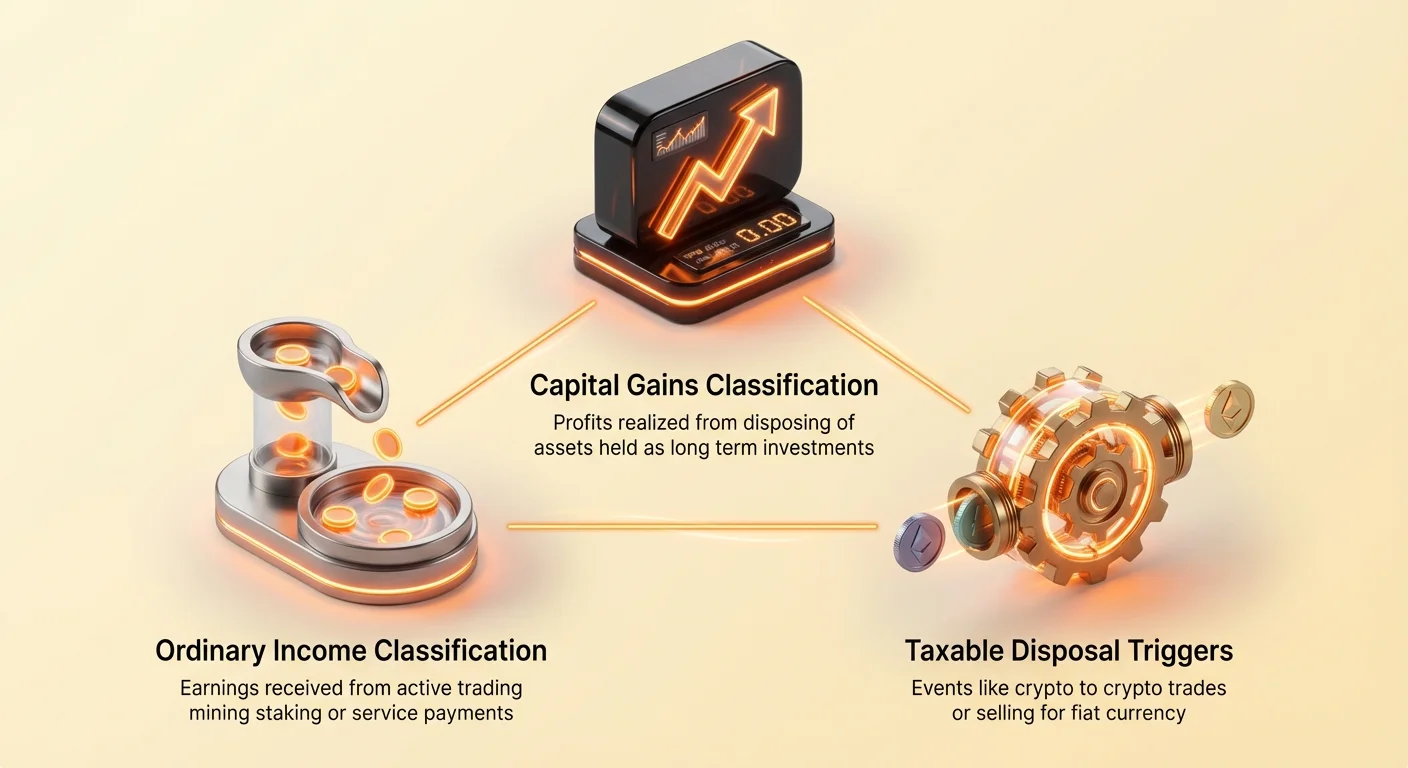
暗号資産課税の基礎:資本 vs. 所得
根本的に、すべての暗号資産課税は分類の問題にかかっています。あなたの活動は投資(キャピタルゲインにつながる)と見なされるか、それとも事業/サービス報酬(通常の所得につながる)と見なされるか?詳細は世界的に異なりますが、概念的な違いは常に一定です。
投資家 vs. トレーダー:意図と頻度の定義
世界中の税制は、資産を時折買って保有する個人(投資家)と、市場変動から利益を得ることを主目的として高頻度取引を行う個人(トレーダーまたは事業)を区別します。
投資家(キャピタルゲイン): 投資家は通常、資産を長期的な値上がりを見込んで保有することを意図して購入します。彼らの取引はまれで、主な収入源は通常暗号資産活動とは別です。投資家にとって、暗号資産を購入する行為は課税対象イベントではありません。課税の引き金は資産が処分された時のみ発生します。つまり、法定通貨で売却したり、他の暗号資産と交換したり、商品やサービスを購入するために使用したりした場合です。処分時の実現利益は一般的にキャピタルゲイン税の対象となります。
トレーダー/事業(所得): 個人の暗号資産活動が一定の基準を満たす場合—例えば取引量の多さ、商業的意図、短期保有期間、専門的な取引機器への依存、マーケティング活動—当局はこれを「貿易」または「事業」とみなす可能性があります。この場合、利益は通常の事業所得として扱われ、標準的な所得税率で課税され、トレーダーは所得税に加えて自営業税や給与税の支払いが求められることがあります。
多くの税制では、「Badges of Trade」(英国法で正式化された概念ですが、世界的に概念的に使用される)として知られる基準を使用して意図を判断し、頻度、組織化、利益動機などの要素を分析します。
「課税対象の処分」の定義
初心者にとって最も混乱を招く概念は、1つの暗号資産を別のもの(例:ビットコインをイーサリアムに交換)と取引することは、普遍的に課税対象イベント—しばしば「処分」と呼ばれる—と見なされる点です。
BTCをETHに交換する場合、まずBTCを「売却」し(初期コストに基づく利益または損失を実現)、次に現在の公正市場価値でETHを「購入」します。
管轄区域共通の課税対象処分:
- 暗号資産を法定通貨(USD、EUR、GBP)で売却。
- 暗号資産を別の暗号資産と交換。
- 暗号資産を商品やサービスの支払いに使用。
- 暗号資産の贈与(異なりますが、一定の閾値を超えると処分として扱われることが多い)。
- 1つのステーブルコインを別のものに変換(価値が$1から乖離する場合)。
重要な点:資産をあなたの保有から移し、新しい価値を実現する(または新しい資産と交換する)すべての取引は、基礎となる取得原価と結果の利益または損失を決定するために追跡する必要があります。
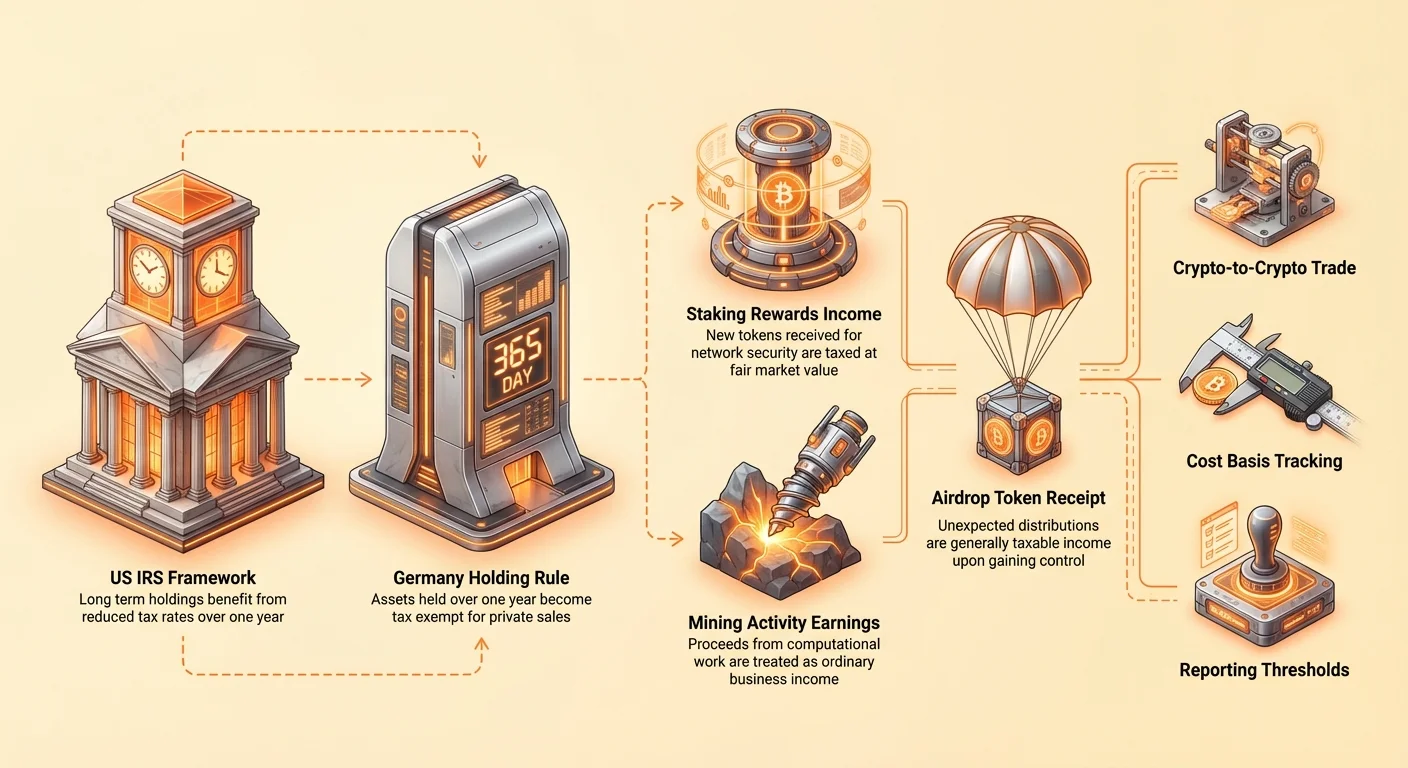
Deep Dive: The U.S. Internal Revenue Service (IRS) Framework
The U.S. approach to crypto taxation is foundational globally, primarily because the IRS classifies virtual currency as property rather than currency. This distinction dictates how capital gains are applied and defines when income is realized.
Capital Gains Treatment: Short-term vs. Long-term
The U.S. tax structure offers a significant advantage for long-term investors: reduced tax rates for assets held longer than one year.
- Short-Term Capital Gains: Applies to profits realized on assets held for 365 days or less. These gains are taxed at the taxpayer’s ordinary income tax rate, which can be as high as 37% (plus state taxes).
- Long-Term Capital Gains: Applies to profits realized on assets held for more than 365 days. These rates are typically much lower (0%, 15%, or 20%), depending on the taxpayer’s overall income bracket.
Example Use Case (IRS): A U.S. investor buys 1 BTC for $10,000.
- Scenario A (Short-Term): After 6 months, they sell the BTC for $30,000. The $20,000 gain is taxed at their ordinary income rate (e.g., 30%).
- Scenario B (Long-Term): After 14 months, they sell the BTC for $30,000. The $20,000 gain is taxed at the lower long-term capital gains rate (e.g., 15%).
Income Classification: Mining, Staking, and Services
The IRS is clear that if crypto is received as payment for services, or generated through activity that creates new economic value, it must be classified as ordinary income upon receipt.
- Mining Income: The fair market value (FMV) of the crypto received from successful mining (or transaction fees) is considered ordinary income on the day it is successfully claimed. The cost of generating that income (electricity, equipment depreciation) is deductible.
- Staking Rewards: Similar to mining, the FMV of staking rewards (new tokens generated for securing a network) is generally considered ordinary income upon receipt.
- Airdrops and Referral Rewards: If an airdrop is received without having to provide any service (a true "gift"), the IRS has historically treated it differently than an airdrop received in exchange for marketing or service. However, in most interpretations, if an airdrop or referral reward has value, its FMV is treated as ordinary income upon receipt.
Double Taxation Risk: It is vital to understand the income classification creates a dual tax liability:
- Income Tax: Paid on the FMV when the asset is received (e.g., $100 worth of ETH staking rewards).
- Capital Gains Tax: Paid later when that asset is disposed of, calculated based on the difference between the disposal price and the original income basis ($100).
Foreign Asset Reporting: FATCA and FBAR
For U.S. citizens and residents, stringent reporting requirements exist for foreign financial accounts, which can include certain crypto holdings on international exchanges. These rules apply regardless of where the individual lives.
- FBAR (Foreign Bank and Financial Accounts Report, FinCEN Form 114): Requires U.S. persons to report aggregate foreign account balances that exceed $10,000 at any point during the calendar year. While the IRS has not explicitly mandated FBAR for all non-custodial wallets, foreign centralized exchanges (CEXs) and custodial services must be reported. Failure to file can result in massive civil and criminal penalties.
- FATCA (Foreign Account Tax Compliance Act, Form 8938): Requires U.S. persons to report specified foreign financial assets if the total value exceeds high thresholds (which vary based on filing status and residency). This form includes many assets and investments not covered by FBAR, sometimes including decentralized or self-custodied assets depending on the interpretation of "financial assets."
Comparative Analysis: UK Her Majesty's Revenue and Customs (HMRC)
The UK’s tax framework treats cryptoassets as property or commodities for tax purposes, similar to the U.S., but employs unique allowances and methods for calculating gains, making it distinct from the American system.
Capital Gains Tax (CGT) Allowance and Calculation
HMRC provides a substantial tax-free annual allowance for capital gains (the Annual Exempt Amount). This means individuals can realize a specific amount of profit each year without incurring CGT liability.
Key Difference: Pooled Assets: Unlike the U.S., where Specific Identification (tracking the exact coin sold) is often the preferred method for cost basis, the UK generally requires investors to use the "Share Pooling" rule, which is akin to a complex Averaging Cost method.
Under HMRC rules, all identical crypto assets (e.g., all units of BTC) are treated as being in a single pool. When assets are sold, the cost basis is calculated by averaging the costs of all assets in that pool.
HMRC Cost Basis Hierarchy (Specific Rules apply in order):
- Same Day Rule: Assets bought and sold on the same day must match against each other first.
- Bed and Breakfasting Rule: Assets bought within 30 days after a sale must be matched against that sale. (This limits loss harvesting.)
- Section 104 Pool: Any remaining assets enter the pool, and the average cost is used for calculation.
Income Treatment and the "Badges of Trade"
HMRC uses a set of established criteria, known as the "Badges of Trade," to determine if an individual's activity constitutes a business (trade) rather than a simple investment.
If the activity is deemed a trade, the profits are subject to Income Tax and National Insurance Contributions (NIC, similar to self-employment tax).
Badges of Trade Criteria (Simplified):
- Frequency: How often are transactions performed?
- Duration of Ownership: Are assets held for years (investment) or minutes/hours (trade)?
- Organization: Is the activity carried out in a business-like manner (special accounts, dedicated website, advertising)?
- Motive: Is the main intention quick profit from price movement, or long-term growth?
HMRC is more likely to classify high-frequency, algorithm-driven trading as a business than a casual staking operation, though guidance on specific activities is constantly evolving.
Treatment of Decentralized Finance (DeFi) Activity
DeFi introduces unique complications because the underlying legal relationships are complex (is lending a loan, or a transfer of property?).
Lending and Staking:
- HMRC generally views the rewards received from staking or liquidity provision as miscellaneous income (taxable immediately upon receipt at FMV).
- However, if you transfer your principal asset to a platform (like a DeFi protocol) and regain rights to a similar asset later, HMRC may treat this as a disposal of the original asset if the transfer is considered a change in beneficial ownership. This means the investor may realize a capital gain or loss immediately upon entering the DeFi protocol, followed by income tax on the rewards received later. This makes accurate tracking of DeFi collateral transfers critically important under UK law.
The Australian Taxation Office (ATO) Model
Australia offers a comparatively clear, though detailed, framework, notable for its explicit "personal use asset" exemption and robust definition of when crypto constitutes a business venture.
Personal Use Exemption: The ATO's Unique Feature
The Australian Taxation Office (ATO) provides a substantial benefit for hobbyists: the Personal Use Asset exemption.
Cryptocurrency acquired and used primarily to purchase goods or services—and not for the purpose of profit generation—may be classified as a personal use asset. Crucially, if the cost base (original purchase price) of the asset is $10,000 AUD or less, any gain realized upon disposal is exempt from Capital Gains Tax (CGT).
Conditions for Personal Use Exemption:
- The asset must be used or intended for personal consumption (e.g., buying a coffee, paying for online services).
- It must not be part of a trading or investment scheme.
- If a loss is realized on a personal use asset, that loss is generally non-deductible.
This exemption provides welcome relief for crypto users who engage in small, everyday transactions but are not trading for profit.
Hobbyist vs. Trader vs. Business: Classification Clarity
The ATO provides clear guidelines to differentiate between investment activities (subject to CGT) and business activities (subject to income tax).
1. Hobbyist/Investor:
- Transactions are infrequent and opportunistic.
- Assets are generally held for long periods.
- Profits are subject to CGT, with a valuable 50% CGT discount available if the asset is held for more than 12 months. This is Australia's equivalent of the U.S. long-term capital gains break.
2. Crypto Business/Trader:
- The activity is conducted in a professional, systematic, and repetitive manner.
- The main intention is continuous profit from market fluctuation.
- Profits are taxed as ordinary business income, but the trader can claim business-related deductions (e.g., subscription fees, software, specialized hardware). Importantly, losses incurred in a crypto business may be offset against other income streams.
Classification of Non-Fungible Tokens (NFTs)
The ATO has issued specific guidance on NFTs, generally classifying them like other crypto assets, but their tax treatment is heavily dependent on their function:
- NFTs as Personal Use Assets: If an NFT is acquired purely for personal enjoyment (e.g., digital art for private viewing) and the cost is under $10,000 AUD, the personal use exemption may apply.
- NFTs as Investment Assets: If the NFT is held primarily for expected future appreciation (flipping), it is subject to standard CGT rules upon disposal.
- NFTs as Trading Stock: If a business creates, mints, and sells large volumes of NFTs in a sustained commercial manner, the profits are taxed as ordinary income.
欧州連合の暗号資産税制の全体像を把握する
欧州連合には単一の統一された暗号資産税法はありません。課税は個々の加盟国レベルで管理されており、大きなばらつきが生じています。しかし、特定の国々は独自の投資家に優しい、あるいは歴史的に厳格な制度により、認められたベンチマークとなっています。
ドイツの保有期間優位性: 1年ルール
ドイツは、世界で最も有利な暗号資産税制の一つとして知られており、重要な保有期間免税を中心に据えています。
個人売却免税(非事業): ドイツ居住者が暗号資産を12ヶ月以上(1年と1日)保有した場合、実現したキャピタルゲインは完全に非課税となります。これは、G7主要国で見られる長期保有(HODLing)の最も強いインセンティブの一つです。
- 短期利益: 1年保有期間内に実現した利益は、個人の通常所得税率で課税されます。
- ステーキングおよびレンディングの例外: ステーキングやレンディング活動に使用された資産は、特定の州の解釈によっては、税免除保有期間が1年から10年に延長される場合があります。これは専門家の助言を要する重要なニュアンスです。
閾値: 短期利益に対して少額の非課税閾値(年間€600)が存在しますが、これは他の個人売却と合算されることが多いです。
ポルトガルの最近の変化: ゼロ税から特定課税へ
歴史的に、ポルトガルは「暗号資産税の避難所」として有名でした。2023年1月まで、暗号資産取引は職業的または事業活動を構成しない限り、一般的に課税されませんでした。この状況は根本的に変わりました。
2023年税制改革: ポルトガルは現在、キャピタルゲインと所得の区別を正式化した構造を導入しています:
- 短期キャピタルゲイン(保有<365日): 1年未満保有の資産からの利益は、28%の固定税率で課税されます。
- 長期免税(保有>365日): ドイツと同様、1年以上保有した資産からの利益はキャピタルゲイン税から免除されます。これにより、長期投資への強いインセンティブが維持されます。
- 所得分類: マイニング、ステーキング、プロトレーダーの資産売却は通常所得として課税され、標準的な累進所得税率が適用されます。
この変化は世界的な傾向を強調しています: 初期の規制曖昧さが、長期保有を奨励しつつ取引活動から即時収入を生む正式な構造に置き換えられています。
MiCAと将来の調和化努力
欧州連合の暗号資産市場規制(MiCA)は、2024/2025年に全面施行予定で、EU全域で暗号資産の発行、取引、サービス提供に関する調和した規制枠組みを目指しています。
MiCAは主にライセンス、消費者保護、運用基準(AML/KYC)に焦点を当てていますが、間接的に税制の調和化への道を開きます。発行者、提供者、取引所活動の定義を標準化することで、加盟国が共有税務報告基準や潜在的な義務的なデータ共有で合意しやすくし、国間での規制裁定の可能性を低減します。
特殊な課税対象イベント:フォーク、エアドロップ、およびマイニング
特定の暗号資産イベント—対応する取引なしに資産を受け取るもの—は、世界中の税務当局に独自の課題を投げかけています。主要な難しさは、取得原価の確立と実現タイミングです。
エアドロップとハードフォーク:いつ実現所得か?
エアドロップとハードフォークは、新しい暗号資産を、しばしば予期せず受け取るものです。
エアドロップ: エアドロップは、既存の保有者へのトークン配布で、しばしばプロモーションやガバナンス目的です。
- 普遍的な分類: 世界的な標準(IRS、HMRC、ATO)は、受け取ったトークンの公正市場価値(FMV)が、受け取り時点で納税者の支配下に置かれた時点で、普通所得とみなされます。
- 取得原価: そのFMV(所得として記録された金額)が、将来のキャピタルゲイン計算の取得原価となります。
例: 100トークンのエアドロップを受け取ります。受け取り時点でFMVは1トークンあたり1ドルです。100ドルの所得を記録します。後でトークンを500ドルで売却した場合、キャピタルゲインは400ドル(500ドルの売却額 - 100ドルの原価)です。
ハードフォーク: ハードフォークは、ブロックチェーンが分岐する場合(例:BitcoinとBitcoin Cash)です。元のコインを保有していれば、通常新しいコインの同等量を保有することになります。
- 米国IRSの見解: 課税所得は、納税者が新しい資産に対して支配と管理を行使した時点(すなわち移動または支出した時点)で実現します。所得額は、その支配行使時点のFMVです。
- HMRC/ATOの見解: 通常、何も対価を支払わずに新しい資産を受け取り、サービスに対する報酬でない場合、即時所得とはみなされません。代わりに、ATOは新しいコインの取得原価を当初ゼロとし、後日の売却額全額をキャピタルゲインとして扱うことを示唆しています。
フォークに関する明確で統一されたグローバルな合意がないため、記録保持が重要で、正確な受領時刻と従う特定の規制指導を記録してください。
ステーキング報酬とバリデータ所得
ステーキングは、資産をロックしてProof-of-Stakeネットワークを保護し、バリデータに報酬を生み出します。
- 所得タイミング: 当局はステーキング報酬を普通所得とみなす点でほぼ一致しています。ただし、いつその所得が実現するかのタイミングは異なります:
- 米国(IRS): 一般的には受領時—報酬が納税者に利用可能になった時点で実現します。プロトコル内でロックされたままでも同様です。
- 一部の提案代替案(米国): 一部のロビー団体は、所得はアンステーキングし完全な支配を達成した時点でのみ実現すべきと主張しており、それまでは報酬が保証されていないとしています。(説得力があるものの、現在のIRS指導ではありません)。
- ドイツ: 元のステーク資産の保有期間は10年に延長される可能性がありますが、ステーキング報酬自体は受領時に所得として課税されます。
貸付および流動性プール課税
流動性提供(LPトークン)や暗号資産貸付は、資産をスマートコントラクトやプラットフォームに移転します。
1. 移転は処分か? これが主な分類課題です。
- 税務当局がBTCをDeFiプールに移転することを、LPトークン(新資産)と交換した所有権移転と見なせば、BTCに対して即時課税対象処分が発生します。
- 当局が移転を単なる貸付と見なし、貸主に実益所有権が残るとすれば、処分は発生せず、受け取った利息/手数料のみが所得として扱われます。
HMRCは複雑なDeFi手配でしばしば「処分」見解を採用しますが、IRSはまだ具体的な指導を策定中で、納税者は特定の契約条件を分析する必要があります。
2. 報酬(利回り)の課税: 貸付および流動性提供から生じる利息、手数料、または利回りは、受領時のFMVで普通所得として普遍的に扱われます。
グローバルコンプライアンスと報告メカニズム
コンプライアンスはルールを知るだけでは不十分です。体系的な記録保持と国際的な開示法の知識が求められます。
国別閾値と報告基準
税務当局は、最低閾値を使用して誰が申告義務を負い、どのような情報を開示する必要があるかを決定します。
| 管轄区域 | 最小報告閾値(概算) | 主な報告書式/要件 |
|---|---|---|
| 米国(IRS) | 規模に関わらず、すべての利益を報告する必要があります。 | Form 8949(売却および処分)、Schedule D(キャピタルゲイン/損失)。 |
| 米国(国際) | 外国口座の合計残高が$10,000超。 | FBAR(FinCEN 114)およびFATCA(Form 8938)の可能性。 |
| 英国(HMRC) | 年間免除額(非課税利益)。利益が免除額の4倍を超える場合に報告が必要です。 | CGT Summary Pages、Self Assessment Tax Return。 |
| オーストラリア(ATO) | 規模に関わらず、すべての利益を報告する必要があります。個人使用免除はAUD $10,000まで適用。 | 所得税申告書のキャピタルゲインセクション。 |
| ドイツ | 短期利益の€600閾値。 | Anlage SO(その他の所得)。 |
注: 英国やドイツでキャピタルゲインが非課税免除額未満であっても、総売却額が税務当局の定めるより高い特定閾値を超える場合、取引を報告する必要があります。
国境を越えた報告:海外在住の米国市民
米国市民は全世界課税の対象であり、居住地に関わらず全世界所得をIRSに報告する必要があります。これにより、海外在住の米国人が現地の外国取引所で取引する場合に極めて複雑な状況が生じます。
救済のための主なメカニズム:
- 外国稼得所得排除(FEIE): 稼得所得(事業/マイニング所得など)の部分を排除しますが、通常キャピタルゲインには適用されません。
- 外国税額控除(FTC): 米国市民が外国で支払った所得税のクレジットを受け取れ、外国と米国による二重課税の影響を緩和します。これは外国の税率が米国より低い場合に特に重要です。
これらの個人にとって、外国報告要件(FBAR/FATCA)は標準の米国税務申告書提出に加えて必要であり、二国間税務計画が不可欠です。
税務ソフトウェアと調整の役割
暗号通貨取引の手動追跡は、数回の取引後には不可能になります。特にDeFiの複雑さと暗号通貨間の処分ルールによりです。
現代の暗号通貨税務ソフトウェア(例: 元資料で言及されたKoinlyやCryptoTaxCalculatorなど)は、もはや贅沢品ではなく、コンプライアンスのための必須ツールです。
税務ソフトウェアに必要な主な機能:
- 管轄区域サポート: 税務当局の特定ルールを使用して利益を計算する必要があります(例: HMRCのプーリング vs. IRSのFIFO/LIFO/Specific ID)。
- DeFiおよびNFT統合: 流動性プールやスマートコントラクトへの送金/送出を正確に分類し、貸付、処分、利回り所得を区別する必要があります。
- 原価基準方法: 承認された原価基準方法(FIFO、LIFO、Specific Identification)を選択し、一貫して適用できる必要があります。
- 書式生成: 必要な公式税務書式(例: IRS Form 8949または英国CGTスケジュール)を生成する必要があります。
監査準備のベストプラクティス
税務監査に対する主な防御は、包括的な記録保持と一貫性です。税務当局は選択した方法(例: FIFO vs. LIFO)自体よりも、その方法が一貫して適用され、明確な証拠で裏付けられているかどうかに重点を置きます。
実践的な記録保持のヒント:
- FMVを記録: すべての所得発生イベント(ステーキング、マイニング、エアドロップ)について、受領時点での暗号通貨の公正市場価値を現地フィアット通貨で記録します。
- 取引ログを維持: 使用したすべての中央集権型取引所、P2Pプラットフォーム、DeFiプロトコルから包括的なCSVログをダウンロードし、アーカイブします。
- 意図を文書化: 本格的な取引事業を運営する場合、事業控除を正当化するための事業運営を証明する記録(例: 別口座の銀行口座、事業登録)を維持します。
- 送金をタイムスタンプ: ウォレット間の内部送金を明確にラベル付けし、課税対象の売却や処分と誤認されないようにします。
結論
デジタル資産革命はグローバルファイナンスの新時代をもたらしましたが、税務コンプライアンスの義務を排除したわけではありません。キャピタルゲインと普通所得の分類の区別を理解することが、規制遵守の基盤です。
これまで見てきたように、米国では暗号資産を財産として扱い、保有期間に基づくキャピタルゲインの優遇措置があります;英国は独自のプーリングルールと年間免除額を採用;ドイツのような国々は長期保有に対する強力なインセンティブを提供しています。これらの違いは、実務家が自らの管轄区域および個々の活動に特化した指導を求める必要性を強調しています—カジュアルな投資家、高頻度トレーダー、DeFi参加者であれ。
暗号資産分野における戦略的な資産管理は、戦略的な税務管理と本質的に結びついています。綿密な記録を維持し、管轄区域の優位性(長期保有免除など)を活用し、原価基準手法を一貫して適用することで、個人はこれらの複雑なグローバルな暗号資産税制を効果的に乗り切り、デジタル経済における持続可能な自己主権への道を切り開くことができます。