
Decentralized networks operate on a fundamental premise that differs significantly from traditional web services. In the centralized world, a company pays for the servers, electricity, and maintenance required to run an application. Users typically access these services for free or via a monthly subscription, oblivious to the computational costs occurring in the background. Blockchain technology flips this model entirely. In this ecosystem, the user pays directly for the shared computational resources they consume.
Every action performed on a blockchain, from a simple currency transfer to a complex financial agreement, requires a specific amount of work from the network. This work is not infinite, nor is it free. To maintain security and prevent abuse, networks impose a cost that scales with the difficulty of the task. This mechanism ensures that resources are allocated efficiently among millions of competing users.
Understanding this cost structure is essential for anyone interacting with digital assets. It is not merely a transaction fee in the banking sense, which is often a flat rate for service. It is a precise calculation of computational effort. This system creates a dynamic market where the price of participation fluctuates based on demand, network traffic, and the complexity of the request.
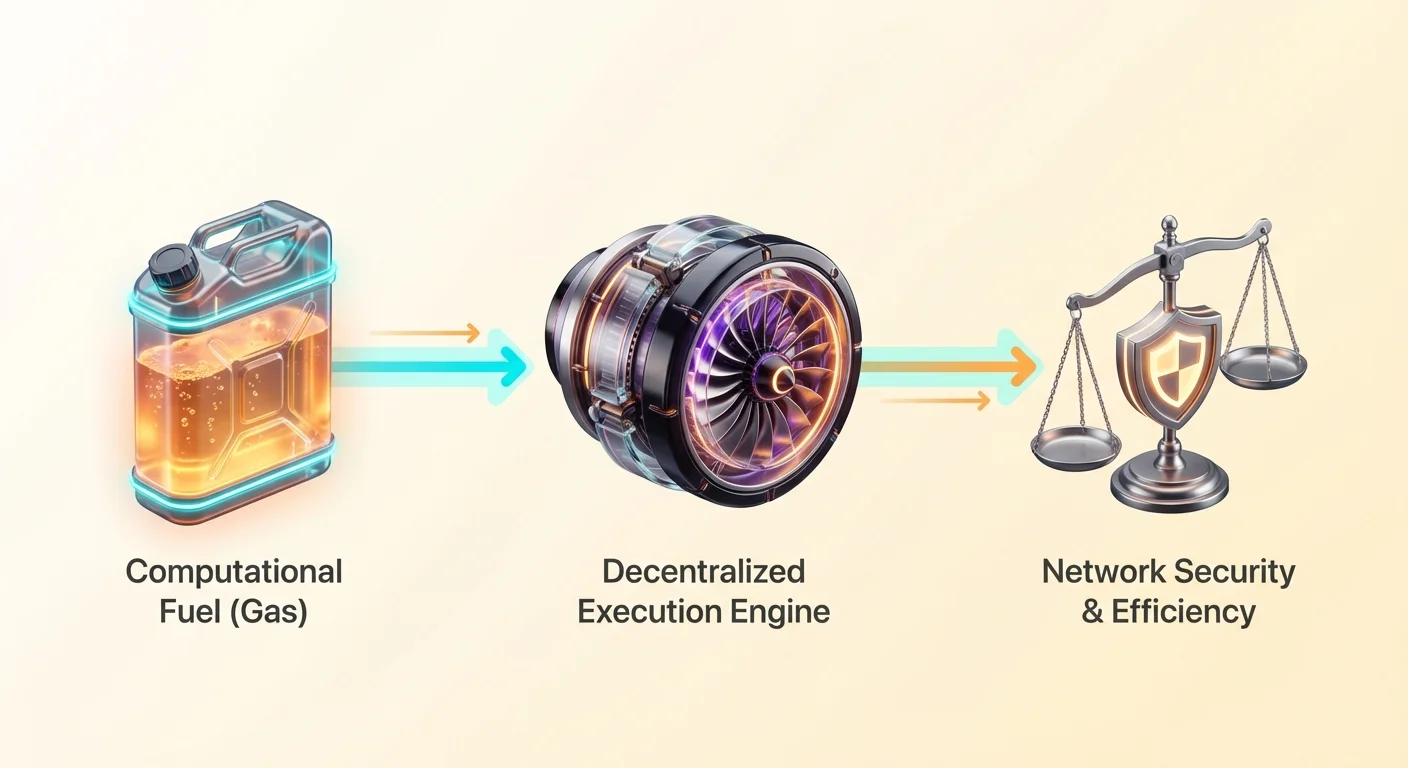
The Concept of Computational Fuel
The term "gas" is frequently used to describe these fees, particularly within the Ethereum ecosystem and compatible networks. The analogy is apt. Just as a vehicle requires a specific amount of fuel to travel from point A to point B, a transaction requires a specific amount of gas to move from initiation to completion. The distance the car travels is comparable to the computational complexity of the transaction.
Gas is a unit of measurement. It quantifies the computational effort required to execute a specific operation. It is distinct from the cryptocurrency itself. For example, on the Ethereum network, gas measures the work, while Ether (ETH) is the currency used to pay for that work. This separation is critical because the amount of work to send a token remains constant, even if the price of the currency fluctuates wildly.
If a standard transfer requires 21,000 units of gas, that requirement remains static regardless of the market value of the underlying asset. However, the price users are willing to pay for each unit of gas changes based on market conditions. This split allows the system to calculate technical requirements objectively while allowing the economic cost to adjust to supply and demand.
The Ethereum Virtual Machine (EVM)
To understand why fees vary, one must understand the engine that processes these transactions. The Ethereum Virtual Machine, or EVM execution layer, is the runtime environment for smart contracts. It is a Turing-complete virtual machine, meaning it can theoretically execute any computer program given enough resources. The EVM interprets bytecode, which is the compiled language of smart contracts.
Every operation in the EVM has a specific cost associated with it. Basic operations, like adding two numbers, are relatively cheap. Complex operations, such as storing data permanently on the blockchain or checking a cryptographic signature, are expensive. When a user initiates a transaction, they are essentially asking the EVM to run a specific script.
The miners or validators who run the EVM on their local hardware must expend electricity and hardware resources to execute these scripts. If there were no cost associated with these operations, a malicious actor could create a program that runs an infinite loop. This would clog the network and halt all legitimate activity.
By assigning a gas cost to every instruction, the network solves the "halting problem." If a program runs for too long, it simply runs out of the gas provided by the user and terminates. This mechanism protects the network from spam and infinite loops while ensuring that validators are compensated for their work.
Deconstructing the Fee Equation
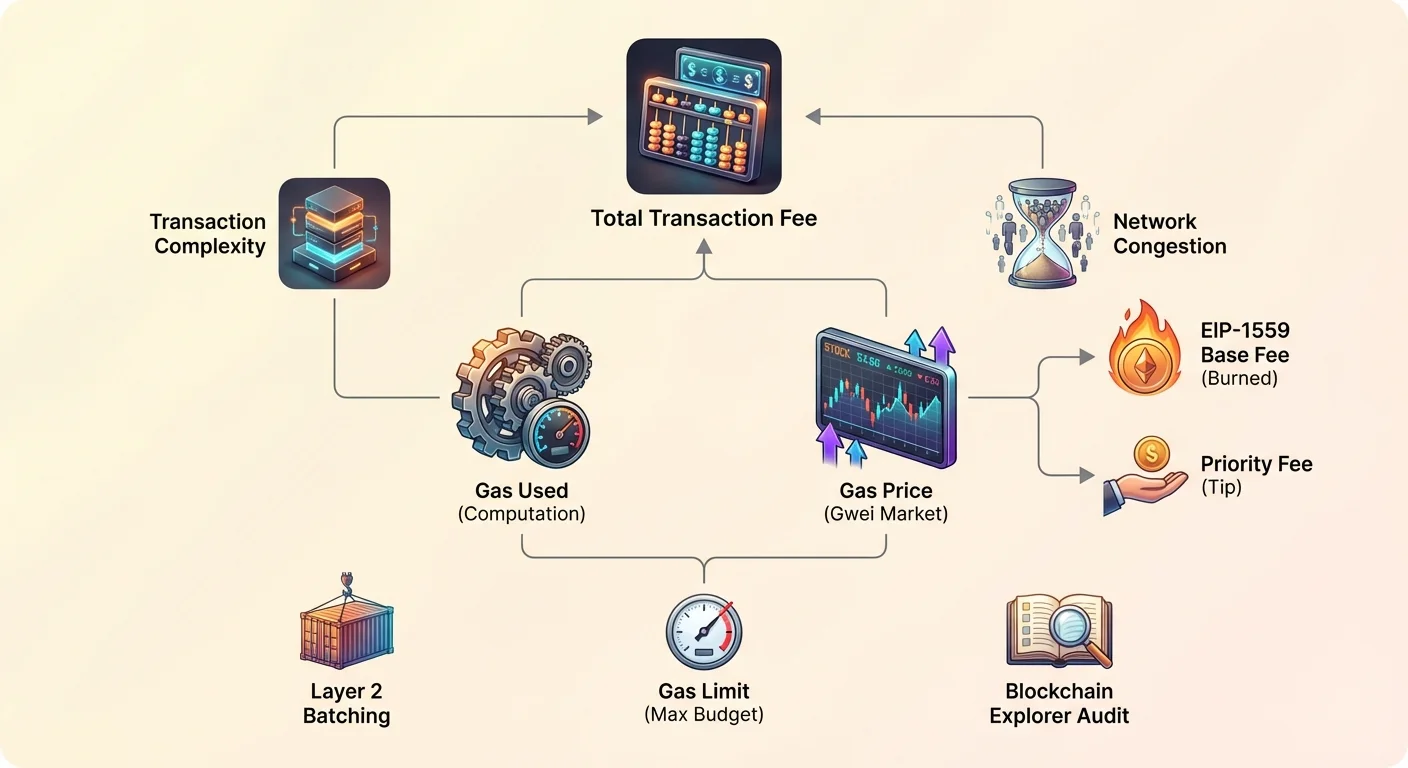
The total cost of a transaction is not a random number. It is the result of a specific formula. The total fee is calculated by multiplying the Gas Used by the Gas Price. The Gas Used represents the quantity of work, while the Gas Price represents the cost per unit of work.
| Component | Definition | Function |
|---|---|---|
| Gas Limit | Maximum fuel allowed | Prevents runaway costs |
| Gas Used | Actual fuel consumed | Measures computational steps |
| Gas Price | Cost per unit (in Gwei) | Determines transaction priority |
Users must specify a "Gas Limit" when initiating a transaction. This is the maximum amount of gas the user is willing to consume. If the transaction uses less than the limit, the remaining gas is refunded. However, if the transaction hits the limit before completing, the operation fails. In this scenario, the user still pays for the work done up to that point, as the network still had to process those computations.
The Gas Price is typically denominated in "gwei." One gwei is equal to 0.000000001 ETH. Using gwei makes the numbers more human-readable. Instead of saying a gas price is 0.000000020 ETH, a user can simply say "20 gwei." This distinct unit helps prevent decimal errors when calculating costs manually.
Complexity and Data Storage
Not all transactions are created equal. The variation in fees is primarily driven by the complexity of the interaction and the amount of data involved. A simple transfer of cryptocurrency from one wallet to another is the most basic operation. It involves changing the balance of two accounts in the ledger. This requires minimal computational power and no interaction with complex code.
In contrast, interacting with a Decentralized Finance (DeFi) protocol involves multiple steps. When swapping tokens on a decentralized exchange, the transaction must interact with a smart contract. It calculates the exchange rate, updates liquidity pool balances, and potentially routes the trade through multiple pools. Each of these steps consumes gas.
Minting a Non-Fungible Token (NFT) is often the most expensive operation. This process involves writing new data to the blockchain. Storage is the most scarce resource on a decentralized ledger because every node in the network must replicate that data forever. Therefore, operations that increase the size of the blockchain state incur significantly higher fees than temporary computational steps.
The Impact of EIP-1559
In August 2021, the Ethereum network underwent a significant upgrade known as EIP-1559. This change overhauled how gas fees are calculated and paid. Previously, the fee system operated strictly as an auction, which led to high volatility and unpredictability. EIP-1559 introduced the concept of a "Base Fee."
The Base Fee is a mandatory charge required to include a transaction in a block. This fee adjusts mathematically block-by-block based on network demand. If the previous block was full, the Base Fee increases. If it was empty, the fee decreases. Crucially, this Base Fee is "burned," or permanently removed from circulation, rather than being paid to validators.
To incentivize validators to prioritize their specific transaction, users add a "Priority Fee," often called a tip. In times of extreme congestion, the Base Fee spikes to discourage demand, while wealthy users may increase their Priority Fee to skip the line. This system provides better predictability for users, as the Base Fee is known in advance, unlike the blind auction model of the past.
Network Congestion and Market Dynamics
The blockchain has a limit on how many transactions can fit into a single block. This scarcity creates a competitive marketplace for "block space." When the network is quiet, block space is abundant, and fees are low. Users can pay the minimum required Base Fee and a small tip, and their transaction will likely be processed in the next block.
However, during periods of high activity—such as a popular NFT launch or a sudden market crash—demand for block space exceeds supply. Thousands of users attempt to broadcast transactions simultaneously. Since validators are profit-driven entities, they naturally select the transactions that offer the highest fees.
This dynamic forces users to outbid each other to get their transactions confirmed. Wallets often attempt to estimate the necessary fee to ensure timely confirmation, but in a rapidly moving market, these estimates can lag. This can result in stuck transactions, where the offered fee is too low to be attractive to validators, leaving the transaction in a pending state until fees drop or the user replaces it with a higher bid.
Understanding Transaction Confirmations
Once a transaction is included in a block, it receives its first "confirmation." A confirmation signifies that the network has accepted the block containing the transaction and added it to the chain. This is a critical moment in the lifecycle of a transaction, marking the transition from a pending request to a recorded fact.
However, a single confirmation is rarely considered finality. As subsequent blocks are added to the chain, the transaction receives more confirmations. Each new block buries the transaction deeper into the ledger's history. This accumulation of blocks makes the transaction increasingly difficult to reverse or alter.
For high-value transfers, recipients often require multiple confirmations before considering the funds secure. This practice mitigates the risk of "chain reorganizations," where a competing version of the blockchain temporarily overrides the current one. While rare, these events can technically reverse the most recent blocks. Waiting for six to thirty confirmations, depending on the specific network, creates a statistical near-certainty of permanence.
Layer 2 Scaling Solutions
The inherent limits of Layer 1 blockchains—the main networks like Bitcoin and Ethereum—have led to the development of Layer 2 solutions. These are secondary frameworks built on top of the main chain. Their primary goal is to increase transaction throughput and reduce costs without sacrificing the security of the base layer.
Layer 2s operate by processing transactions off the main chain. They bundle hundreds or thousands of individual transfers into a single batch. This batch is then compressed and submitted to the Layer 1 blockchain as a single transaction. By splitting the Layer 1 gas fee among thousands of users, the individual cost drops dramatically.
There are different types of Layer 2 technologies, such as Optimistic Rollups and Zero-Knowledge (ZK) Rollups. While they function differently technically, the economic result for the user is similar: significantly lower gas fees. The computational heavy lifting is done outside the expensive environment of the main chain, while the final proof of validity is stored securely on Layer 1.
The Role of Consensus Mechanisms
The method a blockchain uses to reach agreement, known as the consensus mechanism, also influences the fee structure. Proof of Work (PoW) and Proof of Stake (PoS) are the two dominant models. In PoW, miners expend vast amounts of energy to solve puzzles, and fees compensate them for this hardware expense.
In Proof of Stake, utilized by networks like Ethereum (post-merge) and Solana, validators are chosen based on the assets they have locked up, or "staked," as collateral. This eliminates the massive energy costs associated with mining. While this makes the network more environmentally friendly, it does not automatically make transactions free.
Validators in a PoS system still require incentives to process transactions and maintain the ledger. They face risks, such as "slashing," where they can lose their staked funds if they act maliciously or fail to maintain uptime. Transaction fees provide the revenue stream that rewards honest participation and covers the operational costs of running a validator node.
Setting Fees in Self-Custodial Wallets
One of the defining features of self-custodial wallets is the ability to customize transaction fees. Unlike centralized exchanges, which often charge a flat withdrawal fee to cover their overhead and generate profit, a self-custodial wallet allows the user to interact directly with the blockchain's fee market.
Most modern wallets offer simplified settings to manage this complexity. Users can typically choose between options like "Slow," "Average," and "Fast." These presets automatically calculate a gas price based on current network conditions. A "Fast" setting sets a higher gas price to ensure inclusion in the very next block, usually confirming in under a few minutes.
An "Eco" or "Slow" setting sets a lower price. This signals that the user is willing to wait for a dip in network activity. If the network is currently congested, a low-fee transaction might sit in the memory pool (mempool) for hours. This option is ideal for non-urgent tasks, such as consolidating balances or interacting with a contract where timing is not critical.
Advanced Fee Customization
For experienced users, custom fee settings provide granular control. This is particularly useful during high-stakes interactions like minting a highly anticipated NFT or saving a collateralized debt position from liquidation in DeFi. In these scenarios, relying on automated estimates might result in a failed transaction if prices spike suddenly.
Users can manually set the Gas Limit and the Max Priority Fee. However, tampering with the Gas Limit is risky. If a user sets the limit too low in an attempt to save money, the transaction will run out of gas halfway through execution. The network will revert the changes, but the validator still keeps the fee for the work performed.
This creates a scenario where a user loses money with nothing to show for it. Therefore, best practices suggest leaving the Gas Limit as estimated by the wallet, which usually adds a safety buffer, and only adjusting the Gas Price or Priority Fee. This ensures the transaction has enough fuel to finish while allowing the user to control the price they pay for that fuel.
Transparency Through Blockchain Explorers
The abstract nature of gas and fees is made concrete through the use of blockchain explorers. These tools act as search engines for the blockchain ledger. They provide absolute transparency into the costs and status of every transaction. By entering a transaction hash or wallet address, anyone can view the specific details of an interaction.
Explorers reveal the difference between the estimated cost and the actual cost. Often, a wallet will estimate a high Gas Limit to be safe, but the actual execution uses less. The explorer shows the "Gas Used by Transaction," allowing users to audit the efficiency of the smart contracts they interact with.
These platforms also serve as vital tools for troubleshooting. If a transaction is taking too long, an explorer can show its status in the memory pool and the estimated time to confirmation based on the fee paid. If a transaction fails, the explorer often provides an error message explaining why, such as "Out of Gas" or "Reverted," giving the user the information needed to correct the mistake.
The Future of Transaction Costs
As the ecosystem matures, the volatility and complexity of gas fees remain a barrier to entry for mainstream adoption. Developers are actively working on solutions to abstract these costs away from the end-user. Concepts like "account abstraction" allow applications to sponsor gas fees for their users, effectively making the blockchain invisible.
Furthermore, the proliferation of Layer 2 solutions is creating a landscape where low-cost transactions are the norm rather than the exception. By moving the bulk of computation off the main chain, these networks are successfully decoupling the security of the blockchain from the cost of using it.
Ultimately, the unit of computation represents the true value of a decentralized network. It is the price of trust, security, and immutability. While the mechanisms for calculating and paying these fees will continue to evolve, the fundamental principle—that decentralized resources have a value that must be compensated—will remain central to the architecture of Web3.
Conclusion
The mechanics of gas and transaction fees serve as the regulatory heartbeat of decentralized networks. By assigning a tangible cost to computational effort, blockchains prevent spam, allocate scarce resources, and incentivize the validators who secure the ledger. While the terminology of gwei, gas limits, and priority fees can seem daunting, they represent a sophisticated market mechanism that balances network security with user demand.
As the technology advances through Layer 2 scaling and protocol upgrades like EIP-1559, the user experience surrounding these costs continues to improve. Understanding these components empowers users to transact more efficiently, avoid failed operations, and navigate the crypto economy with confidence. The shift from blind fee payment to strategic resource management is a key step in mastering digital asset ownership.
Fees are not just a cost of doing business; they are the fuel that keeps the decentralized engine secure, efficient, and operational.