
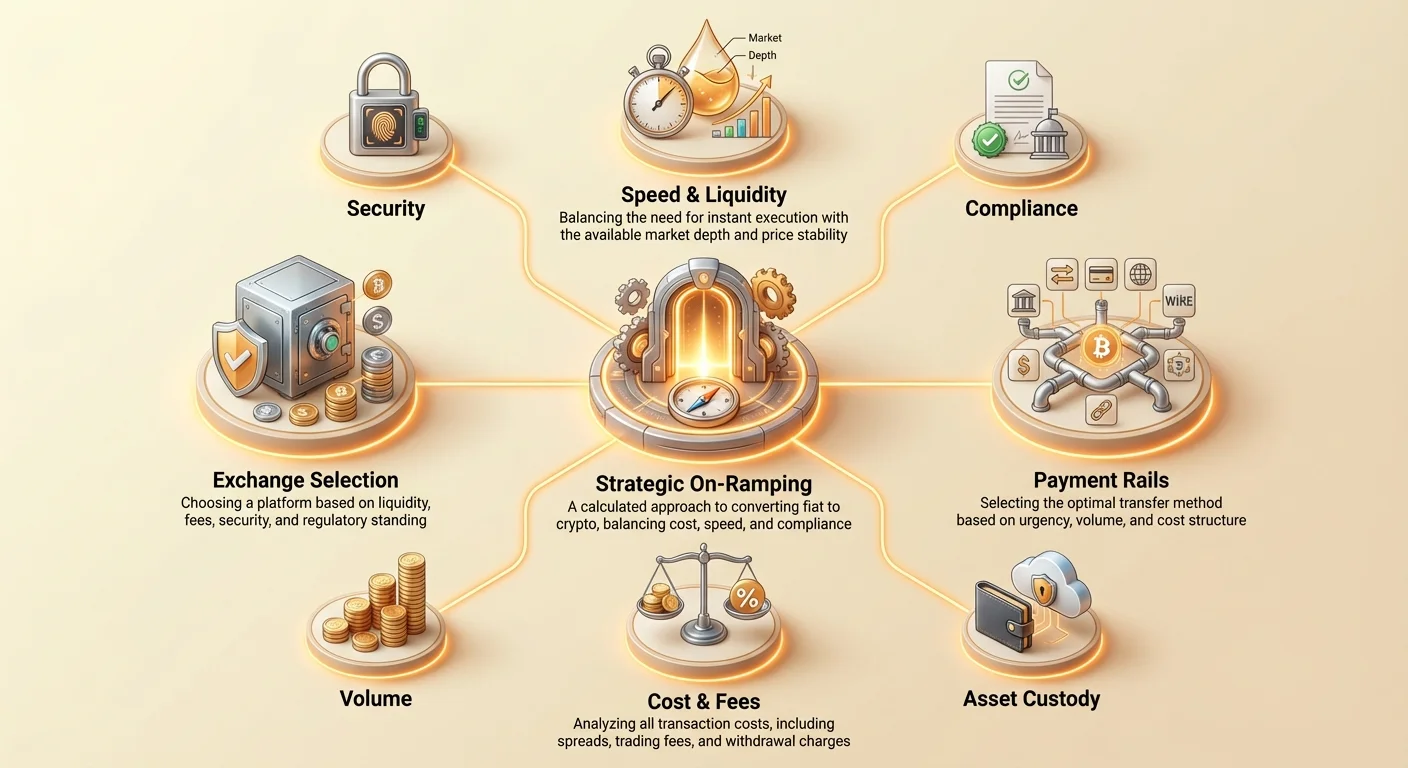
Put u gospodarstvo digitalnih imovina počinje kritičnim procesom poznatim kao on-ramping — sigurnom i učinkovitom pretvorbom tradicionalne fiat valute (kao USD, EUR ili GBP) u kriptovalutu. Za novake je uobičajeni cilj samo steći imovinu. Međutim, za one koji žele izgraditi trajnu samodostatnost i strateški upravljati svojim digitalnim bogatstvom, fokus se mora pomaknuti s pukog izvođenja na čistu optimizaciju.
Svaki dolar potrošen na naknade, spreadove i skrivene troškove transakcija je dolar koji ne radi za vas u vašem portfelju. Ovi mali postoci, često otpušteni kao „trošak poslovanja“, brzo se gomilaju, značajno erodirajući kapital, posebice kod čestih transakcija ili velikih količina. Ovladavanje on-rampom je stoga prvi ključni korak u strateškom upravljanju imovinom.
Ovaj vodič pruža putokaz za srednje praktičare za navigaciju kroz pejzaž centraliziranih burzi, analizu učinkovitosti različitih plaćarskih šina (ACH, wire, kartica) i izgradnju strategije minimizirane troškova koja optimizira brzinu, usklađenost i na kraju, početnu vrijednost vašeg portfelja.
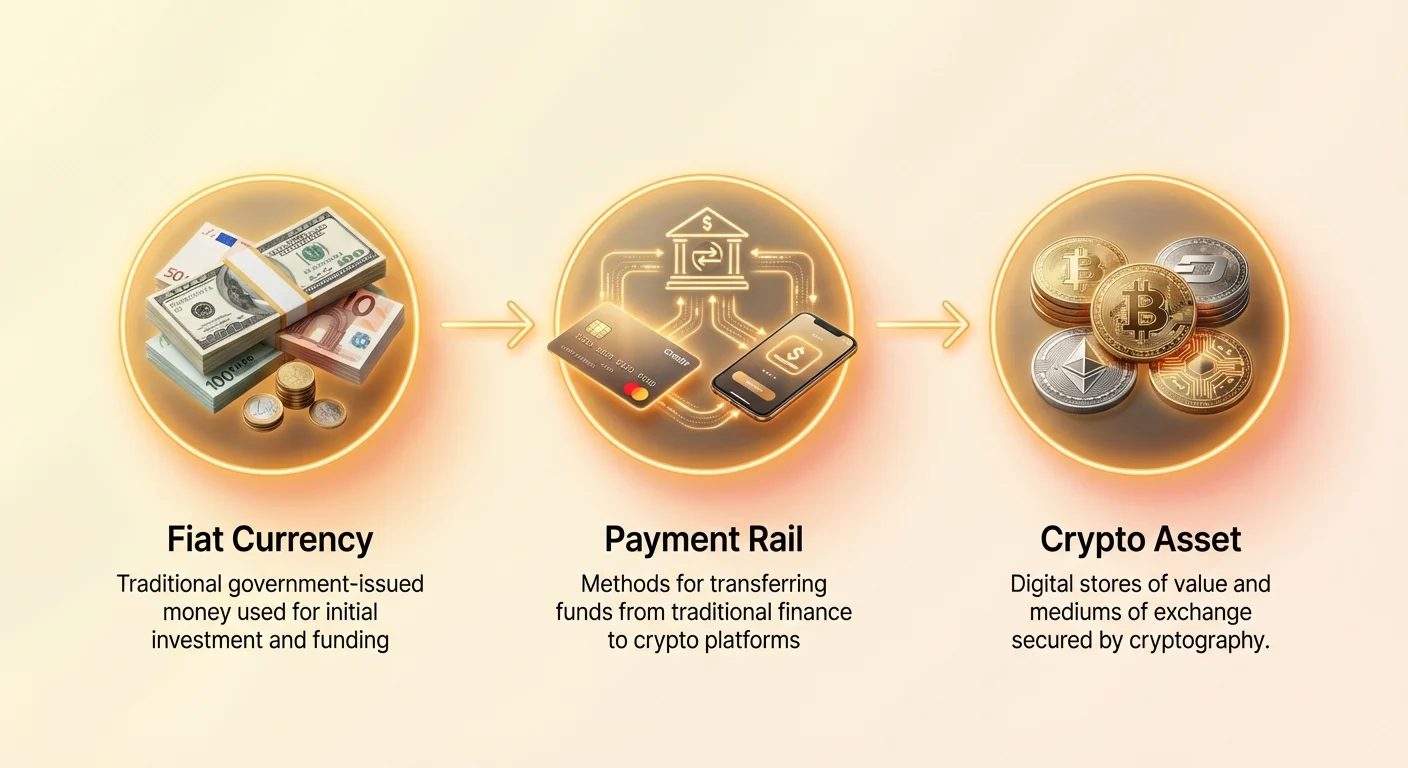
1. The Foundation: Centralized Exchange (CEX) Selection
Your choice of Centralized Exchange (CEX) is the primary determinant of your fees, speed, and overall asset security. While many beginners gravitate toward the platform with the cleanest mobile app, strategic users prioritize liquidity, regulatory compliance, and most importantly, the fee schedule.
Key Factors Beyond User Interface
While ease of use is important, high-volume traders and long-term investors must evaluate a CEX based on its structural advantages, not just its aesthetics.
Liquidity and Spreads: Liquidity refers to how easily an asset can be bought or sold without significantly affecting its price. High-liquidity exchanges allow for tighter spreads—the difference between the highest buy order and the lowest sell order. When you buy crypto using a simple "instant purchase" button, you are often paying the spread, which acts as an invisible, untracked fee. Exchanges with deep order books and high trading volumes inherently offer better pricing and tighter spreads, making them generally more cost-efficient for large transactions.
Regulatory Status and Jurisdiction: The CEX must operate under a stable and recognized regulatory framework in your jurisdiction (e.g., FinCEN registration in the US or similar licensing in Europe). A regulated exchange offers better security guarantees, consumer protection, and ensures smoother banking integrations. Attempting to use an unregulated international platform might offer lower trading fees, but it introduces significant jurisdictional risk, potential banking difficulties, and complex tax compliance issues down the line.
Security and Insurance: Prioritize exchanges with robust security protocols (two-factor authentication, cold storage reserves for a majority of assets) and consider those that offer FDIC or private insurance for fiat balances held on the platform.
Understanding Tiered Fee Structures (Maker vs. Taker)
Most advanced CEXs use a tiered fee structure designed to reward high-volume traders and those who provide liquidity to the market. Understanding this system is crucial for cost minimization:
- Taker Fees: These are paid when you take liquidity off the order book. This happens when you place a market order—an order that executes immediately at the best available price. Since you are removing an existing order, you are deemed a Taker. Taker fees are generally higher.
- Maker Fees: These are paid when you make liquidity. This happens when you place a limit order—an order set to execute at a specific price not currently available. Your order sits on the order book, providing liquidity for future Takers. If your order executes, you are deemed a Maker, and you pay a significantly lower fee, or sometimes even receive a rebate (negative fee).
Optimization Tip: Always use limit orders when on-ramping, even if the price is only slightly below the current market rate. This forces you into the lower Maker fee category, minimizing your transactional cost dramatically, especially when buying frequently.
The Role of KYC and Jurisdictional Compliance
Know-Your-Customer (KYC) requirements are mandatory for almost all regulated centralized exchanges. While often seen as a bureaucratic hurdle, KYC is the necessary link that allows the CEX to connect with the traditional banking system.
Impact on Banking Access: Completing KYC (providing government ID and proof of address) is essential for linking bank accounts, which in turn unlocks the most cost-efficient payment rails (ACH and Wire transfers). Exchanges cannot accept fiat funds from unverified sources due to anti-money laundering regulations. Skipping KYC confines you to higher-fee options like anonymous P2P services or card purchases with restrictive limits.
Impact on Volume: KYC verification often occurs in tiers. A basic tier might allow $5,000 in monthly purchases, while a fully verified professional account might allow unlimited or six-figure daily deposits. If your strategy involves large or infrequent purchases, ensure your CEX verification level supports your target volume.
2. Decoding Fiat Payment Rails: Speed vs. Cost
The method you choose to transfer funds from your bank to the CEX wallet—the payment rail—is the single greatest variable in determining speed and direct cost. Every rail represents a fundamental trade-off between instant access and transactional expense.
| Payment Rail | Speed | Cost Structure | Best Use Case |
|---|---|---|---|
| ACH Transfer | 3–5 Business Days | Low/Zero Fee | DCA, Regular Savings, Large Savings Purchases |
| Wire Transfer | Same Day/1 Business Day | Flat Fee (High) | High-Volume, Time-Sensitive Purchases ($50k+) |
| Debit/Credit Card | Instant | High Percentage Fee (3%–5%) | Urgent Purchases, Highly Volatile Trading |
Automated Clearing House (ACH): The Low-Cost Standard
The ACH network is the standard mechanism for routine electronic transfers within the U.S. banking system (similar low-cost systems exist globally, like SEPA in Europe).
Cost and Speed: ACH transfers are typically offered for free by CEXs, as the underlying cost is minimal for the institution. However, they are inherently slow, often taking 3 to 5 business days to fully clear.
Pre-Crediting and Risk: To maintain a good user experience, many large exchanges pre-credit your account, allowing you to buy crypto immediately after initiating the ACH transfer, even though the fiat funds haven't officially settled. This is a form of temporary lending by the exchange. If the underlying ACH transfer fails (e.g., insufficient funds), the exchange will liquidate the crypto purchased, often resulting in penalties or account freezes.
Optimization: ACH is ideal for Dollar-Cost Averaging (DCA) and routine, non-urgent asset accumulation where speed is secondary to cost minimization. Always ensure sufficient fiat balance to avoid the risk associated with pre-credited funds.
Wire Transfers: Speed and Volume Efficiency
Wire transfers are direct, real-time, irreversible transfers between financial institutions. They are necessary for professional or high-net-worth investors making substantial purchases.
Cost and Speed: Banks charge a high, flat fee for wire transfers (often $25–$50). However, because the transfer is direct and settled quickly (often same-day if initiated before the cut-off time), CEXs treat these funds as fully cleared immediately. This avoids the delay and risk associated with ACH pre-crediting.
Volume Optimization: While a $30 wire fee is expensive for a $100 purchase (30% cost), it becomes negligible for a $100,000 purchase (0.03% cost). The flat fee structure makes wires the most efficient rail for high-volume on-ramping, regardless of urgency.
Debit/Credit Card Purchases: The Price of Instantaneity
Using a card is the fastest way to acquire crypto, but it is universally the most expensive method.
Cost Structure: Card processors classify crypto purchases as high-risk, leading to processing fees ranging from 3% to 5% of the transaction value. These fees are usually passed directly to the user by the exchange. Furthermore, if you use a credit card, the issuer may classify the transaction as a "cash advance," triggering immediate, high interest rates and additional fees imposed by the card company itself.
Use Case Limitations: Card purchases are highly restricted by volume and are primarily intended for immediate, small, or urgent purchases—for example, if a sudden market dip occurs and you need to deploy funds faster than an ACH or wire allows. Strategic investors should minimize card usage due to the exorbitant cost.
3. The Total Cost of Acquisition (TCA) Model
Optimized on-ramping requires evaluating the Total Cost of Acquisition (TCA). TCA is not just the fiat deposit fee; it encompasses every cost incurred from the moment you decide to purchase to the moment the asset is secured in your self-custody wallet. Ignoring components of the TCA leads to significant capital leakage.
Trading Fees vs. Withdrawal Fees (The Hidden Costs)
Many users focus solely on the low trading fee (the Maker/Taker fee) without considering the cost of moving the asset off the exchange.
Withdrawal Fee Analysis: When you purchase crypto, the goal is often to move it off the CEX and into a self-custody wallet for security. This final step incurs a network fee, often subsidized or standardized by the exchange.
- Fixed Fees: Some exchanges charge a fixed withdrawal fee in the cryptocurrency itself (e.g., 0.0005 BTC). If you are making frequent, small purchases, these fixed fees can quickly consume a large percentage of the acquired asset.
- Dynamic Fees: High-efficiency exchanges often use dynamic fees that adjust based on current network congestion, ensuring your withdrawal executes quickly.
Optimization Strategy: If you plan to move funds into self-custody regularly, select an exchange with competitively low, or highly efficient, fixed withdrawal fees for your target asset. Alternatively, aggregate smaller purchases over several weeks or months before making a single, cost-effective withdrawal.
Spreads and Liquidity: The Invisible Tax
As mentioned, the spread is the cost you pay for immediate execution, often disguised within the "instant purchase" price.
Example Scenario:
- Exchange A (High Liquidity): BTC is trading at $60,000. The spread is $50. You buy at $60,025.
- Exchange B (Low Liquidity/Broker Model): BTC is trading at $60,000. The spread is $300. You buy at $60,150.
Even if Exchange A charges a higher transactional fee (e.g., 0.25%) than Exchange B (e.g., 0.10%), the cost incurred through the wide spread on Exchange B might make it significantly more expensive in real terms.
Actionable Tip: Always compare the purchase price offered on the simple "Buy" screen versus the price available on the advanced "Trade" screen (which shows the order book). This difference is the spread you are paying for convenience. Strategic investors avoid instant purchase buttons.
Volume Optimization: Scaling Your Purchases
The relationship between trading volume and fees is crucial for intermediate practitioners planning large investments or regular high-frequency trading.
- Tiered Fee Reduction: CEX fee schedules are generally structured around a 30-day rolling trading volume. As your volume increases, your Maker/Taker fees drop dramatically. For example, a beginner might pay 0.60% in Taker fees, while a trader doing $1 million in volume might pay 0.08%.
- Strategic Phasing: If you are planning a very large capital allocation (e.g., $250,000), consider breaking it into smaller, timed purchases over a short period. The first few purchases will incur higher fees, but they will rapidly push you into a lower fee tier for the majority of the capital deployment, leading to significant net savings.
- Flat Fees vs. Percentage Fees: Always favor flat-fee mechanisms (like wire transfers) over percentage-based mechanisms (like credit cards) when scaling up capital. A 3% card fee on a $50,000 purchase is $1,500—an unacceptable loss of capital.
4. Strateški ulazak za specifične ciljeve
Odabir optimizirane plaćarske šine u potpunosti ovisi o vašem investicijskom cilju i vremenskom horizontu.
Strategija 1: Male, česte kupnje (Dollar-Cost Averaging - DCA)
DCA podrazumijeva dosljednu kupnju fiksne iznosa dolara kripta bez obzira na fluktuacije cijena. Ovo je najčešći pristup za početnike i dugoročne akumulatore.
Optimizirana šina: ACH transfere su apsolutno najbolji odabir. Budući da DCA prioritet daje dosljednosti i niskom održavanju nad brzinom, vrijeme obračunavanja od 3–5 dana je irelevantno. Naknada za depozit od nule osigurava da se maksimalan iznos fiat-a pretvori u kripto, održavajući TCA izrazito niskim.
Najbolja praksa: Postavite ponavljajuće ACH transfere direktno na svoj CEX račun, a zatim koristite naprednu trgovačku platformu (ne značajku instant buy) za izvršenje limit narudžbi kako fondovi stižu.
Strategija 2: Velike, rijetke kupnje (Raspodjela kapitala)
Ova strategija se primjenjuje pri raspodjeli značajnog jednokratnog iznosa kapitala, možda iz likvidiranih tradicionalnih imovina ili ušteda. Brzina i sigurnost su visoki prioriteti.
Optimizirana šina: Wire transfere. Cilj je maksimizirati konačnu vrijednost stečene kripta. Iako fiksna wire naknada od 25 USD izgleda visoka, njezin postotni utjecaj na veliki iznos zanemariv je. Štoviše, wire sredstva se brzo obračunavaju i odmah su upotrebljiva, smanjujući rizik izloženosti tržištu inherentan čekanju 3–5 dana za obračun ACH transfera.
Najbolja praksa: Potvrdite upute za wire burze (uključujući jedinstvene referentne kodove) prije pokretanja transfera. Kada fiat sleti, iskoristite limit narudžbe za trenutno izvršenje velike trgovine, prelazeći u niži stupanj Maker naknade.
Strategija 3: Hitne ili osjetljive na volatilnost kupnje
Ovo uključuje izvršenje trgovine na temelju trenutnih tržišnih uvjeta, poput kupnje iznenadnog dubokog pada ili reagiranja na lomeće vijesti. Vrijeme je apsolutni prioritet.
Optimizirana šina: Debitna kartica ili, ako je potrebno, korištenje pre-financiranih fiat stanja na CEX-u. Budući da su kartične naknade visoke, ova opcija treba se koristiti samo kada potencijalni tržišni dobitak od trenutnog izvršenja dramatično nadmašuje trošak transakcije od 3-5 %.
Najbolja praksa: Održavajte mali tampon fiat valute već depozirane i obračunate na vašem CEX-u (pomoću ACH-a ili Wire-a) za trenutno raspoređivanje tijekom neočekivanih događaja. Ovo eliminira visoku kartičnu naknadu uz zadržavanje brzine trenutnog izvršenja.
5. Alternativne metode ulaska (zaobilaženje tradicionalnih CEX-ova)
Dok centralizirane burze nude najbolju likvidnost i regulatornu sigurnost za većinu korisnika, napredni praktičari mogu tražiti alternativne metode za povećanu privatnost, brži regionalni pristup ili zaobilaženje lokalnih bankarskih ograničenja.
Peer-to-Peer (P2P) tržišta: Privatnost i fleksibilnost
P2P burze povezuju kupce i prodavače direktno. Umjesto rada s knjigom narudžbi burze, dogovarate uvjete s pojedinačnim protustrankom.
Mehanizam i trošak: P2P platforme često olakšavaju trgovinu, držeći kripto u escrowu dok se ne potvrdi fiat plaćanje (putem bankovnog transfera, PayPal-a, gotovine itd.). Trošak je vrlo varijabilan; prodavač često naplaćuje premiju (povišenu cijenu) iznad spot cijene tržišta kako bi nadomestio rizik protustranke i naknade za obradu plaćanja.
Strateška prednost: P2P je superioran za korisnike u jurisdikcijama s restriktivnim bankarskim politikama ili one koji traže maksimalnu privatnost (često nude opcije bez KYC-a). Također omogućuje vrlo fleksibilne metode plaćanja koje CEX-ovi ne podržavaju.
Trgovine: Rizici su viši. Oslanjate se na pouzdanost i pouzdanost pojedinačnog prodavača, potencijalno nailazeći na kašnjenja ili sporove.
Kripto posredovanja i agregatori
Kripto posredovanje je platforma koja kupuje i prodaje kripto u vaše ime, često nudeći vrlo pojednostavljeno sučelje (poput značajke instant buy na CEX-u). Agregator pretražuje više CEX-ova i decentraliziranih burzi (DEX-ova) kako bi pronašao najbolju cijenu.
Model posredovanja: Posredovanja obično ne koriste Maker/Taker naknade. Umjesto toga, sve troškove (spread, naknadu, obradu) uključuju u konačnu cijenu kupnje, čineći njihove usluge „bez naknade“. To znači da je konačna cijena često viša nego da ste sami izvršili limit narudžbu na velikoj CEX-u.
Model agregatora: Agregatori su moćni alati za brzinu. Pretraživanjem više mjesta osiguravaju da dobivate najjeftiniju trenutnu cijenu, minimizirajući spread. Međutim, naknada koju naplaćuje agregator mora se odmotriti u odnosu na postignute uštede.
Optimizacija: Koristite posredovanja samo za ultimativnu praktičnost kada su troškovi sekundarni. Koristite agregatore ako trebate brzinu kombiniranu s robusnom usporedbom cijena preko više mjesta visoke likvidnosti.
6. Compliance and Record Keeping for Optimized Tracking
Optimization extends beyond transactional cost into managing the regulatory burden, which affects long-term cost efficiency (e.g., tax preparation time and professional fees).
Establishing a Compliance Baseline (Tax Implications)
In most major jurisdictions, every crypto-to-crypto, crypto-to-fiat, or crypto-to-good transaction triggers a taxable event. Accurate record-keeping is vital for calculating capital gains and losses correctly.
Actionable Tip: Immediately upon starting your on-ramping process, commit to a robust record-keeping or crypto tax solution. These platforms integrate directly with your CEX (via APIs or CSV exports) to automatically track transactions, apply appropriate cost basis methods (like FIFO or LIFO), and generate necessary tax forms. Trying to manually reconcile thousands of transactions later is a costly and time-consuming endeavor that negates any optimization gained on the front end.
Segregating Funds and Wallets
For security and compliance purposes, maintain clear segregation between your funds:
- CEX Wallet (Hot Wallet): Used only for immediate trading, on-ramping, and off-ramping. Keep balances low.
- Self-Custody Wallet (Cold Storage): Used for long-term savings and holdings. This is the final destination for assets you have optimized for acquisition.
By treating the CEX as a temporary transaction hub and moving optimized assets swiftly to self-custody, you reduce exposure to exchange-specific risks while maintaining clear records of capital deployed.
Zaključak
Optimizirani on-ramping je vrata ka odgovornom i strateškom upravljanju kripto imovinom. Zahtijeva prelazak preko mentaliteta „instant buy“ i tretiranje pretvorbe fiat-u-kripto kao viševarijabilne jednadžbe gdje se brzina, usklađenost, likvidnost i trošak moraju uravnotežiti.
Odabirom centraliziranih burzi visoke likvidnosti, iskorištavanjem limit narudžbi za postizanje statusa Maker naknade i rigoroznom primjenom odgovarajuće plaćarske šine (ACH za rutinski DCA, Wire za raspodjelu velikog volumena) na temelju vaših specifičnih ciljeva, osiguravate da se maksimalan iznos vašeg fiat kapitala pretvori u radne digitalne imovine. Započnite pratiti svoj Ukupni trošak stečenja danas; minimiziranje trenja naknada prvi je, najvažniji korak prema izgradnji otpornog digitalnog portfelja.