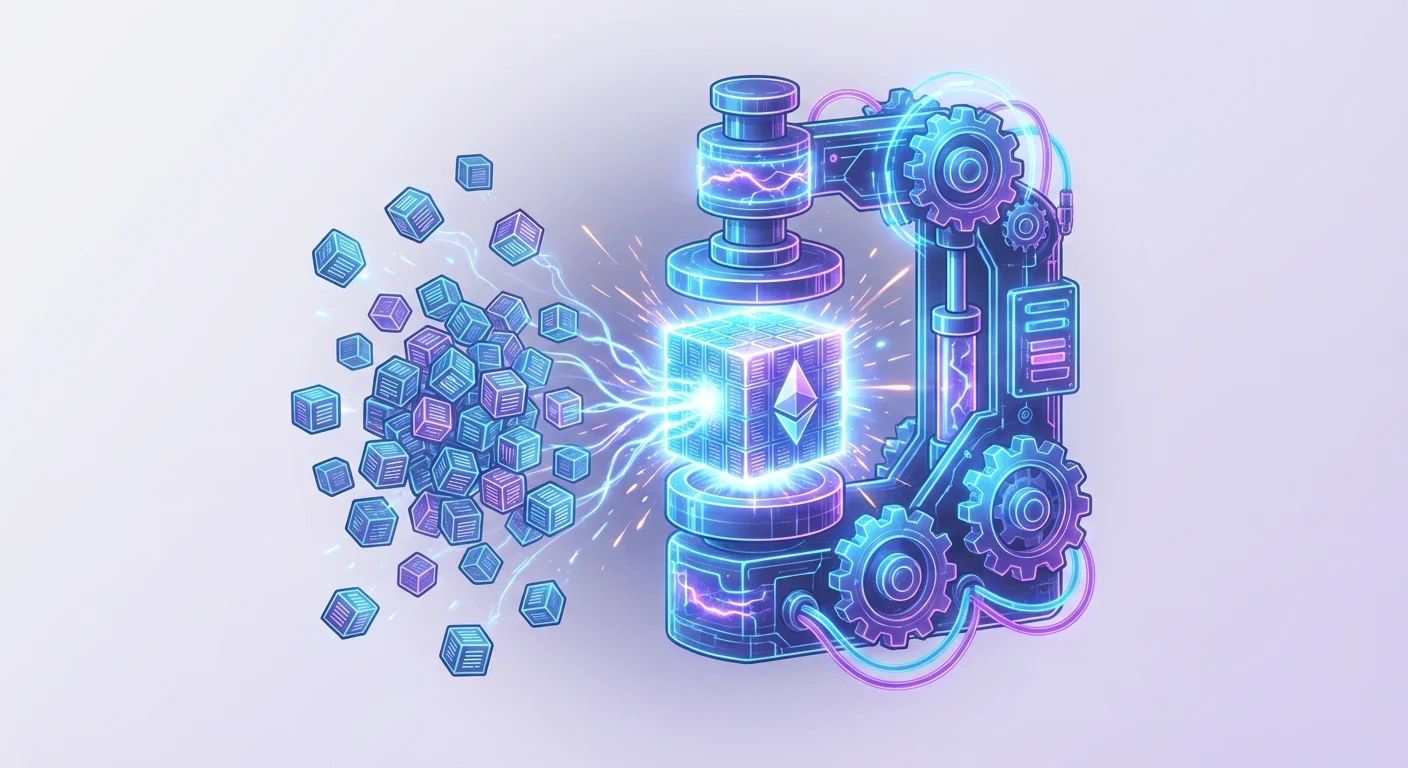
Ethereum has established itself as the dominant global platform for smart contracts and decentralized applications. However, this immense success has created significant challenges regarding network capacity and performance. When thousands of users attempt to transact simultaneously on the network, the system becomes congested. This results in slower processing times and skyrocketing transaction fees that price out everyday users.
These limitations have driven the rapid development of scaling solutions designed to handle exponential growth without compromising the network's core security. Layer 2 protocols sit on top of the main Ethereum blockchain, often referred to as Layer 1. They process transactions off-chain and then report the results back to the main network for final settlement.
Among the various scaling approaches, rollups have emerged as the most promising technology for the immediate and long-term future. They execute transactions outside the main chain but store transaction data on it. This unique architecture allows them to inherit the robust security properties of Ethereum while reducing costs by orders of magnitude.
The Scalability Trilemma
Blockchain architects often face a difficult trade-off known widely as the scalability trilemma. This fundamental concept suggests that a decentralized network can only simultaneously achieve two of three core benefits: decentralization, security, and scalability. It is nearly impossible to maximize all three within a single layer.
Ethereum originally prioritized security and decentralization at the expense of scalability. This design choice ensures the network remains resistant to censorship and attacks, which is vital for a global settlement layer. However, it makes the main chain expensive and slow during periods of high demand.
Layer 2 solutions attempt to solve this by offloading the heavy lifting of transaction execution. They leave the main chain to handle consensus, security, and data availability. This modular approach allows the ecosystem to scale effectively without altering the core protocol's trust model.
The Role of Gas Fees
Gas fees are the payments made by users to compensate for the computing energy required to process and validate transactions. On the main network, block space is limited. Users must effectively bid against each other to have their transactions included in the next block.
During a bull market or a highly anticipated NFT launch, these fees can become prohibitively expensive. A simple token swap might cost more in fees than the value of the trade itself. This economic barrier prevents widespread adoption of decentralized finance and limits the utility of the network.
Layer 2 rollups drastically reduce these costs by bundling hundreds or even thousands of transactions into a single batch. The gas fee for that single batch transaction on the main chain is split among all the users in the bundle. This results in individual fees that are significantly lower than Layer 1 operations.
The Mechanics of Transaction Bundling
Rollups function as a separate execution layer that operates parallel to the main Ethereum chain. Users deposit funds into a smart contract on Layer 1, which then unlocks equivalent funds on Layer 2. Once on the rollup, users can transact freely with high speed and low friction.
The technology gets its name from the process of "rolling up" multiple transactions into a single piece of data. Instead of the main network verifying every signature and contract interaction individually, it only needs to verify the summary of the batch. This creates massive efficiency gains.
This compression of data is the key to scalability. The rollup operator receives transactions from users, sequences them, and executes the computations. The operator then submits a highly compressed batch of data back to the main Ethereum network for finalization.
On-Chain Data Availability
For a rollup to remain secure, the data required to reconstruct the state of the chain must be available to everyone. Rollups publish this transaction data onto Ethereum Layer 1 as "calldata." This ensures that the history of the chain is preserved securely and publicly.
Because the data lives on the main chain, the rollup remains censorship-resistant. Even if the rollup operators go offline or act maliciously, users can use the on-chain data to calculate their balances. They can then withdraw their funds directly from the smart contract without permission from the operator.
This distinguishes rollups from other scaling solutions like sidechains. Sidechains usually store their data separately and rely on their own independent set of validators. If a sidechain fails, user funds can be lost. Rollups derive their safety directly from the Ethereum consensus mechanism.
The Sequencer Role
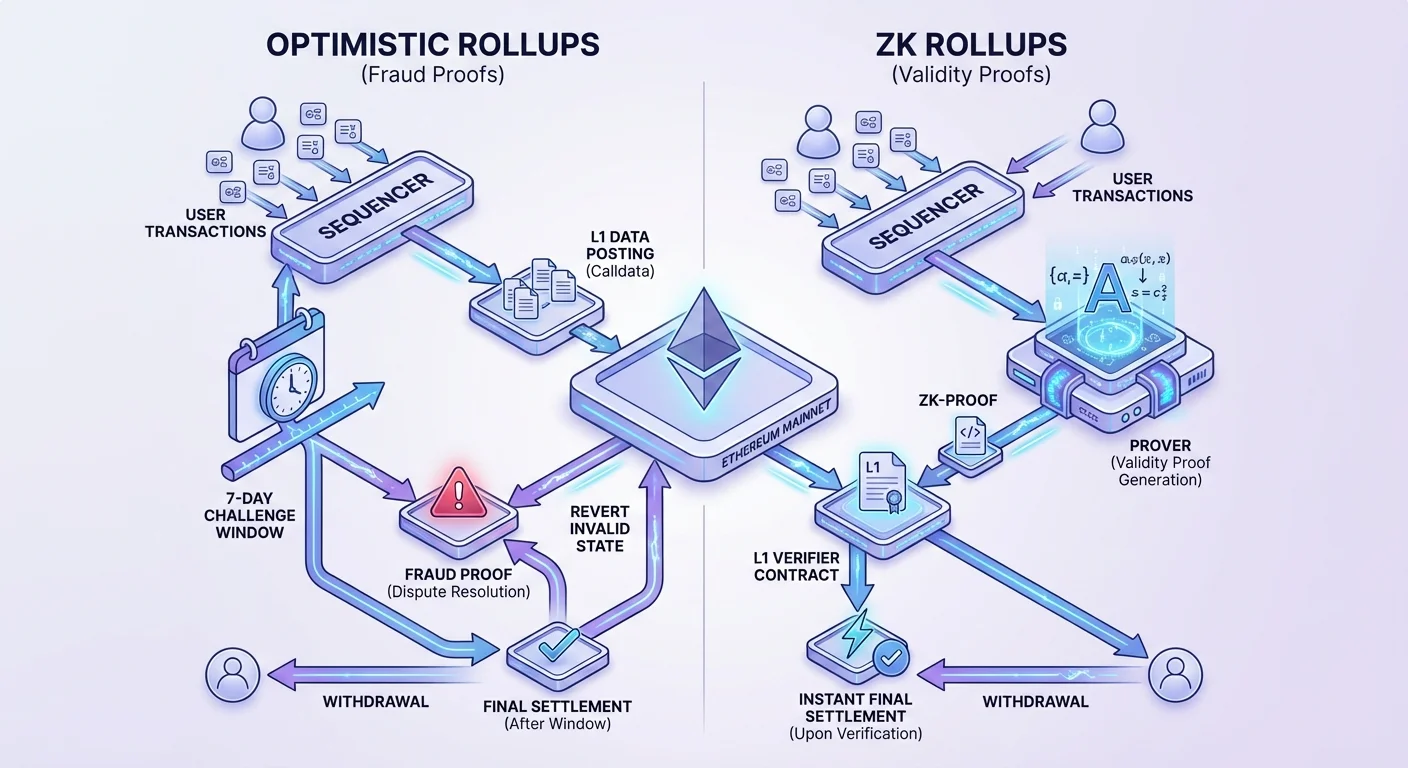
In most current rollup implementations, a specific node known as the sequencer is responsible for ordering transactions. Users send their trade requests to the sequencer. The sequencer orders them, executes the logic, and packages them into a block for submission.
While this introduces a momentary point of centralization, the sequencer cannot steal funds or forge invalid transactions if the underlying proof system is sound. The worst a sequencer can do is censor transactions, but users can bypass this by submitting transactions directly to Layer 1.
Projects are actively working to decentralize the sequencer role to improve resilience. A distributed network of sequencers would further enhance the robustness of the system. This evolution ensures that no single entity has control over the transaction ordering process, aligning with crypto ethos.
Exploring Optimistic Rollups
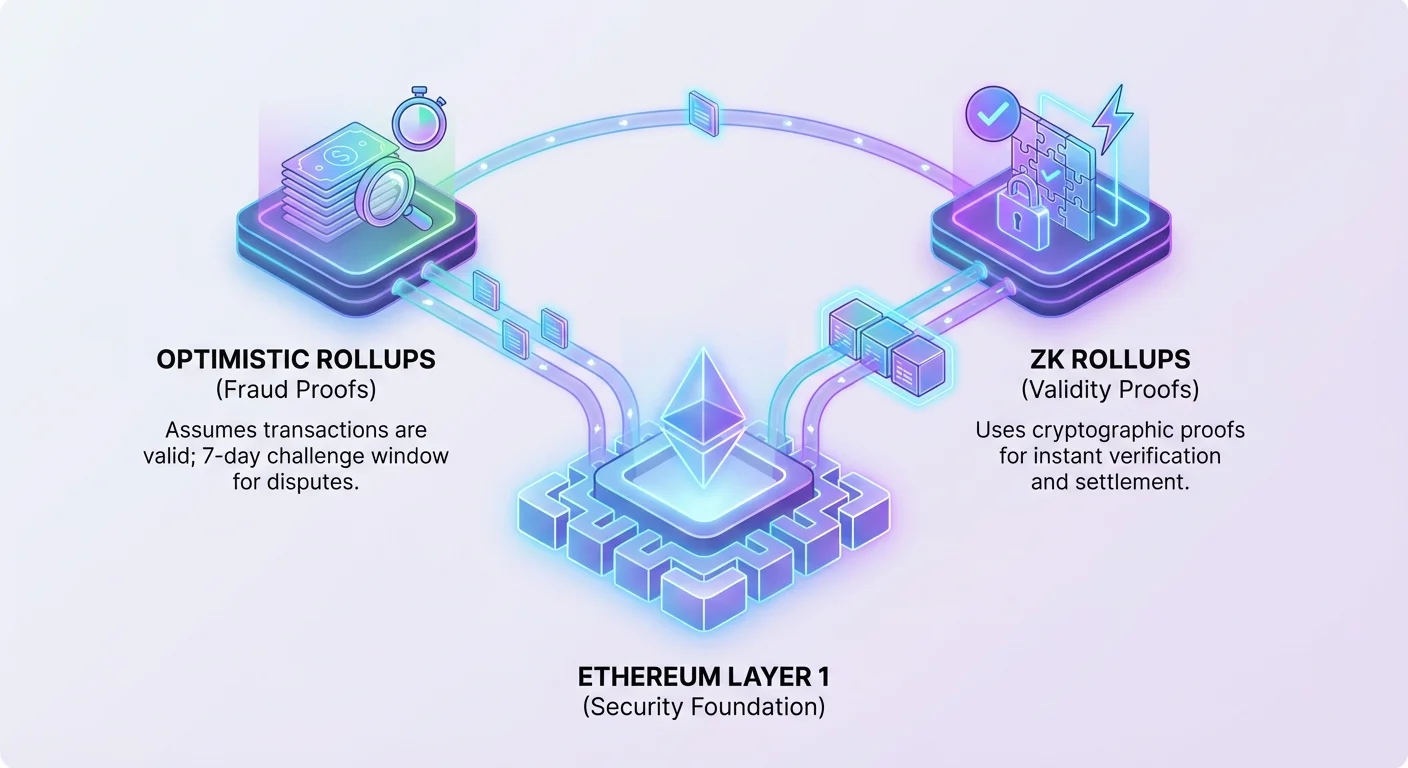
Optimistic Rollups derive their name from the assumption they make about transactions. They assume that all transactions submitted to the chain are valid by default. They do not perform complex cryptographic verification for every batch they process.
This "optimistic" approach allows for extremely fast processing speeds. Since the network does not need to expend computation power verifying every signature upfront, it can handle a high throughput of activity. The focus is on speed and ease of implementation.
The system relies on a mechanism called fraud proofs to ensure security. If a sequencer attempts to submit an invalid transaction, any network participant can challenge it. This creates a system based on economic incentives and game theory rather than pure mathematics.
The Dispute Resolution Window
To allow time for challenges, Optimistic Rollups enforce a delay period on withdrawals to the mainnet. This is often referred to as the "challenge period" and typically lasts for seven days. During this time, funds cannot be moved back to the main Ethereum network.
If someone spots a fraudulent transaction within this window, they can submit a fraud proof. The smart contract on Layer 1 then verifies the claim by re-executing the specific transaction. If the transaction is indeed invalid, the sequencer is penalized, and the chain state is rolled back.
Validators are required to post a bond or stake to participate in the network. If they act maliciously, this bond is slashed and given to the challenger. This economic penalty serves as a strong deterrent against fraud, ensuring rational actors process transactions honestly.
Compatibility with the EVM
One of the greatest strengths of Optimistic Rollups is their compatibility with the Ethereum Virtual Machine (EVM). Developers can port their existing smart contracts from Ethereum Layer 1 to the rollup with little to no modification.
This ease of migration has led to rapid adoption by major DeFi protocols. Applications for lending, trading, and yield farming work seamlessly on these networks. Users get the same experience they are used to on Ethereum, using the same wallets, but with a fraction of the cost.
Because the computation is handled off-chain and only disputed if necessary, the computational overhead is low. This efficiency makes Optimistic Rollups a practical and immediate solution for scaling the current Ethereum ecosystem while other technologies mature.
The Power of Zero-Knowledge Rollups
Zero-Knowledge (ZK) Rollups take a fundamentally different approach to verification. Instead of assuming transactions are valid, they generate a cryptographic proof that certifies the validity of every batch. This proof is submitted to the Ethereum mainnet along with the data.
This method follows the mantra of "don't trust, verify." The smart contract on Layer 1 verifies the cryptographic proof before accepting the state update. If the proof is mathematically correct, the transactions are guaranteed to be valid immediately.
Because the verification happens instantly upon submission, there is no need for a challenge period. Once the proof is accepted on Ethereum, the state is final. Users can withdraw their funds immediately without waiting for days, offering a significant user experience advantage.
Understanding Validity Proofs
The core technology behind ZK Rollups involves complex mathematics known as Zero-Knowledge Proofs. These proofs allow one party to prove to another that a statement is true without revealing any information beyond the validity of the statement itself.
In the context of scaling, these are often called "validity proofs." They mathematically demonstrate that the new state of the blockchain is the correct result of applying the batch of transactions to the previous state. No fraud is possible because an invalid state cannot generate a valid proof.
There are two main types of proofs used: SNARKs and STARKs. SNARKs are concise and quick to verify but typically require a trusted setup ceremony. STARKs are more transparent and resistant to quantum computing threats but generally have larger proof sizes.
Computational Challenges
The primary drawback of ZK Rollups is the intense computational power required to generate these proofs. Creating a proof for a batch of transactions is a heavy task that requires specialized hardware and significant time compared to optimistic execution.
This complexity has historically made it difficult to support general-purpose smart contracts. Early ZK Rollups were limited to simple transfers and specific trading applications. Building a fully EVM-compatible ZK environment is a massive engineering challenge that developers are still refining.
However, recent breakthroughs have led to the development of zkEVMs. These systems aim to combine the security and speed of validity proofs with the developer experience of Ethereum. This represents a major leap forward, allowing standard smart contracts to run on ZK architecture.
Comparative Analysis of Scaling Approaches
Choosing between Optimistic and ZK Rollups often depends on the specific needs of the user or developer. Optimistic models prioritize ease of integration and lower upfront computational costs. ZK models prioritize trustless security and speed of finality.
Data compression is another point of difference. ZK Rollups can be more efficient with on-chain data because the proof verifies the changes. They do not need to publish as much transaction data as Optimistic Rollups, which must allow for replayability in case of fraud.
The following table outlines the key distinctions between these two dominant scaling paradigms to help visualize their differences.
| Feature | Optimistic Rollups | ZK Rollups |
|---|---|---|
| Security Model | Economic incentives (Game Theory) | Cryptographic (Validity Proofs) |
| Withdrawal Time | ~7 Days (Challenge Period) | Instant (after verification) |
| EVM Support | High (Native compatibility) | Moderate (zkEVM growing) |
Capital Efficiency Considerations
The withdrawal delay in Optimistic Rollups creates a capital inefficiency. Liquidity providers often step in to offer instant withdrawals for a fee, bridging the gap. This creates a secondary market but adds cost for the user who wants instant speed.
ZK Rollups eliminate this issue entirely. Capital is not locked for dispute windows, allowing for more fluid movement of assets between layers. This is particularly important for institutional traders and arbitrage strategies that require rapid settlement across different markets.
Long-term viability discussions often favor ZK technology. While Optimistic Rollups provided a crucial first-mover advantage, many experts believe validity proofs are the ultimate endgame. The mathematical guarantee offers a stronger foundation than economic assumptions, especially for high-value financial systems.
The Hybrid Future
As the technology matures, the lines between these solutions may begin to blur. Some projects are exploring hybrid approaches that use optimistic execution for speed but generate validity proofs periodically. This could offer the best of both worlds.
Ultimately, the competition between these two technologies is healthy for the ecosystem. It drives innovation, lowers costs, and improves the user experience. Developers have more choices, and users benefit from a more diverse and resilient network.
Conclusion
The evolution of Layer 2 solutions represents a critical maturity phase for the blockchain industry. By moving execution off-chain while retaining the security of the base layer, these protocols address the most pressing hurdles to mass adoption. Both Optimistic and ZK Rollups provide viable pathways to a more accessible, efficient, and scalable decentralized financial system.
While Optimistic Rollups currently dominate regarding total value locked and developer usage due to their compatibility, ZK Rollups are rapidly closing the gap. As proof generation becomes cheaper and zkEVMs become more robust, the distinction may blur. Ultimately, this technological competition accelerates innovation, leading to a faster, cheaper, and more secure experience for users worldwide.
Rollups are the key to unlocking crypto's potential by making transactions fast and cheap without sacrificing security.