Za mnoge ljude znatiželjne o Bitcoinu, najveća prepreka je percipirana cijena. Videnje Bitcoina koji se trguje za desetke tisuća dolara često dovodi do pogrešnog zaključka da samo bogate institucije ili iskusni trgovci mogu sudjelovati. Ova zabluda uzrokuje da brojni novaci odgađaju ulazak, pretpostavljajući da moraju uštedjeti dovoljno novca za kupnju „cijelog novčića.“
Stvarnost je sasvim drugačija. Ne morate kupiti cijeli Bitcoin (BTC), a zapravo većina maloprodajnih investitora kupuje ga u sitnim frakcijama. To je moguće jer je Bitcoin djeljiv do osam decimalnih mjesta. Najmanja jedinica Bitcoina zove se Satoshi ili „sat“ u skraćenici – nazvana po pseudonimnom tvorca Bitcoina, Satoshi Nakamoto. Jedan jedini Bitcoin sastoji se od 100.000.000 Satoshi.
Ovaj vodič je osmišljen kako bi demistificirao prvu kupnju. Fokusirat ćemo se na praktičan, korak-po-korak proces stjecanja Bitcoina, naglašavajući Strategiju Sats i kombinirajući je s najpouzdanijom tehnikom niskorizičnog ulaganja: Prosječno ulaganje u dolare (DCA). Do kraja ovog putokaza imat ćete znanje potrebno za sigurnu, upravljivu investiciju i početak putovanja prema samodostatnosti.
Korak 1: Razumijevanje frakcija Bitcoina (Strategija Sats)
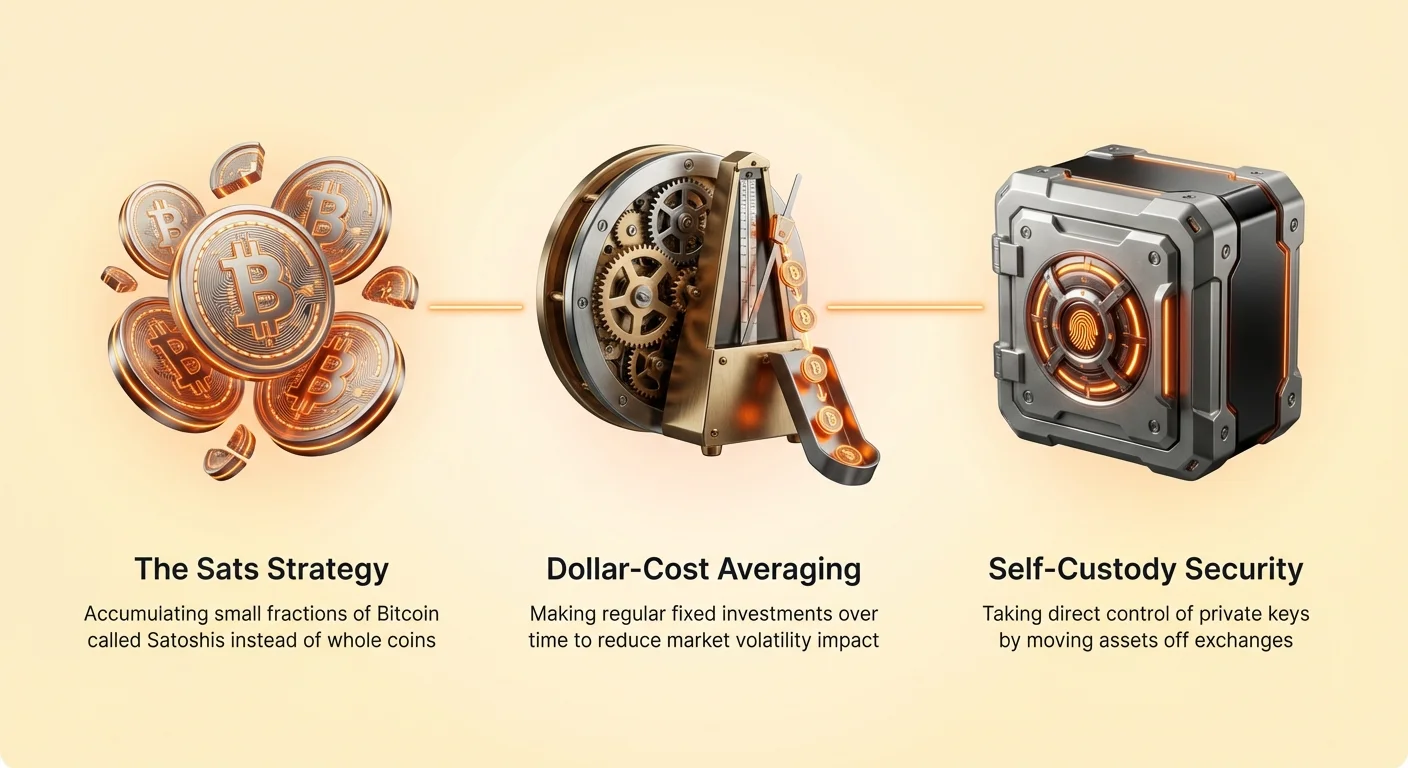
Prva psihološka barijera za kupnju Bitcoina je njegova zastrašujuća cijena. Preokviravanjem vaše investicije s kupnje „Bitcoina“ na akumulaciju „Satsa“, proces odmah postaje pristupačniji i skalabilniji.
Zašto kupujemo Satoshi, a ne cijele novčiće
Razmišljanje u satoshijima omogućuje normalizaciju ponavljajućih, malih investicija. Kad kupite BTC u vrijednosti od 25 USD, ne kupujete 0,0004 BTC; kupujete 40.000 Satoshi. To je potpuna jedinica vrijednosti koja se može slati, pohranjivati i koristiti baš kao cijeli novčić.
Ovaj koncept odgovara na ključno pitanje koje postavljaju početnici: Možete li kupiti manje od jednog Bitcoina? Apsolutno. Strategija Sats omogućuje ulaganje bilo kojeg iznosa – od 1 USD do 1.000 USD – bez brige o trenutnoj tržišnoj cijeni punog Bitcoina. Vaš cilj je jednostavno nagomilati više satova tijekom vremena.
Izračunajte svoju prvu kupnju
Budući da je satoshi samo stotina milijunita Bitcoina, bilo koji iznos fiat valute (USD, EUR itd.) pretvara se u veliki broj satova, čineći kupnju osjećajem značajnom, čak i za male budžete.
Primjer izračuna: Ako je cijena Bitcoina 60.000 USD, a odlučite uložiti 50 USD:
- 50 USD / 60.000 USD = 0,00083333 BTC
- 0,00083333 BTC * 100.000.000 = 83.333 Satoshi
Fokusirajući se na 83.333 satoshi koje ste stekli, umjesto na malu frakciju cijelog novčića, transakcija djeluje osnažujuće. Ova promjena mindseta ključna je za dugoročnu akumulaciju.
Step 2: Choosing Your Crypto Entry Point (Exchanges)
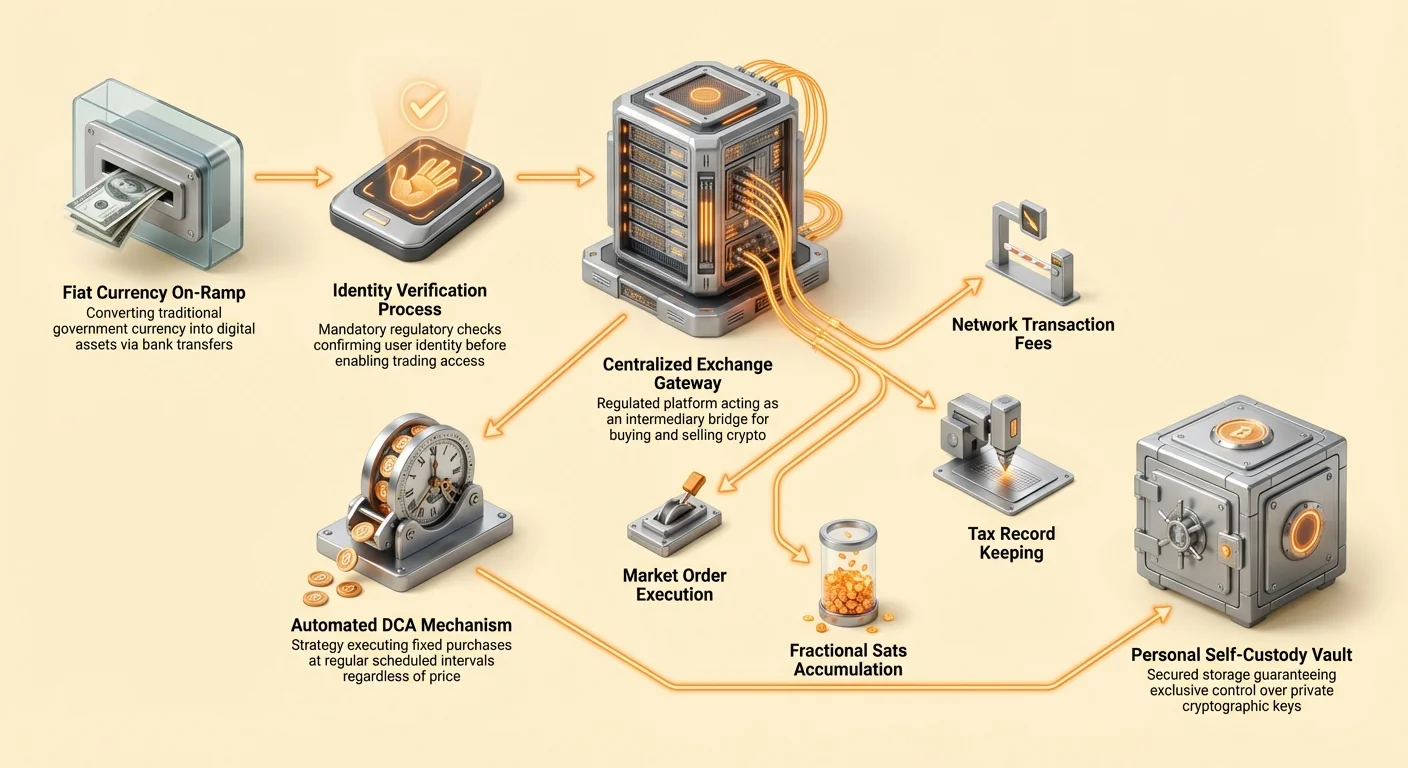
To convert your traditional government-issued currency (fiat) into Bitcoin, you need to use a regulated trading platform, known as a cryptocurrency exchange. For beginners, the safest and easiest route is typically through a Centralized Exchange (CEX).
Centralized Exchanges (CEXs): The Easiest On-Ramp
Centralized Exchanges act as highly regulated intermediaries. They operate similarly to traditional stock brokerages, offering high liquidity (meaning trades execute quickly) and a user-friendly interface. They are the essential bridge between the legacy financial system and the crypto economy.
Advantages of using a CEX for beginners:
- Familiarity: Interfaces resemble banking apps or stock trading platforms.
- Liquidity: Easily buy or sell large amounts of crypto instantly.
- Support: They offer customer service if you forget a password or encounter an issue.
- Fiat Gateways: Simple integration with bank accounts, debit cards, and wire transfers.
Necessary Verification Steps (KYC/AML)
Because CEXs deal with fiat currency and operate under government regulations, they are required to implement Know Your Customer (KYC) and Anti-Money Laundering (AML) policies. Before you can deposit funds or purchase Bitcoin, you will need to complete an identity verification process.
This usually involves:
- Providing a government-issued photo ID (driver’s license or passport).
- Proof of address (utility bill or bank statement).
- Sometimes, a live webcam selfie to confirm identity (liveness check).
While this centralized step might seem counterintuitive to the decentralized philosophy of Bitcoin, it is a necessary regulatory requirement for converting fiat to crypto through standard, legal banking rails.
Comparing Fees and Security
When selecting a CEX, compare two primary factors:
- Trading Fees: These are fees charged for executing the buy or sell order. They typically range from 0.1% to 0.6% per transaction. Look for tiered systems, where higher volume traders pay lower fees, although beginners should prioritize simplicity over marginal savings initially.
- Withdrawal Fees: This is the cost incurred when you move your Bitcoin off the exchange and into your private, self-custody wallet (a crucial step we cover in Step 5). Withdrawal fees cover the cost of the Bitcoin network transaction fee (the "miner fee") plus a small margin the exchange may charge.
Choose an exchange known for its high security standards, strong insurance policies (though these rarely cover user error), and transparent fee structure.
Step 3: Mastering the Dollar-Cost Averaging (DCA) Strategy
The largest enemy of a beginner investor is volatility and emotion. Bitcoin’s price can swing wildly, tempting investors to try and "time the market"—buying low and selling high. This rarely works, even for professionals. The simplest and most proven strategy to mitigate volatility and build wealth responsibly is Dollar-Cost Averaging (DCA).
This foundational technique is vital for successfully executing the DCA bitcoin strategy.
What is DCA and Why Does it Work?
Dollar-Cost Averaging (DCA) is an investment strategy in which an investor divides the total amount they wish to invest across periodic purchases of a target asset. These purchases occur at regular intervals (e.g., weekly or monthly), regardless of the asset's price.
How DCA smooths volatility: Imagine you have $1,200 to invest over a year.
- Lump Sum (Buying all at once): If you buy $1,200 worth of BTC when the price is $60,000, and the price immediately drops to $40,000, you have suffered a significant immediate loss.
- DCA (Buying $100 every month): You buy some Bitcoin when the price is $60,000, some when it drops to $40,000, and some when it rises to $70,000. By buying at multiple price points, your average purchase price becomes lower than if you had bought only at the peak.
DCA removes the emotion from investing. You commit to a schedule, not a price prediction. Over the long term, this structured approach generally outperforms impulsive, speculative attempts to time the market.
Setting Up Automated Purchases
Most major Centralized Exchanges facilitate automated DCA purchases, making the process effortless and adhering to the "set it and forget it" principle.
- Determine Your Budget: Decide on a sustainable weekly or monthly amount you are comfortable committing (e.g., $20 every Friday).
- Configure the Exchange: Go to the "Recurring Buys" or "Auto-DCA" section of your chosen exchange.
- Link and Schedule: Link your bank account and select the amount, frequency, and the asset (Bitcoin/BTC).
- Confirmation: The exchange will automatically draw the funds from your account and execute the purchase at the scheduled time.
Automated DCA is the most effective way for how to buy bitcoin for beginners reliably, steadily increasing your stack of sats without requiring constant monitoring of the market.
DCA vs. Lump Sum Investing
While financial theory sometimes suggests a lump sum investment might yield better returns if the asset is expected to rise consistently, this assumes the investor has the discipline and luck to buy at an optimal time.
For beginners, the psychological benefit of DCA outweighs the potential edge of lump sum investing. DCA offers peace of mind because you know you are neutralizing the risk of a major market downturn immediately after your purchase. DCA teaches discipline and patience—two essential traits for successful long-term Bitcoin investors.
Step 4: The Buying Process: From Fiat to Bitcoin
Once your exchange account is verified and you understand the power of DCA, executing the actual purchase is straightforward.
Linking Your Bank Account and Funding the Exchange
The first step is moving your fiat money onto the platform.
- ACH/Bank Transfer: This is usually the cheapest method but can take 3-5 business days for funds to clear and become available for trading.
- Debit Card Purchase: Instant funding, but often comes with a much higher transaction fee (sometimes 2-4%), making it generally unsuitable for large, recurring DCA investments.
For automated DCA, setting up a direct ACH withdrawal from your checking account is the standard, low-cost approach.
Executing the Trade (Market vs. Limit Orders)
When you are ready to make a manual purchase, you will encounter two main order types:
- Market Order: This is the easiest choice for beginners. You simply tell the exchange, "Buy $100 worth of Bitcoin right now." The order executes immediately at the best available current market price. This guarantees speed but not necessarily the best possible price.
- Limit Order: You set a specific price you are willing to pay. For example, "Buy $100 worth of Bitcoin only if the price drops to $59,000." If the market never hits your limit price, the order does not execute. Limit orders are useful for experienced traders attempting to capitalize on short-term dips but are unnecessary for long-term DCA buyers.
Beginner Tip: For scheduled DCA, a simple Market Order is used by the exchange to ensure the purchase is completed on time.
Confirmation and Exchange Account Balance
Once the trade is executed, the exchange confirms the transaction, showing you exactly how many Satoshis you received and the average price you paid. This Bitcoin will initially reside in your exchange account balance.
Crucially, while the exchange holds your funds, they are technically holding the private keys to your Bitcoin. This means the exchange is the custodian. For true self-sovereignty, the next step is mandatory.
Step 5: Securing Your Investment (Moving to Self-Custody)
The most important step in the entire investment process is taking control of your private keys. If you leave large amounts of Bitcoin on an exchange indefinitely, you subject yourself to risks such as exchange hacks, regulatory seizures, or bankruptcy.
Why "Not Your Keys, Not Your Coin" Matters
This famous crypto adage is the cornerstone of Bitcoin philosophy. Your Bitcoin wallet is not a physical place; it’s a digital key. Whoever holds the private key controls the funds. When funds are on a CEX, the exchange holds the key.
Self-custody means: You move your newly acquired sats from the exchange and send them to a non-custodial wallet (either software or hardware). In this wallet, you alone possess the private keys, usually in the form of a 12- or 24-word "seed phrase." This makes you your own bank, responsible for your own security.
(For detailed guidance on setting up your wallet, refer to the related guide: Choosing Your First Wallet: A Non-Custodial vs. Custodial Decision Guide.)
The Withdrawal Process (Sending to your wallet address)
To move your sats, follow these steps on your exchange:
- Obtain Your Wallet Address: Open your non-custodial wallet application and select the "Receive" function. This generates a long string of letters and numbers called a Bitcoin wallet address (starting with 1, 3, or bc1).
- Initiate Withdrawal: On the CEX platform, select "Withdraw BTC" or "Send Crypto."
- Enter Destination Address: Paste the receiving address from your personal wallet into the exchange’s withdrawal field. Double-check this address. Errors here can lead to permanent loss of funds.
- Confirm Amount and Fee: Specify the amount of BTC you wish to withdraw. The exchange will show the network fee (the cost to process the transaction on the blockchain).
- 2FA Confirmation: Use Two-Factor Authentication (2FA) codes, usually sent via email and/or an authenticator app, to confirm the withdrawal.
Best Practices for Transaction Safety
When moving crypto, especially for the first time, take these precautions:
- Test Transaction: For your very first withdrawal (regardless of the amount), send a tiny amount (e.g., $5 worth of sats) first. Wait until the small amount arrives in your non-custodial wallet before sending the main bulk of your funds.
- Use 2FA: Never rely solely on passwords. Use Google Authenticator or similar apps for both your exchange login and your withdrawal confirmation.
- Address Verification: Always visually verify the first and last few characters of the pasted wallet address to ensure it hasn't been altered by malicious software (clipboard hijackers).
Korak 6: Kretanje kroz porezni krajolik (Brzi priručnik)
Iako ne pružamo specifične porezne savjete (uvijek se posavjetujte s ovlaštenim stručnjakom u vašoj jurisdikciji), razumijevanje osnova kako se Bitcoin investicije obično oporezuju ključno je za odgovornu akumulaciju.
Kada kripto postaje oporezivo?
U većini jurisdikcija, porez se aktivira kada se dogodi porezno opterećujući događaj. Jednostavno kupovanje i držanje Bitcoina obično nije porezno opterećujući događaj.
Porezno opterećujući događaji često uključuju:
- Prodaja kripta za fiat: Iskashiranje BTC za USD.
- Trgovanje kriptom za drugu kriptu: Zamjena BTC za Ethereum (ETH) ili bilo koju drugu altcoin.
- Korištenje kripta za kupnju robe ili usluga: Trošenje Bitcoina kod trgovca.
U tim događajima ostvarujete kapitalnu dobitak ili gubitak. Dobi nastaje ako je cijena Bitcoina koji ste prodali bila viša od cijene po kojoj ste ga originalno kupili (vaša osnovica troška).
Važnost vođenja evidencije
Budući da DCA uključuje mnoge male kupnje tijekom vremena, određivanje vaše osnovice troška za svaku transakciju može postati komplicirano. Morat ćete pratiti svaku kupnju, prodaju i trgovinu.
Ključne evidencije za čuvanje:
- Datum kupnje/prodaje: Točan datum kada se transakcija dogodila.
- Osnovica troška (cijena po satu/BTC): Cijena koju ste platili u fiatu u trenutku kupnje.
- Transakcijska naknada: Trošak izvršenja trgovine ili slanja sredstava.
Srećom, većina glavnih burzi pruža detaljna izvješća o povijesti transakcija koja se mogu izvesti u svrhu poreza. Dodatno, postoji specijalizirani softver za poreze na kripto koji pomaže agregirati ove podatke i automatski izračunati kapitalne dobitke i gubitke. Ne podcjenjujte ovaj korak; robusno vođenje evidencije sprječava potencijalne komplikacije u budućnosti.
Zaključak
Pokretanje vašeg putovanja investiranja u Bitcoin manje je pitanje pogodivši lutriju i više uspostavljanje discipliniranih navika. Usvajanjem Strategije Sats prevladate psihološku barijeru visoke cijene Bitcoina. Korištenjem Prosječnog ulaganja u dolare neutralizirate tržišnu volatilnost i uklanjate stres uhvatanja vremena za vašu investiciju.
Sada posjedujete temeljni putokaz za sigurno stjecanje Bitcoina: odaberite sigurnu burzu, automatizirajte svoj DCA, izvršite kupnju i odmah premjestite te dragocjene satove u svoj osobni samostalni novčanik. Ovaj proces prvi je, najključniji korak prema financijskoj neovisnosti i izgradnji prave samodostatnosti u digitalnom gospodarstvu.