
Kada većina ljudi razmišlja o premještanju novca, zamišljaju jednostavan ažuriranje središnjeg dnevnika: stanje Alicina bankovnog računa se smanjuje, a Bobovo raste. To je jednostavan model baziran na računima koji koriste centralizirani financijski sustavi širom svijeta.
Međutim, Bitcoin, kao decentralizirana digitalna valuta, ne može se oslanjati na središnje tijelo za praćenje stanja svih korisnika. Takav sustav bio bi ranjiv na prijevare, jedinstvene točke kvara i beskrajne sporove o pravom stanju mreže.
Kako bi riješio ovaj duboki izazov, Bitcoin je uveo jedinstvenu, robusnu i visoko revidirajuću strukturu računovodstva poznatu kao model Nepotrošenih izlaza transakcija (UTXO). Model UTXO je motor ispod haube Bitcoina, osiguravajući da je svaki satoshi (najmanja jedinica Bitcoina) jedinstveno praćiv, da je dvostruko trošenje matematički nemoguće i da cijela mreža može provjeriti dnevnik bez povjerenja u bilo koju pojedinačnu stranu.
Ovaj vodič ide dalje od jednostavne definicije transakcije; analiziramo jezgru arhitekture – model UTXO – kako bismo razumjeli zašto je fundamentalan za Bitcoininu sigurnost, revidirajuću prirodu i arhitektonski integritet. Razumijevanjem kako se ovi digitalni elementi stvaraju, zaključavaju i troše, dobivate dublje razumijevanje složene kriptografije koja podupire pravu digitalnu suverenost.
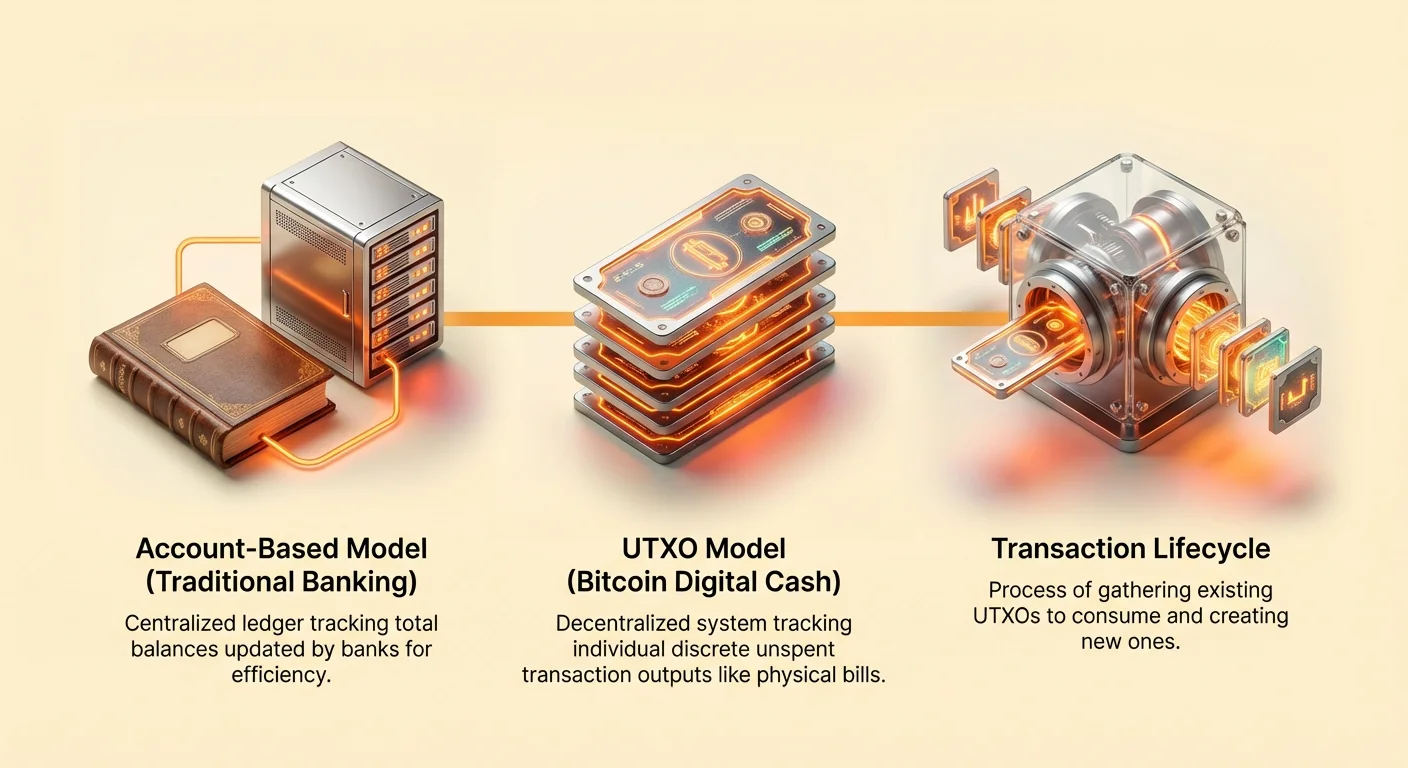
Traditional Banking vs. The Blockchain Ledger
To fully grasp the brilliance of the UTXO model, we must first understand the limitations of the traditional financial structures it replaced.
The Account-Based Model: Tracking Balances
Centralized systems, including banks, payment processors, and even centralized databases for digital games, rely on the account-based model.
In this model, the system maintains a master list of all users and their current net worth within the system. If Alice has $1,000 and sends Bob $100, the system simply performs two mathematical operations:
- Subtract $100 from Alice’s account record ($1,000 → $900).
- Add $100 to Bob’s account record ($0 → $100).
The advantage of this system is its simplicity and efficiency. Since the central bank maintains the canonical, verifiable state (the master list of balances), transactions are quick updates to existing data fields.
Why the Account Model Fails in Decentralized Systems
While efficient for centralized institutions, the account model presents critical flaws when applied to a trustless, decentralized network like Bitcoin:
- State Verification Complexity: In a decentralized network, every node must agree on the current state (i.e., everyone’s precise balance). If nodes constantly update balances, verifying the true state requires replaying every single transaction from the beginning of time or trusting an arbitrary checkpoint. This makes verification computationally heavy and susceptible to disagreement.
- Double-Spending Risk: The primary challenge in digital cash is ensuring that Alice cannot send the same $100 to both Bob and Carol. In an account model without a central referee, if Alice simultaneously broadcasts two conflicting transactions ("Send $100 to Bob" and "Send $100 to Carol"), there is no immediate, universal mechanism to determine which is valid and prevent both from being accepted.
- Audibility Issues: Account balances are constantly changing variables. While you can see the final balance, understanding how that balance was accumulated (and ensuring the system didn't err during one of the million previous updates) can be obscured behind a private corporate ledger.
The UTXO model sidesteps all these issues by abandoning the concept of a "balance" entirely and focusing instead on traceable, discrete units of value.
Decoding the UTXO Model (Unspent Transaction Output)
Bitcoin does not track how much money an address holds. Instead, the network tracks a collection of digital vouchers known as Unspent Transaction Outputs, or UTXOs.
A UTXO is, fundamentally, a record of Bitcoin that has been sent to a specific person and is now waiting to be spent. It is the fundamental building block of Bitcoin’s security and accounting system.
The Analogy of Digital Cash
The best way to understand the UTXO model is to think of it as handling physical cash, specifically banknotes, rather than managing a checking account balance.
Imagine you receive $50 from a friend. That $50 isn’t added to a running digital total; it exists as a single, physical $50 bill.
- If you want to spend $30: You cannot split the $50 bill. You must spend the entire $50 bill (the input) and, in return, receive two new things: a $30 payment for the merchant and $20 in change (a new UTXO) sent back to you.
- The $50 bill is "consumed" (spent) entirely, and new bills are created (new UTXOs).
This "consumption and creation" process is the core mechanism of the UTXO model. An address’s total "balance" is merely the sum total of all the unspent UTXOs that are currently locked to that address's cryptographic key.
Anatomy of a UTXO
Every UTXO is defined by three critical pieces of information recorded on the blockchain:
- The Source (Transaction ID and Index): A reference to the previous transaction where this UTXO was first created as an output. Since a single transaction can have multiple outputs, an index number (0, 1, 2, etc.) specifies which output is being referenced. This lineage is crucial because it ensures the network knows where the money came from.
- The Amount: The specific quantity of Bitcoin or satoshis contained within that UTXO.
- The Locking Script (ScriptPubKey): This is the cryptographic "lock" that dictates the specific conditions required to spend the UTXO in the future. In the most common scenarios (Pay-to-Public-Key-Hash or P2PKH), this script locks the funds to a specific public key hash, meaning only the person who possesses the corresponding private key can unlock it.
Once a UTXO is spent, it ceases to exist. It is marked as spent forever on the blockchain and cannot be used again, thus solving the double-spending problem.
The Concept of Change Outputs
The process of spending requires the sender to use the entire value of the selected UTXOs (inputs). If the total value of the inputs exceeds the amount the sender wants to pay the recipient, the excess amount does not simply vanish—it must be explicitly accounted for in a new output, known as the change output.
For example, Alice wants to pay Bob 0.05 BTC. She only has a single UTXO worth 0.1 BTC.
| Input (Consumed UTXO) | Output 1 (Payment) | Output 2 (Change) | Fee |
|---|---|---|---|
| 0.1 BTC | 0.05 BTC (to Bob) | 0.049 BTC (to Alice's new address) | 0.001 BTC |
In this scenario:
- The original 0.1 BTC UTXO is destroyed.
- Two new UTXOs are created: one for Bob and one for Alice (the change).
- The remainder (0.001 BTC) is implicitly claimed by the miner as the transaction fee.
This mandatory accounting for change is a core security feature, ensuring that value is conserved across the entire network and providing a natural mechanism for paying network fees.
Životni ciklus Bitcoin transakcije: Od ulaza do izlaza
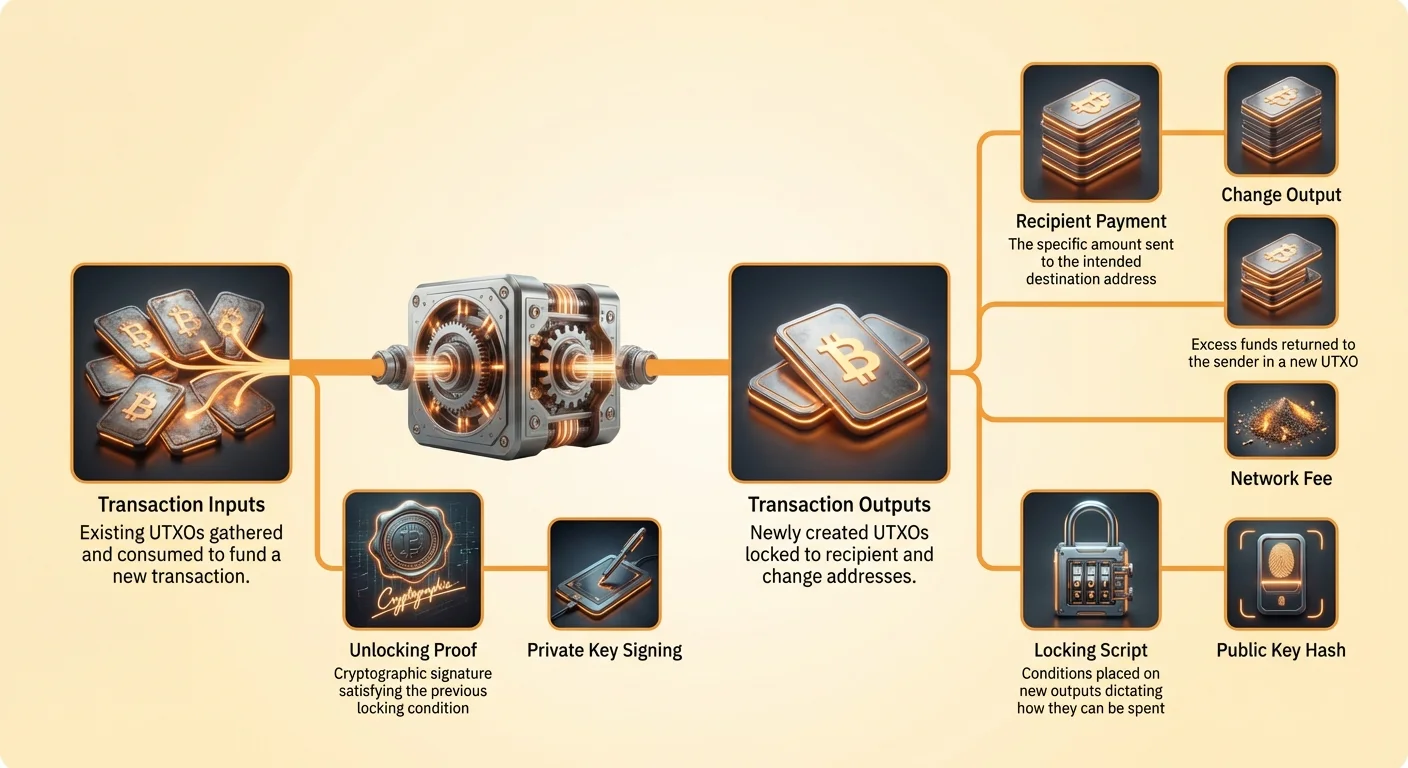
Bitcoin transakcija nije naredba koja naređuje središnjem poslužitelju da ažurira stanje računa; ona je pažljivo konstruirana poruka koja dokazuje da pošiljatelj ima ovlast za otključavanje i potrošnju postojećih UTXO-ova te upućuje mrežu kako stvoriti nove zaključane UTXO-ove na njihovo mjesto.
Korak 1: Prikupljanje ulaza (Proces potrošnje)
Prije slanja bilo kakvog Bitcoina, softver novčanika korisnika mora locirati postojeće UTXO-ove povezane s njihovim adresama. Ovi UTXO-ovi služe kao ulazi za novu transakciju.
Odgovornost novčanika: Kada kliknete „Pošalji“ u svom novčaniku, softver pregledava blockchain kako bi utvrdio koje UTXO-ove posjedujete, a zatim izračunava koliko UTXO-ova je potrebno za pokrivanje željene iznose plaćanja plus naknade za transakciju.
- Odabir: Ako želite potrošiti 1 BTC, a imate dva UTXO-a (0.7 BTC i 0.4 BTC), novčanik može odabrati oba, ukupno 1.1 BTC, za upotrebu kao ulaze.
- Dokaz otključavanja: Za svaki UTXO odabran kao ulaz, pošiljatelj mora pružiti kriptografski dokaz — digitalni potpis — koji zadovoljava uvjet zaključavanja postavljen prethodnom transakcijom (ScriptPubKey). Ovaj proces dokazuje vlasništvo bez otkrivanja privatnog ključa.
Korak 2: Definiranje izlaza (Novi UTXO-ovi)
Ulazi su UTXO-ovi koji se uništavaju; izlazi su novi UTXO-ovi koji se stvaraju. Tipično postoje dva tipa izlaza:
A. Izlaz primatelja
Ovaj izlaz definira količinu Bitcoina koju će primiti namjeravani primatelj (Bob). Ovaj novi UTXO se stvara i zaključava na Bobov specifični hash javnog ključa. Kada se potvrdi u bloku, Bob može koristiti svoj privatni ključ da potroši ovaj novi UTXO.
B. Izlaz promjene
Ako ukupna vrijednost ulaza premašuje namjereno plaćanje, višak se mora vratiti pošiljatelju kao novi UTXO. Najbolja praksa nalaže da novčanik pošalje ovu promjenu natrag na novu, jedinstvenu adresu koju kontrolira pošiljatelj. Ova praksa poboljšava privatnost prekidanjem eksplicitne veze između stare adrese pošiljatelja i njihovih budućih transakcija.
Korak 3: Plaćanje mrežne naknade
U svakoj valjanoj Bitcoin transakciji, ukupna vrijednost svih ulaza mora biti jednaka ili veća od ukupne vrijednosti svih izlaza.
Razlika između ukupne vrijednosti ulaza i ukupne vrijednosti izlaza je naknada za transakciju.
Ova naknada se ne šalje na specifičnu adresu; umjesto toga, ostaje nezahtjevana od strane bilo kojeg izlaza, omogućavajući rudaru koji uspješno provjeri i doda transakciju u blok da zatraži taj preostali iznos kao nagradu za svoj rad.
Mehanizam poticaja: Ovaj mehanizam je ključan za Bitcoinov model sigurnosti. Pruža rudarima ekonomski poticaj da prioritetno obrađuju i potvrđuju transakcije, osiguravajući da mreža nastavi raditi čak i kada subvencija bloka (novokovane kovanice) opada tijekom vremena. Iznos naknade je općenito proporcionalan veličini podataka transakcije (u bajtovima) i trenutnom nivou gužve u mreži, omogućavajući korisnicima da licitiraju za bržu uključenost. (Za dublji uvid, pogledajte našu povezanu stranicu: Dinamika mempoola: Analiza tržišta naknada Bitcoina i cijena gužve).
Cryptographic Security: Locking and Unlocking the Digital Vault
The true ingenuity of the UTXO model lies not just in the accounting structure, but in the cryptographic mechanisms used to govern who can spend them. This control is implemented through a simple but powerful scripting language embedded in every transaction.
The Role of Cryptographic Scripts
Bitcoin transactions are not digitally signed by the wallet software; they are processed by a stack-based, non-Turing complete scripting language. While it sounds complicated, its purpose is straightforward: to act as the "lock" and the "key" for the UTXO.
A typical transaction involves two primary scripts:
1. The Locking Script (ScriptPubKey)
This script is placed in the output of the transaction (the UTXO being created). It sets the spending condition. Essentially, it declares: "Only someone who can prove they control this public key hash can spend this money." This is the lock.
2. The Unlocking Script (ScriptSig)
This script is provided in the input when the UTXO is consumed. It provides the data necessary to satisfy the locking script—primarily the user’s digital signature and the corresponding public key. This is the key.
When a node verifies a transaction, it combines the ScriptSig (the proposed solution) and the ScriptPubKey (the challenge) and executes the combined script. If the script executes successfully (resolves to "True"), the transaction is valid, and the UTXO can be consumed.
Standard Transaction Types
While Bitcoin’s scripting language allows for complex conditions (like multi-signature requirements or time-locked funds), the vast majority of transactions use two standard forms:
Pay-to-Public-Key-Hash (P2PKH)
This is the original and most common transaction type. It locks the funds to a hash of the recipient's public key (the Bitcoin address you are familiar with). To unlock it, the spender must provide the original public key and a valid digital signature generated by the corresponding private key.
Analogy: You lock a safety deposit box with a complex biometric lock (the address hash). To open it, you must present the specific biometric identifier (public key) and a signed document proving you authorized the action (digital signature).
Pay-to-Script-Hash (P2SH)
P2SH transactions allow users to send funds to an address that is derived from a complex script (a set of custom spending rules), rather than just a public key. This is often used for multi-signature wallets (requiring 2-of-3 signatures to spend) or time-locks. P2SH simplifies the recipient's address while allowing for much greater security and complexity behind the scenes.
The Verification Process: Digital Signature and Public Key
The most critical element of the unlocking script is the digital signature.
- Signing: The sender uses their private key to digitally sign the new, proposed transaction. This signature proves that the holder of the private key authorized the spend and ensures that the transaction details (recipients, amounts, fees) cannot be tampered with after signing.
- Verification: The network uses the sender's public key (which is publicly available, often included in the ScriptSig) to mathematically verify that the digital signature was created by the corresponding private key.
Crucially, the public key allows the network to verify ownership without the private key ever leaving the owner’s control. This process is the foundational mechanism for establishing self-custody and preventing fraud in a trustless environment.
Superiority of UTXOs: Audibility, Security, and Privacy
The decision to utilize the UTXO model, rather than the more intuitive account model, was a deliberate choice that underpins the unique properties of Bitcoin’s security architecture.
Enhanced Security Through Explicit Spends
The account model must rely on consensus rules to prevent double-spending (e.g., "Whoever records the transaction first wins"). The UTXO model, however, makes double-spending mathematically impossible through the very structure of the transaction:
The Consumption Rule: An input (UTXO) can only be consumed once. Once it is included in a confirmed block, it is effectively destroyed. If a malicious user attempts to broadcast two transactions that reference the same UTXO as an input, the second transaction is automatically invalidated by the network because the referenced input no longer exists.
This consumption-and-creation structure provides a much stronger guarantee against double-spending attempts, ensuring the absolute integrity of the ledger state.
Audibility and Simplicity of State
While the account model requires tracking a constantly evolving set of balances (a dynamic state), the UTXO model tracks a static collection of spent and unspent units (a simplified state).
The global state of the Bitcoin network—the definitive list of all money currently available—is simply the aggregation of all UTXOs that exist in the world (the UTXO Set).
- Ease of Verification: For a node to verify the entire history of Bitcoin, it only needs to check that every newly mined block correctly consumes existing UTXOs and creates new ones. There is no confusion about "running balances." This transparent, auditable history is essential for decentralized systems, ensuring any participant can verify the chain’s history independently.
- Proof of Work Synergy: The UTXO model provides the precise units of account that miners, operating within the Proof of Work (PoW) consensus mechanism, compete to validate. The miner’s job is to ensure the UTXO transformations proposed in the transaction block are 100% valid before sealing the block. (For more on the underlying consensus mechanism, see: Proof of Work (PoW): Bitcoin's Economic Solution to the Byzantine Generals Problem).
Privacy and Pseudonymity Benefits
While Bitcoin is often described as "anonymous," it is more accurately defined as pseudonymous, meaning addresses and transactions are public, but they are not linked directly to real-world identities. The UTXO model naturally enhances this pseudonymity.
- Change Addresses: As discussed, when you spend a UTXO, the leftover change is typically returned to a brand-new address controlled by your wallet. This practice prevents observers from easily linking all of your Bitcoin holdings together under a single address.
- Input Consolidation: When you need to gather several small UTXOs (inputs) to make a large payment, the resulting transaction creates two brand-new, unlinked outputs (payment and change). This action effectively obscures the origin of the funds, providing stronger separation between your different Bitcoin activities.
Actionable Tip: To maximize the privacy benefits of the UTXO model, always ensure your wallet software utilizes new addresses for change outputs. This is standard for most modern non-custodial wallets, but it is a critical practice for maintaining financial pseudonymity.
Improved Parallel Processing
The UTXO model inherently allows for greater network efficiency compared to the account model.
In an account-based system (like Ethereum), if Alice and Bob are trying to transact simultaneously using the same Smart Contract or the same shared pool of funds, those transactions must be processed sequentially to prevent data conflicts.
In the UTXO model, transactions are isolated events involving the consumption of specific, unique UTXOs. As long as two transactions are not trying to consume the same input, they are entirely independent. This characteristic allows nodes to verify and process different transactions simultaneously (in parallel), significantly improving the network's potential processing throughput and resilience.
Sažetak upravljanja UTXOm za samokontrole
Za korisnike koji prelaze na samokontrolu, razumijevanje kako se njihovi Bitcoin pohranjuje – ne kao agregirano stanje, već kao zbirka pojedinačnih UTXOs – bitno je za sigurnost i optimizaciju naknada.
Odabir UTXOs i upravljanje naknadama
Naknada za transakciju se određuje ne po dolarskoj vrijednosti Bitcoina koji se šalje, već po veličini podataka transakcije. Primarni pokretač veličine podataka je broj ulaza (UTXOs) potrebnih za financiranje transakcije.
- Manje UTXOs = Jeftinija transakcija: Ako financirate transakciju jednim velikim UTXOm (npr. 5 BTC), podaci transakcije su mali, rezultirajući niskom naknadom.
- Mnogo UTXOs = Skupija transakcija: Ako financirate istu transakciju od 5 BTC koristeći pedeset malih UTXOs (0,1 BTC svaki), veličina podataka transakcije naglo raste jer transakcija mora uključiti otključavajući skript (potpis i javni ključ) za svih pedeset ulaza. To rezultira mnogo višom naknadom.
Praktični slučaj upotrebe: Konsolidacija UTXOs Ako ste nagomilali mnogo sitnih UTXOs tijekom vremena (ponekad nazvanih "prah"), financijski je pametno povremeno izvršiti transakciju "konsolidacije UTXOs". To znači slanje svih ovih malih ulaza na jedinu novu adresu koju kontrolirate. Iako naknada za ovu konsolidacijsku transakciju može biti visoka inicijalno (zbog velikog broja ulaza), rezultirajući jedan veliki UTXO bit će mnogo jeftiniji za potrošnju u budućnosti.
Evolucija skripta i priprema za budućnost
Fleksibilnost Bitcoina skriptnog mehanizma znači da model UTXO može se prilagoditi novim kriptografskim standardima koji poboljšavaju učinkovitost i snižavaju naknade.
Na primjer, uvedba SegWita (Segregated Witness) i Taproot tehnologija bila je specifično dizajnirana da učini kriptografske dokaze (ScriptSig) potrebne za otključavanje UTXOs manjima ili učinkovitijima za prijenos preko mreže. Ova poboljšanja su fundamentalno ovisna o UTXO strukturi, dokazujući da ovaj računovodstveni metod nije samo baštinski sustav, već arhitektura dizajnirana za dugoročnu kriptografsku evoluciju.
Zaključak
Bitcoinov model UTXO predstavlja revolucionarni pristup decentraliziranom računovodstvu. Odustajanjem od centraliziranog stanja računa i usvajanjem sustava baziranog na diskretnim, praćivim i potrošnim jedinicama vrijednosti, Bitcoin rješava fundamentalne probleme dvostrukog trošenja i povjerenja.
Životni ciklus transakcije, upravljan eksplicitnim skriptovima zaključavanja i otključavanja, osigurava da se vrijednost očuva i da se vlasništvo kriptografski dokaže u svakom slučaju. Za samosuverenu pojedinačnu osobu, model UTXO pruža neusporedivu sigurnost, revidirajućnost i temelj za pseudonimnost, učvršćujući svoje mjesto kao ključni motor koji omogućuje pouzdan digitalni novac za novu globalnu ekonomiju. Razumijevanje UTXO strukture nije samo tehničko znanje; to je razumijevanje izvornog koda povjerenja u digitalnom dobu.