
Za iskusnog investitora ili marljivog novajliju, razumijevanje rizika je kamen temeljac bilo kojeg uspješnog investicijskog plana. Dok tipično financijsko tržište nosi rizike povezane s kamatnim stopama, neplaćanjem duga i makroekonomskim šokovima, decentralizirane imovine poput Bitcoina suočavaju se s jedinstvenom skupinom prijetnji — sustavnim rizicima koji bi mogli dovesti u pitanje dugoročnu održivost i vrijednosnu ponudu cijele mreže.
Sustavni rizik, u ovom kontekstu, odnosi se na ranjivost sposobnu uzrokovati kaskadni kvar na cijelom Bitcoinovom ekosustavu, temeljno narušavajući njegove ključne osobine sigurnosti, decentralizacije ili otpornosti na cenzuru. Prelazeći izvan dnevnog volatiliteta, moramo kritički procijeniti tri glavne kategorije egzistencijalnih prijetnji: iznenadne regulatorne promjene (crni labudovi), tehnološke preokrete (kvantno računarstvo) i unutarnje strukturne ranjivosti (51% napad). Opsežna analiza ovih opasnosti nije medvjeđa vježba; već je ključna due diligence potrebna za izgradnju samovladajuće pozicije u novoj digitalnoj ekonomiji.
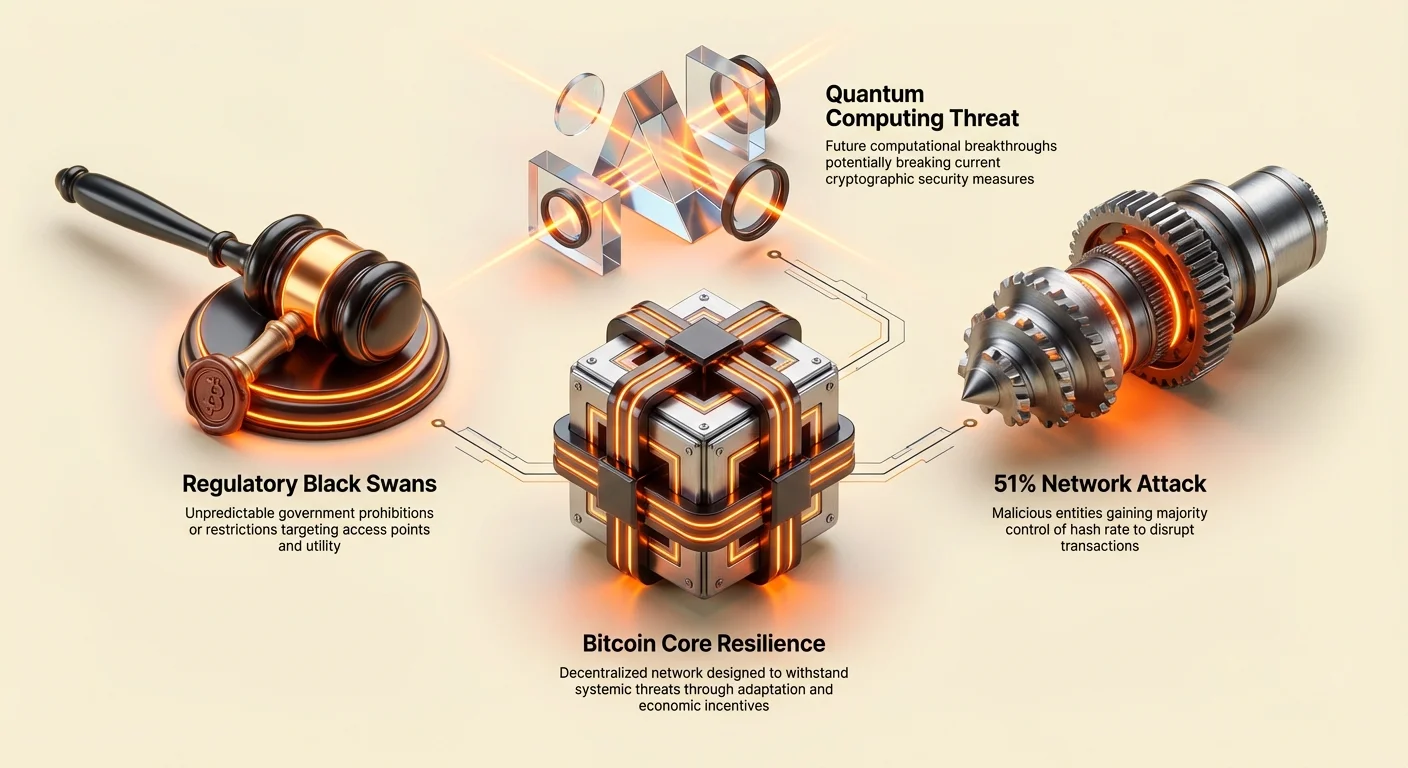
The Regulatory Landscape: Analyzing Black Swan Events
Regulation poses the most immediate and complex systemic risk to Bitcoin, primarily because it is governed by unpredictable political cycles and the competing interests of global sovereign nations. A regulatory "Black Swan" event is an unforeseen, high-impact policy decision—such as a sudden, coordinated global prohibition—that fundamentally restricts the utility or exchangeability of cryptocurrencies.
Global Fragmentation and Policy Inconsistency
Currently, the regulatory environment is fragmented. Different major jurisdictions treat Bitcoin in vastly different ways, creating both opportunities and friction points. This inconsistency is a systemic risk in itself because it prevents Bitcoin from achieving seamless global integration.
In regions like the European Union, comprehensive frameworks like the Markets in Crypto Assets Regulation (MiCA) aim to provide clarity, consumer protection, and operational certainty for crypto firms. This institutional adoption, while positive for market maturation, creates centralized chokepoints—the exchanges and custodians that serve as the main on- and off-ramps between fiat currency and Bitcoin.
Conversely, the United States has operated under a patchwork system of enforcement actions and conflicting definitions from multiple agencies (SEC, CFTC, IRS). This uncertainty creates policy risk, driving development and capital overseas and introducing the possibility of severe, market-crushing rulings.
Analyst Focus: The Chokepoint Strategy Governments rarely attempt to ban the holding of Bitcoin, which is technically difficult to enforce due to self-custody. Instead, the greatest regulatory systemic risk lies in the regulation of access points. If major countries impose restrictions on banks interfacing with crypto exchanges, or enforce strict KYC/AML (Know Your Customer/Anti-Money Laundering) requirements that compromise privacy, the fungibility and utility of Bitcoin as a permissionless monetary network could be severely curtailed.
The Institutionalization Paradox: Mitigation vs. Exposure
The massive influx of institutional capital, particularly through mechanisms like Bitcoin Spot Exchange Traded Funds (ETFs), presents a paradox.
On one hand, institutional adoption acts as a political firewall. As pension funds, corporations, and major Wall Street players gain exposure to Bitcoin, they acquire a powerful lobbying voice. This increased political capital helps mitigate the risk of outright prohibition in democratic nations, as a ban would negatively impact a significant portion of the financial establishment and their clientele.
On the other hand, institutionalization introduces new centralized points of failure. When billions of dollars of BTC are held by a handful of regulated custodians (required for ETF operations), these holdings become targets for:
- Regulatory Seizure: A court order or emergency mandate could force these custodians to freeze or transfer assets, effectively centralizing control over a large portion of the circulating supply.
- Compliance Burden: The rules imposed on institutional custodians (e.g., specific rules on the source of funds) could indirectly blacklist certain "tainted" coins, potentially hurting Bitcoin's fungibility.
The long-term resilience of Bitcoin depends on its ability to serve users outside these regulated channels, maintaining its permissionless nature even if institutional pathways become heavily restricted.
The Coordinated Global Ban Scenario
While highly improbable due to conflicting national interests, the theoretical systemic risk of a coordinated global ban requires assessment. For such a "Black Swan" to occur, the world’s major economies (US, EU, China, India) would need to simultaneously declare Bitcoin illegal and successfully enforce that ban.
Why it’s Difficult to Execute:
- Political Consensus: Achieving this level of global political alignment on any issue, let alone a complex technological one, is historically difficult. Nations view crypto as a strategic tool—either for financial innovation (EU/UK) or capital control circumvention (smaller economies).
- Technical Resistance: Banning the underlying protocol is impossible. The network would continue to operate as long as nodes and miners exist anywhere in the world, shifting to jurisdictions that remain permissive.
- Economic Cost: Banning a multi-trillion-dollar asset would lead to massive economic disruption, potential capital flight to less restrictive jurisdictions, and the rise of robust peer-to-peer dark markets, undermining the ban's effectiveness.
Actionable Tip for Due Diligence: Focus on where you hold your keys. The regulatory risk is drastically reduced if you utilize robust self-custody (hardware wallets) rather than relying on regulated, centralized exchanges (where assets are held in the name of the exchange and subject to their jurisdiction).
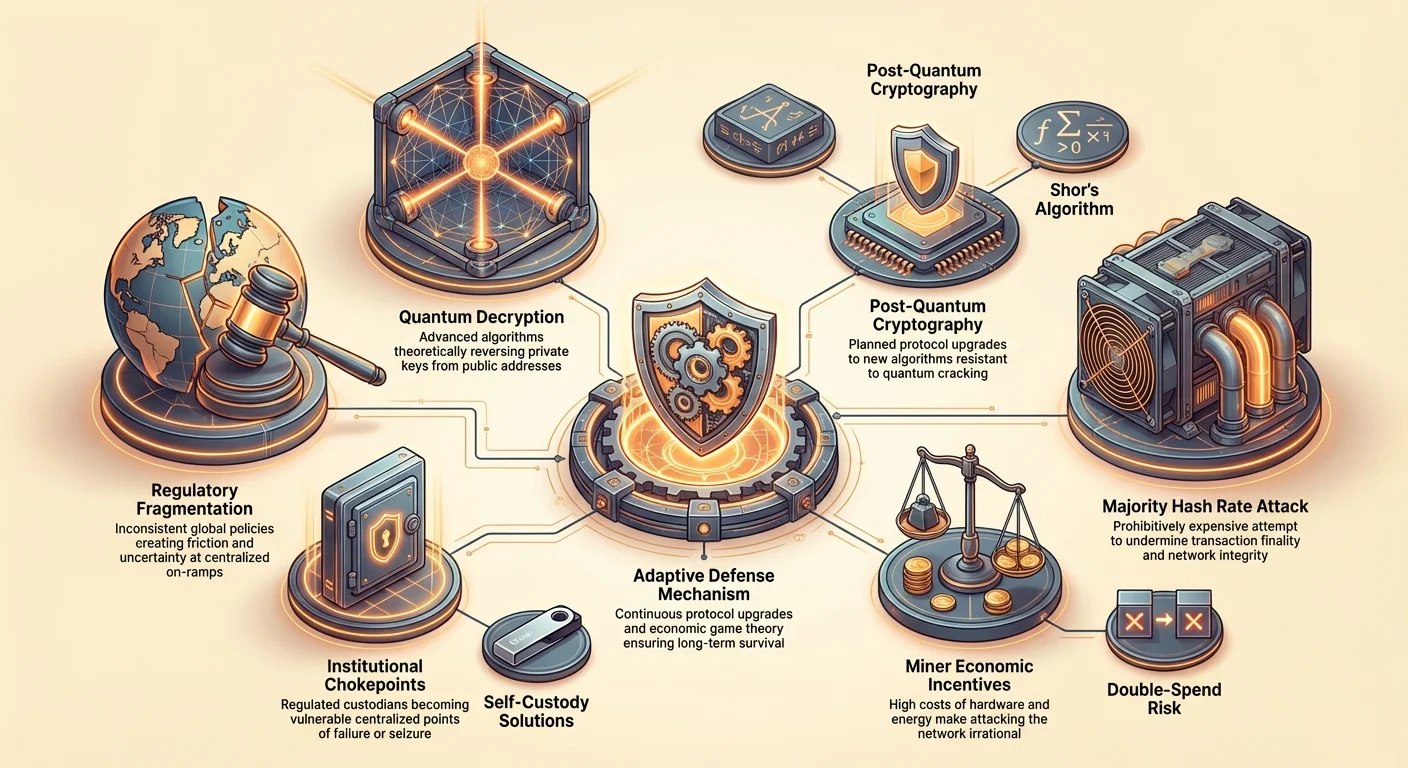
Technological Obsolescence: The Quantum Threat and Beyond
All modern digital security relies on cryptography. Bitcoin, like the global banking system and internet security, uses cryptographic algorithms to secure transactions and verify ownership. The most cited technological systemic risk is the emergence of sufficiently powerful quantum computers capable of breaking current encryption standards.
Understanding the Quantum Computing Threat
Bitcoin primarily uses two types of cryptographic functions:
- Hashing (SHA-256): Used for mining (Proof-of-Work) and linking blocks. Quantum computers accelerate certain types of search algorithms (Grover's algorithm), but the threat to SHA-256 is manageable and requires only a doubling of the hash output (e.g., moving to SHA-512) to restore security. This is generally not considered an existential threat.
- Digital Signatures (Elliptic Curve Digital Signature Algorithm, ECDSA): This is the crucial vulnerability. ECDSA secures your private key. When you send Bitcoin, you use your private key to generate a unique mathematical signature proving ownership.
The critical threat comes from Shor’s algorithm. A quantum computer running Shor's algorithm could efficiently reverse-engineer a private key from its corresponding public key.
The Attack Vector: In current Bitcoin practices, your public key (the address where coins are sent) is exposed only when you spend the coins. Once the public key is exposed on the blockchain, a sufficiently powerful quantum computer could, in theory, deduce the private key almost instantly, allowing the attacker to steal all funds associated with that address.
Vulnerabilities and Mitigation Strategies
While the quantum threat is existential, it is not an immediate one. Experts generally estimate that "cryptographically relevant" quantum computers—machines powerful enough to run Shor’s algorithm efficiently—are likely a decade or more away. This gives the Bitcoin developer community a crucial window of opportunity for mitigation.
The Mitigation Plan: Post-Quantum Cryptography (PQC)
The primary systemic defense against the quantum threat is a protocol upgrade to PQC algorithms. PQC refers to new cryptographic methods that are designed to be secure against both classical and quantum computers.
Implementing PQC in Bitcoin would involve a soft fork (a backward-compatible network upgrade) or a hard fork (a mandatory upgrade). This migration would replace ECDSA with a quantum-resistant signature scheme (e.g., schemes developed under the NIST standardization process).
Current Vulnerabilities:
- Legacy Addresses: Bitcoin spent using older protocols that immediately expose the public key are more vulnerable. Funds held in these addresses might need to be proactively moved to PQC-compliant addresses before the "quantum reckoning" arrives.
- In-Transit Transactions: A transaction broadcast to the network exposes the public key before it is confirmed in a block. A quantum attacker could theoretically steal the funds mid-transaction before the legitimate owner’s transaction is confirmed.
Analyst Focus: The Soft Fork Feasibility The critical question is whether the developer community can achieve consensus to implement such a massive change. While the necessity of the quantum upgrade would be universally accepted, the challenge lies in coordinating millions of users, nodes, and miners to adopt the new standard without creating a chain split, which would itself be a systemic crisis. Given Bitcoin's history of managing contentious upgrades (like SegWit), the capability exists, but the risk of failure to coordinate remains a systemic vulnerability.
Beyond Quantum: Obsolescence of Utility
Another, less publicized technological risk is the obsolescence of Bitcoin’s core utility—its settlement layer—due to superior alternatives.
If a new distributed ledger technology emerged that offered the same level of security and decentralization as Bitcoin, but with drastically faster finality, zero fees, and energy efficiency orders of magnitude better, the market might gradually transition away from Bitcoin.
However, Bitcoin's greatest defense against this risk is its Lindy Effect (the longer something exists, the longer it is likely to continue to exist) and its network effect. It possesses the highest hash rate and the largest established financial infrastructure. New technologies have a high barrier to entry because they must achieve the same scale of trust and security that Bitcoin has built over fifteen years of continuous operation. Obsolescence would require a fundamental, rather than marginal, technological leap.
Unutarnji rizici mreže: Otpornost na 51% napad
Dok vanjske sile poput regulative i kvantne fizike postavljaju prijetnje, Bitcoin se mora zaštititi i iznutra. Najkritičniji unutarnji sustavni rizik je 51% napad, gdje napadač stekne kontrolu nad većinom mrežne hash stope (kolektivne računske snage koju koriste rudari).
Definicija i izvođenje 51% napada
U Proof-of-Work sustavu, rudari valiliraju transakcije i sigurnost mreže. Kontrola 51% hash stope omogućuje napadaču:
- Dvostruko trošenje: Napadač može potvrditi transakciju (npr. slanje Bitcoina na burzu), primiti robe ili usluge u zamjenu za taj BTC, a zatim koristiti svoju većinsku hash snagu da tajno izgradi dužu, konkurentnu verziju blockchaina bez te transakcije. Kada se napadačev tajni lanac otkrije i validira, originalna transakcija se briše, a napadač zadržava i BTC i robu — uspješno dvostruko trošenje.
- Cenzura transakcija: Napadač može spriječiti specifične transakcije (ili sve transakcije od specifičnih korisnika) da se potvrde u blokovima.
Ključno, 51% napad ne može stvoriti novi Bitcoin, ukrasti sredstva iz novčanika koje ne kontrolira ili promijeniti osnovna pravila protokola (poput ograničenja ponude od 21 milijun). Opasnost leži isključivo u narušavanju završnosti transakcija i integriteta mreže.
Ekonomija obrane: Trošak akvizicije
Za manje, manje poznate kriptovalute (altcoine) s niskim hash stopama, 51% napadi su nažalost uobičajeni jer se potrebna hash snaga može jeftino iznajmiti. Bitcoin je međutim zaštićen neviđenom količinom posvećene računske snage, čineći napad ekonomski neizvedivim.
Ekonomska sigurnost Bitcoina oslanja se na čistu, zapanjujuću cijenu akvizicije i održavanja 51% globalne hash stope:
- Trošak hardvera: Početna investicija potrebna za kupnju potrebnog specijaliziranog rudarskog hardvera (ASIC-ova) iznosila bi desetke ili stotine milijardi dolara. Ova oprema je ograničena u ponudi, što znači da jedna entiteta ne bi mogla steći bez podizanja masivnih alarmnih zvona.
- Trošak energije: Napadač bi trebao kontinuiranu, industrijsku razinu potrošnje energije — dovoljno za napajanje malih zemalja — s dnevnim operativnim troškovima u desecima milijuna dolara.
- Trošak prilike: Napadač, uloživši ovaj kapital, odustaje od legitimnog prihoda koji bi zaradio jednostavnim poštenim rudarenjem.
Teorija igara i racionalnost: Da bi 51% napad na Bitcoin uspio, napadač mora potrošiti astronomne sume samo za privremeno dvostruko trošenje i, u tom procesu, trajno uništiti vrijednost imovine u koju je upravo uložio milijarde za sigurnost. Ako vrijednost Bitcoina padne na nulu zbog uspješnog napada, napadačeva investicija u hardver i energiju postaje beskorisna. Bitcoinova sigurnost je time osigurana racionalnim, samointeresiranim ekonomskim akterima.
Teorija smrtne spirale i poticaji rudara
Složeniji unutarnji rizik odnosi se na dugoročnu strukturu poticaja mreže. Bitcoinova sigurnost financirana je iz dva izvora: nagradom bloka (novokovanim BTC) i naknadama za transakcije. Nagrada bloka halvira otprilike svake četiri godine (Halving), smanjujući poticaj rudarima za sigurnost mreže.
Hipoteza „smrtne spirale“: Teorija sugerira da kako nagrade bloka opadaju prema nuli, naknade za transakcije možda neće biti dovoljne da kompenziraju rudare, dovodeći mnoge do gašenja. Ako ukupna hash stopa naglo padne, trošak izvođenja 51% napada pao bi na pristupačnu razinu, dovodeći do kvara sigurnosti i daljnje erozije cijene — silazna spirala.
Protivargumenti i sustavna otpornost:
- Dinamika tržišta naknada: Kako mreža sazrijeva i volumen transakcija raste (posebno kroz skalirajuće slojeve poput Lightning Networka), naknade bi trebale prirodno rasti da kompenziraju rudare. Trošak sigurnosti utemeljen je u korisnosti mreže.
- Otpornost cijene: Povijesno, svaki Halving slijedio je značajan rast cijene BTC-a. Viša cijena BTC-a čini čak i manju nagradu bloka visoko unosnom u dolarima, održavajući hash stopu.
- Podešavanje sigurnosti: Bitcoinov mehanizam podešavanja težine osigurava da rudarenje ostane profitabilno (ili barem konkurentno) bez obzira na broj aktivnih rudara. Ako mnogi rudari odu, težina pronalaženja bloka automatski se smanjuje, čineći lakše i jeftinije preostalim rudarima zaraditi nagradu bloka, time stabilizirajući mrežu.
Sustav je dizajniran da bude dinamički samopopravljajući. Trošak 51% napada ostaje proporcionalan vrijednosti mreže — ako je vrijednost visoka, trošak napada je zabranjeno visok, ojačavajući sigurnost.
Akcijski savjet za analizu investicija: Prilikom procjene sustavnih rizika, razlikujte Bitcoin (teško zaštićeni, vodeći protokol na tržištu) od drugih kriptovaluta. Za manje lance, 51% napad je trenutna i praktična prijetnja; za Bitcoin, ostaje primarno teoretska minimizirana robusnom ekonomskom realnošću.
Zaključak: Due diligence i adaptivna obrana
Sustavni rizici s kojima se Bitcoin suočava — regulatorna nepredvidivost, kvantna prijetnja i unutarnji sukobi poticaja — stvarni su i zahtijevaju kontinuirano praćenje. Međutim, kritička procjena otkriva da Bitcoin posjeduje moćne urođene mehanizme obrane protiv svakog:
- Protiv regulatornih crnih labudova: Decentralizacija i samostalno čuvanje pružaju tehničku otpornost protiv centraliziranog provođenja. Institucionalizacija, iako uvodi nova uska grla, stvara i političku protutežu.
- Protiv tehnološke zastarjelosti: Rizik je vidljiv i daje zajednici developera dovoljno vremena za implementaciju adaptivnih nadogradnji (PQC), koristeći robusni mehanizam konsenzusa mreže.
- Protiv unutarnjih napada: Imensa ekonomska cijena i igaro-teoretski disincentivi ugrađeni u Proof-of-Work sustav čine katastrofalni kvar visoko nevjerojatnim.
Za ozbiljnog investitora, prepoznavanje ovih sustavnih rizika nije razlog za povlačenje, već vitalan korak u razumijevanju prave, dugoročne vrijednosne ponude imovine. Bitcoinova izdržljivost oslanja se ne na stagnaciju, već na sposobnost prilagođavanja i prevladavanja ovih egzistencijalnih prijetnji kroz tehnološke nadogradnje, konsenzus zajednice i neprobojne ekonomske principe. Due diligence zahtijeva fokus na ovu adaptivnu otpornost.