
Za novajlije koji se približavaju prostoru digitalnih imovina, povijest cijene Bitcoina može izgledati nepredvidiva — niz nepredvidivih skokova i dramatičnih padova. Međutim, kada primijenimo strukturirani analitički pristup, uzorci se pojavljuju. Ovi ponavljajući uzorci, poznati kao cikli tržišta, nisu slučajni; oni su pokretani temeljnim mehanizmima ponude Bitcoina i, još važnije, kolektivnim ponašanjem i psihologijom sudionika na tržištu.
Razumijevanje ovih ciklusa tržišta ključno je za svakoga tko želi izgraditi čvrstu investicijsku tezu, prelazeći izvan praćenja samo dnevnih kretanja cijena. Umjesto da vidimo volatilnost kao kaos, učimo prepoznati je kao predvidivu posljedicu ljudskih emocija koje prelaze između ekstremnog straha i iracionalnog oduševljenja.
Ova analiza usvaja perspektivu financijskog analitičara, raspadajući tržište Bitcoina na četiri različite faze. Identificirajući psihološke, tehničke i makroekonomske karakteristike svake faze — Akumulacija, Mark-Up, Distribucija i Mark-Down — investitori mogu razviti robusne strategije dizajnirane za hvatanje dugoročne vrijednosti i minimiziranje izloženosti emocionalnom donošenju odluka.
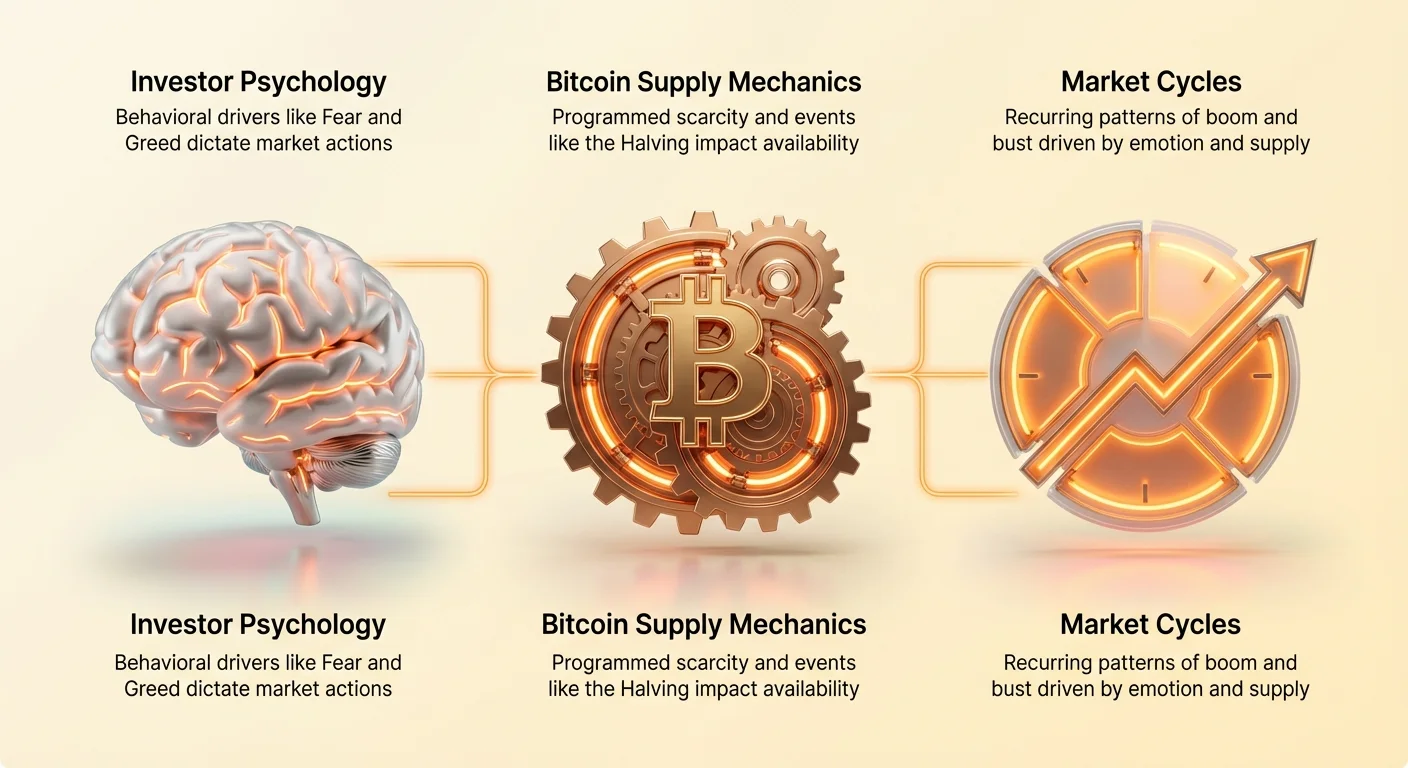
Osnovni mehanizam: Cikli pokretani ljudskom psihologijom
Tradicionalne financije često se fokusiraju isključivo na fundamentalne pokazatelje (zarade, omjere duga). Na mladom i visoko volatilnom kripto tržištu, tehnički mehanizmi ponude se sijeku s moćnim ljudskim emocijama kako bi stvorili ove dramatične ciklove procvata i pada. Volatilnost Bitcoina nije mana, već značajka njegove putanje rasta i statusa rijetke imovine koja se globalno usvaja.
Okvir ciklusa tržišta koji ovdje koristimo potječe iz bihevioralne ekonomije, sugerirajući da je kretanje cijene primarno ogledalo koji odražava prevladavajuće raspoloženje investitora.
Ponašajni komponent: Strah, pohlepa...
Svaki ciklus tržišta može se izravno mapirati na krivulju psihologije investitora. Ova krivulja pokazuje kako kretanje cijene eskalira ljudske emocionalne reakcije, koje zauzvrat potiču sljedeće kretanje cijene:
- Nada/Optimizam: Cijene se stabiliziraju nakon pada; rani investitori počinju osjećati olakšanje.
- Uzbuđenje/Euforija: Cijene dramatično ubrzavaju; pokrivenost medija raste; svi vjeruju da su geniji. Ovo je vrhunac pohlepe.
- Anksioznost/Poricanje: Cijene prestaju rasti i počinju padati; investitori odbijaju prodavati, očekujući da će trend nastaviti.
- Kapitulacija/Očaj: Cijene se ruše; investitori prodaju po bilo kojoj cijeni da zaustave bol. Ovo je vrhunac straha.
Prepoznavanje gdje se tržište trenutno nalazi na ovom emocionalnom spektru fundamentalni je izazov analize ciklusa tržišta Bitcoina. Investitori koji kupuju u fazi očaja i prodaju u fazi euforije često uspijevaju; maloprodajni investitori često rade suprotno.
Uloga volatilnosti u otkrivanju cijene
Bitcoin pokazuje volatilnost značajno veću od tradicionalnih imovina poput zlata ili dionica. Ovo ekstremno kretanje ima ključnu funkciju: otkrivanje cijene. Budući da Bitcoin nema podlogu u korporativnim novčanim tokovima ili opipljivim fizičkim imovinama za modeliranje njegove vrijednosti, njegova cijena neprestano traži ravnotežu na temelju stopa usvajanja, makroekonomske rizike i sigurnosti mreže.
Visoka volatilnost tijekom bikovskih faza (Mark-Up) signalizira brzo usvajanje i masivan priljev kapitala, dok visoka volatilnost tijekom medveđih faza (Mark-Down) signalizira sistematsku averziju rizika i masovnu likvidaciju. Cikli su jednostavno ritmički proces tržišta koje se korigira između ovih dviju ekstremnih točaka.
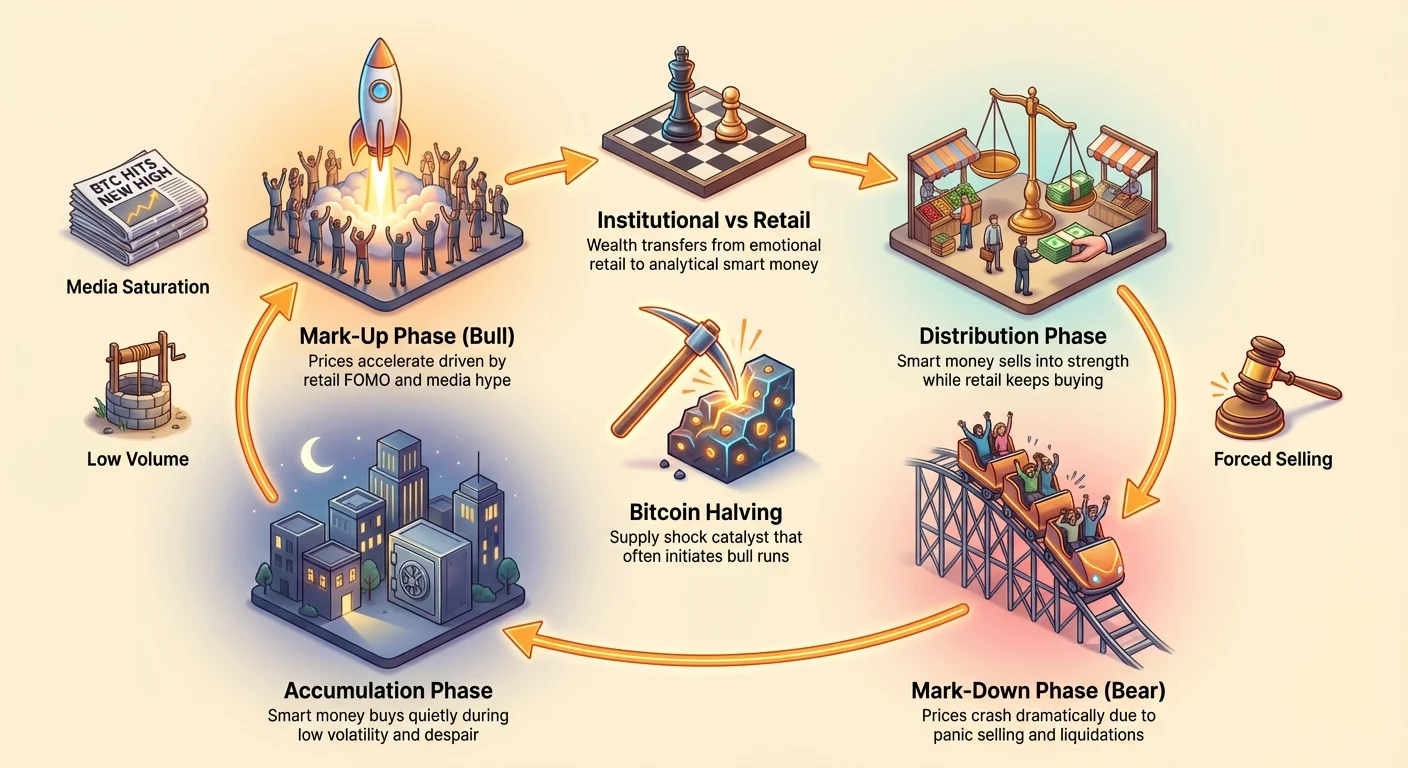
Phase 1: Accumulation (The Hope Phase)
The Accumulation phase marks the beginning of a new cycle and immediately follows the devastating "Capitulation" event of the previous cycle. This period is typically long, boring, and emotionally taxing for those who lived through the preceding crash.
The accumulation zone is defined by consolidation. Price action is flat, liquidity is low, and major institutional players and "smart money" (experienced investors and funds) quietly begin purchasing assets they believe are oversold.
Identifying the Accumulation Zone Indicators
Identifying the true accumulation zone is key to maximizing returns, as this is where asset risk is theoretically lowest relative to potential reward.
The primary indicators of the accumulation zone include:
- Low Volatility and Volume: After the chaos of the crash, daily price swings shrink dramatically. Trading volume often dries up, showing little retail interest.
- Time Duration: Accumulation often lasts 12 to 18 months, representing the market’s need to fully absorb the supply dumped during the preceding crash.
- Advanced On-Chain Metrics: Professional analysts often look for specific on-chain signals that indicate long-term holders are entering the market while short-term speculators have left. For example, when the Spent Output Profit Ratio (SOPR) is consistently below 1, it implies that most people selling are doing so at a loss, a hallmark of the final emotional exhaustion required before a cycle reverses. (For a deeper dive into these tools, see: On-Chain vs. Macro Valuation Models: Tools for Determining BTC Fair Value).
Best Practices for the Patient Accumulator
For investors targeting this phase, patience is the ultimate virtue. This phase tests conviction, as negative news headlines (FUD – Fear, Uncertainty, and Doubt) often proliferate, reinforcing the idea that the asset is "dead."
- Dollar-Cost Averaging (DCA): Because the exact bottom of the accumulation zone is impossible to pinpoint, consistently buying fixed dollar amounts over an extended period smooths out the entry price and negates the need for perfect timing.
- Establish a Base Thesis: Revisit why you believe in Bitcoin’s long-term value. Focus on network growth, hash rate security, and scarcity rather than daily price fluctuations.
- Prepare for Boredom: The accumulation phase lacks the excitement of the bull market. Use this quiet time for education and strategy refinement.
Phase 2: Mark-Up (The Greed Phase / Bull Market)
The Mark-Up phase is the most celebrated period of the cycle, commonly referred to as the Bull Market. It begins when the price breaks out of the accumulation range, usually triggered by a significant macroeconomic shift or a supply-side shock.
During Mark-Up, confidence returns. The price rises slowly at first, convincing skeptical investors, then accelerating into a parabolic ascent driven by retail and media excitement.
The Cyclical Relationship with the Halving
The primary structural catalyst historically associated with initiating the Mark-Up phase is the Bitcoin Halving. Approximately every four years, the reward miners receive for validating transactions is cut in half.
This event directly impacts the available supply of new Bitcoin entering the market, creating a structural supply shock against a backdrop of increasing demand. Historically, the most intense Mark-Up (bull market) phases begin roughly 12–18 months after a halving event, once the supply squeeze has fully materialized.
This relationship demonstrates how structural economics influence market behavior, moving prices from the flat Accumulation phase into the explosive Mark-Up. (For detailed analysis, see: Supply Shock Economics: Analyzing the Bitcoin Halving Cycle and Pre/Post-Event Pricing).
Warning Signs During Exponential Growth
While the Mark-Up phase is profitable, it harbors the greatest risk for new investors who suffer from FOMO (Fear of Missing Out). As the Mark-Up accelerates, price increases become exponential, signaling that the move is unsustainable.
Key behavioral and technical indicators that the Mark-Up is maturing include:
- Retail FOMO: New, highly leveraged capital (retail investors) enters the market, often buying assets without understanding the underlying technology or risk.
- Media Saturation: Bitcoin becomes front-page news; celebrity endorsements and mainstream finance coverage treat the asset as a guaranteed win.
- "Top Signal" Memes: When price targets become highly aggressive, such as calling for 10x returns in a matter of weeks, it signals irrational euphoria.
- Exchange Liquidity: Institutions and experienced traders often look at the supply of Bitcoin held on centralized exchanges. If this supply drastically decreases during a bull run, it suggests investors are moving their crypto into self-custody for the long term. Conversely, if supply increases rapidly, it indicates potential sellers preparing to distribute.
Phase 3 & 4: Distribution and Mark-Down (The Fear Phases)
The Mark-Up cannot last forever. Once momentum fades, the cycle shifts into the most dangerous periods for investors: Distribution and the ensuing Mark-Down.
Identifying Market Tops (Distribution)
Distribution is the subtle, often lengthy process where smart money (institutional funds and long-term holders) strategically sells their accumulated assets to the new retail buyers pouring in during peak euphoria. This phase is characterized by extreme volatility but little net upward movement.
Market top indicators during the Distribution phase include:
- Divergence in Volume and Price: The price hits a new high, but the volume supporting that move is significantly lower than previous highs. This suggests that fewer people are willing to buy at that price point.
- Long Consolidation with Weak Highs: The asset trades in a choppy range, unable to break significantly higher. The early sellers are able to offload large positions without crashing the price because retail buyers are soaking up the supply.
- Institutional Selling into Strength: Major corporate treasury movements or institutional ETF outflows may signal professional actors are taking profits.
Once the initial distribution is complete and buyers are exhausted, the price inevitably begins its descent.
The Capitulation Event (Mark-Down)
The Mark-Down is the official Bear Market phase, representing the full psychological shift from greed to panic. Prices decline steadily at first, moving through periods of denial ("It’s just a healthy correction") and finally into the devastating Capitulation.
Capitulation is the point of maximum pain, defined by sharp, severe drops in price driven by forced selling and margin calls.
- Forced Selling: Highly leveraged traders who borrowed money to buy during the Mark-Up are liquidated (forced to sell their assets by the exchange). This creates massive cascade effects, driving the price down rapidly.
- Media Panic: Financial media shift from hyping the asset to predicting its demise. This sensationalism further fuels the retail exodus.
- Duration: Mark-down phases can be swift (a few months of intense selling) but often lead directly into the slow, grueling 12–18 month period of re-accumulation.
Retail vs. Institutional Behavioral Patterns
Understanding btc bull vs bear phases is impossible without distinguishing the behavior of different market actors:
| Actor Type | Primary Action During Bull (Mark-Up) | Primary Action During Bear (Mark-Down) |
|---|---|---|
| Retail Investor | Buys aggressively during high volatility (FOMO), often using leverage. | Sells aggressively during crashes (Capitulation), locking in losses. |
| Institutional/Smart Money | Sells strategically into retail strength (Distribution). | Buys strategically during low volatility (Accumulation). |
| Long-Term Holders | Holds through the cycle, sometimes selling a fraction near the peak, but primarily focuses on network security. | Holds through the bear market, often increasing positions. |
The market cycle effectively transfers wealth from the psychologically driven retail investors (who follow emotion) to the analytically driven smart money (who follow the cycle framework).
Primjena okvira: Strategije za različite faze
Analiza ciklusa tržišta nije samo akademska; ona je ključni alat za razvoj praktičnih, upravljanih rizikom investicijskih strategija. Salignanjem svojih akcija s prevladavajućom fazom, značajno poboljšavate vjerojatnosti uspjeha.
Važnost dugoročnog vremenskog horizonta
Najmoćnija lekcija iz ciklične analize je nužnost dugoročnog vremenskog horizonta. Bitcoin je dosljedno pokazao da vrhunac prethodnog ciklusa na kraju postaje podlog (ili razina podrške) za sljedeći ciklus.
Budući da se Bitcoin često navodi zbog svog potencijala kao store of value — imovina očekivana da održi ili poveća svoju kupovnu moć tijekom dugih razdoblja — investitori se moraju pripremiti za podnošenje višegodišnjih padova. Faze Mark-Down i Akumulacije neophodni su reseti koji odbacuju slabe ruke i pripremaju temelj za sljedeći eksplozivni Mark-Up.
Matriks taktičke strategije
| Faza | Raspoloženje investitora | Preporučena akcija | Postava rizika |
|---|---|---|---|
| Akumulacija | Očaj, dosada | Sistematske DCA kupnje. Uspostavite jezgru poziciju. | Visoka nagrada/Nizak percipirani rizik |
| Mark-Up (Rana) | Nada, optimizam | Držite jezgru poziciju. Pratite modele valorizacije. | Umjeren rizik |
| Mark-Up (Kasna/Euforija) | Pohlepa, uzbuđenje | Smanjite rizik. Ostvarite djelomične profite ili postavite stop-loss. | Ekstremni rizik |
| Distribucija | Anksioznost, poricanje | Prestanite kupovati. Fokusirajte se na zaštitu kapitala. | Visok rizik |
| Mark-Down | Strah, kapitulacija | Izbjegavajte emocionalnu prodaju. Pripremite gotovinu za fazu Akumulacije. | Ekstremni rizik/Kratkoročna bol |
Ovaj okvir služi kao disciplinska kontrapunkt emocionalnim zamahu kripto tržišta. Zamjenjuje reaktivni FOMO i paničnu prodaju proaktivnim, izračunatim odlukama temeljenim na strukturnoj i psihološkoj analizi.
Zaključak
Cikli tržišta Bitcoina fundamentalna su značajka povijesti cijene imovine, odražavajući jedinstvenu mješavinu njegove programirane rijetkosti (Halving) i univerzalnih uzoraka psihologije investitora (strah i pohlepa). Usvajanjem četverofaznog modela — Akumulacija, Mark-Up, Distribucija i Mark-Down — investitori mogu prijeći izvan jednostavnog chartinga cijena i integrirati moćan bihevioralni ekonomski okvir u svoju analizu.
Konačni cilj analize ciklusa tržišta Bitcoina nije predviđanje točne cijene, već identificiranje gdje smo u emocionalnom putovanju. Samodostatnost u digitalnoj ekonomiji počinje samokontrolom, a ovladavanje cikličnom prirodom volatilnosti prvi je korak prema postajanju zaista discipliranog investitora.