
The ability to spend cryptocurrencies in the real world is the ultimate test of their utility. While holding digital assets in a secure wallet is essential, true integration into daily life requires fast, affordable, and seamless payment infrastructure. For beginners entering the crypto space, two primary methods emerge for spending their digital wealth: the familiar structure of a centralized crypto debit card, or the technologically advanced path of decentralized payment rails accessed via a Web3 wallet.
This guide moves beyond simple product listings to explore the underlying infrastructure, comparing the convenience of traditional finance integration with the control and cost-efficiency offered by native decentralized solutions. Understanding the technology—whether it’s a Layer 2 scaling solution or a conventional Visa network—is key to becoming a strategic “crypto power user.”
We will compare how centralized services offer instant fiat conversion at the cost of control, versus how true Web3 payment rails leverage scaling technologies to deliver low-cost, direct peer-to-peer (P2P) transactions, preserving the decentralized ethos of digital currency.
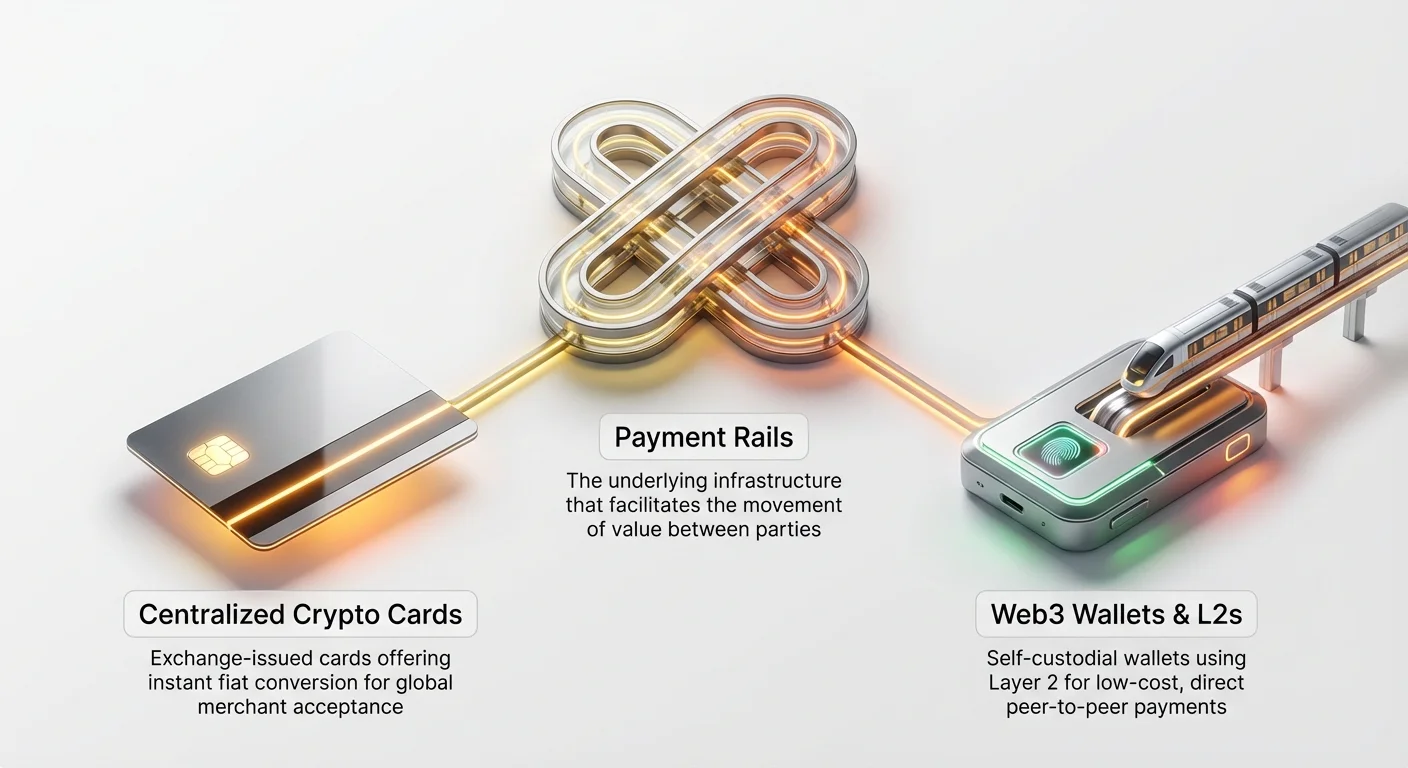
1. The Centralized Solution: Convenience Through Compromise
For many newcomers, the easiest way to spend crypto is through a centralized crypto card. These solutions bridge the gap between the cryptocurrency world and the traditional banking system (often called fiat systems, referring to government-issued currencies like USD, EUR, or JPY).
How Centralized Crypto Cards Function
A centralized crypto card, typically branded by major networks like Visa or Mastercard, is issued by a centralized exchange (CEX) or a specialized financial service provider. The core mechanism is a simple conversion process:
- Funding: The user loads their card account with crypto (e.g., Bitcoin, Ethereum, stablecoins) held on the CEX platform.
- Point of Sale (PoS): When the user swipes the card at a coffee shop or retailer, the merchant receives a fiat currency request (e.g., $5 USD).
- Instant Conversion: The centralized card issuer immediately sells the exact amount of crypto required from the user’s balance to cover the $5 fiat payment. This conversion happens behind the scenes, instantly, and requires no awareness from the merchant.
- Traditional Settlement: The transaction then settles through the traditional payment network, exactly like a standard debit card.
The key takeaway here is that you are rarely, if ever, paying the merchant in actual crypto. You are paying them in fiat, and the CEX is simply liquidating your crypto asset to fund the payment.
The Trade-Offs of Centralization
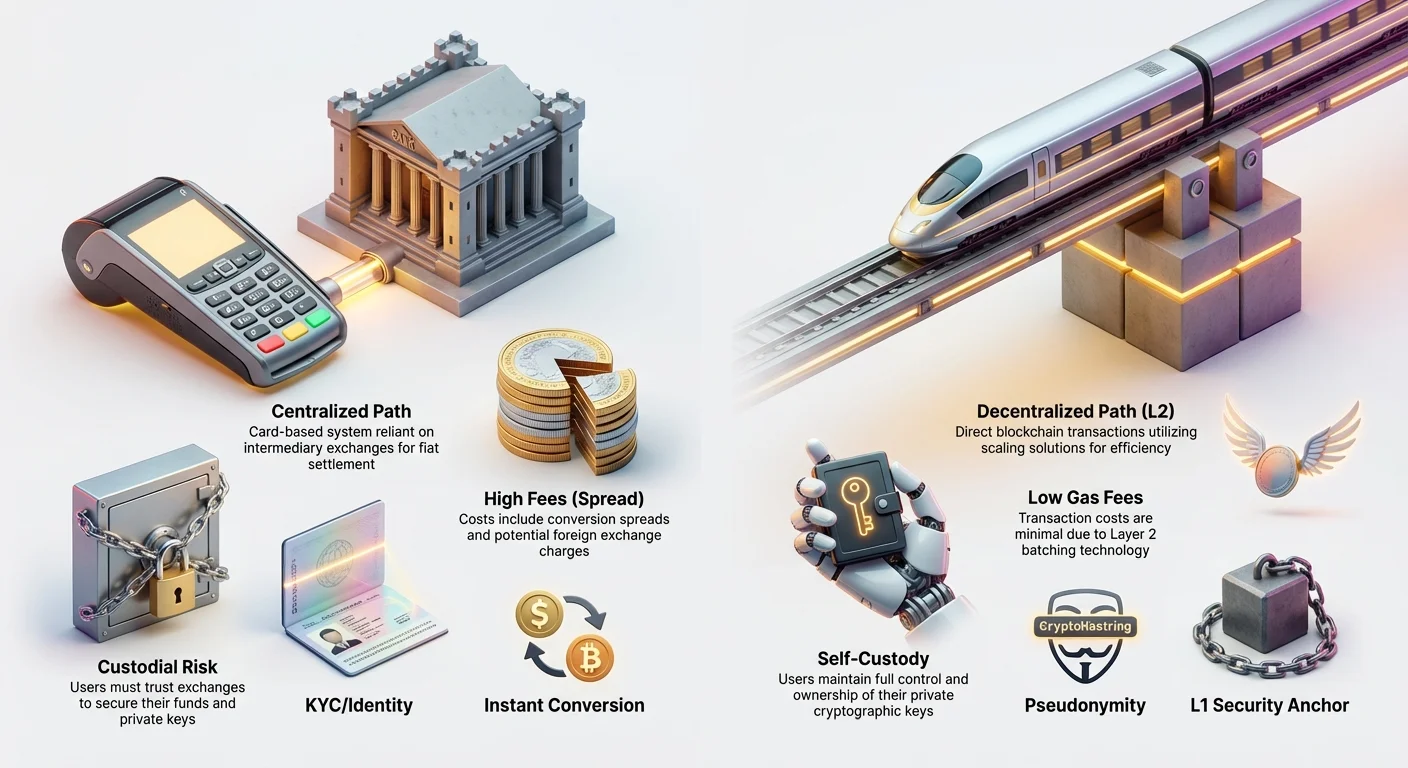
While these cards offer unmatched ease of use—working anywhere standard cards are accepted—they inherently reintroduce elements that cryptocurrency was designed to bypass:
A. Required Know-Your-Customer (KYC) Processes
Because centralized cards operate within regulated financial systems, users must undergo strict KYC checks, providing identification and proof of address. This sacrifices the pseudonymity often valued in Web3.
B. Custody and Security Risk
To use the card, the user must typically keep their funds on the centralized exchange. This means the CEX has custody of the funds, exposing the user to potential exchange hacks or regulatory shutdowns. You do not hold the private keys.
C. Conversion and FX Fees
While many cards advertise low fees, users often incur costs related to the conversion rate (spread) applied when liquidating crypto to fiat. If the card is used internationally, foreign exchange (FX) fees may also apply, making the true cost of the transaction variable.
2. The Decentralized Path: Web3 Wallets and Direct Rails
Decentralized crypto spending, utilizing a Web3 wallet (like MetaMask, Trust Wallet, or Phantom), represents the ultimate vision of peer-to-peer digital cash. This approach bypasses traditional banks and card networks entirely, sending crypto directly from the spender’s wallet to the merchant’s wallet address.
Defining Web3 Wallets and Self-Custody
A Web3 wallet is a crucial tool in this process. Unlike the account you hold on a centralized exchange, a Web3 wallet is non-custodial or self-custodial. This means you and only you hold the private keys (the cryptographic proof of ownership).
When you pay using a Web3 wallet, you are initiating a transaction directly on the blockchain. The funds move immediately from your control to the recipient’s control without any third-party intermediary required for verification, conversion, or settlement.
The Challenge of Layer 1 Limitations
While direct wallet payments are philosophically pure, the underlying technology of early blockchains (known as Layer 1, or L1) presented major scalability problems for everyday spending:
A. High Transaction Fees (Gas)
Blockchains like the main Ethereum chain (L1) require users to pay a fee, known as "gas," to network validators for processing and securing the transaction. During periods of high network congestion, this gas fee can soar to tens or even hundreds of dollars. Paying $50 in gas for a $4 coffee is obviously unsustainable.
B. Slow Confirmation Times
Traditional L1 blockchains were designed for security and immutability, not speed. A Bitcoin transaction can take 10 minutes to confirm, and an Ethereum transaction might take several minutes—far too long for a retail point-of-sale environment.
These limitations demonstrate why, historically, centralized cards were the only viable retail solution. However, the development of specialized payment infrastructure—Layer 2 solutions—has fundamentally changed the landscape, enabling true, decentralized crypto spending.
3. Scaling Solutions: The Engine of Decentralized Spending
To make decentralized crypto payments feasible, developers built scaling solutions that allow transactions to be executed quickly and cheaply off the main blockchain, while still inheriting the L1's security guarantees. These systems are the core of true decentralized payment rails.
Understanding Layer 2 Protocols
A Layer 2 (L2) protocol is a separate framework built on top of a Layer 1 blockchain, designed to handle a massive volume of transactions without overloading the main chain. Think of the L1 as a highly secure vault (slow but safe) and the L2 as a high-speed expressway built specifically for moving value around the city.
A. The Lightning Network (Bitcoin)
The Lightning Network (LN) is arguably the most successful L2 payment rail to date, specifically designed for Bitcoin.
- Payment Channels: LN uses "payment channels," which are secure, private, two-way pathways between users. Instead of broadcasting every micro-transaction to the main Bitcoin blockchain, users settle thousands of transactions within this channel off-chain.
- Speed and Cost: Transactions on the Lightning Network are near-instant (seconds) and cost fractions of a cent. This makes LN ideal for micropayments, like buying a sandwich or tipping a content creator.
- Practical Example: If you use a wallet that supports the Lightning Network (like Wallet of Satoshi or Phoenix), you can scan a QR code at an accepting merchant and pay instantly in BTC, confirming the transaction before you’ve even put your phone away.
B. Ethereum Rollups (Optimistic and ZK)
Ethereum, due to its complex smart contract capabilities, uses different L2 approaches called "Rollups."
- How They Work: Rollups execute transactions off-chain (on the L2 network) and then "roll up" or bundle thousands of these transactions into a single batch. This batch is submitted back to the Ethereum L1, where it is verified. Because the L1 only has to process one proof instead of thousands of individual transactions, gas costs are drastically reduced.
- Key Platforms: Arbitrum and Optimism are two prominent examples of these rollup chains that facilitate fast, cheap, and secure spending for tokens and decentralized applications (dApps).
C. High-Performance Sidechains and L1s
While technically separate, some high-performance blockchains or dedicated sidechains function similarly to L2 payment rails due to their inherent speed and low cost:
- Solana: Often utilized for its exceptionally high throughput (transactions per second) and minuscule transaction fees, Solana has developed an ecosystem focused on fast consumer transactions and remittances.
- Polygon (Sidechain): Polygon functions as a separate, faster chain compatible with Ethereum, allowing users to spend tokens quickly and cheaply, effectively serving as an affordable payment layer.
4. Practical Comparison: Card vs. Rail Strategy
Choosing between a centralized card and a decentralized payment rail depends entirely on your priority: maximum convenience or maximum control and low cost. The strategic crypto user understands when to deploy each tool.
Comparison of Key Factors
| Feature | Centralized Crypto Card | Decentralized Payment Rail (L2/Web3) |
|---|---|---|
| Custody | Custodial (Exchange holds private keys) | Non-Custodial (User holds private keys) |
| Merchant Acceptance | Global (Anywhere Visa/Mastercard is accepted) | Limited (Only merchants/websites accepting native crypto) |
| Privacy / KYC | Full KYC required; transactions trackable by the issuer. | Pseudonymous; no KYC required for payment initiation. |
| Transaction Speed | Instant (Settlement occurs later via traditional rails) | Near-instant (Seconds, depending on L2 finality) |
| Fees | Conversion fees, FX fees, withdrawal fees, annual fees. | Tiny gas fees (often fractions of a cent on L2). |
| Asset Type | Only assets supported by the CEX (usually major coins/stablecoins). | Any token or asset supported by the native L2/L1 protocol. |
Use Case Scenarios for Strategic Spending
The following scenarios illustrate when one method clearly outweighs the other:
Scenario A: Daily Coffee Shop Run (Low-Value, High-Frequency)
- Best Tool: Decentralized Payment Rail (Lightning Network or L2 using a fast L1 stablecoin).
- Why: The goal is maximum efficiency and minimum cost. Paying $0.001 in fees is significantly better than incurring a 1-2% conversion spread fee from a centralized card issuer, especially on small transactions.
Scenario B: International Travel and Hotel Bookings (High-Value, Low-Frequency)
- Best Tool: Centralized Crypto Card.
- Why: Merchant acceptance is paramount. Attempting to use a decentralized rail internationally is highly impractical, as the overwhelming majority of traditional businesses do not accept native crypto. The CEX card ensures global utility, trading fee efficiency for reliability.
Scenario C: Purchasing a Digital NFT or Web3 Service
- Best Tool: Decentralized Payment Rail (Web3 Wallet).
- Why: These services are native to the blockchain ecosystem. They require direct interaction with smart contracts and often necessitate paying gas fees in the native chain token (e.g., ETH on an Arbitrum L2). A centralized card cannot facilitate these transactions.
Scenario D: Payments in Unstable Economies or High Inflation Zones
- Best Tool: Decentralized Payment Rail (often using a stablecoin on an L2).
- Why: In regions where access to banking is difficult or local fiat currency is rapidly devaluing, decentralized stablecoin rails offer a fast, censorship-resistant, and predictable store of value and payment method that cannot be seized or frozen by banks.
5. Understanding Transaction Costs in Depth
The cost structure is the most technical but critical difference between the two payment systems.
Centralized Card Fees: The Invisible Spread
When a centralized exchange converts your crypto to fiat, they typically charge a fee through two mechanisms:
- The Spread: This is the difference between the price at which the exchange buys the asset and the price at which it sells the asset to fund your transaction. If the live market price of BTC is $60,000, the CEX might sell yours for $59,800, pocketing the $200 spread. While this spread is tiny on small purchases, it accrues over time.
- Explicit Conversion Fees: Some cards charge a flat percentage (e.g., 0.5% to 3%) every time a conversion takes place, especially if you use a card that pulls from a volatile asset like BTC rather than a stablecoin.
Decentralized Rail Costs: Minimizing Gas
The cost of decentralized spending is almost entirely tied to the gas fee required to process the transaction. The goal of Layer 2 solutions is to drive this cost as close to zero as possible.
Gas Fee Structure on L2s
When you use a rollup or a payment channel:
- Execution Fee: The tiny amount required to process the transaction on the L2 itself.
- L1 Data Posting Fee: The cost required to bundle and post the transaction proof back to the secure Layer 1 blockchain.
Because the L2 amortizes (spreads out) the high L1 gas cost across thousands of users bundled into one proof, the cost per user drops dramatically, usually to below $0.05, regardless of the transaction size.
Cost Efficiency Comparison
If a power user transacts 20 times per month with an average transaction size of $25:
| System | Fee Structure | Estimated Monthly Cost |
|---|---|---|
| Centralized Card | Average 1.5% conversion spread | $7.50 |
| Decentralized Rail (L2) | Average $0.05 execution fee | $1.00 |
Over the course of a year, the decentralized rail offers significant savings, reinforcing its position as the strategic choice for high-frequency crypto spending.
6. Privacy, Identity, and Control: The Philosophical Divide
The decision between a centralized card and a decentralized rail often comes down to fundamental views on financial privacy and personal autonomy.
KYC and the Loss of Pseudonymity
Centralized cards operate as regulated financial instruments. This means all spending activity is tied directly to your legal identity via the KYC process. The issuing exchange must report transactions and adhere to government regulations regarding capital gains taxes and anti-money laundering (AML).
While this offers convenience and security (if your card is lost, you can call the CEX to freeze it), it eliminates any semblance of financial privacy. Every single purchase is logged and linked to your name.
Web3 Payments: Trustless and Censorship-Resistant
Decentralized payments operate using blockchain addresses that are pseudonymous—they are linked to a string of numbers and letters, not a government ID.
Financial Freedom and Control
Because decentralized payments are trustless (verified by cryptography, not a bank) and self-custodial, they offer inherent censorship resistance.
- No Freezing: No central authority (including the wallet provider or the government) can unilaterally freeze or seize the funds in a self-custodial wallet.
- Global Access: As long as you have internet access and your seed phrase, you can initiate a payment anywhere in the world, regardless of political borders or banking restrictions.
The Privacy Paradox
It is crucial to understand that standard blockchain transactions are pseudonymous, not fully anonymous. While your real name isn't attached to the address, all transactions are recorded permanently on the public ledger. Sophisticated blockchain analytics firms can often link patterns of spending or deposits to external identifiers, potentially de-anonymizing users.
For maximum privacy, users must employ dedicated privacy-focused cryptocurrencies or protocols, but even standard L2 transactions offer a far greater degree of financial separation from traditional oversight compared to a centralized card.
The Weakest Link: The On/Off Ramps
The primary interface between the crypto economy and the fiat economy is the point where funds enter or exit the system (the "on-ramp" and "off-ramp").
If you acquire your crypto through a centralized, KYC-compliant exchange, even if you spend it later using a decentralized rail, the initial source of the funds is known. Similarly, if a merchant receives payment via a decentralized rail and then transfers those crypto funds to a centralized exchange to convert them back to fiat, that conversion acts as an off-ramp, linking the funds to a legal identity.
True end-to-end decentralized commerce requires both the consumer and the merchant to operate primarily within the Web3 economy, minimizing reliance on traditional banking off-ramps.
7. Strategic Integration: Moving Towards Crypto Power Usage
For the beginner looking to transition into a crypto power user, the goal is to integrate decentralized payment rails seamlessly into daily financial habits, only relying on centralized cards when absolute global merchant acceptance is required.
Best Practices for Maximizing Utility
1. Prioritize Stablecoin Spending on L2s
Volatile assets like Bitcoin and Ethereum are generally better held as investments. For spending and day-to-day payments, use stablecoins (digital currencies pegged 1:1 to fiat, like USDC or USDT) routed through a Layer 2 network (Lightning, Polygon, Arbitrum). This removes the risk of market volatility between the moment you decide to pay and the moment the transaction confirms, and minimizes potential tax events.
2. Choose Wallets with Native L2 Support
Ensure your preferred Web3 wallet is not just a basic Ethereum L1 wallet, but one that natively integrates fast payment solutions. Look for wallets that support:
- Lightning Network payments (for BTC).
- Multiple L2s (Optimism, Arbitrum, etc.) for general token spending.
- Fast L1/Sidechains (Solana, Polygon).
3. Understand Tax Implications
In many jurisdictions, spending crypto is classified as a taxable event (a capital gain or loss) if the asset has appreciated or depreciated since you acquired it.
- Centralized Cards: The exchange often tracks and reports these events automatically, simplifying tax documentation but centralizing control.
- Decentralized Rails: The user is fully responsible for tracking the cost basis of the assets spent. Using stablecoins for spending minimizes these tracking complexities, as their value is theoretically constant.
4. Educate Merchants (Where Possible)
The adoption of decentralized rails hinges on merchant acceptance. If you are a business owner or interacting with small vendors, advocating for and setting up simple Lightning or Solana payment processors helps build out the necessary decentralized infrastructure. These setups are often cheaper for the merchant than traditional card processing fees (which can range from 2% to 4%).
The Future of Payment Rails: Convergence
As the technology matures, the line between centralized cards and decentralized rails is beginning to blur. Some innovative companies are building "hybrid" solutions:
- Self-Custodial Card Services: These services link a user's self-custodial Web3 wallet directly to a traditional payment card network. The funds remain in the user's control until the exact moment of transaction, where a smart contract or regulated custodian facilitates the instant conversion and payment. This offers the best of both worlds: self-custody with global acceptance.
- L2-Integrated Merchant Tools: As L2 networks become dominant, point-of-sale systems will begin to natively integrate crypto payment acceptance directly. In the future, every checkout terminal could have a single QR code capable of receiving payments across dozens of different L2 networks instantly.
Conclusion: Choosing Control or Convenience
Navigating the world of crypto payments requires a fundamental choice: do you prioritize the immediate convenience and global compatibility offered by Centralized Crypto Cards, or do you value the low cost, self-custody, and financial autonomy inherent in Decentralized Payment Rails?
The centralized card is your easy bridge, relying on established banking infrastructure but bringing back the fees, KYC, and custodial risk of traditional finance. It is an excellent tool for beginners and for spending in the legacy world where crypto is not accepted.
The decentralized rail, powered by Layer 2 scaling solutions like Lightning and Rollups, is the future of digital currency. It offers near-zero cost, instant transactions, and true financial sovereignty via your Web3 wallet. This is the strategic choice for high-frequency transactions and engagement within the native Web3 ecosystem.
For the advanced crypto user, the key is not to choose one permanently, but to strategically deploy both: the card for global travel and quick, unfamiliar purchases; the Web3 wallet and L2 rails for daily spending, remittances, and full engagement with the decentralized economy. By understanding the underlying infrastructure, you equip yourself to maximize rewards, minimize fees, and maintain control over your digital assets.