
Accessing the cryptocurrency market requires a reliable bridge between traditional finance and digital assets. This bridge, often referred to as an "on-ramp," is defined by the payment methods a platform accepts. For traders and investors, the choice of how to fund an account is just as critical as selecting the assets to buy.
The method of deposit dictates transaction speed, fee structures, and security levels. It also influences which platforms are available to a user based on their geographic location.
This guide provides a comprehensive analysis of crypto platforms categorized by their primary payment methods. It explores the mechanics of bank transfers, card payments, and digital wallets. It also examines how leading exchanges integrate these systems to serve different types of market participants.
Understanding the Crypto Payment Ecosystem
The landscape of cryptocurrency exchanges has evolved significantly since the early days of Bitcoin. Initially, funding an account was a complex process often involving international wires to unregulated entities. Today, the ecosystem is far more sophisticated.
Centralized exchanges (CEX) and brokerage platforms now function much like traditional financial institutions. They maintain relationships with banks and payment processors to facilitate the movement of fiat currency.
These relationships determine the speed and cost of entry for the user. A platform with strong banking ties can offer instant settlement and low fees. A platform without these connections may rely on third-party processors that charge higher premiums.
The Distinction Between Exchanges and Brokers
It is important to distinguish between varying types of trading venues when discussing payment methods. Centralized exchanges act as intermediaries. They match buyers and sellers in an open market.
When a user funds an account on an exchange, they typically hold a fiat balance until they choose to execute a trade. This model is common for platforms like Coinbase and Binance.
Cryptocurrency brokers operate differently. They often sell assets directly to the user at a set price. This price usually includes a "spread," which is the difference between the market price and the price offered to the client.
Brokers focus on simplicity and ease of access. They prioritize user-friendly interfaces and streamlined payment processes. However, this convenience often comes with higher costs compared to the open market structure of a traditional exchange.
The Role of Regulation in Payment Options
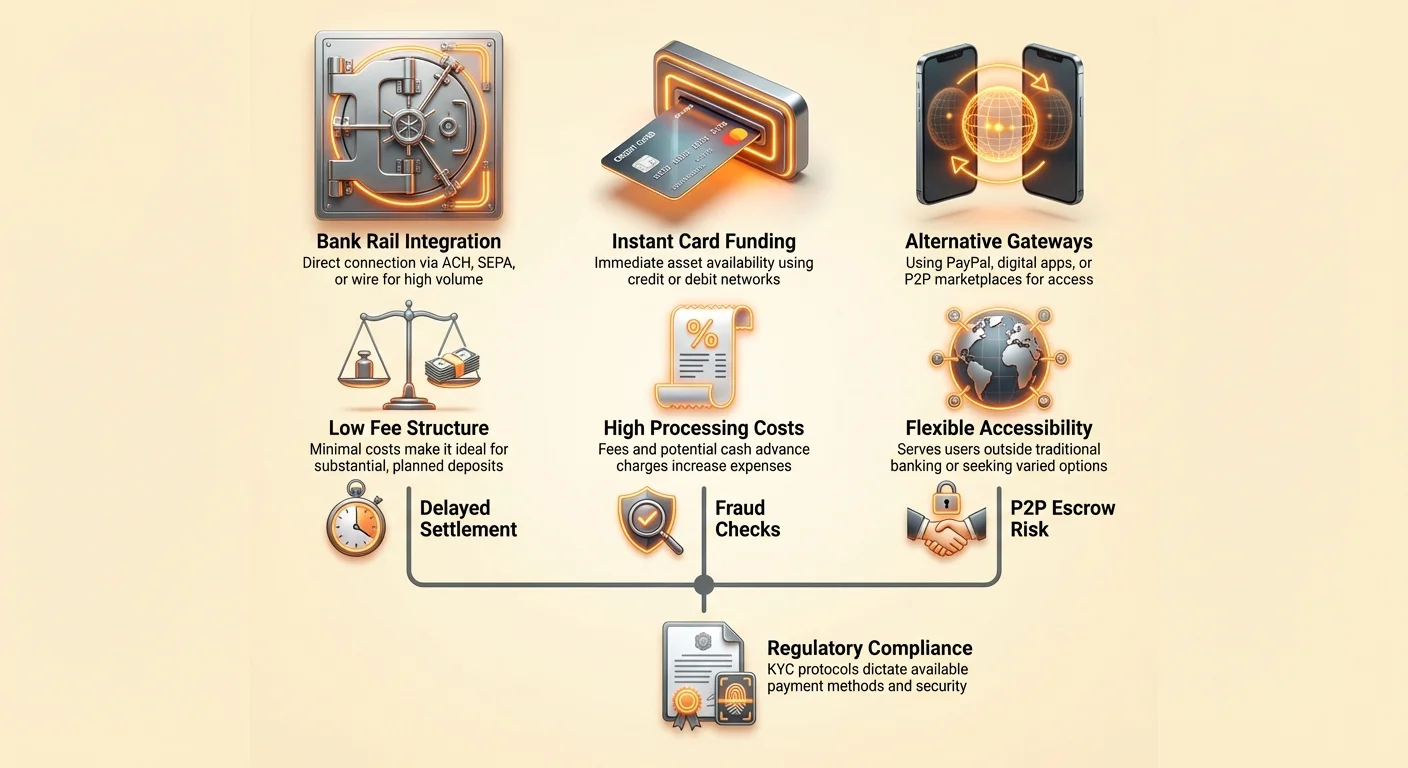
Regulatory compliance is the primary factor influencing which payment methods an exchange can offer. Platforms that implement strict Know Your Customer (KYC) protocols are more likely to secure partnerships with major banks and credit card issuers.
Exchanges that prioritize anonymity or lack regulatory licenses often struggle to maintain stable fiat gateways. These platforms may rely heavily on cryptocurrency deposits or Peer-to-Peer (P2P) marketplaces to facilitate entry.
For users in regions like the United States or Europe, regulated platforms offer the most diverse payment options. These include direct bank links, instant card purchases, and integration with regulated payment providers like PayPal.
Bank Transfers: The Foundation of High-Volume Trading
Direct bank transfers remain the most common and cost-effective method for funding cryptocurrency accounts. This method is favored by institutional investors and retail traders moving significant capital.
Bank transfers are generally slower than other methods but offer the lowest fee structure. They are the preferred route for "makers" and "takers" who plan their entry points and do not require instant execution.
ACH and Domestic Wire Transfers
In the United States, the Automated Clearing House (ACH) system is the standard for connecting a bank account to a crypto exchange. ACH transfers are typically free or carry a nominal fee.
However, ACH transfers are not instant. They can take several business days to clear. Some platforms, such as Coinbase, offer instant trading credits for ACH deposits. This allows users to buy crypto immediately, though they cannot withdraw the funds until the bank transfer clears.
Wire transfers are faster but more expensive. They are used for larger sums where the flat fee is negligible compared to the deposit size. Wires are irreversible, which reduces fraud risk for the exchange.
SEPA and Regional Payment Rails
In Europe, the Single Euro Payments Area (SEPA) network facilitates bank transfers. SEPA transfers are often faster and cheaper than US-based ACH transfers. Many European-licensed exchanges, such as Bitpanda, leverage this network to offer near-instant deposits at low costs.
Other regions have their own rapid payment rails. The UK uses the Faster Payments Service (FPS), while Australia uses PayID. Exchanges that integrate these local rails provide a superior user experience compared to those relying solely on international SWIFT transfers.
SWIFT transfers are the fallback for international deposits. They are slow, expensive, and subject to intermediary bank fees. Traders should avoid SWIFT whenever a local option is available.
Security Implications of Bank Links
Linking a primary bank account to a crypto exchange requires a high level of trust. Security features become paramount in this scenario. Users must evaluate the platform’s track record and security protocols.
Exchanges like Coinbase and Gemini emphasize their regulatory compliance and insurance policies. They use cold storage for the majority of digital assets to protect against online threats.
Cold storage involves keeping private keys offline, disconnected from the internet. This ensures that even if the exchange's web servers are compromised, the core funds remain secure. When linking a bank account, selecting a platform with robust cold storage policies is essential.
Credit and Debit Cards: Speed vs. Cost
For many beginners, credit and debit cards represent the most familiar way to purchase goods and services online. Crypto exchanges have adopted this method to lower the barrier to entry.
Card payments offer speed and convenience. A user can see a price, enter their card details, and own the asset within seconds. This immediacy appeals to retail investors reacting to sudden market movements.
The Mechanics of Card Processing
When a user buys crypto with a card, the exchange acts as a merchant. However, the underlying transaction is complex. Credit card networks categorize crypto purchases as "high risk."
This classification often leads to higher processing fees. Exchanges typically pass these fees on to the user. A card purchase can incur a fee ranging from 3% to 5% of the transaction value.
Furthermore, credit card issuers may treat crypto purchases as "cash advances" rather than standard purchases. This triggers immediate interest accrual and additional fees from the card issuer, separate from the exchange's fees.
Debit Cards as a Middle Ground
Debit cards offer a compromise. They pull funds directly from a bank account, avoiding the cash advance issue. They are processed through the same networks (Visa/Mastercard) as credit cards, meaning they still offer instant settlement.
While debit cards eliminate interest charges, they usually still incur the exchange's processing fee. Platforms like Binance and Bitget support debit card purchases to facilitate quick access to altcoins and other digital assets.
Verification Hurdles
Using a card often triggers stringent fraud checks. Exchanges use "3D Secure" protocols to verify ownership. This may require the user to confirm the transaction through their banking app or via SMS code.
These measures are necessary because card transactions are reversible. A dishonest user could buy crypto, withdraw it, and then file a chargeback with their card issuer. To prevent this, exchanges often impose "withdrawal holds" on funds deposited via cards, preventing the assets from leaving the platform for a set period.
Digital Wallets: PayPal and Third-Party Processors
The integration of digital wallets marks a significant shift in crypto accessibility. Platforms like PayPal have massive user bases that are already comfortable with digital transactions.
Integrating these wallets into crypto exchanges simplifies the process for users who are reluctant to enter banking details directly into a trading platform.
The PayPal Ecosystem
PayPal has taken a dual approach to cryptocurrency. Users can buy, sell, and hold specific assets directly within the PayPal app. Alternatively, they can use PayPal as a funding source on external exchanges.
Coinbase is a notable example of an exchange that supports PayPal integration. Users can link their PayPal accounts to deposit funds or withdraw fiat currency. This integration provides a familiar interface for transaction management.
The benefit of using PayPal is speed. Transactions are typically instant. The downside is cost. Fees for PayPal transactions on crypto exchanges can be higher than bank transfers due to the fees PayPal charges the merchant (the exchange).
Peer-to-Peer (P2P) Marketplaces
For users in regions with limited banking access, or for those seeking alternative payment methods, P2P marketplaces are vital. Platforms like Binance and specialized P2P exchanges facilitate these trades.
In a P2P trade, the exchange does not process the fiat payment directly. Instead, it connects a buyer and a seller. The exchange holds the crypto in escrow.
The buyer sends funds to the seller using a mutually agreed method—this could be PayPal, Skrill, a local bank transfer, or even cash. Once the seller confirms receipt, the exchange releases the crypto to the buyer.
This method opens the door to hundreds of payment options. However, it carries higher risks. Users must be vigilant against scammers who claim payment was sent when it was not.
Privacy Considerations with Digital Wallets
Digital wallets offer a layer of separation between the user's bank account and the crypto exchange. The exchange sees the digital wallet address rather than the direct bank details.
However, this does not equate to anonymity. Regulated digital wallets require their own identity verification. When linked to a regulated exchange, the flow of funds is traceable.
For traders seeking strict privacy, anonymous exchanges or decentralized platforms are the alternative. These platforms typically do not accept fiat currency. Users must already possess cryptocurrency to trade, effectively removing the "payment method" variable from the equation.
Platform Analysis: Matching Users to Payment Methods
Different exchanges tailor their services to specific user profiles. This segmentation often aligns with the payment methods they prioritize.
Coinbase: The Banking Gateway
Coinbase is frequently cited as a top entry point for beginners. Its strength lies in its seamless integration with the traditional banking system. The platform supports ACH transfers, wire transfers, and debit cards.
The user interface simplifies the connection process. It uses services like Plaid to authenticate bank accounts instantly. This focus on banking infrastructure makes it an ideal choice for users who prioritize safety and ease of use over the absolute lowest fees.
Coinbase also incorporates PayPal for withdrawals and, in some regions, deposits. This flexibility ensures that users can exit their positions as easily as they enter them.
Uphold: The Multi-Asset Converter
Uphold differentiates itself with a unique trading model. It allows users to trade "anything to anything." This means a user can use a credit card to buy a fractional amount of a precious metal, or convert Bitcoin directly into a fiat currency balance.
This platform is particularly strong for users who want to move fluidly between fiat and crypto without multiple steps. Uphold’s "Trade Anything to Anything" feature reduces the friction typically associated with converting assets.
The platform supports bank transfers and cards. Its emphasis on transparency, with real-time reserve updates, appeals to users concerned about solvency.
Bitget and Binance: The Trader’s Hubs
Platforms like Bitget and Binance focus on active traders and global accessibility. They offer a wide array of deposit methods to cater to an international audience.
These exchanges often feature P2P marketplaces alongside direct deposit options. This allows them to serve users in jurisdictions where direct banking links to crypto exchanges might be restricted.
They also support credit and debit card purchases for a vast selection of altcoins. While the fees for card purchases can be higher, the immediate access to trading liquidity is a selling point for active market participants.
BTCC and PrimeXBT: Derivatives and Leverage
Exchanges focused on derivatives and futures, such as BTCC and PrimeXBT, often have different payment dynamics. These platforms allow users to trade contracts based on the price of assets rather than owning the asset itself.
BTCC, one of the longest-running exchanges, facilitates fiat-to-crypto trading to fund these activities. Users can deposit via cards or wire transfers to build their margin collateral.
PrimeXBT allows users to trade traditional markets (forex, commodities) alongside crypto. This convergence requires robust funding channels. However, some derivatives platforms may not offer direct fiat withdrawals, requiring users to move profits out via cryptocurrency to a different exchange for cash conversion.
The Cost of Entry: Fee Structures Analyzed
Fees are the most significant variable when ranking platforms by payment method. A "low fee" exchange can become expensive if the deposit method carries high costs.
Deposit Fees vs. Trading Fees
Users must distinguish between the cost to fund an account and the cost to execute a trade. A bank transfer might be free (deposit fee $0), but the subsequent trade might incur a 0.5% fee.
Conversely, a credit card purchase might have a 4% processing fee but include the trade execution in that cost. This "all-in" pricing is common on brokerage apps but can mask the true cost of the asset.
Source materials indicate that platforms like BTCC and PrimeXBT compete on low trading fees. However, users must verify the costs associated with getting fiat currency onto these platforms initially.
Understanding Spreads
Many platforms that advertise "zero fees" or "low fees" monetize through the spread. The spread is the gap between the market price and the price the user pays.
When using instant payment methods like credit cards, spreads are often wider to account for price volatility during the transaction processing time. A user might pay $50,000 for Bitcoin when the market price is $49,500.
This hidden cost is prevalent in "Instant Buy" features. Advanced trading interfaces, which typically require pre-funded accounts via bank transfer, usually offer tighter spreads and transparent Maker/Taker fee schedules.
Maker and Taker Dynamics
For users funding via bank transfers to trade on open order books, the Maker/Taker fee model applies. "Makers" provide liquidity by placing limit orders. "Takers" remove liquidity by placing market orders.
Exchanges incentivize makers with lower fees. Some platforms offer rebates to high-volume makers. Users utilizing slow payment methods (bank transfers) are often better positioned to use limit orders and reduce their trading costs compared to users relying on instant card buys.
Security Protocols and Payment Safety
Security is the bedrock of any financial platform. When fiat currency is involved, the stakes are higher due to the link with the user's real-world identity and financial history.
Fraud Prevention and Chargebacks
Exchanges employ sophisticated risk engines to detect fraud. This is especially true for card payments and digital wallets. If a payment method is flagged as suspicious, the exchange will freeze the account.
This security protects the exchange from chargeback fraud, where a user falsely claims a transaction was unauthorized. For honest users, this can sometimes result in false positives and temporary account lockouts.
Using established payment methods that match the user's verified identity (KYC data) is the best way to avoid these triggers. Sending funds from a bank account in a different name is a common reason for rejected deposits.
Cold Storage and Asset Protection
Once funds are deposited, they are converted to digital assets. The safety of these assets depends on the exchange's storage architecture.
Leading platforms use cold storage for the vast majority of customer funds. This means the private keys are stored in secure, offline environments, often distributed geographically.
Hot wallets are used only for immediate liquidity needs. When ranking platforms, the ratio of cold to hot storage is a key security metric. Platforms like Gemini and Coinbase are noted for their institutional-grade custody solutions.
The Role of Two-Factor Authentication (2FA)
Regardless of the payment method, account access must be secured. Two-Factor Authentication (2FA) is a non-negotiable feature for safe trading.
2FA requires a second form of verification, such as a code from an authenticator app or a hardware key, in addition to a password. This prevents unauthorized access even if login credentials are stolen.
Some exchanges mandate 2FA for all withdrawals. This is a critical safeguard. If a hacker gains access to an account, they cannot withdraw funds without the second factor, protecting the user's capital.
Regional Accessibility and Compliance
The availability of payment methods is heavily dependent on jurisdiction. Banking systems are national or regional, not global.
SEPA vs. ACH vs. SWIFT
European users benefit significantly from SEPA. It allows for cross-border Euro transfers with the ease of domestic payments. Exchanges serving the EU market prioritize SEPA integration.
US users rely on ACH. While reliable, it is older technology and slower than modern alternatives. The US market is also fragmented by state-level regulations, meaning some payment methods may be available in Texas but not New York.
Global users in regions without dedicated crypto banking rails often rely on SWIFT or P2P markets. SWIFT is universal but inefficient for frequent trading due to high minimum fees.
The Importance of Licensing
Licensing ensures that an exchange complies with local financial laws. A licensed exchange can offer stable, reliable payment gateways.
Unlicensed exchanges often play a "cat and mouse" game with payment processors. Their deposit options may change frequently as banks sever ties. For long-term stability, users are advised to choose platforms that hold relevant licenses in their jurisdiction.
Platforms like Bitpanda (Europe) and Coinbase (US) base their value proposition on regulatory compliance. This ensures that their payment channels remain open and consistent.
Navigating Withdrawal Options
The ease of depositing funds should be matched by the ease of withdrawing them. Many users focus solely on the "on-ramp" and neglect the "off-ramp."
Closed Loop Systems
Some payment methods operate as closed loops. If a user deposits via PayPal, the exchange may require them to withdraw to the same PayPal account. This is an Anti-Money Laundering (AML) measure.
Similarly, some credit cards do not support deposit withdrawals. A user who buys crypto with a credit card may need to verify a bank account to withdraw fiat currency later. This adds a step to the process that users should anticipate.
Withdrawal Limits and KYC
Withdrawal limits are often tiered based on the user's verification level. A user with basic verification might be limited to withdrawing a small amount per day.
To access higher limits, users must provide more detailed documentation. This is standard practice for exchanges compliant with global financial regulations. High-volume traders must ensure their verification level matches their liquidity needs before depositing large sums.
Specialized Trading Needs and Payments
Different trading strategies require different payment infrastructures.
Day Trading and Speed
Day traders require rapid deployment of capital. They cannot wait three days for an ACH transfer to clear. These users often keep a fiat balance on the exchange or use wire transfers for same-day settlement.
Platforms that offer instant trading credits against pending bank transfers are highly valuable for this demographic. They allow the trader to capture an opportunity immediately while the logistics of the payment settle in the background.
Long-Term Holding and Dollar Cost Averaging (DCA)
For long-term investors, fees are the primary concern. Even a small difference in fees compounds over time. These users benefit from setting up recurring bank transfers (DCA) on platforms that offer low fees for automated buys.
Automation features allow users to invest a fixed amount at regular intervals. This strategy mitigates the impact of volatility. The payment method powering this must be reliable and low-cost to be effective.
The Future of Crypto Payments
The line between traditional finance and crypto is blurring. Exchanges are launching their own debit cards, allowing users to spend crypto directly. This effectively turns the exchange account into a checking account.
These cards convert crypto to fiat at the point of sale. This innovation completes the payment cycle, allowing funds to move in both directions—from the bank to the exchange, and from the exchange back to the real economy.
As the industry matures, we can expect faster, cheaper, and more integrated payment rails. The friction that once defined the crypto on-ramp is steadily disappearing, replaced by seamless digital finance interfaces.
Conclusion
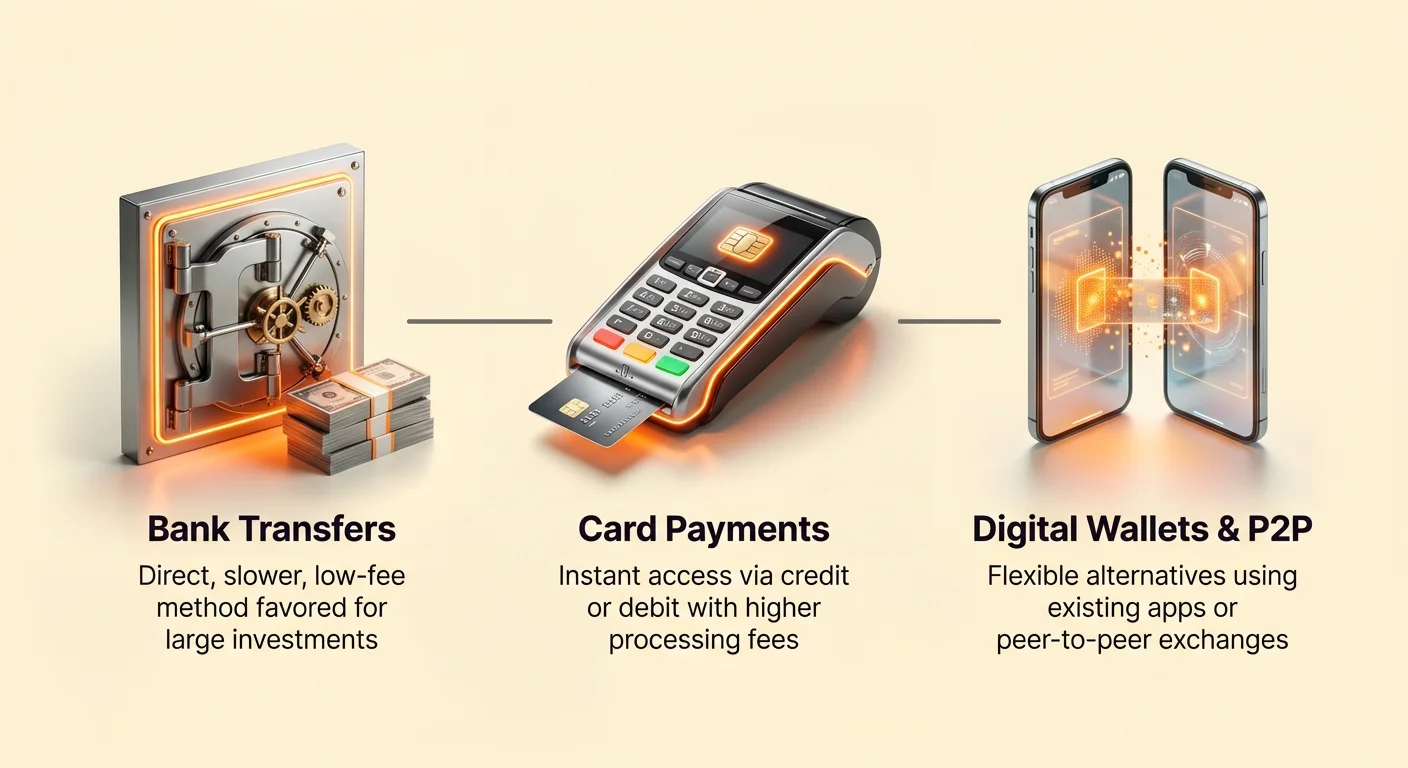
The choice of a cryptocurrency platform is inextricably linked to the payment methods it supports. Bank transfers offer the most cost-effective route for substantial investments, providing security and stability for those willing to wait for settlement. Credit and debit cards deliver speed and convenience, ideal for capturing immediate market opportunities, though they come at a premium in fees. Digital wallets and P2P marketplaces provide essential flexibility and accessibility, bridging the gap for users outside the traditional banking infrastructure or those prioritizing specific transaction flows.
Ultimately, there is no single "best" method, only the right method for a specific user's needs. A high-volume trader will prioritize the low fees of wire transfers, while a casual buyer may prefer the instant gratification of a debit card. Security, however, remains constant; regardless of how funds enter an account, the safety of the platform's storage and the user's authentication practices are paramount. By understanding the mechanics, costs, and risks associated with each payment avenue, investors can select the exchange that best aligns with their financial goals and trading style.
Select a payment method that balances your need for speed with your tolerance for fees, and always prioritize platforms with verifiable security and regulatory compliance.