
Introduction
For newcomers to the world of digital assets, one of the most persistent hurdles is bridging the gap between volatile cryptocurrency holdings and tangible, everyday financial utility. While owning crypto is exciting, converting it back to usable currency (fiat) or spending it directly often involves slow processes, high exchange fees, or cumbersome Know Your Customer (KYC) requirements. efficiently converting crypto to fiat
This friction has led many savvy crypto users to explore alternative solutions. One of the most efficient and often overlooked methods is the strategic use of merchant gift cards. Far from being a simple way to spend crypto, gift cards can be integrated into an advanced financial strategy known as arbitrage.
In this comprehensive guide, we move beyond the basic purchase of gift cards and focus on Gift Card Arbitrage. Arbitrage, in this context, means optimizing the conversion pathway to maximize your spending power, minimize transactional loss, and strategically stack financial rewards. This guide will provide beginners with the necessary framework to turn gift cards into a powerful off-ramp tool, increasing both your crypto liquidity and your overall financial return rate.
The Role of Gift Cards in the Crypto Ecosystem (Fundamentals)
To understand arbitrage, we must first establish why gift cards are superior to traditional off-ramps in certain scenarios. They are not merely a retail product; they are a unique type of fungible, prepaid value that requires minimal friction to use.
The Crypto Off-Ramp Challenge
An "off-ramp" refers to any process that allows you to convert cryptocurrency back into traditional fiat currency (like USD or EUR) or spend it in the mainstream economy. Traditional off-ramps—such as centralized exchanges (CEXs)—come with inherent challenges: Safely Selling Crypto and converting to fiat.
- High Fees: Exchanges charge trading fees, withdrawal fees, and often a spread (the difference between the buy and sell price).
- Regulatory Delays: Large fiat withdrawals often trigger regulatory review and can take several days to process.
- Tax Implications and Traceability: Every fiat conversion creates a taxable event that is easily traceable back to the user’s bank account.
Using a crypto-backed debit card is an option, but these often impose limits, require staking specific tokens, and add layers of conversion fees that eat into your spending power.
Gift Cards as a Low-Friction Liquidity Tool
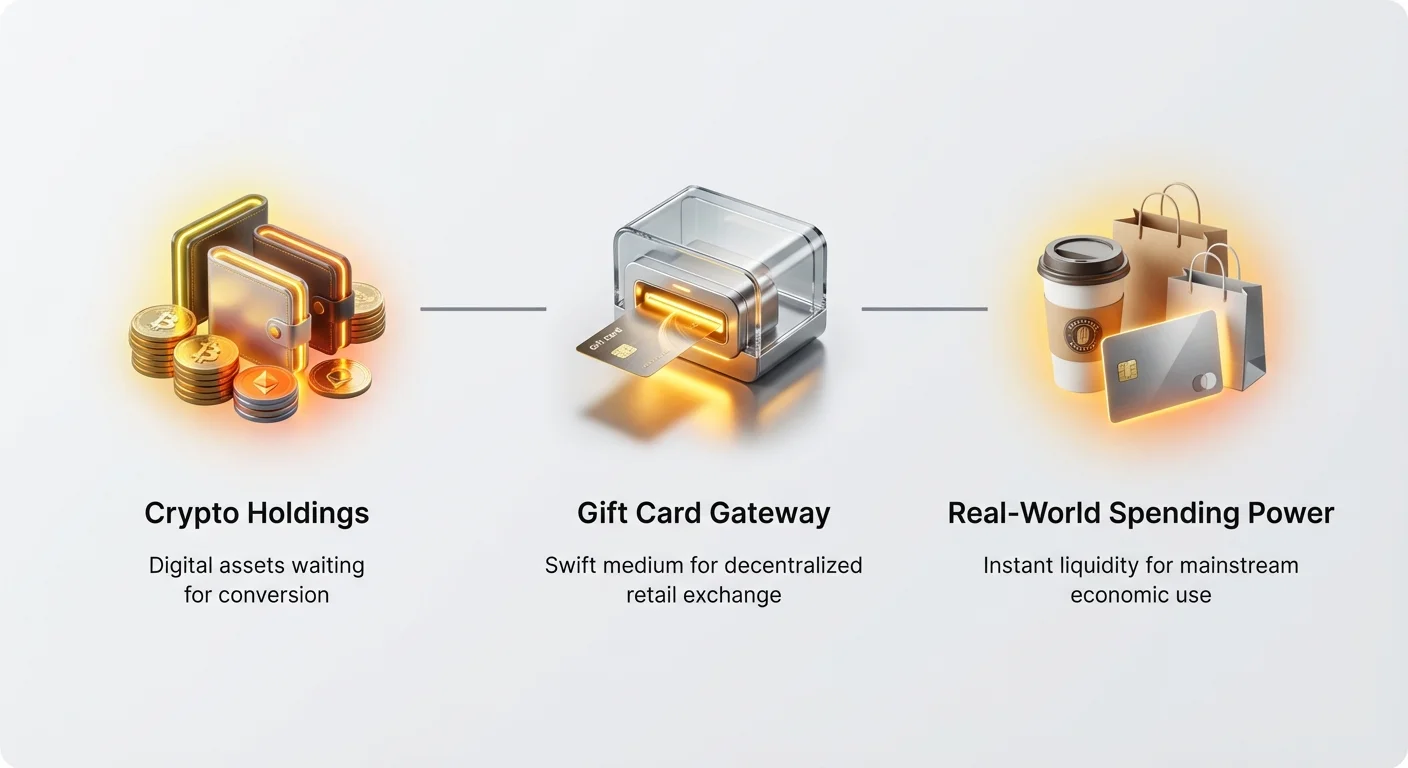
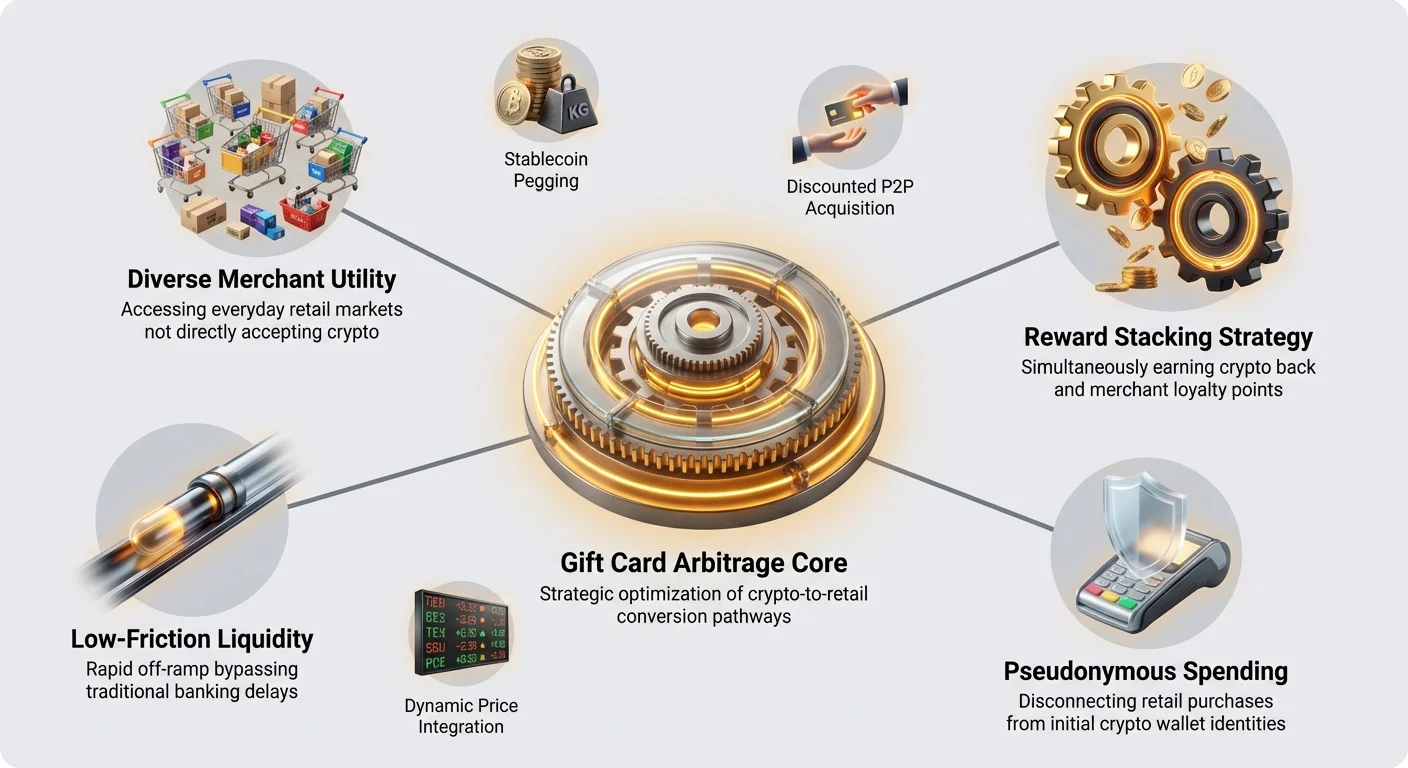
Gift cards bypass many of these issues by acting as a swift, decentralized medium of exchange. When you use crypto to purchase a $100 gift card, you have achieved instant liquidity in terms of retail spending power, without involving a bank or triggering a complex withdrawal process.
Key advantages include:
- Speed: Transactions are usually instant once the crypto transfer confirms.
- Low Barrier to Entry: Many providers require minimal personal information compared to CEXs.
- Utility: They provide access to specific retail markets (Amazon, Walmart, gaming stores) that may not accept direct crypto payments.
Foundational Strategy: Simple Crypto-to-Retail Conversion (The Basics)
Before attempting advanced optimization, you must master the simple mechanics of converting digital assets into gift card value.
Step-by-Step: Buying Gift Cards with Cryptocurrency
The process is straightforward across most dedicated gift card platforms (like certain decentralized marketplaces or dedicated vendors):
- Select a Platform: Choose a reputable platform that accepts a variety of cryptocurrencies and offers a wide selection of merchants.
- Choose the Merchant and Value: Specify the retailer (e.g., Target) and the precise denomination ($50, $100).
- Select Payment Crypto: Choose which asset you want to spend (e.g., Bitcoin, Ethereum, USDT). The platform instantly calculates the required crypto amount based on the current market rate.
- Complete the Transaction: The platform provides a wallet address and QR code. You send the exact amount of crypto.
- Receive the Code: Once the transaction is confirmed on the blockchain (usually within minutes), the digital gift card code is delivered to you via email or directly on the platform dashboard.
Evaluating Provider Metrics (Fees, Speed, Selection)
Not all gift card platforms are created equal. The difference between a standard purchase and an optimized purchase often lies in the platform’s underlying metrics, particularly the fees and the "spread" they charge.
| Metric | Impact on Arbitrage | Optimization Goal |
|---|---|---|
| Transaction Fee | Direct cost subtracted from your crypto. | Seek platforms with flat, low fees or volume discounts. |
| Exchange Spread | The inherent difference between the crypto market price and the price used by the vendor to calculate the gift card cost. | Choose providers that use real-time, competitive exchange rates to minimize hidden costs. |
| Crypto Selection | Determines your flexibility. Using stablecoins (USDT, USDC) often results in better spreads than volatile assets (BTC, ETH). | Use stablecoins to lock in value and reduce spread risk. |
| Liquidity/Speed | How fast the code is delivered. Slow providers can result in lost arbitrage opportunities. | Use platforms known for instant digital code delivery. |
Practical Tip: Always calculate the total effective fee. If a platform charges 2% but uses an unfavorable exchange rate that costs you an additional 3% in spread, your effective fee is 5%.
Advanced Arbitrage Techniques: Maximizing the Return Rate
Arbitrage involves exploiting market inefficiencies or creating additive value chains. In the gift card context, this means maximizing the value derived from the initial crypto expenditure. This is where "power users" separate themselves from casual spenders.
The Double-Dip Strategy (Rewards Stacking)
The most effective form of gift card arbitrage is the "Double-Dip Strategy," which involves stacking multiple layers of rewards on a single crypto conversion. stacking rewards
Phase 1: Crypto Purchase Rewards When you use certain crypto payment platforms or utility tokens, you receive immediate crypto rewards simply for using the network.
- Example: You spend $100 worth of Coin X to purchase a gift card on Platform Y. Platform Y offers 3% back in its native utility token. You instantly receive $3 worth of Coin X or the utility token.
Phase 2: Merchant Loyalty Rewards Once you have the gift card, you spend the card on the merchant's site, which offers its own loyalty program, cash back, or credit card points (if the gift card purchase itself was made via a crypto debit card).
- Example: You use the $100 gift card at the retailer. The retailer offers 5% cash back or loyalty points (e.g., airline miles, store credit) on all purchases.
The Arbitrage Result: Instead of a simple $100 crypto spending event, you have created a loop:
- Initial value spent: $100 Crypto.
- Value received (Gift Card): $100 Retail Credit.
- Reward 1 (Crypto Back): $3.00 (3% crypto).
- Reward 2 (Retail Loyalty): $5.00 (5% loyalty value).
- Total Effective Return: $108.00 in value and rewards, achieving an 8% effective return rate, significantly higher than a direct fiat withdrawal might yield after fees.
Utilizing Discounted or Peer-to-Peer Gift Card Markets
The traditional gift card market often deals in discounted cards. People who receive unwanted gift cards (for a store they don't frequent) will sell them below face value on P2P marketplaces for immediate liquidity.
Arbitrage Opportunity: If you can buy a $100 gift card for $90 on a P2P market using crypto, you have created an instant 10% arbitrage gain.
- Buying Discounted Cards: Search P2P crypto gift card exchanges where users sell their unwanted cards. You use your crypto to buy this discounted fiat-denominated value.
- Selling for Liquidity: If you purchased a card at a discount and realize you need cash (fiat) quickly, you can often sell the unused gift card on dedicated liquidator sites for fiat or other crypto assets, often retaining a portion of the discount you initially received, creating a smoother, cheaper crypto-to-fiat pathway than an exchange withdrawal.
Arbitrage Through Geographical Price Differences (Niche Use)
In highly specialized scenarios, differences in pricing or taxation across international markets can create an arbitrage gap, although this is complex and carries higher risk.
For example, a gift card purchased in Country A using a tax-advantaged stablecoin may be redeemable for goods priced 5% lower in Country B (after accounting for exchange rates) compared to the local price of those goods in Country B. This strategy requires detailed knowledge of international VAT laws and shipping logistics and is generally reserved for institutional or very experienced traders. For beginners, focus solely on reward stacking and discount purchasing.
Strategic Comparison: Choosing the Right Gift Card Platform
The foundation of successful gift card arbitrage is selecting the platform that maximizes your specific goals, whether that is high liquidity, maximum reward stacking, or enhanced privacy.
Key Metrics: Fees, Spreads, and Accepted Cryptos
When analyzing platforms, look past the initial marketing and scrutinize the actual transaction costs:
1. Real-Time Pricing vs. Fixed Spreads
Some platforms lock in the crypto price for a 15-minute window, which is ideal if crypto prices are rising but disastrous if they fall. Better platforms integrate dynamic, real-time pricing from major exchanges, ensuring you are paying a fair market rate with minimal spread deviation. For stablecoins (USDT, USDC), the spread should be almost negligible.
2. Network Fees (Gas)
Ensure the platform supports low-fee networks for the crypto you use. Spending $50 on a gift card might not be worthwhile if the Ethereum network fee (gas) is $20. The best platforms support low-fee blockchains like Polygon, Solana, or Lightning Network Wallets for Bitcoin transactions, keeping the overall cost structure low enough for arbitrage to be effective.
3. Redemption Flexibility
A platform that only offers generic retailer gift cards (e.g., Amazon) provides less utility than one offering utility cards (e.g., phone top-ups, gaming credits, or prepaid Visa cards). Utility cards offer greater financial flexibility, which is crucial for maximizing liquidity.
Analyzing Merchant Selection and Utility
The choice of merchant directly impacts the utility of your crypto.
| Merchant Type | Best for... | Arbitrage Strategy Focus |
|---|---|---|
| Mass Retail (Amazon, Walmart) | Everyday spending; high liquidity; simple off-ramp. | Double-Dip (use the card to buy discounted items or utilize Amazon's own rewards programs). |
| Gaming/Digital (Steam, Xbox) | Converting assets into digital goods that can sometimes be traded or sold (secondary market arbitrage). | Purchasing digital items during sales periods for later use or P2P resale. |
| Travel/Airlines | Large conversions; capitalizing on high-value travel points programs (often very high returns). | Purchasing high-value airline miles that provide a significantly better return on spending than cash. |
| Prepaid Visa/Mastercard | The highest liquidity; allows spending everywhere, effectively mirroring a debit card without the bank connection. | Use as a privacy layer and an immediate source of fiat-like spending power. |
Gift Cards and Financial Privacy (Security & Control)
For many crypto enthusiasts, preserving financial privacy and autonomy is a primary concern. Gift cards offer a compelling middle ground between fully traceable bank transactions and complex, anonymous cryptocurrency mixers.
When Gift Cards Offer Enhanced Pseudonymity
Most dedicated crypto gift card platforms require an email address for delivery, but they typically do not require the rigorous KYC verification (government ID, proof of address) demanded by centralized exchanges for fiat withdrawals. KYC, AML, and Regulatory Friction
By using privacy-focused cryptocurrencies or wallets that are not directly tied to your real identity, purchasing a gift card provides a degree of separation between your digital assets and your real-world spending.
- Scenario: You hold Bitcoin in a self-custodial wallet. You use it to buy an Amazon gift card. Amazon recognizes the gift card code, but the transaction on the retailer's side is disconnected from the initial Bitcoin purchase. The paper trail ends at the gift card vendor.
This provides pseudonymity, meaning your identity is not broadcast, but the transaction still occurred on a public blockchain.
Traceability vs. Untraceability: Understanding the Limits
It is crucial to understand that gift cards are not a perfect cloak of invisibility.
- Blockchain Traceability: The initial crypto transaction is still recorded forever on the blockchain. If investigators can link your initial wallet address to your identity (e.g., if you funded that wallet from a KYC-compliant exchange), the trail can be followed to the gift card platform.
- Redemption Traceability: If you redeem the gift card on a retailer's website where you have a fully registered account with your real name and address (e.g., using an Amazon Prime account for delivery), the purchase is inherently traceable back to you through the retailer's data.
Privacy Best Practice: To maximize privacy through gift cards, use minimal or pseudonymous information when setting up accounts with the gift card vendor, and redeem the cards for in-person purchases or digital goods that don't require physical shipment to your home address.
Practical Risks and Best Practices
While gift card arbitrage can be highly lucrative, it is essential for beginners to be aware of the specific risks involved in this niche market.
Liquidity Risk and Vendor Volatility
The value stored on a gift card is tied to the financial health and operating status of the issuing retailer.
- Risk: If the retailer files for bankruptcy or significantly changes its loyalty program, the value of your gift card could be reduced or wiped out instantly. Unlike crypto, which is globally decentralized, a gift card is centralized authority (the store).
- Best Practice: Prioritize highly stable, major retailers (Amazon, large national chains) for high-value purchases. Avoid accumulating large balances on gift cards for niche or struggling retailers.
Scams and Counterfeit Codes
Digital gift cards are a prime target for fraudsters. Scammers often sell codes that have already been partially used or were obtained through illicit means.
- Risk: Using a fraudulent code means you lose your crypto payment and receive no spending power.
- Best Practice:
- Only use established, highly-reviewed gift card platforms. Avoid unknown P2P marketplaces until you are highly experienced.
- Immediately verify the balance of the digital code upon receipt. Do not wait hours or days to check if the code is valid.
- Keep comprehensive records of the transaction, including the crypto hash ID, for dispute resolution.
Managing Cryptocurrency Volatility During the Transaction
In the time it takes for your crypto transaction to confirm (especially on slower networks like older Bitcoin transactions), the price of the crypto could drop significantly, meaning you effectively paid more for the gift card than you intended. Real-Time Market Execution is key to mitigating this risk.
- Best Practice: Use stablecoins (USDT, USDC, DAI) for gift card purchases. Stablecoins lock in the value, eliminating the volatility risk during the confirmation window and ensuring the most accurate rate for arbitrage calculations. If you must use a volatile asset like BTC, use platforms that support instant confirmation layers (like the Lightning Network).
Conclusion
Gift card arbitrage transforms what appears to be a simple retail transaction into a strategic component of your crypto financial life. By looking beyond the basic purchase and focusing on optimization—maximizing rewards, minimizing fees, and utilizing the low-friction nature of these prepaid assets—you create a highly efficient pathway for extracting value from your digital holdings.
For the beginner crypto power user, mastering the art of the Double-Dip Strategy and leveraging stablecoins for speed and predictability are essential steps. Gift cards offer immediate liquidity, enhanced pseudonymity compared to bank transfers, and a reliable strategy for moving digital value into the real-world economy while simultaneously growing your wealth through strategic reward stacking. Approach this niche market with diligence, prioritize platform security, and you can unlock a new level of crypto utility.