
The landscape of digital finance is undergoing a profound transformation as users increasingly demand financial privacy. In the early days of cryptocurrency, the public nature of blockchains like Bitcoin network architecture was celebrated as a feature of transparency. However, as adoption grew, the limitations of a fully transparent ledger became apparent. Every transaction, balance, and financial relationship is visible to anyone with an internet connection. This radical transparency poses significant risks for individuals and businesses alike, ranging from targeted advertising and surveillance to security threats and a lack of fungibility.
To address these challenges, cryptographers developed advanced privacy-preserving technologies. These protocols aim to obscure transaction details while ensuring the integrity of the network. Two of the most prominent technologies in this arena are Zero-Knowledge Succinct Non-Interactive Arguments of Knowledge (zk-SNARKs) and Ring Signatures. These two methods represent different philosophical and mathematical approaches to the same problem: how to prove a transaction is valid without revealing who sent it, who received it, or how much was transferred.
This technological showdown is not merely academic. It defines the usability, scalability, and security of modern privacy coins. While Zcash championed the use of zk-SNARKs, allowing for optional shielded transactions, other projects like Monero and Zano have pushed the boundaries of Ring Signatures. The choice between these technologies impacts everything from transaction speed and network fees to the fundamental trust assumptions required to use the currency. Understanding the nuances of each is essential for anyone navigating the private sector of the crypto economy.
The Necessity of Fungibility and Privacy
Privacy in cryptocurrency is often misunderstood as a tool solely for illicit activity. In reality, privacy is a prerequisite for sound money, primarily due to a property known as fungibility. Fungibility ensures that every unit of a currency is interchangeable with another unit of the same value. In a transparent system, specific coins can be "tainted" by their transaction history. If a coin was previously used in a hack or illegal trade, exchanges might blacklist it, rendering it less valuable than a "clean" coin.
Privacy technologies restore fungibility by breaking the link between a coin's history and its current owner. When transaction histories are opaque, all coins are equal because no one can discriminate based on past usage. This protects users from receiving funds that might be frozen or devalued due to actions taken by previous owners. It ensures that digital cash functions like physical cash, where a dollar bill is accepted regardless of who held it yesterday.
Beyond fungibility, privacy provides essential security for personal wealth. On a transparent blockchain, paying a merchant reveals your entire wallet balance to them. This exposure can make individuals targets for theft, scams, or kidnapping. Privacy coins shield this information, ensuring that a simple payment does not compromise the sender's financial safety. This level of protection is crucial for widespread merchant adoption and peer-to-peer commerce.
Ring Signatures: The Art of Digital Camouflage
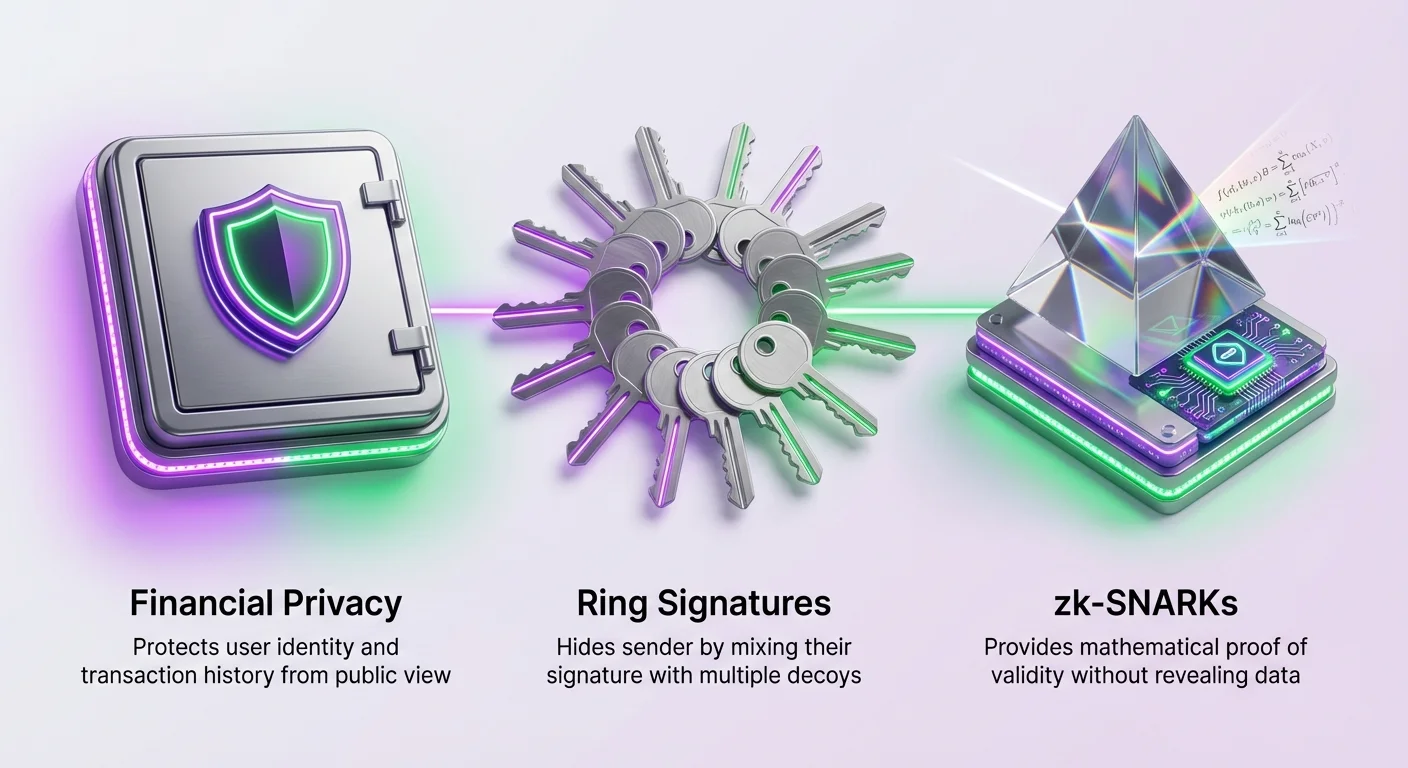
Ring Signatures function as a form of digital camouflage for cryptocurrency transactions. The concept is derived from a group signature scheme where a user signs a message on behalf of a group. In the context of crypto, when a user initiates a transaction, their digital signature is fused with the signatures of several other users—past transaction outputs pulled from the blockchain. These other outputs serve as decoys, creating a "ring" of possible signers.
To an outside observer, it is computationally infeasible to determine which member of the ring actually signed the transaction. All members appear equally likely to be the sender. If a ring size is set to 16, for example, there is only a 1 in 16 chance of guessing the true sender correctly. This method does not rely on a central mixing service; instead, it occurs at the protocol level, ensuring that privacy is inherent to the network structure.
Evolution into Ring Confidential Transactions (RingCT)
Basic Ring Signatures only hide the sender's identity. However, true financial privacy also requires concealing the amount being transferred. This led to the development of Ring Confidential Transactions (RingCT). This protocol upgrade combines Ring Signatures with cryptographic commitments that hide transaction amounts.
With RingCT, the network can mathematically verify that the input amounts equal the output amounts—meaning no new coins were created out of thin air—without ever knowing the actual values. This prevents inflation bugs while maintaining total opacity regarding the value of transfers.
Advanced iterations of this technology have further refined its efficiency. For instance, d/v-CLSAG signatures, utilized by networks like Zano, optimize the verification process. These signatures reduce the size of the transaction data, which in turn lowers fees and speeds up confirmation times. By making the math more efficient, developers ensure that privacy does not come at the cost of network bloat.
The Role of Stealth Addresses
Ring Signatures are almost always paired with Stealth Addresses to provide comprehensive privacy. While Ring Signatures protect the sender, Stealth Addresses protect the receiver. When a user sends funds to a public address, the protocol automatically generates a unique, one-time address for that specific transaction.
This one-time address is recorded on the blockchain, decoupling the transaction from the recipient's actual public profile. Only the recipient, holding the private view key, can scan the blockchain and identify the funds that belong to them. To the rest of the world, the transaction appears to be going to a random, unrelated address.
This dual approach—Ring Signatures for the sender and Stealth Addresses for the receiver—creates a closed loop of anonymity. It ensures that neither party in a transaction can be linked to the other, and no outside observer can map the flow of funds across the network. This combination is the standard for privacy coins like Monero and Zano.
ZK-SNARKs: The Mathematical Fortress
Zero-Knowledge Succinct Non-Interactive Arguments of Knowledge, or zk-SNARKs, represent a different approach to privacy. The core concept of zero-knowledge proofs is the ability to prove that a statement is true without conveying any information apart from the truth of the statement itself. In a cryptocurrency context, a user can prove they have the funds to cover a transaction and that they have the authority to spend them, without revealing their balance or identity.
The "Succinct" part of the acronym refers to the size of the proof. Zk-SNARKs are incredibly small in terms of data size and can be verified very quickly by the network. This offers a potential scalability advantage, as the burden of proving validity lies with the sender, while the verifier (the blockchain) has very little work to do.
The Trusted Setup Dilemma
One of the historical criticisms of early zk-SNARK implementations, such as the original Zcash launch, was the requirement for a "trusted setup." This involves the generation of cryptographic parameters that serve as the foundation for the system's proofs. During this creation phase, a secret number (often referred to as "toxic waste") is generated.
If this secret were to be preserved rather than destroyed, a malicious actor could use it to forge false proofs. This would allow them to create counterfeit coins undetected, though it would not allow them to steal user funds or break anonymity. While modern implementations have developed "ceremonies" to distribute this risk or eliminate the trusted setup entirely (via zk-STARKs or Halo), it remains a fundamental distinction from the trustless nature of Ring Signatures.
Computation and Complexity
While verifying a zk-SNARK is fast, generating the proof can be computationally intensive. For the user sending a transaction, creating a shielded transaction using zk-SNARKs requires significant processing power and memory. In the early days, this made private transactions difficult to perform on mobile devices or weaker hardware.
Recent advancements have drastically reduced these requirements, making shielded transactions more accessible. However, the mathematical complexity of zk-SNARKs remains higher than that of Ring Signatures. This complexity can make the code harder to audit. If a vulnerability exists in the cryptographic circuit, it may be more difficult for developers to spot compared to the relatively more straightforward cryptography used in Ring Signatures.
Comparing the Technologies
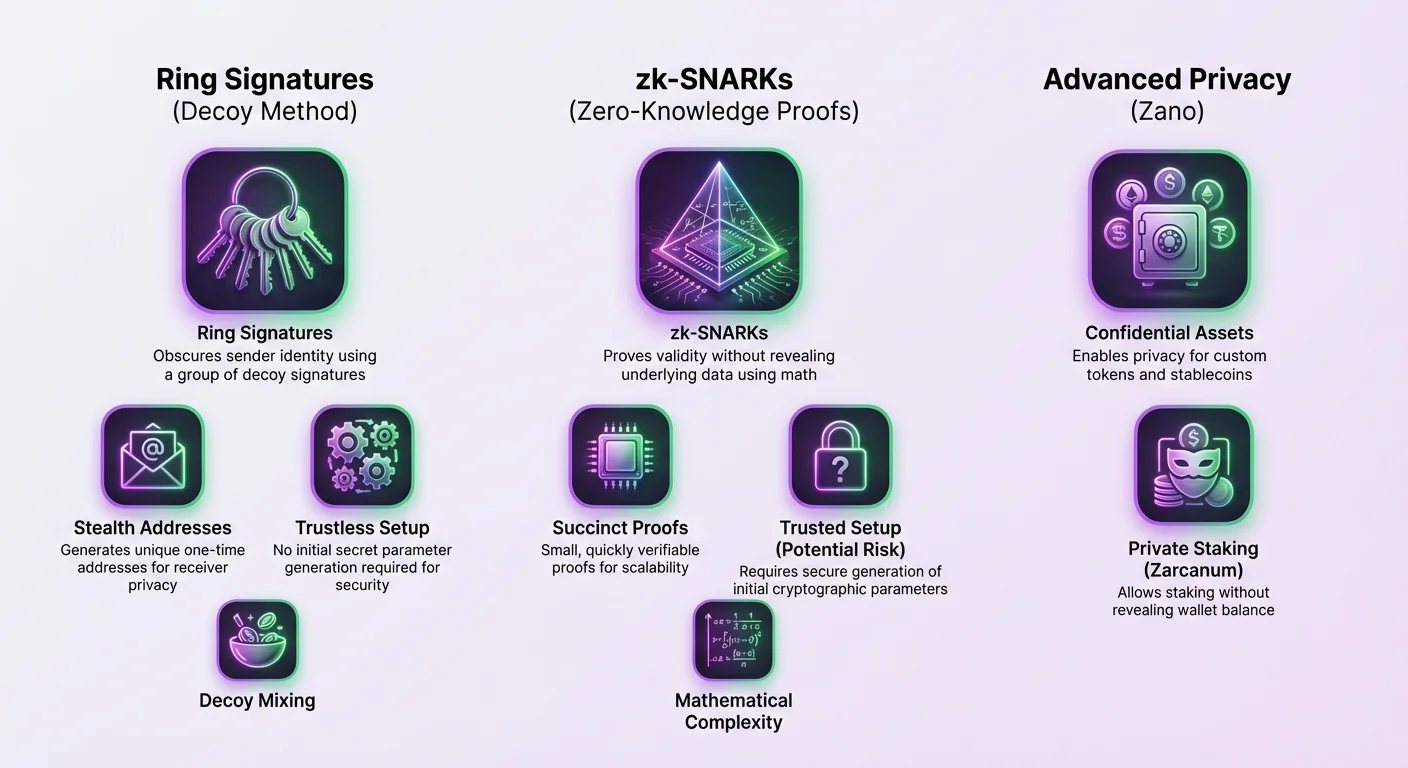
The choice between these technologies involves trade-offs regarding trust, auditability, and performance. Ring Signatures rely on established cryptographic assumptions and do not require a trusted setup. They provide plausible deniability by hiding the user in a crowd. ZK-SNARKs offer a stronger mathematical guarantee of privacy—absolute shielding rather than obfuscation—but often come with higher complexity.
| Feature | Ring Signatures | ZK-SNARKs |
|---|---|---|
| Privacy Mechanism | Decoy mixing (Probability) | Cryptographic Proofs (Zero-Knowledge) |
| Setup Requirement | Trustless (No setup ceremony) | Often requires Trusted Setup |
| Auditability | Generally easier to audit | High mathematical complexity |
Scalability and Block Size
Ring Signatures inherently involve adding decoy data to the blockchain. As the ring size increases to provide better anonymity, the transaction size also grows. This can lead to "blockchain bloat," where the ledger becomes large and unwieldy over time. Optimization techniques like Bulletproofs+ have significantly mitigated this, compressing the data required to hide transaction amounts.
Zk-SNARKs excel in keeping the on-chain footprint small. Since the proof itself is succinct, the transaction data stored on the ledger is minimal regardless of the complexity of the transaction. This theoretical efficiency makes zero-knowledge technology attractive for scaling solutions, not just privacy coins. However, the off-chain generation time for these proofs acts as a counterbalance to the on-chain storage savings.
Zano and the Innovation of Zarcanum
While Monero established the standard for Ring Signatures in Proof-of-Work (PoW) chains, the Zano project has adapted this technology for a hybrid Proof-of-Work/Proof-of-Stake (PoS) consensus. This innovation addresses a longstanding conflict between staking and privacy. In traditional PoS systems, a user must stake a specific amount of coins to validate transactions. This inherently reveals their wealth, compromising privacy.
Zano introduced Zarcanum, a hidden-amount Proof-of-Stake model. Zarcanum allows users to stake their coins and secure the network without revealing the amount they are staking. It utilizes Ring Signatures to obscure the identity of the staker and Bulletproofs+ to hide the amount. This ensures that the network remains secure and decentralized without forcing validators to dox their financial status.
Upgrading the Privacy Stack
The Zano ecosystem utilizes a suite of privacy tools that refine the Ring Signature model. By implementing d/v-CLSAG signatures, the protocol optimizes the verification process, making transactions smaller and faster than previous generations of privacy coins. This efficiency is critical for maintaining a high throughput network.
Furthermore, Zano integrates these privacy features by default. Unlike some chains where privacy is an optional toggle—often leading to a small anonymity set and weaker privacy—Zano ensures that all transactions are shielded. This "privacy by default" approach strengthens the network's overall security, as every transaction contributes to the global anonymity set, making it exponentially harder for surveillance firms to analyze the ledger.
Confidential Assets: Extending Privacy Beyond Native Coins
A major limitation of early privacy coins was that they only supported a single asset: the native currency (e.g., XMR or ZEC). Zano has expanded the application of Ring Signatures through its Confidential Assets framework. This technology allows users to issue their own tokens on the Zano blockchain that inherit the same privacy features as the native ZANO coin.
In a standard token model, like ERC-20 on Ethereum, the contract address is visible. Even if you hide the sender, an observer can see that a user is interacting with a specific stablecoin contract. Zano’s architecture uses blinded asset tags. This mechanism hides not only the sender, receiver, and amount but also the type of asset being transferred.
The Freedom Dollar (fUSD) Example
The practical application of this technology is exemplified by the Freedom Dollar (fUSD). Launched on the Zano blockchain, fUSD is a private stablecoin pegged to the U.S. dollar. Because it runs on the Confidential Asset layer, transactions made with fUSD are indistinguishable from transactions made with ZANO or any other token on the network.
This level of privacy is achieved using extended RingCT (Ring Confidential Transactions). The protocol creates a cryptographic commitment that conceals the asset ID. To an outsider, the blockchain simply records a transaction; they cannot tell if the value moved was volatile cryptocurrency or a stable fiat-pegged asset. This breakthrough allows for the creation of a private DeFi ecosystem where users can trade, lend, and borrow without exposing their portfolio composition.
Regulatory Considerations and Auditability
The rise of privacy technology has inevitably drawn the attention of regulators. Governments are concerned about the potential for money laundering and illicit finance. However, privacy protocols often include features that allow for voluntary transparency, striking a balance between personal privacy and regulatory compliance.
Both Ring Signature-based systems like Zano and Monero, and ZK-based systems, typically offer "view keys." A view key is a cryptographic tool that allows a user to reveal their transaction history to a specific third party, such as an auditor or tax authority, without making it public to the world. This "opt-in" transparency ensures that businesses can comply with accounting laws while protecting their trade secrets and payroll data from competitors.
The Compliance Advantage of ZK-SNARKs
Proponents of zk-SNARKs often argue that the technology is better suited for selective disclosure. Because zero-knowledge proofs allow for the verification of specific data points without revealing the underlying data, it is theoretically possible to prove compliance (e.g., "this user is not on a sanctions list") without revealing the user's identity.
However, in practice, most privacy coins function similarly regarding regulation: they provide privacy by default to protect the user, with tools to share information when necessary. The challenge for all privacy tech is the "guilty until proven innocent" stance taken by some exchanges, which may delist privacy coins to avoid regulatory friction.
Use Cases in the Real World
The theoretical battles between ZK-SNARKs and Ring Signatures translate into distinct user experiences. Ring Signature-based coins tend to offer a robust, reliable experience for peer-to-peer payments. The technology is mature, the wallets are responsive, and the lack of a trusted setup appeals to purists who value decentralization above all else.
For example, utilizing Zano for confidential remittances allows workers to send money across borders without high fees or banking delays, and without exposing their earnings to local criminals. The integration of private stablecoins like fUSD enhances this use case, as it removes the volatility risk associated with holding crypto for payments.
Enterprise and DeFi Applications
On the enterprise side, businesses require confidentiality for supply chain payments and payroll. A company paying international contractors in a transparent stablecoin inadvertently reveals its entire payroll structure to competitors. By using Confidential Assets on a chain like Zano, the business can execute these payments privately.
DeFi applications also benefit from these technologies. In a transparent DeFi ecosystem, strategy copying and front-running are rampant because every trade is visible in the mempool. Privacy-preserving DeFi, enabled by either ZK-SNARKs or blinded asset tags, allows traders to execute strategies without leaking information to predatory bots. This creates a fairer market environment for all participants.
Future Developments in Privacy Tech
The technology behind anonymous transactions is moving rapidly. In the Ring Signature camp, research is focused on increasing the ring size (the number of decoys) without increasing the transaction size. Schemes like Triptych and Seraphis aim to allow for massive ring sizes, potentially involving thousands of decoys, which would make statistical analysis virtually impossible.
On the ZK-SNARK front, the industry is moving away from trusted setups. Newer protocols like HALO allow for recursive proof composition without the "toxic waste" phase. This evolution removes the biggest trust assumption in the ZK model, potentially making it the superior long-term solution for scalability.
Additionally, hybrid approaches are emerging. Some protocols are looking to combine the statistical obfuscation of Ring Signatures with the succinct proofs of zero-knowledge cryptography. The goal is to create a "perfect" privacy protocol that is trustless, lightweight, scalable, and mathematically secure against quantum computing threats.
Conclusion
The showdown between ZK-SNARKs and Ring Signatures is not a zero-sum game; rather, it is a competition that drives innovation across the entire cryptocurrency sector. ZK-SNARKs offer the allure of perfect mathematical privacy and incredible scalability, ideal for shielding vast amounts of data with minimal on-chain footprint. Ring Signatures, particularly as implemented in modern protocols like Zano, offer a battle-tested, trustless approach that integrates seamlessly with decentralized governance and staking.
As the digital economy matures, the importance of technologies like Confidential Assets and private stablecoins will only grow. Whether through the complex proofs of zero-knowledge systems or the sophisticated decoys of ring signatures, the ultimate goal remains the same: to restore financial sovereignty to the individual. These tools ensure that in a digital world, cash can remain private, fungible, and free from censorship.
True financial freedom requires the ability to transact without surveillance, ensuring your money remains yours alone.