
Blockchain technology has evolved significantly since the inception of Bitcoin. Early networks operated as single layers that handled everything from execution to security. However, as demand grew, these monolithic structures faced a bottleneck often described as the scalability trilemma. This concept suggests that a decentralized network can typically only optimize for two of three properties: decentralization, security, and scalability. To solve this, the industry has shifted toward a modular architecture.
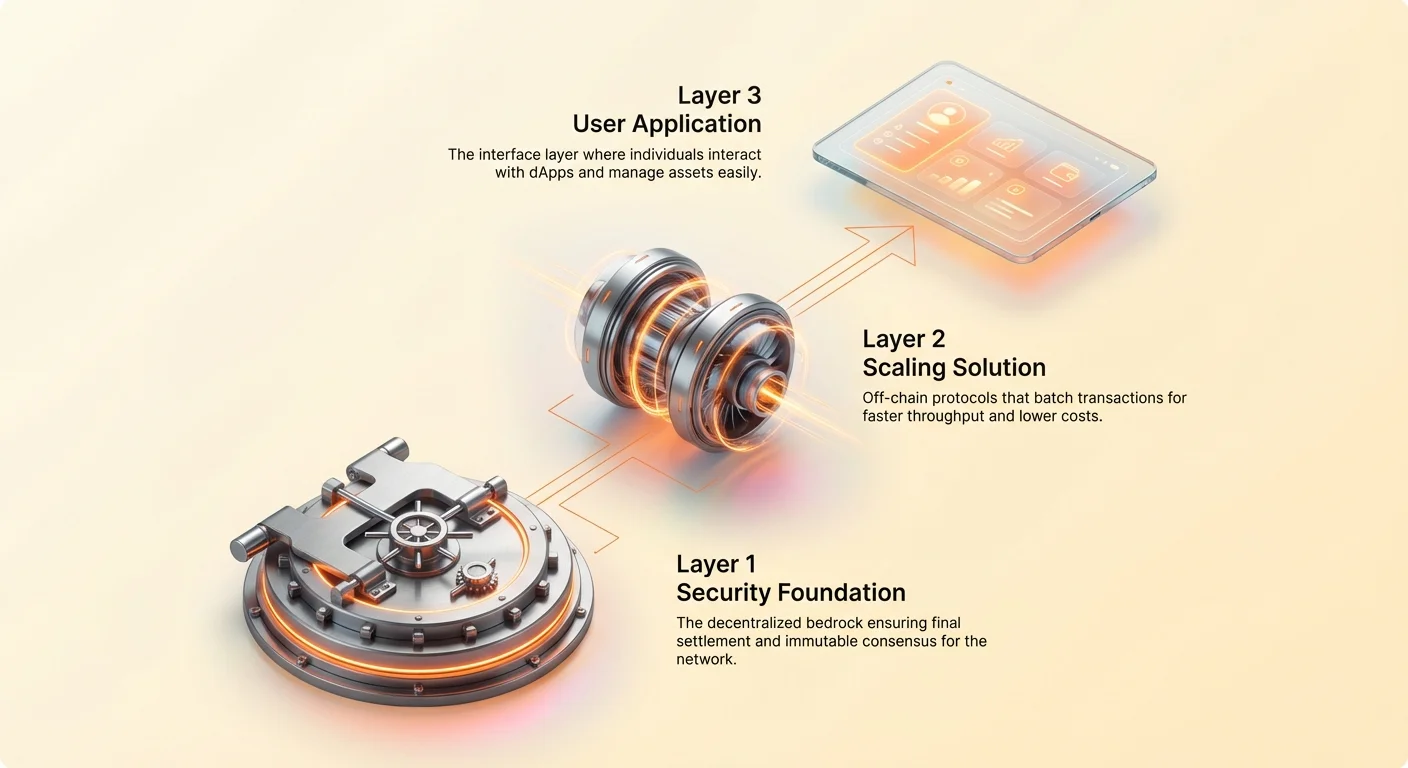
This new approach involves building a "stack" of specialized protocols. Instead of one chain doing everything, different layers handle specific tasks. This creates a hierarchy ranging from Layer 0, the foundational infrastructure, up to Layer 3, where users interact with applications. Understanding this stack is essential for grasping how modern crypto ecosystems function. It explains how networks can process thousands of transactions per second while maintaining the security of the underlying ledger.
This architecture allows for specialization. The base layers focus on security and consensus, while upper layers focus on speed and user experience. This separation of concerns is similar to how the internet works, with different protocols handling data transmission, routing, and website display. In the crypto world, this layered approach ensures that digital assets remain secure while becoming usable for daily activities.
The Foundation: Layer 0 (Interoperability)
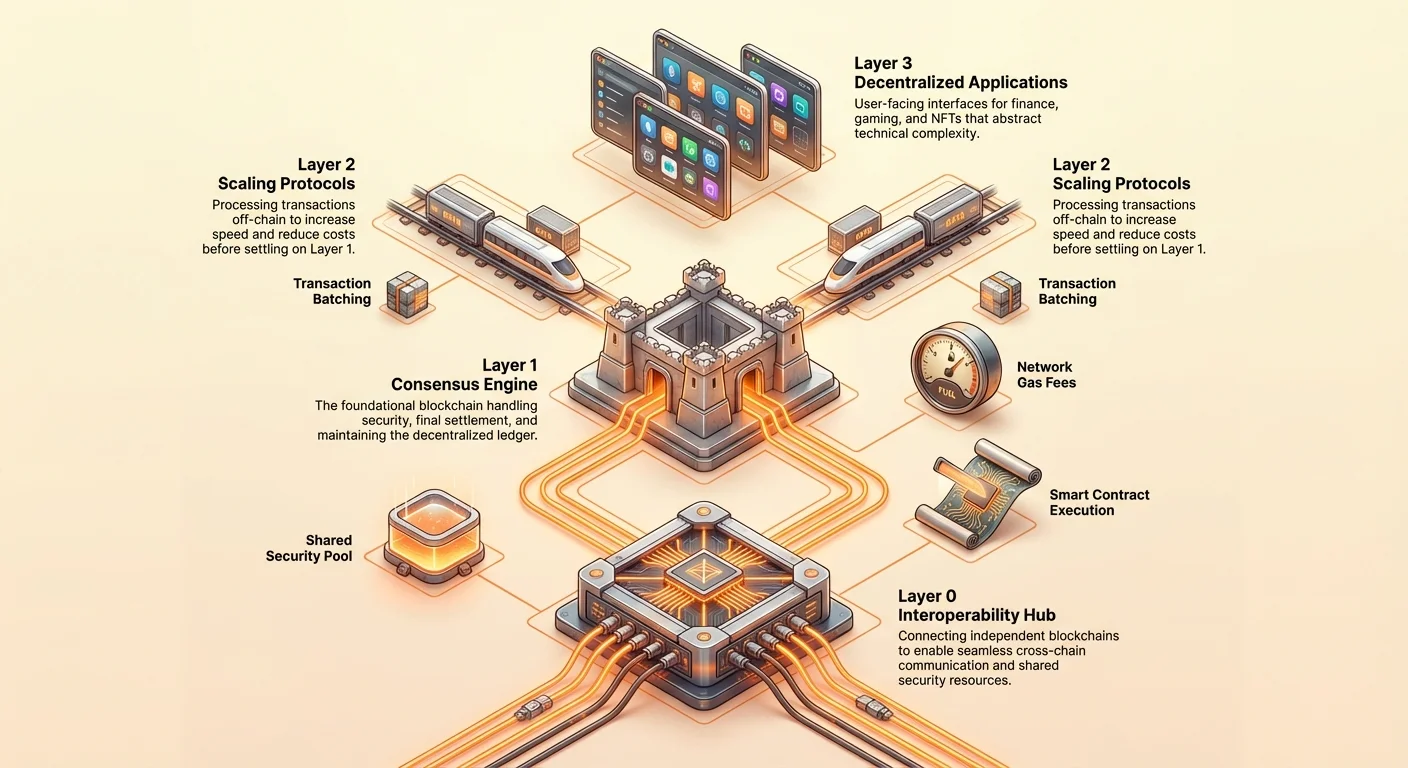
Layer 0 is often referred to as the "internet of blockchains." It serves as the underlying infrastructure that allows different blockchain networks to communicate and interact with one another. Without this layer, blockchains would operate as isolated islands, unable to exchange data or assets without complex intermediaries. Layer 0 protocols provide the framework for building and connecting various Layer 1 blockchains.
The Role of Connectivity
The primary function of Layer 0 is interoperability. It acts as a bridge that connects independent chains, enabling them to share information seamlessly. This capability is crucial for the future of the web3 ecosystem. It allows a user on one network to utilize assets or data from another network without leaving the interface. By standardizing communication, Layer 0 reduces the fragmentation that currently plagues the crypto space.
These protocols also facilitate cross-chain transactions. This means tokens can move fluidly between different ecosystems. Examples of this architecture include Cosmos and Polkadot, which provide hubs or relay chains. These hubs allow various independent chains to plug in and communicate. This creates a vast network of interconnected ledgers rather than a series of walled gardens.
Shared Security Frameworks
Beyond communication, Layer 0 often provides a shared security layer. New blockchains typically struggle to bootstrap a secure network of validators. By building on top of a Layer 0 infrastructure, these new chains can leverage the existing validator sets and security protocols of the foundation layer. This lowers the barrier to entry for developers.
Developers can focus on creating unique features for their blockchain without worrying about the massive capital and hardware requirements needed to secure a new network from scratch. This efficiency encourages innovation. It allows for specialized blockchains to exist that are optimized for specific use cases, such as gaming or finance, while still retaining high-level security.
Layer 1: Security and Consensus
Layer 1 represents the base blockchain networks that most people are familiar with, such as Bitcoin and Ethereum. This layer is responsible for the heavy lifting of security, consensus, and final settlement. It is the ultimate source of truth for the ledger. All transactions, regardless of where they originate in the stack, eventually settle here to be considered permanent.
Reaching Consensus
The core function of Layer 1 is maintaining the decentralized ledger through consensus mechanisms. This is the process by which the network agrees on the state of the data. Bitcoin uses Proof of Work, where miners solve complex puzzles. However, many modern blockchains and updated versions of Ethereum use Proof of Stake (PoS).
In PoS systems, validators replace miners. These participants are chosen to propose new blocks based on the amount of cryptocurrency they hold and are willing to "stake" as collateral. This staked crypto acts as a financial guarantee of good behavior. If a validator attempts to validate fraudulent transactions or disrupt the network, they risk losing their staked assets. This economic incentive aligns the interests of the validators with the health of the network.
Confirmations and Finality
Security on Layer 1 is measured in confirmations. A confirmation represents the acceptance of a new block by the network. When a transaction is included in a block, it has one confirmation. As subsequent blocks are added to the chain, the transaction receives additional confirmations. This deepens its position in the ledger and makes it increasingly difficult to reverse.
Different networks require different confirmation thresholds for a transaction to be considered final. For example, a Bitcoin transaction is often viewed as secure after six confirmations. Ethereum transactions usually require around 30 confirmations to achieve a similar level of security. This finality is crucial for businesses and exchanges, which need absolute certainty that funds have been transferred before crediting a user's account.
The Computational Engine: EVM and Gas
To understand how Layer 1 networks process activity, one must look at the execution environment. For Ethereum and similar chains, this is the Ethereum Virtual Machine (EVM). The EVM is a Turing-complete virtual machine that executes smart contracts. It functions as a sandboxed environment, ensuring that code running on the network cannot harm the underlying protocol.
Executing Smart Contracts
The EVM interprets the bytecode of smart contracts. When a developer deploys a decentralized application, the code is compiled into this machine-readable format. Every time a user interacts with that application, the EVM executes the specific function requested. This allows for complex operations beyond simple transfers, such as swapping tokens on a decentralized exchange or minting an NFT.
However, this computational power comes with a cost. Every operation on the EVM consumes resources. Complex interactions, like those involving liquidity pools or lending protocols, require more computational effort than sending ETH from one wallet to another. This resource consumption is measured in a unit called "gas."
Understanding Transaction Costs
Gas is the fuel that powers the network. It quantifies the computational effort required for a transaction. Users must pay for this gas using the network's native currency, such as ETH. The total fee is determined by the amount of gas used multiplied by the gas price the user is willing to pay. This price is often determined by supply and demand.
During periods of high network congestion, the demand for block space increases. Users essentially bid against each other to have their transactions included in the next block. This leads to higher fees. The system is designed to deter spam and prioritize important transactions. However, it also means that during peak times, using Layer 1 directly can become prohibitively expensive for smaller transactions.
| Metric | Simple Transfer | Token Swap | NFT Minting |
|---|---|---|---|
| Complexity | Low | Medium | High |
| Data Size | Small | Medium | Large |
| Gas Cost | Lowest | Moderate | Highest |
Layer 2: Scaling Solutions
Layer 2 solutions address the limitations of Layer 1 by improving scalability and efficiency. These protocols sit on top of the base layer and handle transaction processing off-chain. By moving the bulk of the computational work away from the main blockchain, Layer 2s can offer significantly faster speeds and lower costs while still relying on Layer 1 for security.
Throughput and Efficiency
The primary goal of Layer 2 is to increase transaction throughput. Layer 1 networks often have a limited capacity for processing transactions per second. When the limit is reached, congestion occurs. Layer 2 protocols solve this by processing thousands of transactions outside of the main chain. They then bundle these transactions into a single batch and submit the final state to Layer 1.
This batching process drastically reduces the data burden on the main network. Instead of the Layer 1 nodes verifying every single signature and operation, they only need to verify the proof of the batch. This efficiency allows Layer 2 networks to offer transaction fees that are a fraction of the cost of the main chain. It makes micropayments and high-frequency trading viable.
Types of Scaling Architectures
There are various approaches to Layer 2 scaling. The most prominent include rollups and the Lightning Network. Rollups come in varieties like Optimistic and Zero-Knowledge (ZK) rollups. They execute transactions off-chain and "roll up" the data before posting it to the Ethereum mainnet. This inherits the security properties of Ethereum while providing a faster lane for activity.
The Lightning Network, used primarily by Bitcoin, works differently. It uses state channels to allow users to transact peer-to-peer. Users open a channel, conduct unlimited transactions privately and instantly, and only record the opening and closing balances on the Bitcoin blockchain. This method is highly effective for payments, ensuring that coffee purchases do not clog the layer responsible for settling billion-dollar transfers.
Layer 3: The Application Layer
Layer 3 is the domain of the end-user. This is where the actual applications live. While the lower layers provide infrastructure, security, and scaling, Layer 3 provides the interface and utility. This layer includes decentralized applications (dApps), games, and the user interfaces of wallets that allow humans to interact with the blockchain stack without needing to understand the code beneath.
Decentralized Applications (dApps)
dApps are the software that runs on the network. They range from decentralized finance (DeFi) platforms, where users can lend and borrow assets, to NFT marketplaces and blockchain-based games. These applications utilize the smart contracts deployed on Layer 1 or Layer 2. However, they present these technical functions through user-friendly websites or mobile apps.
For example, a user interacting with a decentralized exchange (DEX) on Layer 3 clicks "Swap." Behind the scenes, the application communicates with a Layer 2 rollup or Layer 1 smart contract to execute the trade. Layer 3 focuses on functionality and user experience (UX), hiding the complexity of gas fees, confirmations, and cryptographic signatures as much as possible.
The User Experience
The success of blockchain technology depends heavily on Layer 3. This layer bridges the gap between complex protocols and everyday utility. Modern wallets and interfaces are becoming increasingly sophisticated. They can automatically select the most efficient path for a transaction, switch between networks, and estimate fees accurately.
As the technology matures, the distinction between layers may become invisible to the user. A Layer 3 application might seamlessly route a transaction through a Layer 2 for speed, while settling on Layer 1 for security, all without the user needing to manually configure network settings. This abstraction is necessary for mass adoption, transforming crypto from a technical niche into a seamless backend for digital finance.
Navigating Data with Blockchain Explorers
Transparency is a core tenet of blockchain technology. This is made visible through tools known as blockchain explorers. An explorer functions like a search engine for the ledger. It allows anyone to view the real-time status of the network. Users can verify transactions, check wallet balances, and inspect the details of specific blocks.
When a user sends a transaction, the explorer is where they go to confirm its status. It displays whether the transaction is pending, confirmed, or failed. It provides critical data points such as the transaction fee paid, the gas used, and the number of confirmations received. This visibility builds trust. It ensures that the system remains accountable, as every movement of funds is permanently recorded and publicly accessible.
Explorers are also vital for security and research. They allow users to track the flow of funds from specific addresses. This can be useful for monitoring exchange wallets or investigating suspicious activity. Developers use explorers to verify that their smart contracts are executing correctly and to debug issues during deployment.
Economic Incentives Across the Stack
The entire layered architecture is held together by economic incentives. At every level, participants are rewarded for maintaining the network's integrity and efficiency. On Layer 1, validators and miners earn rewards and transaction fees for securing the ledger. These fees act as a spam filter, ensuring that the limited block space is used efficiently by those willing to pay for it.
Fees are dynamic. As mentioned regarding gas, costs rise with demand. This market mechanism ensures that during congestion, the most urgent transactions are prioritized. However, this also drives users toward Layer 2 solutions. By moving to Layer 2, users pay lower fees, which in turn reduces the load on Layer 1.
This creates a balanced ecosystem. Layer 1 becomes the premium settlement layer for high-value transactions and Layer 2 data availability. Layer 2 becomes the high-volume execution layer for daily commerce. The economic structure encourages this separation. Validators on Layer 1 are paid to be secure, while operators on Layer 2 are paid to be fast and efficient.
The Future of Layered Architecture
The evolution of the blockchain stack is ongoing. We are moving toward a future where cross-layer integration becomes seamless. Innovations in Layer 0 are making it easier for different chains to share security and liquidity. Layer 2 solutions are becoming more robust, offering privacy features and even lower costs through advanced data compression techniques.
Developers are focusing heavily on abstracting the complexity. The goal is a "chain-agnostic" experience. In this future state, a user might play a game or pay a merchant without ever knowing which blockchain handles the transaction. The wallet and application layer will handle the routing, fee negotiation, and settlement in the background.
This maturation of the hierarchy is essential for global scale. It solves the trilemma by distributing the workload. Security remains decentralized on the base layer, while performance scales infinitely on layers above. This collaborative architecture creates a robust foundation for the next generation of the internet.
Conclusion
The layered architecture of blockchain technology provides a comprehensive solution to the scalability trilemma. By dividing responsibilities across Layers 0 through 3, the ecosystem achieves a balance of security, decentralization, and speed. Layer 0 connects the networks, Layer 1 secures the ledger, Layer 2 scales the throughput, and Layer 3 delivers the utility to the end user.
This modular approach ensures that blockchain networks can grow to support millions of users without collapsing under their own weight. As each layer continues to improve, the friction of using cryptocurrencies will diminish. The synergy between these layers creates a powerful, decentralized infrastructure capable of supporting the future of global finance and digital interaction.
Layered architecture transforms blockchain from a slow, singular ledger into a high-speed, scalable global computer.