
Entering the world of Bitcoin and digital assets can feel daunting. As a technology designed to fundamentally disrupt global finance and established power structures, Bitcoin is constantly subjected to intense scrutiny, often manifesting as sensationalized headlines and half-truths known collectively as FUD (Fear, Uncertainty, and Doubt).
For newcomers, these narratives—concerning Bitcoin's energy usage, its alleged dominance by criminals, or the certainty of its collapse—are the primary stumbling blocks that prevent them from moving past the education phase and securing true self-sovereignty.
This guide aims to cut through the noise. By tackling the most pervasive and persistent myths surrounding Bitcoin, we provide the factual context necessary to understand the technology's true utility, limitations, and potential. Our goal is to neutralize these common objections, allowing you to focus on the profound problems Bitcoin was designed to solve.
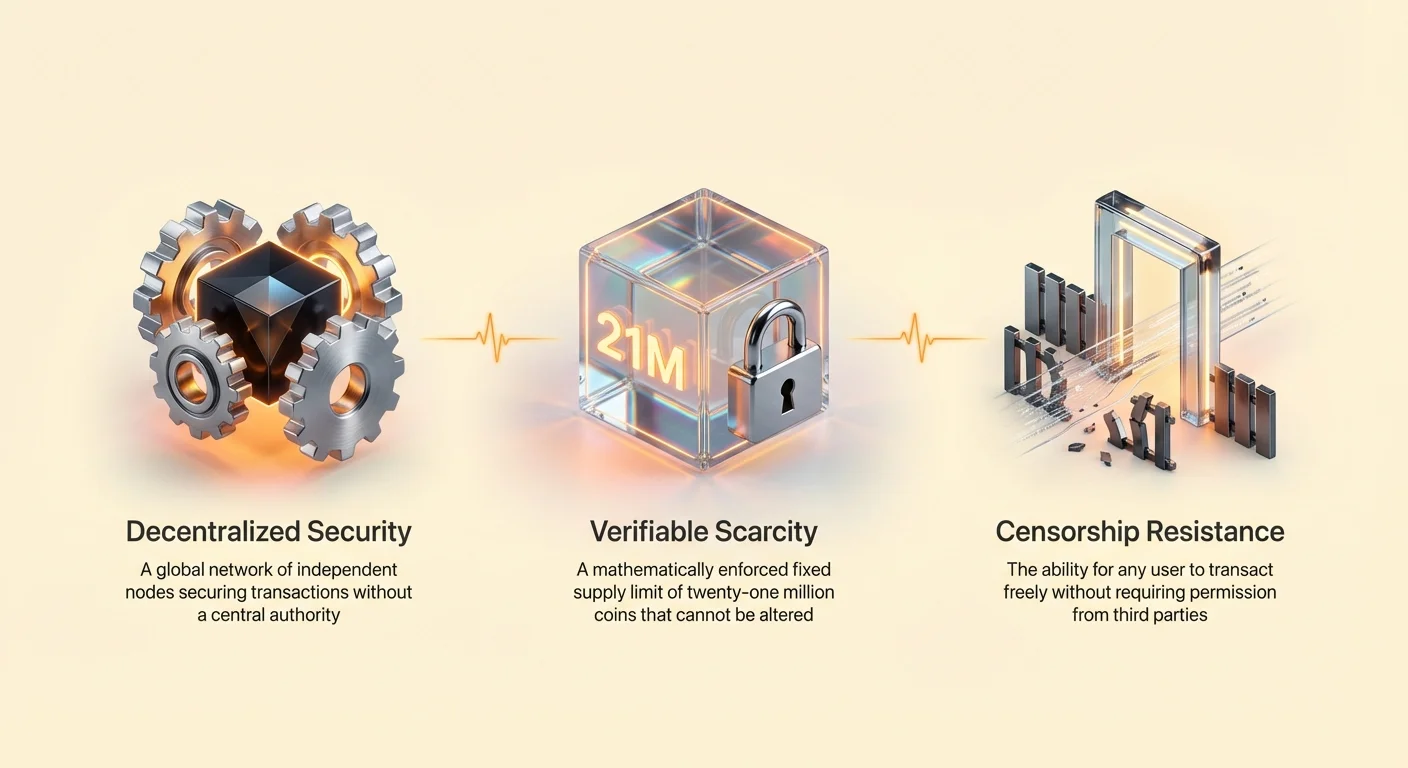
Myth 1: Bitcoin is an Environmental Disaster
The most common and emotionally charged criticism leveled against Bitcoin is its energy consumption. Critics often point to statistics showing that the Bitcoin network consumes more electricity than entire small countries. While this fact is true, it is entirely divorced from context.
Bitcoin’s energy use is a necessary function of its security model, and analyzing it without comparing it to existing systems or considering its source energy leads to flawed conclusions.
The Necessity of Proof-of-Work (PoW)
Bitcoin runs on a consensus mechanism called Proof-of-Work (PoW). This mechanism requires "miners" (powerful computers) to expend computational energy to validate transactions and secure the network. The energy cost acts as a barrier to entry, making it prohibitively expensive for a single malicious entity to control or corrupt the network.
The key takeaway here is fundamental: The energy consumption is not a bug; it is the cost of absolute decentralization and security. It is what prevents the network from relying on a trusted third party (like a government or a bank) and ensures that its monetary policy cannot be altered.
Contextualizing Energy Usage
To understand if Bitcoin’s energy use is "too much," we must compare it to the energy consumed by the traditional financial systems and other industries that offer similar levels of security and value transfer.
When examining the environmental footprint of global banking, one must account for:
- The Physical Infrastructure: Thousands of glass-and-steel data centers globally, ATM networks, corporate offices, and the energy required to power billions of employee computers.
- Transportation: The global logistics required for cash movement, armored vehicles, private jets for executives, and government protection.
- Gold Mining: The massive environmental impact of extracting gold, which includes the use of toxic chemicals (cyanide and mercury) and destructive land practices.
Studies that attempt to measure the total energy footprint of the traditional banking system consistently show that the energy required to run data centers alone far surpasses Bitcoin’s usage. Bitcoin accomplishes a superior level of security and final settlement without requiring the vast physical infrastructure associated with incumbent finance.
The Shift to Sustainable and Stranded Energy
A growing body of research shows that Bitcoin mining is not just a drain on existing power grids; it can actively incentivize the adoption of renewable energy sources and previously wasted energy sources.
1. Monetizing Stranded Energy: A significant portion of Bitcoin mining is done using stranded energy—power that is produced but cannot be efficiently delivered to urban population centers. Examples include:
- Flared Natural Gas: Oil drilling sites often burn off excess natural gas (flaring) because it is uneconomical to transport. Miners can set up mobile units at these sites, capturing this gas, converting it to electricity, and using it for mining. This effectively reduces methane emissions (a far more potent greenhouse gas than CO2).
- Remote Renewables: Hydro, wind, and solar farms sometimes produce excess power at off-peak times. Since electricity is difficult to store, this energy is often wasted (curtailed). Bitcoin miners act as a guaranteed, flexible buyer of this excess energy, making renewable projects more economically viable.
2. Grid Stabilization: Bitcoin miners are unique because they are interruptible energy buyers. They do not need to operate 24/7. During peak demand (e.g., a hot summer day when everyone uses A/C), power grid operators can contract with miners to instantly shut down their operations, freeing up massive amounts of electricity for cities. This acts as a crucial stabilizing force for the grid, incentivizing better energy infrastructure.
In summary, the environmental argument against Bitcoin often misses the mark by focusing solely on total consumption rather than comparing its utility to existing systems or acknowledging its unique role in promoting the economics of renewable and wasted energy sources.
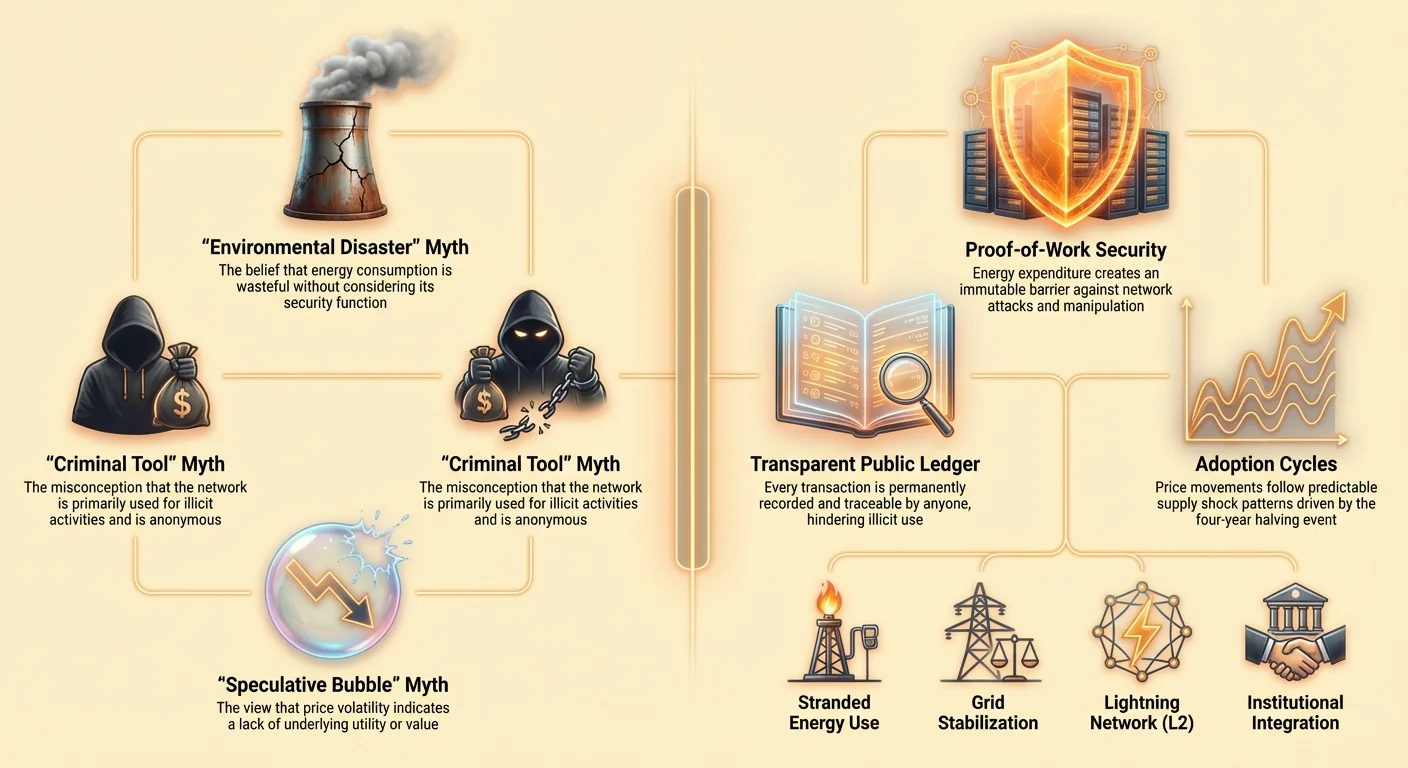
Myth 2: Bitcoin is Only Used by Criminals and Terrorists
Sensationalized headlines often paint Bitcoin as the currency of choice for the dark web and illicit activities. While it is undeniable that criminals utilize Bitcoin, just as they use cash, gold, and wire transfers, the scope of this use is vastly exaggerated.
This myth relies on a critical misunderstanding of how the Bitcoin network operates and the relative scale of crime committed using traditional (fiat) finance.
Transparency vs. Anonymity
The biggest misconception about Bitcoin is that it is anonymous. Bitcoin is, in fact, pseudonymous.
- Anonymous (Cash): No record of who owns it or where it has been.
- Pseudonymous (Bitcoin): Every transaction ever made is permanently recorded on a public ledger (the blockchain), tied to a unique wallet address. While the address itself isn't immediately tied to a government ID, advanced forensic analysis and law enforcement tools (like Chainalysis) can track the flow of funds with high certainty, especially when criminals try to interact with regulated, centralized exchanges.
This transparency is Bitcoin’s greatest weakness for illicit actors.
Practical Consequence: If funds are stolen or used in a ransomware attack, law enforcement can track the movement of those coins across the globe, sometimes for years. This capability is virtually impossible with physical fiat cash or complex international wire transfers handled by banks.
The Scale of Illicit Activity
When analyzing the actual use cases, the data definitively shows that fiat currency remains the undisputed king of criminal finance:
| Medium of Exchange | Estimated Illicit Use (Fraction of Total Volume) | Ease of Tracking |
|---|---|---|
| Physical Fiat Cash | Billions, often untracked. Used for nearly 100% of street-level crime and much of high-level money laundering. | Impossible to track once physical change of hands occurs. |
| Traditional Banking | Trillions of dollars laundered annually through complex shell corporations and legal loopholes. | Highly dependent on bank cooperation and complex international legal frameworks. |
| Bitcoin/Crypto | Consistently less than 1% of total transaction volume. | High—transactions are permanent and visible on the public ledger. |
Major government bodies, including Europol and the U.S. Treasury, routinely acknowledge that the overwhelming majority of global money laundering still occurs within the traditional banking system. Banks frequently pay massive fines for failing to comply with Anti-Money Laundering (AML) and Know-Your-Customer (KYC) regulations, demonstrating the scale of the problem in fiat.
Criminals prefer traditional finance because it offers liquidity, regulatory opacity, and the ability to handle transaction volumes far exceeding the scope of the current crypto ecosystem without public record.
Myth 3: Bitcoin is Just a Bubble Waiting to Pop
The price volatility of Bitcoin often leads to the conclusion that it is merely a speculative bubble—a phenomenon detached from real-world value, similar to the Dutch Tulip Mania of the 17th century. While Bitcoin has experienced multiple dramatic price swings, confusing volatility with a lack of intrinsic value overlooks the fundamental technology.
Defining a Bubble vs. Disruptive Adoption
A true financial bubble is characterized by mass speculation in an asset with little to no underlying utility or tangible value. Tulip bulbs, dot-com stocks without business models, or subprime mortgages are classic examples. Once the speculation fades, the asset value drops to near zero.
Bitcoin, however, is not a stock or a commodity in the traditional sense; it is a monetary network. Its value is derived from the utility it provides:
- Decentralized Scarcity: It is the first digitally native asset with a mathematically enforced supply limit (21 million coins).
- Censorship Resistance: It allows anyone, anywhere, to transact without needing permission from a bank or government.
- Final Settlement: Transactions are irreversible and settle quickly, globally.
The volatility we see is typical of any radically disruptive technology in its early adoption phase. Think of the early internet: Amazon stock, for example, dropped over 90% during the dot-com bust of the early 2000s, but the company’s underlying utility (e-commerce) ensured its eventual recovery and dominance.
The Anatomy of Bitcoin Market Cycles
Bitcoin's price movements are not random; they follow predictable, albeit intense, cycles driven by the network’s core inflation mechanism: the Halving.
- What is the Halving? Approximately every four years, the reward paid to miners for securing the network is cut in half. This reduces the supply of new Bitcoin entering the market.
- The Result: Since the demand side of the market continues to grow (more users, more institutional interest), suddenly restricting the supply creates immense scarcity pressure. This typically leads to a sharp price increase (the bull market), followed by a necessary correction (the bear market) as speculative euphoria fades.
These recurring cycles demonstrate that Bitcoin’s price behavior is linked directly to its controlled supply mechanics, not simply random speculation. Each cycle sees the “floor” of the price higher than the previous one, showing steady, foundational growth in value and adoption over the long term.
Bitcoin as Insurance Against Systemic Risk
Beyond speculation, Bitcoin is increasingly viewed by institutions and individuals as a hedge, or "digital gold." As central banks continue to expand monetary supply, devaluing traditional fiat currencies, Bitcoin offers a non-sovereign, hard-capped alternative.
The long-term value proposition lies not in its ability to generate high returns quickly, but in its guarantee of monetary integrity—the promise that no one can arbitrarily print more of it or confiscate it easily.
Myth 4: Governments Will Just Ban It and Shut It Down
A pervasive fear among skeptics and newcomers is that if Bitcoin ever becomes a large enough threat to the existing financial order, governments will coordinate a global ban, rendering the asset worthless. While regulation is inevitable and necessary, a global shutdown is virtually impossible.
The Difficulty of Decentralization
Bitcoin operates on thousands of independent nodes across the globe. It is not managed by a CEO, nor does it have a physical headquarters that can be raided or shut down. It is simply software running on the internet.
- Censorship Resistance: Even if a major government (like the U.S. or China) were to ban Bitcoin mining and transactions within its borders, the network would simply continue operating elsewhere. The history of technology shows that attempts to ban a decentralized protocol often simply push the activity underground or offshore, rather than eliminating it entirely.
- The Internet Analogy: Trying to ban Bitcoin is similar to trying to ban the BitTorrent protocol or specific types of encryption. The code exists; stopping its use globally is an impractical regulatory fantasy.
The Shift from Hostility to Integration
Global regulatory bodies have largely moved past the idea of an outright ban and are now focused on integration, taxation, and consumer protection. Why the shift?
1. Economic Reality: Banning Bitcoin means banning innovation, talent, and capital from one's jurisdiction. Governments have realized that it is far more profitable to regulate and tax the industry than to try and eliminate it.
2. Institutional Adoption: The entry of large, regulated financial firms (such as BlackRock, Fidelity, and major banks) into the crypto space via products like spot Bitcoin ETFs (Exchange-Traded Funds) has fundamentally changed the political calculus. These institutions now have a vested interest in the stability and acceptance of the asset, lobbying for clear rules rather than prohibition.
3. Sovereign Interest: A handful of countries (like El Salvador) have adopted Bitcoin as legal tender, while numerous others are exploring it as a state reserve asset or a tool for national payment infrastructure. Once sovereign states hold Bitcoin, the likelihood of coordinated global bans drops dramatically.
Regulation is Bullish, Not Bearish
For the long-term health of the network, regulation is positive. Clear rules legitimize the asset class, making it safer for finance professionals and institutional investors to allocate capital. The primary goal of current regulation is not destruction, but managing risks like money laundering and investor fraud—risks that exist in every financial market.
Further Objections and Clarifications
While energy, crime, and bubbles are the big three myths, a few other common points of confusion need swift clarification:
Myth: Transaction Fees Are Too High for Everyday Use
The Reality: The Bitcoin base layer (the main blockchain) is designed for high-security, final settlement transfers of large value, not daily micro-transactions. For things like buying coffee or small everyday payments, the Lightning Network exists.
The Lightning Network is a "Layer 2" technology built on top of Bitcoin that enables near-instant, virtually free transactions. This two-layered approach allows Bitcoin to function simultaneously as a secure, decentralized store of value (Layer 1) and a usable, fast medium of exchange (Layer 2).
Myth: It’s Too Slow (Only 7 Transactions Per Second)
The Reality: Bitcoin’s limit of approximately 7 transactions per second (TPS) on Layer 1 is deliberate. It is a necessary trade-off to ensure every single transaction can be verified by thousands of nodes globally (decentralization). Increasing this capacity without a second layer would require sacrificing decentralization, making the network weaker.
Again, the solution lies in Layer 2 scaling technologies like the Lightning Network, which can process thousands of TPS without sacrificing the security guarantees of the base chain.
Conclusion: Focus on the Fundamentals, Not the FUD
The narrative surrounding Bitcoin often focuses on its most volatile elements—price swings and energy consumption—while ignoring the core innovation it represents: verifiable digital scarcity and censorship-resistant money.
For those serious about learning the fundamentals and achieving self-sovereignty, neutralizing these common myths is the first crucial step. By understanding that Bitcoin’s energy usage is tied to its security, that its illicit use is minimal compared to fiat, and that its volatility is characteristic of an early, disruptive asset, you can move past fear and focus on the unprecedented utility Bitcoin offers.
The future of finance is built on transparency, verifiability, and immutability. As the most secure and decentralized network in existence, Bitcoin’s technological answers to these FUD narratives demonstrate its resilience and its foundational role in the new digital economy.