
For decades, the global financial system operated under a clear hierarchy: central banks created money, commercial banks distributed it, and the public used it. This traditional structure relied entirely on trust in governmental and financial institutions. The emergence of Bitcoin in 2009 shattered this paradigm by introducing decentralized, digital money that functioned without intermediaries.
Today, the digital currency landscape is defined by a fundamental struggle between two opposing visions: the decentralized, peer-to-peer approach pioneered by public blockchains (like Bitcoin and Ethereum) and the state-controlled, centrally-issued approach known as Central Bank Digital Currencies (CBDCs). This is not merely a debate over competing technologies; it is a profound ideological conflict concerning control, autonomy, and the very nature of money in the 21st century.
This guide moves beyond simple definitions to critically examine the technical infrastructure, economic goals, and privacy implications that separate public, "private" digital assets from state-controlled digital fiat. Understanding this divergence is crucial for grasping the future trajectory of global finance, and the significant trade-offs involved in choosing between permissionless freedom and centralized efficiency.
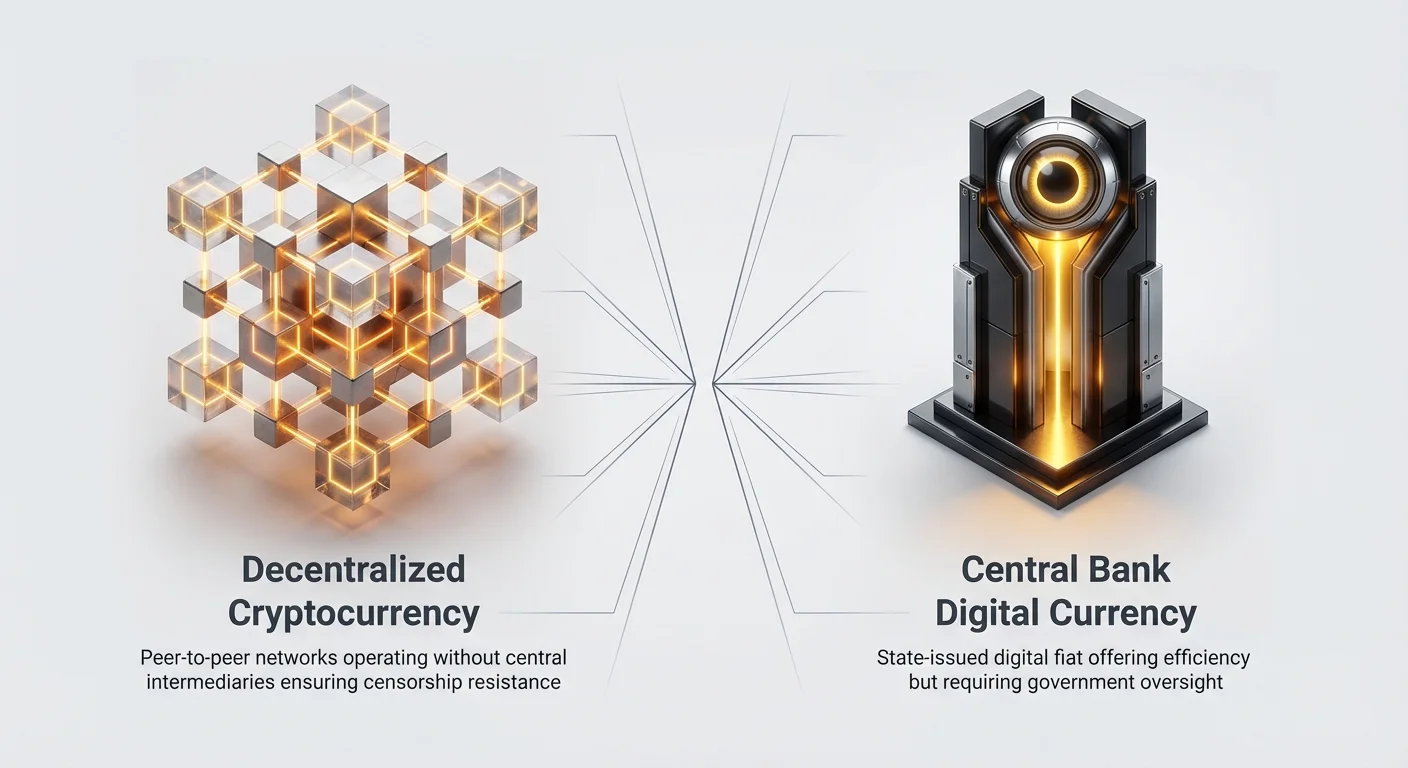
Foundational Ideologies: Control vs. Autonomy
The most significant difference between decentralized cryptocurrencies and CBDCs lies in their founding philosophy. Cryptocurrencies were born from a political distrust of centralized power, while CBDCs are conceived as a modernization tool designed to reinforce that centralized authority.
The Crypto Manifesto: Censorship Resistance and Decentralization
Public blockchains were designed specifically to operate without the need for trust in any single entity—a concept known as "trustlessness." This goal is achieved through extreme decentralization. In networks like Bitcoin, thousands of nodes (computers) around the world validate transactions, making it virtually impossible for any single government, corporation, or individual to stop the network or selectively block transactions, a feature inherent in the architecture of Digital Freedom.
This commitment to decentralization serves two primary political ends:
- Censorship Resistance: If no single authority controls the network, no single authority can prevent you from sending money, regardless of your location or political affiliation. This makes public blockchains powerful tools for financial inclusion and opposition to authoritarian regimes.
- Immutability: Once a transaction is validated and added to the blockchain, it cannot be altered or reversed. The historical record is permanent, enforced by cryptography and consensus among the network participants.
For users of decentralized systems, the core value proposition is financial sovereignty—the ability to control your wealth without external permission.
The CBDC Mandate: Monetary Policy and Stability
In stark contrast, a CBDC is merely a digital version of a nation’s fiat currency (like the digital dollar, euro, or yuan). It is issued and controlled directly by the country’s central bank. Its primary goals are stability, efficiency, and the maintenance of current economic policy tools.
CBDCs are not created to provide users with financial autonomy; rather, they are designed to:
- Improve Payments: Offer instant, cheap, and secure digital payments that complement or replace physical cash and reduce reliance on private, often costly, commercial banking systems.
- Enhance Monetary Policy: Give central banks faster, more granular, and more direct control over the money supply and interest rates.
- Ensure Financial Stability: Provide a risk-free form of digital central bank money, distinct from commercial bank deposits, which could be vulnerable during a financial crisis.
The underlying philosophy is that money should remain under the stewardship of elected or appointed officials who are responsible for the national economic health.
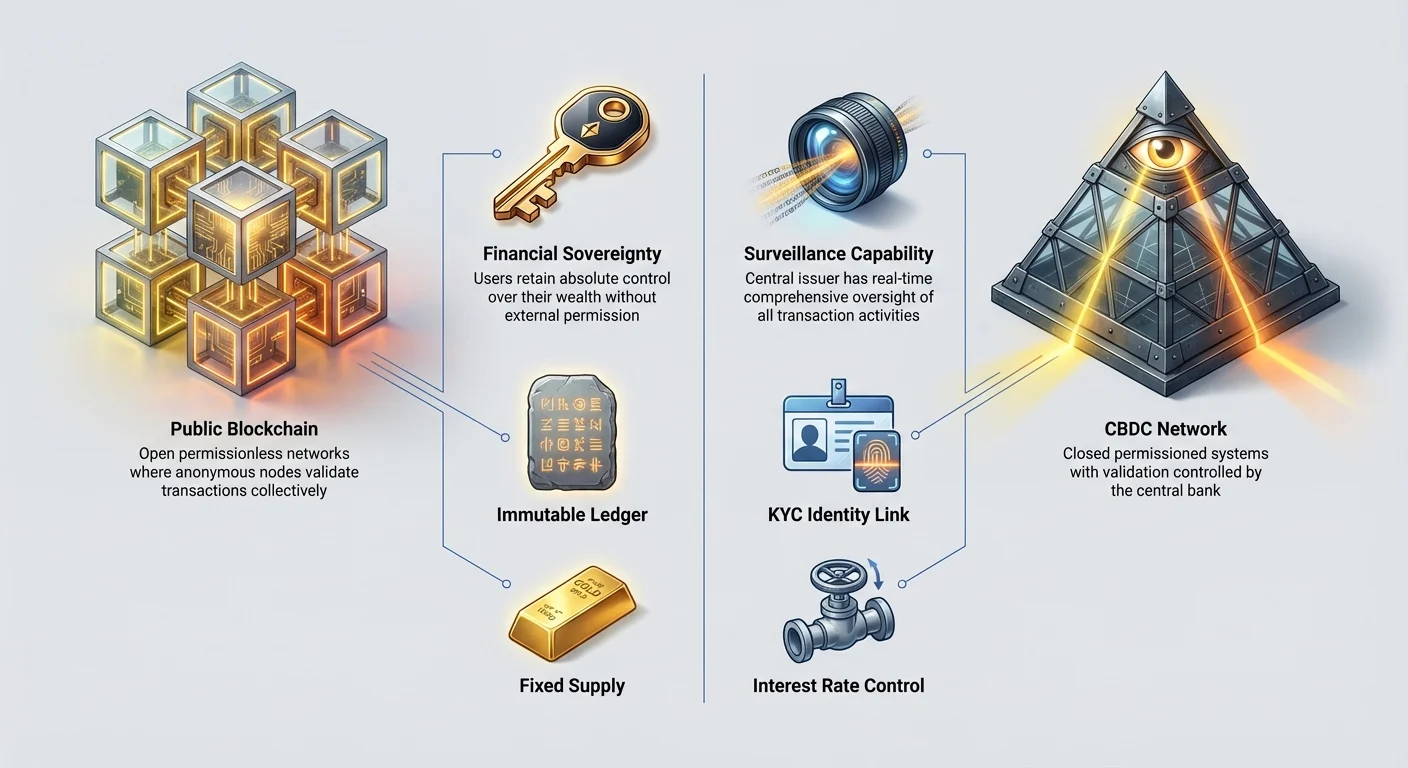
Analyzing the Technology Stack: Permissioned vs. Permissionless
The ideological differences manifest clearly in the technological architecture. Public blockchains are built on "permissionless" technology, while CBDCs rely on "permissioned" or closed-access structures. This technical divergence fundamentally determines who can use the system and what capabilities that system possesses.
Public Blockchains: Open Access and Network Effects (Permissionless)
A permissionless blockchain means anyone, anywhere, can join the network, download the software, validate transactions, and create an address to hold and send currency, all without asking for authorization.
Key Technical Characteristics:
- Anonymity/Pseudonymity: Users do not need to register personal details. Wallets are identified by strings of letters and numbers (public keys), providing pseudonymity.
- Decentralized Consensus: Decisions on upgrading the network or validating transactions are made collectively by the nodes, secured by mechanisms like Proof-of-Work (PoW) or Proof-of-Stake (PoS).
- Innovation: Because the system is open, developers can build complex decentralized applications (dApps), smart contracts, and new financial products (DeFi) on top of the base layer without permission from a central entity. This open architecture fosters the expansive ecosystem often referred to as Web3.
The engineering trade-off for this openness is often reduced speed and scalability compared to highly centralized databases, a limitation frequently addressed through layer-two solutions.
CBDCs: Closed Networks and Delegated Authority (Permissioned)
CBDCs utilize a distributed ledger technology (DLT), but it is inherently permissioned. This means the central bank or a consortium of approved financial institutions determines who can operate the network, validate transactions, and in some cases, even participate as users.
Key Technical Characteristics:
- Central Authority: The central bank maintains the ultimate control over the ledger, including the ability to issue new currency and, potentially, modify or reverse transactions.
- Identity Verification (KYC/AML): Because the CBDC represents a sovereign currency, strict Know Your Customer (KYC) and Anti-Money Laundering (AML) checks are mandatory for participation. Access is not granted pseudononymously but tied directly to verifiable identities.
- High Speed and Scalability: Since there are only a handful of approved, high-performance validators running the network (instead of thousands of anonymous ones), consensus is achieved almost instantly. This centralization allows CBDCs to easily handle transaction volumes far exceeding current public blockchains.
In essence, a CBDC uses the technical structure of a DLT (a shared digital database) but throws out the core crypto principles of decentralization and trustlessness in favor of speed and governmental oversight.
The Core Conflict: Privacy, Traceability, and Surveillance
The divergence in technological stack leads directly to the most contentious aspect of the debate: privacy. The ability to track and program money shifts from a user-driven concern in public blockchains to a state-controlled feature in CBDCs.
Pseudonymity in Public Blockchains
While many users mistakenly call Bitcoin "anonymous," it is more accurately described as "pseudonymous". Transactions are recorded publicly on the ledger forever, but they are linked only to alphanumeric wallet addresses, not to a person's identity.
This architectural choice creates a challenge for regulators but a shield for users:
- Data Minimization: Users are not required to give up personal data to use the currency.
- Transparency vs. Identity: Every movement of funds is transparent to the world, but the identity of the person making the movement is obscured, unless they connect their wallet to a centralized exchange (CEX) or service that performs mandatory KYC.
- Privacy Tools: Advanced public chains are increasingly implementing features like Zero-Knowledge Proofs (ZKPs) to enhance privacy further, allowing verification of a transaction without revealing the underlying details.
The political goal here is transaction transparency for network integrity, balanced with identity privacy for individual freedom.
Programmable Control and Transaction Visibility in CBDCs
The defining feature of a permissioned CBDC is the ability of the issuer (the central bank) to have real-time, comprehensive oversight of all transactions. While proponents argue this is necessary for financial crime enforcement, critics warn of unprecedented surveillance capabilities.
Traceability in a CBDC moves from a passive, optional outcome (as with public chains) to an active, inherent design feature:
- Full Identity Linkage: Since access is permissioned via KYC, every digital wallet is tied directly to a known individual or entity. The central bank could potentially see who owns what and where every unit of digital fiat has traveled.
- Programmability: Because the currency is centrally issued, it can be "programmed" with specific conditions. While simple programmability could automate tax payments or welfare disbursements, more intrusive capabilities could include:
- Expiration Dates: Programming funds to expire if not spent by a certain time (e.g., stimulating consumer spending during a recession).
- Spending Restrictions: Limiting how the currency can be used (e.g., banning spending on certain products or services).
This shift from currency being a neutral bearer instrument (like cash) to a conditional, programmable tool is the core ideological breakpoint for advocates of decentralized money, who view it as a direct threat to personal liberty.
Economic Goals and Monetary Policy Implications
The two types of digital currencies also present dramatically different views on economic stability and how money should be managed—whether it should be "hard" (difficult to change) or "soft" (easily adjustable by policy).
Crypto: Fixed Supply and Deflationary Tendencies (Hard Money)
Decentralized public chains, particularly Bitcoin, are modeled after the "hard money" philosophy. They are designed to be inflation-resistant and politically neutral: a fixed supply is enforced mathematically, relying entirely on the predetermined code to enforce digital scarcity and monetary policy.
- Fixed or Predetermined Supply: The total number of units is capped (e.g., 21 million Bitcoin) or the issuance schedule is algorithmically predetermined. This prevents a central authority from arbitrarily inflating the currency supply.
- Discipline on Policy: By removing the central bank’s ability to print unlimited money, the crypto model imposes fiscal discipline. The currency’s value is determined entirely by market demand and supply, outside of political influence.
- Long-Term Store of Value: The scarcity and censorship resistance position these assets as potential long-term stores of value, intended to preserve purchasing power over time.
While high volatility remains a challenge for crypto, the architectural design prioritizes safeguarding the individual’s wealth from debasement by the state.
CBDC: Tools for Policy Intervention (Soft Money)
A CBDC, unlike cryptocurrency, is a liability of the central bank, exactly like physical cash or reserves. Therefore, it is designed to be fully integrated into existing "soft money" frameworks where policy is actively managed:
- Interest Rate Control: If a CBDC is designed to pay interest, the central bank gains a powerful, direct tool to influence spending. Rates could be applied directly to digital wallets, affecting consumer behavior faster and more universally than through traditional commercial banks.
- Targeted Stimulus: Through programmability, the central bank could precisely target economic stimulus by depositing money directly into the digital wallets of specific demographic groups, potentially with spending conditions attached.
- Negative Interest Rates: Critics worry that cash, which currently acts as a floor for interest rates (you cannot have negative interest on physical cash), could be phased out. A digital-only CBDC environment would allow central banks to implement negative interest rates seamlessly to discourage saving and force spending during economic downturns.
From an economic engineering perspective, CBDCs offer policymakers unparalleled agility and precision. From a political perspective, they offer unparalleled control over economic behavior.
Bridging the Divide: Oracles, Web3, and Hybrid Systems
While public blockchains and CBDCs are fundamentally opposed in governance, the technical advancements born out of the crypto world—specifically Web3 infrastructure—are essential context for understanding the scope of decentralized systems.
The Role of Oracles in Real-World Integration
A core technical challenge for decentralized smart contracts is the inability of the blockchain to independently access data from the outside world (like stock prices, weather conditions, or election results).
This is where Blockchain Oracles come in. An oracle is a third-party service that securely retrieves real-world data and verifies it before submitting it to a smart contract, triggering its execution.
- Trust Constraint: Oracles are a necessary layer of centralization in an otherwise decentralized system. While protocols strive to decentralize the oracle function by aggregating data from multiple sources (decentralized oracle networks), relying on external data introduces a point of trust in the system.
- Use Case: A smart contract betting on a sports game relies on an oracle to provide the definitive, verified final score to determine the payout.
The need for oracles highlights the technical difficulty of running decentralized financial systems that interact with the inherently centralized real world, a difficulty CBDCs, being centralized from the start, bypass entirely.
Web3 Infrastructure and the Decentralized Internet
The vision of decentralized currency extends far beyond just payment systems. Public blockchains power Web3, the third generation of the internet, which aims to shift control of data and applications away from centralized tech giants (Web2) and back to the users.
- Decentralized Identity: Users own their identity and data, moving freely between applications without requiring new accounts or permission.
- Decentralized Autonomous Organizations (DAOs): Governance structures managed by code and token holders, allowing for collective decision-making without traditional corporate hierarchies.
CBDCs exist solely within the traditional Web2 framework of centralized authority and data ownership. They are designed to digitize existing fiat structures, not to power a new, permissionless internet infrastructure.
Practical Trade-Offs: Security, Scalability, and Speed
The ideological and technical choices made by public chains and CBDCs directly impact their operational efficiency, illustrating the core tension of the Blockchain Trilemma: decentralization, security, and scalability. You can generally optimize for two, but never all three.
Decentralization vs. Efficiency: The CBDC Speed Advantage
CBDCs prioritize speed and scalability by sacrificing decentralization. Since the central bank controls the validation process, they can deploy the fastest possible hardware and software, achieving transaction throughput rates comparable to major credit card networks.
| Feature | Decentralized Public Chain (e.g., Bitcoin) | Centralized Digital Currency (CBDC) |
|---|---|---|
| Scalability/Speed | Low to Moderate (Requires Layer-2 solutions) | Extremely High (Instantaneous finality) |
| Latency | Dependent on block time (minutes/seconds) | Near-zero, similar to bank transfers |
| Efficiency Trade-Off | Sacrifices speed for maximum trustlessness. | Sacrifices trustlessness for maximum speed. |
In the technical analysis, CBDCs are more efficient payment systems because they do not have to contend with the overhead required to maintain a global, anonymous, consensus-driven network.
The Cost of Trustlessness: Security and Economic Viability
While CBDCs win on pure transactional speed, public blockchains excel in security and integrity against political risks.
Security in Public Blockchains: Their massive, distributed network and cryptographic security make them nearly immune to external takeover or internal fraud, provided the majority of network participants remain honest. The cost of mounting a 51% attack on Bitcoin or Ethereum is prohibitively expensive, ensuring robust network security enforced by economic incentives.
Security in CBDCs: The security relies entirely on the central bank's digital infrastructure and cyber defenses. If the central ledger is successfully hacked or compromised, the integrity of the entire currency could be jeopardized. Furthermore, the security is guaranteed by law and state power, not by cryptography and network consensus.
The ultimate trade-off: Do you want a system that is incredibly fast and cheap but requires you to trust the government's competence and honesty? Or do you want a system that is slower and more complex but requires no external trust whatsoever?
Conclusion
The debate between decentralized public ledgers and Central Bank Digital Currencies is the defining digital policy challenge of our era. It forces us to confront fundamental questions about the future of money, privacy, and sovereignty.
Public blockchains represent a technical solution to a political problem: the lack of trust in centralized institutions. They offer a future where finance is censorship-resistant, verifiable, and controlled by the individual—a permissionless world based on autonomy and cryptographic truth.
CBDCs, conversely, represent a technical solution to an efficiency problem, utilizing modern ledger technology to reinforce and enhance existing centralized control mechanisms. They offer a future of instantaneous payments, targeted economic intervention, and pervasive traceability—a permissioned world based on state-sponsored stability and policy tools.
The outcome of this debate will determine whether the foundational infrastructure of the digital economy prioritizes individual sovereignty or governmental control. As these technologies mature, users, investors, and policymakers must understand that adopting a CBDC is not simply upgrading money; it is a fundamental shift in the political and economic architecture of the nation, marking a profound ideological divergence from the decentralized ethos of crypto.