
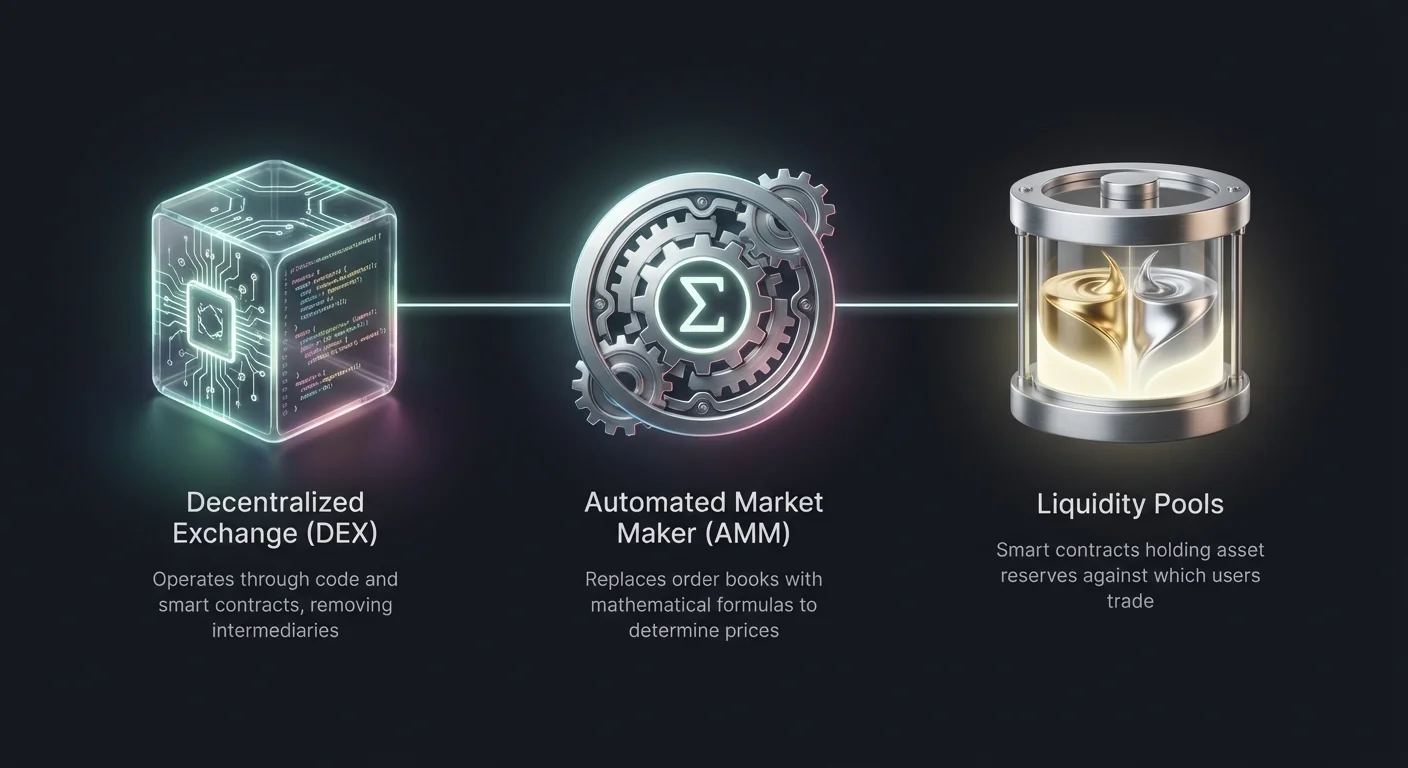
Decentralized finance offers a distinct approach to trading that removes the need for traditional intermediaries. At the heart of this ecosystem lies the decentralized exchange, or DEX. Unlike centralized platforms where a company manages order books and holds user funds, a DEX operates through code. It relies on smart contracts to facilitate peer-to-peer transactions directly between users. This shift grants individuals full control over their assets but requires a deeper understanding of the underlying mechanics.
To navigate this landscape effectively, traders must understand the tools and concepts that power these platforms. The transition from custodial exchanges to self-custodial trading involves more than just a change in interface. It represents a fundamental shift in how liquidity is sourced, how prices are determined, and how market participants earn returns.
The ecosystem is built on permissionless protocols. Anyone with an internet connection and a funded crypto wallet can participate. There are no lengthy registration processes or identity verifications to start trading. However, this freedom comes with the responsibility of managing one's own security and understanding the financial risks involved in providing liquidity.
The Foundation of Decentralized Trading
The primary engine driving most decentralized exchanges is the Automated Market Maker (AMM). In traditional finance and centralized crypto exchanges, an order book model is used. Buyers and sellers list the prices at which they are willing to trade, and a matching engine connects them. If there are no sellers at a buyer's desired price, the trade does not happen.
AMMs replace this matching engine with liquidity pools and mathematical formulas. A liquidity pool is a smart contract that holds reserves of two or more tokens. Users trade against this contract rather than directly against another person. The price of the assets in the pool is determined algorithmically. This ensures that trades can always be executed as long as there is sufficient liquidity in the pool.
The most common formula used is the constant product formula, often expressed as $x * y = k$. Here, $x$ and $y$ represent the quantities of the two tokens in the pool, and $k$ is a fixed constant. When a trader buys one token from the pool, they add the other token to it. This changes the ratio of assets, which automatically adjusts the price.
Understanding Liquidity Mechanics
Liquidity is the lifeblood of any financial market, but its role in DeFi is particularly tangible. In the context of a DEX, liquidity refers to the depth of assets available in a specific trading pair. High liquidity means there are substantial reserves of both tokens in the pool. This allows for large trades to occur without causing significant price changes.
Low liquidity creates a volatile environment where even small trades can drastically shift the price. This phenomenon is known as price impact. For a trader, deep liquidity results in a more stable experience closer to the global market price. For a decentralized exchange, attracting liquidity is the primary goal to ensure usability and volume.
Market liquidity is distinct from financial liquidity, which refers to how easily an asset can be converted to cash. In crypto, major pairs like BTC/USDT are highly liquid financially. However, a specific pool for a new token on a small DEX might lack market liquidity. This makes it difficult to enter or exit positions without accepting a poor price.
The Role of the Liquidity Provider
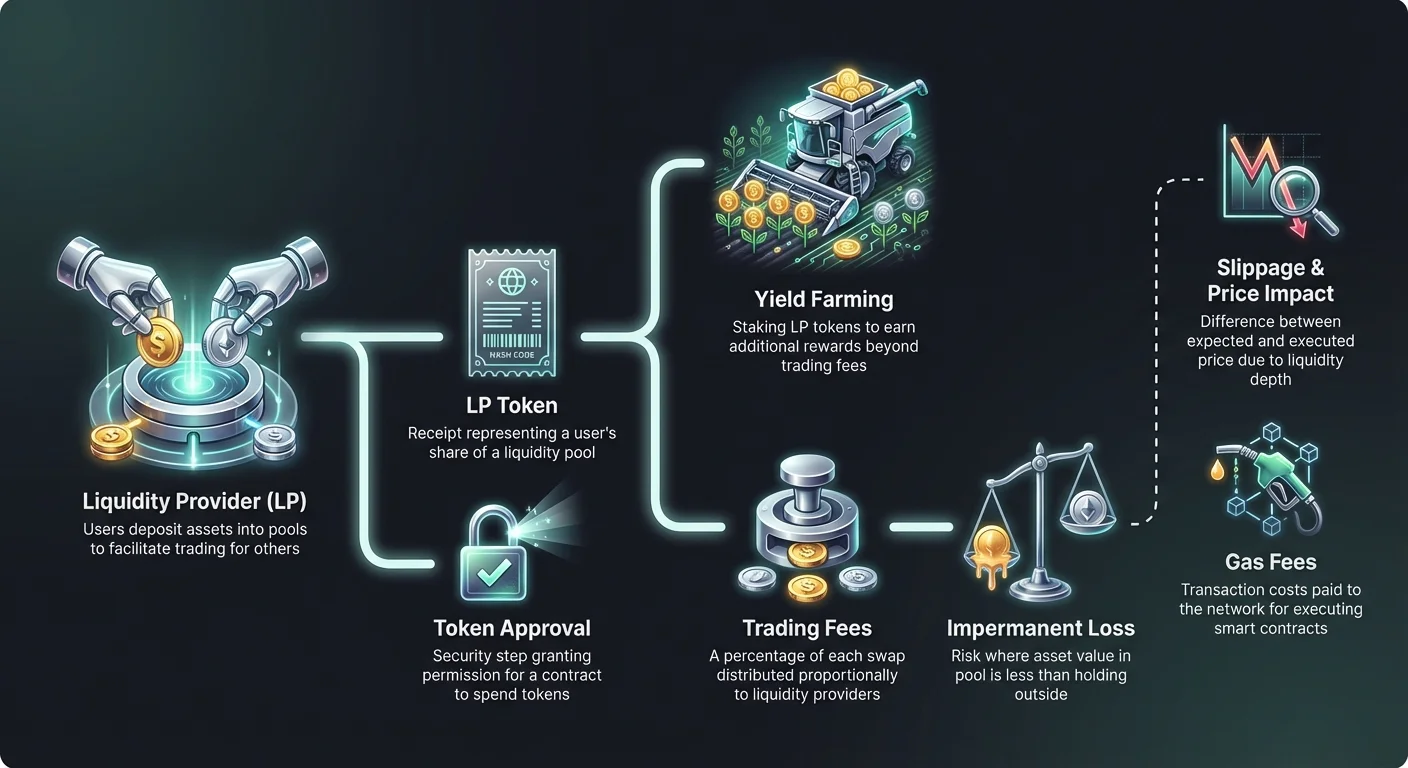
A DEX cannot function without users who deposit their assets into these pools. These users are known as Liquidity Providers (LPs). By depositing an equal value of two different tokens into a smart contract, LPs facilitate trading for other users. In return for taking on this role, they are incentivized with trading fees.
When a swap occurs on the exchange, the protocol charges a small percentage fee to the trader. This fee is not kept by a central corporation. Instead, it is distributed among the liquidity providers proportional to their share of the pool. If a user provides 1% of the total liquidity, they are entitled to 1% of the accrued trading fees.
Upon depositing assets, the protocol issues a receipt known as an LP token. This token represents the user's share of the pool. It acts as proof of ownership and is required to reclaim the deposited funds and any earned fees. These LP tokens are themselves crypto assets and can sometimes be used elsewhere in the DeFi ecosystem.
The Risks of Impermanent Loss
Providing liquidity is not a risk-free passive income strategy. The most significant danger LPs face is a concept called Impermanent Loss (IL). This occurs when the price of the deposited tokens changes relative to each other after they are deposited in the pool. The loss is calculated by comparing the value of the assets in the pool versus simply holding them in a wallet.
Because AMMs constantly rebalance the ratio of assets to maintain the pricing formula, LPs often end up holding more of the underperforming asset and less of the outperforming one. If one token doubles in price while the other stays flat, the pool sells the appreciating asset to buy more of the stable one. This results in a portfolio value that is lower than if the user had just held the original tokens.
The term "impermanent" can be misleading. The loss is only realized if the liquidity is withdrawn while the price ratio is different from the time of deposit. However, if the prices never return to their original ratio, the loss becomes permanent upon withdrawal. Pairs with high volatility are more susceptible to severe impermanent loss.
| Scenario | Risk Level | Description |
|---|---|---|
| Stablecoin Pairs | Low | Both assets are pegged (e.g., USDT/USDC), minimizing price divergence. |
| Blue Chip Pairs | Medium | Assets like ETH/BTC often move in correlation, reducing extreme divergence. |
| Volatile Pairs | High | Small cap tokens paired with stablecoins often see massive price separations. |
Maximizing Returns with Yield Farming
To offset the risks of impermanent loss and attract more capital, protocols often introduce additional incentives. This practice is known as yield farming or liquidity mining. It involves taking the LP tokens received from depositing liquidity and staking them in a separate contract or "farm."
By staking LP tokens, users earn rewards in the form of the protocol's native governance token or another crypto asset. These rewards are paid on top of the standard trading fees. The combination of trading fees and farming rewards can result in high Annual Percentage Yields (APY).
This mechanism essentially allows protocols to "rent" liquidity from users. It is a crucial tool for new exchanges that need to deepen their order books quickly. However, traders must be aware that high APY often correlates with higher risk tokens or temporary inflationary rewards that may depreciate over time.
Navigating Slippage and Price Impact
When executing a trade on a DEX, the final price paid often differs from the spot price displayed on the screen. This difference is called slippage. Slippage occurs due to the mechanics of the AMM and market movements that happen between the time a transaction is submitted and when it is confirmed on the blockchain.
In pools with low liquidity, large orders push the price significantly against the trader. This creates negative slippage, where the user receives fewer tokens than expected. Most DEX interfaces allow users to set a "slippage tolerance." This is a percentage limit on how much price movement is acceptable. If the price slips beyond this threshold, the transaction reverts to protect the user.
Setting the tolerance too low can result in failed transactions during volatile periods. Conversely, setting it too high leaves the trader vulnerable to front-running bots that extract value from the trade. Finding the right balance depends on the specific pair's liquidity and current market conditions.
Gas Fees and Network Costs
Every interaction with a decentralized exchange requires a transaction fee paid to the blockchain network. These are known as gas fees. Whether swapping tokens, depositing liquidity, or harvesting yield farming rewards, the user must pay gas in the network's native currency (e.g., ETH for Ethereum).
Gas fees pay for the computational power required to execute the smart contracts. On popular networks like Ethereum, these fees can become expensive during times of high congestion. This adds a layer of cost that must be factored into potential profit calculations. A small trade or yield farming claim might not be profitable if the gas fee exceeds the value of the action.
Advanced users often monitor gas prices to execute non-urgent transactions when the network is less busy. Additionally, newer blockchains and Layer-2 solutions offer significantly lower gas fees, making high-frequency trading and complex DeFi strategies more accessible to smaller portfolios.
Smart Contract Interactions and Approvals
Using a DEX involves a specific sequence of smart contract interactions. Before a specific token can be traded or deposited for the first time, the user must grant permission to the DEX's smart contract to spend that token. This is called a token approval transaction.
Approvals are a security feature that ensures a contract cannot access a user's wallet without explicit consent. However, they also present a potential vulnerability. If a malicious or buggy contract is granted unlimited approval, it could theoretically drain the user's holdings of that specific token.
Best practices suggest only approving the specific amount needed for a transaction, rather than an unlimited amount. While this requires approving again for future trades—costing more gas—it significantly reduces security risks. Tools exist to review and revoke old approvals that are no longer needed.
Aggregators and Routing
With liquidity fragmented across dozens of different decentralized exchanges, finding the best price can be difficult. A single trading pair might have different prices or liquidity depths on Uniswap, SushiSwap, or Curve. Checking each platform individually is inefficient.
DEX aggregators solve this problem. These platforms scan multiple exchanges simultaneously to find the most efficient trade execution. They often split a single large order across several different liquidity pools to minimize slippage. This process is known as smart routing.
For example, swapping ETH for a smaller token might be cheaper if routed through a stablecoin intermediary (ETH -> USDC -> Token) rather than a direct swap. Aggregators automate this complexity, presenting the user with a simple interface while handling the intricate routing logic in the background.
Analyzing Total Value Locked (TVL)
One of the most common metrics used to gauge the health of a decentralized exchange is Total Value Locked (TVL). This figure represents the aggregate dollar value of all crypto assets currently deposited in the protocol's smart contracts. A high TVL generally indicates a healthy, trusted platform with deep liquidity.
However, TVL can be volatile. It fluctuates based on the market price of the underlying assets, not just the number of tokens deposited. A drop in the price of Ethereum will lower the TVL of an Ethereum-based DEX even if no users withdraw their funds.
Traders use TVL to assess the risk and stability of a platform. Protocols with billions in TVL are generally considered safer and more battle-tested than new forks with low liquidity. Nevertheless, it is a lagging indicator and does not guarantee the future security or solvency of the project.
The Difference Between APR and APY
When evaluating yield farming opportunities or liquidity provision returns, understanding interest rate terminology is vital. Platforms may display returns as either Annual Percentage Rate (APR) or Annual Percentage Yield (APY). While they sound similar, they represent different payout structures.
APR reflects simple interest. If a farm offers 100% APR, a user depositing $1,000 would earn $1,000 in profit over one year, assuming rates stay constant. It does not account for reinvesting the earnings.
APY includes the effects of compounding. It assumes that the trading fees or rewards earned are immediately reinvested back into the pool to generate further returns. This compounding effect can significantly inflate the headline number. A high APY might require daily manual compounding, which incurs gas costs that could negate the benefits for smaller deposits.
Security in a Permissionless Environment
Decentralized exchanges operate without a central authority to reverse transactions or recover lost funds. This places the burden of security entirely on the user. Self-custody means "your keys, your coins," but also "your mistake, your loss."
Scams are prevalent in the open DEX landscape. Because listing a token is permissionless, scammers often create fake tokens with names identical to popular projects. They add initial liquidity to generate a price and trick users into swapping real assets for worthless fakes.
Verifying the contract address of a token is the only way to be certain of its authenticity. Trusted data aggregators and official project documentation are the best sources for these addresses. Relying solely on the token name or ticker symbol in the DEX search bar is a common vector for loss.
The Evolution of Cross-Chain Trading
Early decentralized exchanges were isolated to their specific blockchains. Trading an Ethereum-based token for a Solana-based token required centralized exchanges or complex bridging processes. This friction limited the flow of capital across the broader crypto economy.
Newer innovations are enabling cross-chain swaps directly within DEX interfaces. These protocols use smart contracts on multiple chains to lock assets on one network and release equivalent assets on another. This interoperability is essential for a truly fluid decentralized market.
Cross-chain functionality introduces new risks, specifically regarding the security of the "bridges" that hold the collateral. However, it significantly expands the toolkit available to traders, allowing them to chase yield and liquidity wherever it exists, regardless of the underlying blockchain architecture.
Privacy and Data Protection
A distinct advantage of DEX trading is the preservation of privacy. Centralized exchanges are subject to Know Your Customer (KYC) and Anti-Money Laundering (AML) regulations. They require users to submit passports, facial scans, and proof of address.
DEXs typically require no personal data. The blockchain records the transaction history of the wallet address, but this address is not inherently tied to a real-world identity. For users in jurisdictions with limited financial infrastructure or those valuing data privacy, this is a critical feature.
However, the public nature of the blockchain means that all trades are visible. Sophisticated analysis can sometimes link wallets to identities based on behavior or interactions with centralized entry points. Privacy on a DEX is about the lack of a central gatekeeper, not necessarily total anonymity.
Conclusion
The decentralized exchange toolkit empowers users to participate in financial markets directly and permissionlessly. By understanding the mechanics of AMMs, liquidity pools, and yield farming, traders can access opportunities that were previously reserved for institutions. The ability to earn fees as a liquidity provider or swap assets without a middleman represents a significant evolution in personal finance.
However, this freedom demands vigilance. Concepts like impermanent loss, slippage, and smart contract risk must be managed proactively. Success in this space requires not just capital, but a commitment to learning the technical nuances of the protocols. As the ecosystem matures, these tools will likely become more efficient, but the core principles of self-custody and decentralized liquidity will remain the foundation.
True ownership in crypto means accepting both the freedom of control and the weight of responsibility.